In the autumn of 1822, the Duke of Ashborne had his wife certified a lunatic, locked her in a private madhouse outside London, and took possession of the estate her father had settled on her for her own keeping. He was wrong about one thing. She was not mad. She had never been mad. And three years later, without raising her voice or once raising a hand, she walked out of that house, holding the deed to the estate he had spent those years calling his own.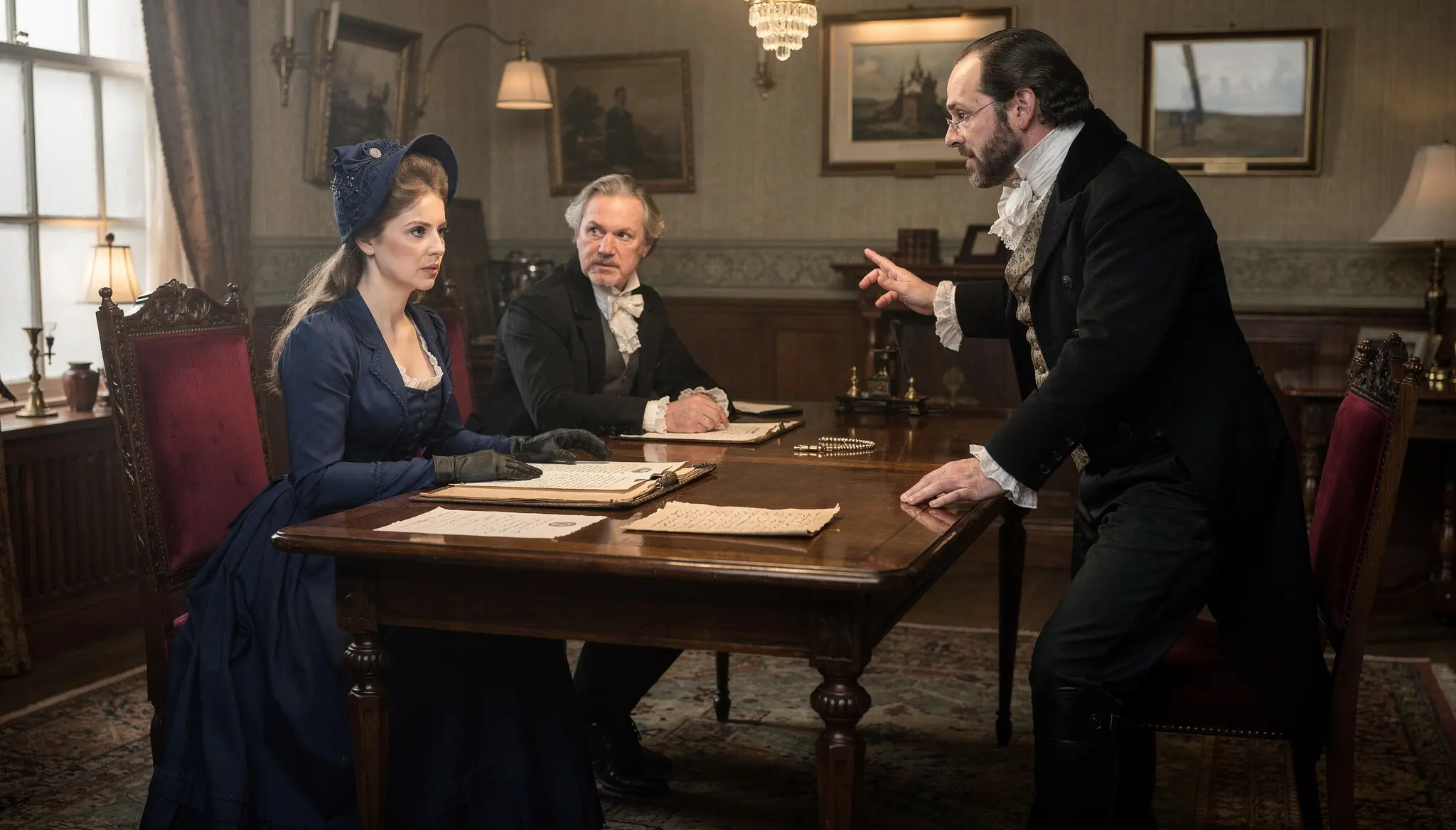
She did it by the very law he had used to bury her inside it. It began, as these things do, with a marriage settlement a clever father had drawn up, and a husband who could never forgive him for it. Honoria, Duchess of Ashborne, was the only child of Matthew Drew, a Birmingham ironmaster who had begun life with a furnace and ended it with one of the largest fortunes in the Midlands, and who had throughout that life retained the hardware trade's healthy suspicion of charming men who came asking for his money. When his daughter married the Duke of Ashborne in 1819, he did the thing such men do, and did it thoroughly. By formal deed of marriage settlement, he settled the estate of Marston Hall and its lands on Honoria, not as a dowry that passed into her husband's control, but as her separate property, held in trust for her sole and independent use, beyond the reach of any debts the Duke might contract, and any spendthrift impulse he might indulge.
A wife's property in that century ordinarily became her husband's the moment the ring was on her finger. A father who wished to protect his daughter's fortune against that rule had to write the protection into the settlement before the wedding, and Matthew Drew had written it in as though he expected the Duke to test every line of it. He was not far wrong. The Duke, Lionel Ashby, was a man who had married the Iron Master's money with the calm intention of treating it as his own, and who had spent the first year of the marriage in the slow, unpleasant discovery that his father-in-law had rather specifically and rather legally prevented him from doing so.
His own seat, Ashborne Park, was mortgaged to the eaves. His own estates returned less each year than they cost. And three counties away, Marston Hall, richer, better managed, and entirely his wife's, sat just beyond the wall his father-in-law had built around it. The Duke could dine at Marston when his wife invited him, and she often did because she was a woman who had made her peace early with the bargain of her marriage, and saw no reason to be ungracious about it.
A lunatic could not hold property in her own right because the law held that a mind unable to govern itself could not govern an estate. The committee appointed to manage the estate of a married woman so certified was almost invariably her husband. The settlement that had protected Marston from the Duke's debts could not protect it from a certificate of madness, because a mad woman, by definition, had no separate property to protect. It was, as the Duke's man of business observed to him one evening, a very neat door in a very thick wall, and all it required to open was a physician willing to sign a paper.
The Duke did not arrive at the decision quickly. He arrived at it the way such men always arrive at such decisions, not in a single monstrous hour, but over months of small, comfortable justifications, until the monstrous thing had become, in his own mind, merely practical. His wife had been out of spirits since the loss of a child that spring, which was true, and which grief he had not troubled himself to comfort. She had spoken sharply to him about his spending, which was also true. She had on two occasions wept in the presence of servants and once refused a dinner invitation and once been seen walking in the gardens at an hour he considered irregular.
To a husband looking for evidence, a grieving, justly angry woman could be made to look like almost anything. And to a physician of a certain kind, paid enough, almost anything could be made to look like madness. The physician's name was Dr. Simeon Pritchard, a man of respectable address and flexible conscience, who made a quiet and considerable living, certifying, for a fee, exactly the people wealthy families wished certified.
He visited Ashborne Park, spoke to the Duke at length, observed the Duchess briefly through a doorway, and signed a certificate to the effect that Honoria, Duchess of Ashborne, was a person of unsound mind, given to melancholy and irrational agitation, and unfit for the management of her person or her affairs. The certificate was sufficient. A commission of lunacy was issued. And one morning in October, while the Duke waited in his study doing his sums, two men and a woman Honoria had never seen came to her dressing room with a carriage and a physician's order, and took her away, still in her morning gown, from the house her father had given her.
She did not understand at first what had been done. She understood only that she was being taken somewhere against her will by strangers on the authority of a paper she was not allowed to read and that her husband when she called for him did not come. The carriage drove west for the better part of a day and stopped at a private house set back from the road behind a high wall. A brass plate by the gate informed her that the house was called Greylands and was licensed for the reception of ladies of disturbed mind.
The keepers were Mr. and Mrs. Grindle, a pair who had found in the warehousing of inconvenient women a trade both profitable and to their way of thinking respectable. Honoria was shown to a room on an upper floor. The door was locked behind her, and Mrs. Grindle, with the particular cheerfulness people use when they wish a thing to sound kinder than it is, told her she was to rest here and to get well and not to excite herself. A woman who protested her sanity in a madhouse, Honoria discovered within the first week, was held to be proving the contrary. To weep was melancholy. To rage was mania. To demand a solicitor was delusion.
To refuse the laudanum they brought each night was proof of a disordered will that required, they said, still more laudanum. The brilliant economy of the place was that everything she did to demonstrate her reason was entered in the keeper's book as evidence against it. The Duke, appointed by the court as the committee of her estate, took possession of Marston Hall within the fortnight and the rents that her father had tied up so carefully began at last to flow into the accounts into which, in the Duke's particular estimation, they had always been meant to flow. He did not visit Greylands. He did not need to.
He had arranged matters so that the woman who might have objected to any of it was on paper incapable of objecting to anything at all. If that is already sitting wrong with you, good. Because what she spent the next three years quietly doing from behind a locked door in a house that existed to make sane women seem mad is about to cost the Duke of Ashborne everything he stole and a great deal more besides. There was, however, one thing the Duke had not accounted for, and it was the same thing men who build on forgeries and false certificates always failed to account for.
He had assumed that the woman he had silenced would stay silent and frightened and forgotten in roughly the proportion that the certificate said she was mad. She was not. She was, in fact, in the full and deliberate possession of a mind considerably more orderly than his own, and she spent the first months of her confinement, not in grief, which would have been understandable, but in the patient assembly of the one thing a wrongfully held woman needs more than any other, a way to put a letter into the right hands. The law, which she had time to consider at length, offered a door of its own. A certificate of lunacy, however convincingly signed, was not irrevocable.
It could be set aside by a writ de lunatico inquirendo, directing a new inquiry before independent commissioners and examiners of the court into whether the person certified was in fact of unsound mind. A single perjured certificate could not stand against a dozen independent witnesses to a woman's perfect sanity examined under the court's own authority. The Duke had built his comfort on the assumption that no such inquiry would ever be requested because the woman with the standing to request it was locked in a room and certified incapable of requesting anything. The flaw in the arrangement was merely that he had to keep her locked up forever and quiet forever and apart from any loyal pair of hands forever.
It is a surprisingly difficult thing even for a duke to manage forever. She had against every instruction one loyal pair of hands. Her maid Nell had been dismissed from Ashborne the week of the certification, paid off, and warned in Dr. Pritchard's mildest tone that a servant who repeated slanders about a duchess's health might find her own health the poorer for it.
Nell had taken the warning and the wages and then, because she had loved her mistress since her mistress was a girl in pinafores, spent the next year finding her. It took her most of that year because private madhouses are not in the habit of advertising their guests. But a woman who has held a position in a great house learns in time to ask the right questions of the right sort of people. And by the second autumn, Nell had located Greylands and secured by means of a small bribe to a discontented underattendant a way to carry a letter in and a letter out.
The letter that came out of Greylands in November of 1824, folded inside a clean napkin, was addressed not to a relation. Honoria had none who would move against a duke, but to a name she had copied from a pamphlet Nell had brought her. The physician was Dr. Gabriel Thorne, who was not the sort of doctor who signed certificates for a fee. He was, in fact, the precise opposite, a man who had spent the better part of a decade campaigning in pamphlets and in testimony before commissions against the trade in false confinements that had grown up around the lunacy laws.
He had argued to anyone who would listen that a married woman's property was not worth the paper it was written on so long as a cooperative physician and an obedient husband could consign her to a madhouse on an afternoon's notice. Most of the people who should have listened told him that he was excitable and that such abuses were rarer than he liked to pretend. The letter from Greylands interested him considerably because it was written in a hand of remarkable composure by a woman certified incapable of composure and it set out in terms a lawyer might have admired exactly which statute had been abused and exactly which writ would mend it. He visited Greylands in December on the pretext of consulting on another patient and was shown after a suitable interval and a further small bribe into the upper room.
What he found there was not a lunatic. It was a woman who had spent two years being treated as one and who had retained through all of it the particular steady courtesy of a woman who has decided precisely what she intends to do and is only waiting for the means. He examined her properly for the better part of an hour, and at the end of it, he set down his notes and said, with the bluntness of a man who has been proved right about a great many things at once, that he had not in twenty years of practice met a mind more sound. There is a kind of solicitor in London who specializes in the quiet unraveling of certificates that powerful men believed unassailable.
Through Nell, Thorne brought her case to a Chancery lawyer named Mr. Edmund Pelham, a dry methodical man who read the Pritchard certificate, the marriage settlement, and Honoria's own account and asked her only one question: whether she meant the Duke exposed or restored. "It is the same question," she said. "It is not," said Pelham. Exposure is loud and quick and it makes a satisfying story for the newspapers for perhaps a week and it tends to ruin along with the guilty, the servants and tenants and dependants who had no part in the fraud and who would be turned out for the disgrace of it.
Restoration is slower. It asks more patience and it leaves you holding the thing you came for rather than the wreckage of it. He had learned, he said, from fifteen years of chancery, that the men who lock up their wives for their property are rarely destroyed by the scandal of it. They are undone by the slow, patient, perfectly lawful process of being made to give the property back. Honoria thought of the tenants of Marston, who had paid their rents in good faith to a man she had not authorized to collect them, and she thought of the other women she had heard through the walls of Greylands, some of them no madder than she was, who would be turned out onto the road if the house were shuttered in a sudden scandal, and she chose restoration.
What she did not yet know, what Pelham himself only learned that winter, was that the Duke, growing careless with a fortune he had held now for two years without challenge, had done the one thing a man in his position must never do. He had contracted to sell a parcel of Marston's best land to a London buyer to cover a fresh round of debts at Ashborne Park. Once the land was conveyed, recovering it would mean a second fight against a second powerful man, and the clean restoration Pelham favored would become a great deal messier. They had at most until the spring. Pelham did not storm Greylands, and Honoria did not confront the Duke in a drawing room.
They did something considerably worse. They let the sale of Marston's land proceed to the point where the Duke's solicitor was required before the conveyance to produce his client's title to sell. And then Thorne, who had been waiting with the patience of a man who has done this before, produced the writ de lunatico inquirendo. It is, in its dry way, a remarkable instrument. It directs that the person certified be examined not by the physician who certified her and the husband who paid him but by a panel of independent commissioners and medical men answerable to the court alone.
The Duke, confident in Pritchard's certificate, raised no objection. He had every reason to believe the inquiry would confirm what the certificate had already confirmed. He had not calculated on Thorne. The panel came to Greylands on a Tuesday in March, and Mrs. Grindle, who had not been warned, received them with the particular unease of a woman whose trade depends on no one looking too closely.
Honoria was brought down to them in the parlor. She was examined for the better part of two hours on her affairs, her memory, her understanding of the settlement, her knowledge of the sale her husband had contracted. She answered with a precision and composure that, the commissioners would later note, reflected poorly on several of their own. And then the panel examined in turn the woman who had been certified against the certificate that had certified her, and the certificate held up to the light of an honest inquiry, began at once to come apart.
The first witness was Nell, who had kept, against all advice, a record of her mistress's letters and conduct across two years. Every page of it in a hand and a mind the certificate said could not exist. The second was a fellow guest of Greylands, a Mrs. Letty Bower, a widow committed by her own brother for the convenience of inheriting her jointure, who had spent eighteen months in the room next to Honoria's, and who could attest with the steady fury of a woman who had nothing left to lose, both to Honoria's perfect sanity and to the practices of the house that had been paid to deny it.
The third, when the panel turned at last to the certificate itself, was Dr. Thorne, whose own examination flatly contradicted Pritchard's, and whose reputation the court had no reason to doubt. By the end of the second day, the commissioners had heard enough. Honoria, Duchess of Ashborne, was declared by the inquiry to be of sound mind and of perfect memory and understanding.
The certificate of Dr. Pritchard was found to have been procured upon insufficient and misleading grounds, and the commission of lunacy under which the Duke had taken her estate was accordingly set aside. The door the Duke had walked through three years earlier, closed behind him. The Duke, summoned to Pelham's chambers to explain how he had come to sell land belonging to a woman the court now held to be sane and the sole owner of it, arrived expecting to manage a technicality the way he had managed a wife.
He found instead a woman seated at the far end of the table in the same steady composure in which she had answered the commissioners. Her hands were folded over the very marriage settlement his father-in-law had drawn up against him. "She is raving," the Duke said, which was, of all the things he might have said, the sentence most directly contradicted by the pile of sworn testimony beside it. "I was remarkably lucid, Your Grace," Honoria said. "It was the certificate that was diseased." "So, I note, were the revenues of Marston, which you have been collecting for three years from an estate the settlement left to me, and which you have now contracted to sell in part—a sale the court's order this morning has voided." Pelham, at the far end of the table, kept his eyes on the documents.
The Duke tried briefly for the version of himself that had always worked: the wounded dignity, the implication that a wife who had been understandably unwell was now being cruelly used by reforming physicians and scheming lawyers. It was not, Pelham pointed out, an account that survived contact with a sworn panel, a fellow guest, and a physician of Dr. Thorne's standing, all of whom had found the duchess rather more rational than the gentleman attempting to explain her away. He had no answer for that. Few men do when the paper is finally laid out straight.
"I did not come here for an apology," Honoria said. And this was the moment, three years in the making, built one patient letter at a time through a bribe and a napkin and a maid who would not be frightened, where the certificate the Duke had built his comfort on, finally came due. She did not want the Duke prosecuted, which the voiding of the commission and the exposure of Pritchard's perjury would have permitted, and which would have made, for a week, a very satisfying newspaper story. She wanted something more durable. She wanted the rents of Marston accounted for, and the lands he had stolen returned to her trust, and the sale he had contracted voided at his expense.
She wanted the Grindles' license reviewed, and Mrs. Bower released because a woman who had been locked up for her jointure had done nothing to deserve remaining there for the convenience of the brother who had put her in it. And she wanted in settlement of the three years of seized revenues and the costs of the inquiry and the damage done to her name the one thing the Duke still possessed of any value and could offer in settlement: a conveyance to her trust of the mortgage on Ashborne Park. The Duke, who had certified his wife mad three years earlier, believing that the woman whose property he coveted would stay quiet and certified forever, discovered that afternoon that he had certified the wrong woman and miscalculated everything.
He had only postponed the accounting. He signed the conveyance. There was very little else left for him to do. A man shown in sworn testimony and a court's order that the estate he has been living in was his wife's, and the estate he has left is now hers also, does not haggle long over the terms by which he agrees to stop calling either of them his.
Word moved through the county slowly, and without the scandal a prosecution would have caused in the particular hush that follows the quiet reversal of a great wrong, that the Duchess of Ashborne had been restored to her estates, that the commission under which she had been held had been set aside upon a matter of medical evidence no one cared to examine too loudly, and that Ashborne Park itself now answered to her trust. The tenants of Marston, who had paid their rents in good faith throughout, noticed only that the rents grew fairer, and that the woman who owned their fields walked them again in the steadier version of the set of shoulders she had always carried. The Duke kept the title. He did not keep the right to spend a shilling of either estate without her signature. He had locked a woman in a room because he judged her in that moment, worth less than the cost of leaving her free.
He spent the remainder of his life discovering in the smallest and most humiliating installments how completely he had miscalculated. Nell, who had carried the letters that undid the certificate at the risk of her own freedom, was granted by the trust a freehold cottage on the edge of Marston and a life position as the estate's housekeeper, answerable to Honoria, and to no one bearing the Ashborne title. Mrs. Letty Bower, released upon Honoria's insistence and Pelham's writ, took the news of her freedom with the particular composure of a woman who had spent eighteen months preparing to be exactly as sane as she had always been and went home to recover her jointure from the brother who had hoped she would not.
Dr. Pritchard and the Grindles were quietly ruined in the way such people are ruined, not by a single dramatic blow, but by the slow withdrawal of the custom that had sustained them once the nature of that custom became known to the right families. It was not vengeance exactly. It was simply the trade in false certificates becoming at last unprofitable. Honoria did not return to Ashborne Park to live.
She kept Marston and her interest in her father's ironworks, which had made her matter on her own account, a woman of considerable means. She visited Ashborne twice a year by the terms of her own trust, to review the accounts of the estate she now held the deed to, a courtesy she extended to no one but herself. She had spent three years being certified in the most literal sense, out of her own property and her own mind. She had spent them anyway, quietly, with a letter folded in a napkin and a physician who would not be bought, and a patience that had never once needed to raise its voice to be obeyed.
It was, she came to think, the only kind of sanity the law could not certify away. Not the loud kind that rages against a locked door, but the kind built so patiently over so long a time that no certificate and no keeper could ever again lock it in. What she did not tell the Duke that afternoon in Pelham's chambers was that Greylands had not held only her, and that the writ that had freed her was not the only one Mr. Pelham knew how to draw. There were other houses, other women certified for the convenience of husbands and brothers, and the value of the estates that came with them.
Dr. Thorne's files and Mr. Pelham's files had grown considerably longer than one Duke's fraud, and somewhere in them was a name behind the trade in false certificates that would matter a great deal more than Ashborne's once she finally decided it was time to set the rest of them free.