He actually bowed to her.
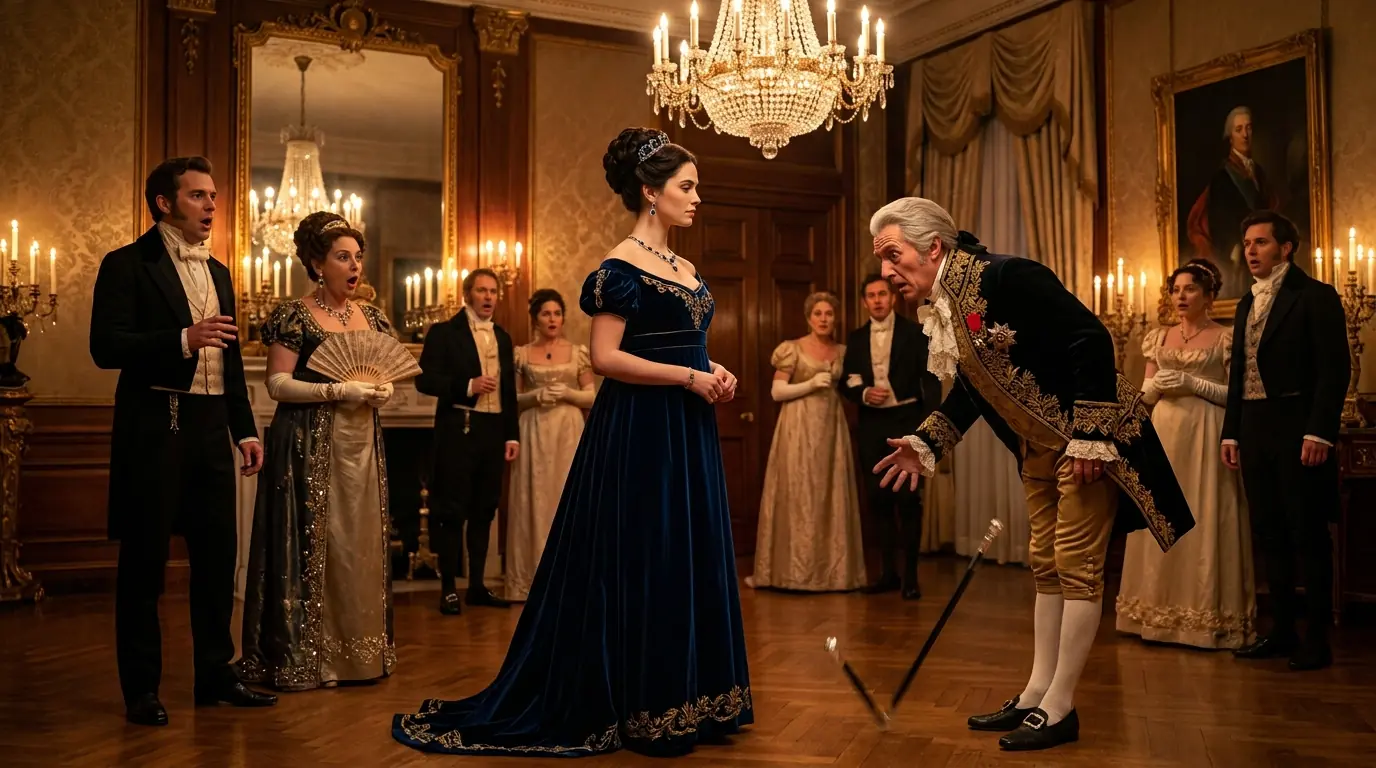
After everything the Duke had said about her origins, he looked ready to burst. The Duke of Somerset thought his country-bred bride was a simpleton. He invited her to his elite political dinner expecting a spectacular humiliation, but when the formidable French ambassador entered the dining room, he didn't laugh. He stopped dead, bowed deeply, and addressed the "uneducated" Duchess in flawless, trembling French.
Arlo Pendleton, the ninth Duke of Somerset, was a man who possessed everything the English aristocracy demanded except money. He had the sharp aristocratic jawline favored by portrait painters, a sprawling ancestral estate in Derbyshire that was slowly crumbling into the earth, and an agonizingly expensive taste for high-stakes whist at White's Club. By the winter of 1813, Arlo was drowning in debt. The whispers of Mayfair had turned from sympathetic murmurs to vicious mockery. He was weeks away from total ruin, from the absolute humiliation of having his prized carriage horses sold at auction to satisfy his creditors.
Salvation came in the form of a humiliating bargain. Sir William Caldwell was a man the ton referred to as "new money," though he rarely showed his face in London — a northern industrialist and landowner who had amassed a staggering fortune through textile mills and shrewd, quiet investments. Sir William wanted only one thing before his ailing heart gave out: a title for his only daughter, Genevieve.
When the marriage contract was signed in a drafty solicitor's office on Chancery Lane, Arlo felt violently ill. He had just sold his ancient noble bloodline for three hundred thousand pounds. He didn't meet his bride until the day of the wedding, in a small, unadorned country chapel in Yorkshire.
Genevieve Caldwell was nineteen, slight of build, with dark hair pulled back in a severe, unfashionable style. She wore a dress of good silk, but it lacked the elaborate embroidery and daring cuts championed by London modistes. Throughout the brief ceremony, she kept her eyes cast downward, speaking her vows in a voice so quiet the vicar had to ask her to repeat them. She seemed terrified, thoroughly out of her depth, and entirely unremarkable.
Arlo's assessment was swift and merciless: she was a dull, uneducated country mouse.
Once they arrived in London, Arlo made his disdain abundantly clear. He installed Genevieve in the east wing of the Somerset townhouse, far from his own chambers, and promptly returned to his life as if he were still a bachelor. He paraded his longtime mistress, the diamond-draped Lady Sue Harrington, through Hyde Park, leaving his new Duchess to dine alone. The servants, taking their cues from the Duke, treated Genevieve with thinly veiled insolence. The housekeeper served her tepid tea, the maids forgot to light the fires in her sitting room, and the footman smirked when she struggled to pronounce the French names of the dishes on the dinner menu, eventually pointing at the page with a gloved finger and asking for "the chicken."
Gossip spreads through Mayfair faster than a plague, and soon the entire town knew the truth about the new Duchess of Somerset: she was not just unrefined, she was hopelessly dim. Lady Sue was heard laughing at a ball, telling a circle of eager aristocrats, "I hear the poor dear can barely read her own prayer book. Arlo caught her holding a volume of poetry upside down. It is a tragedy, truly — what a man must endure to keep the roof over his head."
What Arlo did not know, what no one in London bothered to investigate, was the reality of Genevieve's upbringing. Sir William Caldwell was indeed a rustic industrialist, but during the bloody height of the French Revolution, his sprawling, secluded Yorkshire estate had served as a safe haven for fleeing European intellectuals, displaced aristocrats, and exiled politicians. While the daughters of English dukes were learning to embroider cushions and play terrible renditions of Mozart on the pianoforte, Genevieve had been quietly educated by men who had drafted constitutions and negotiated treaties. She had learned statecraft from former ministers, mathematics from exiled scholars, and languages by sitting at the knees of diplomats who had narrowly escaped the guillotine. She spoke fluent French, pristine Italian, and conversational Russian.
But Genevieve had made a calculated decision upon arriving in London. She saw the sheer hostility in Arlo's eyes. She recognized the cruelty of his social circle. If she revealed her intellect, they would view her as an arrogant upstart, a threat to be destroyed. So she played the part they assigned her. She became the silent, bumbling country girl. She read her Greek philosophy hidden inside the covers of cheap penny novels. She observed everything, cataloging the alliances, the affairs, and the political machinations of Arlo's friends with the cold, precise eye of a spy in enemy territory. She was waiting. For what, exactly, she did not know. But she knew that in a city built on deception, being underestimated was the greatest weapon a woman could possess.
By the spring of 1814, the war with France had shifted, and London was electric with political maneuvering. The Allied Powers were preparing to redraw the map of Europe, and the British government was selecting its ambassadors for the upcoming negotiations. Arlo Pendleton desperately wanted a diplomatic appointment to Paris. Not only would it carry a massive government stipend that would further solidify his restored wealth, but it would also elevate him beyond the whispers of his newly bought fortune.
To secure the post, Arlo needed the endorsement of the foreign diplomats currently stationed in London. Most crucial among them was the newly appointed French ambassador, the Marquis Henri de la Tour. The Marquis was a legend — a man who had miraculously survived the Reign of Terror, thrived under Napoleon, and smoothly transitioned back into the favor of the returning Bourbon monarchy. He was known to be brilliant, ruthless, and utterly intolerant of English buffoonery. He destroyed political careers with a single, softly spoken insult at the dinner table. If the Marquis approved of Arlo, the ambassadorship was guaranteed. If the Marquis found him lacking, Arlo's political aspirations would be dead in the water.
Arlo planned an intimate but lavish dinner party for twelve guests to court the Marquis. The guest list included the Prime Minister's secretary, Lord Alister Fitzroy; the formidable Russian envoy, Count Orlov; and, naturally, Lady Sue Harrington, who was meant to act as the unofficial hostess, dazzling the men with her wit.
It was Lady Sue who planted the poisonous seed. Three days before the dinner, as Arlo lounged in Sue's opulent parlor, she stroked his hair and murmured, "Arlo, darling, it simply won't do to have me act as hostess with the Marquis present. He is a stickler for protocol. If your wife is in the house and not at the table, he will take it as a slight. The French are terribly sensitive about such things."
Arlo frowned, sitting up. "Genevieve, at a diplomatic dinner? Sue, she asked the butler yesterday if foie gras was a type of English shrubbery. She will ruin me."
Sue smiled, a slow, predatory curving of her painted lips. "Exactly, my love. Let the Marquis see what you are burdened with. Let him see the tragic, uneducated country girl you were forced to marry to save your noble house. The Marquis is a man of the world. He will pity you. He will see you as a martyr." She paused, her eyes glinting. "And more importantly — once she makes an absolute spectacle of herself in front of foreign dignitaries, you will have the perfect, unassailable excuse to banish her to the country permanently. No one could blame you for sending her away after she offends the Marquis de la Tour."
Arlo's eyes widened as the brilliance of the plan washed over him. It was perfect. A controlled demolition of his wife's already frail reputation. She would stumble over her words, use the wrong forks, embarrass herself completely, and he would play the long-suffering, dignified lord.
That evening, Arlo stormed into Genevieve's sitting room without knocking. She was sitting by the window, hastily sliding a leather-bound book under a cushion as he entered.
"You will dine with us on Thursday," Arlo commanded, his tone clipped. "We are hosting the Marquis de la Tour and Count Orlov. It is a dinner of state importance."
Genevieve looked up, her expression perfectly blank. "A dinner? Your Grace? Am I — am I to speak with them?"