The Duke of Alderwick had survived a war, inherited a fortune burdened by debt, and endured three London Seasons without losing his temper in public. Yet on a wet September morning in 1814, he was brought dangerously close to doing so by a woman he had never met.
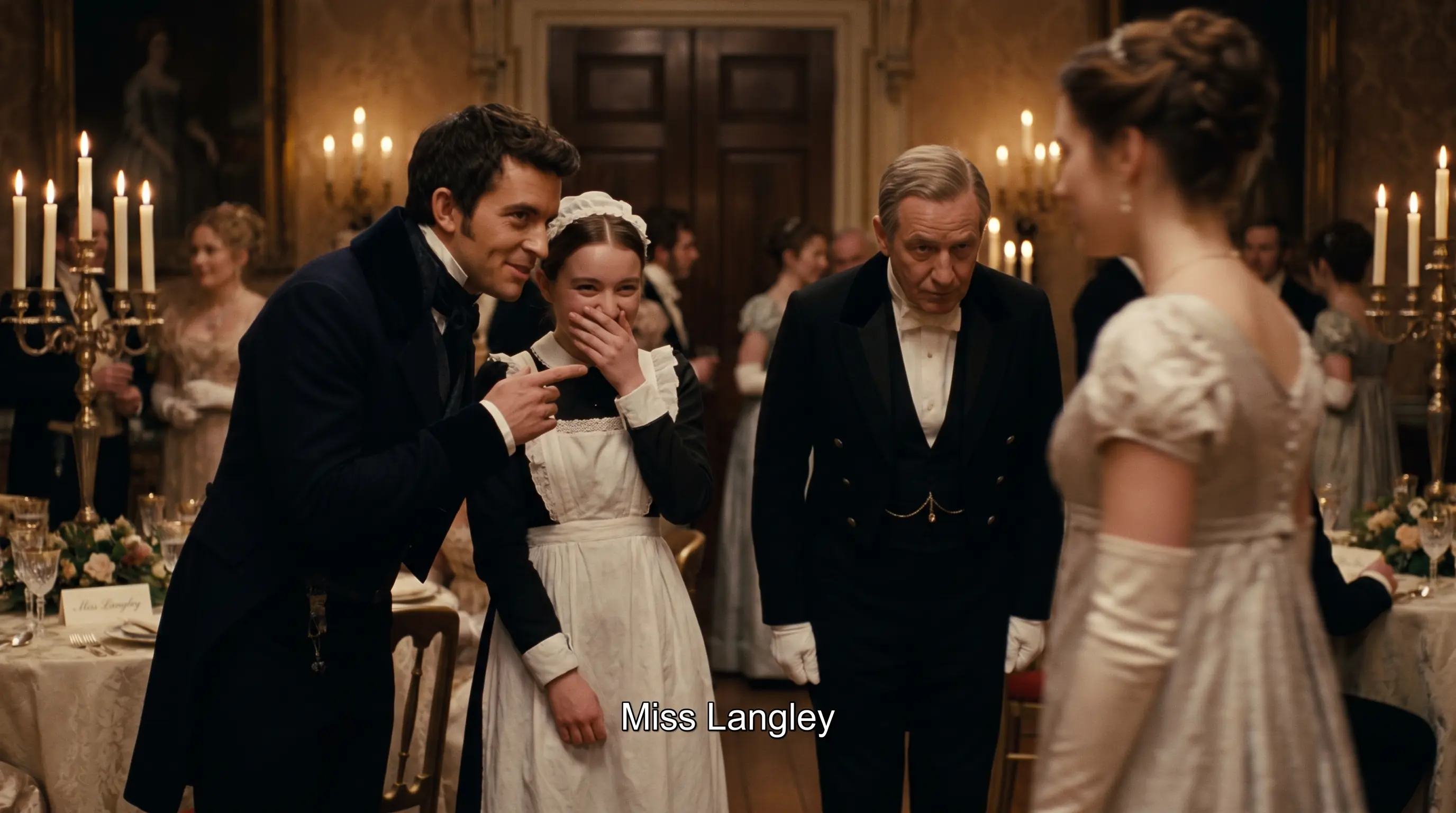
Her name was Miss Clara Langley.
And according to everything His Grace had been told, she was the most unbearable creature in England.
“A woman who sends instructions regarding the arrangement of my furniture before she has even crossed my threshold,” Julian Vale declared, “is not a woman I should care to marry.”
He stood beside the tall windows of his private morning room, holding a letter between two fingers as though it were something unpleasant discovered beneath a dinner plate.
At thirty-five, Julian was the seventh Duke of Alderwick, a man whose appearance had caused more than one ambitious mother to abandon an otherwise sensible marriage scheme. He was tall, broad-shouldered, and possessed of a face that might have appeared almost perfectly handsome had it not been for the habitual severity of his expression. His dark hair was cut shorter than fashion required, his jaw was cleanly shaven, and a thin white scar near his left temple was the only obvious reminder of his years in the army.
He had inherited Alderwick House three years earlier, following the unexpected death of his elder brother, Matthew. The title had brought with it twenty thousand acres, a London residence, several villages, and financial difficulties of a magnitude that the family solicitor preferred to describe as unfortunate irregularities.
It had also brought an expectation that he would marry.
Miss Clara Langley was the proposed solution.
She possessed a considerable independent fortune, respectable family connections, and a parcel of land adjoining the duke’s northern estate. Their marriage had been suggested by her late father’s executor, Sir Edmund Cross, and warmly encouraged by Julian’s aunt, Lady Honoria Vale.
The arrangement was sensible in every respect.
Except, apparently, for the lady herself.
Julian tossed the letter onto his desk.
“Last week she objected to my choice of guests for the winter. Before that, she informed me that the west drawing room receives insufficient morning light. Now she wishes to know whether the servants are permitted to read newspapers.”
A soft clatter interrupted him.
Near the fireplace, a young housemaid had nearly dropped the silver tongs she was using to arrange fresh coals.
Julian glanced over.
The girl stood with her back half-turned to him, dressed in a plain gray gown, white apron, and modest linen cap. A few stubborn strands of chestnut-brown hair had escaped around her temples.
She was rather taller than most of the housemaids, and there was something unusually composed about the way she stood.
But Julian was too irritated to notice.
“Have I said something amusing?” he asked.
The maid bent to retrieve a fallen piece of coal.
“No, Your Grace.”
“Then why are you smiling?”
“I was wondering whether the lady had expressed an opinion on the weather.”
Julian stared at her.
“The weather?”
“Yes, Your Grace. Since she appears determined to govern the entire household, I thought she might have instructed the rain to fall elsewhere.”
For a moment, silence settled over the room.
Then Julian laughed.
It was an unexpected sound, low and genuine, and it surprised him almost as much as it surprised the young woman.
“Upon my word,” he said. “At least someone in this house possesses a sense of humor.”
The maid returned the coal to the grate.
“Perhaps Miss Langley possesses one as well.”
“Then she has concealed it with remarkable success.”
“Perhaps Your Grace has not looked very carefully.”
Julian lifted an eyebrow.
“You are an unusually impertinent servant.”
“So I have been told.”
“And yet you remain employed.”
“For the present, Your Grace.”
He laughed again.
It occurred to him that he had not laughed twice in one morning for several months.
“Tell me something,” he said, moving toward the fireplace. “Have you ever encountered a woman who finds fault with absolutely everything?”
The maid considered the question.
“I have encountered several gentlemen of that description.”
Julian stopped.
“You are determined to be insolent.”
“I am attempting to be truthful.”
“A dangerous habit in a servant.”
“More dangerous in a duke, I should imagine.”
Julian looked at her closely for the first time.
Her skin was fair, with a faint warmth at the cheeks. Her eyes were a clear, intelligent gray-green, framed by dark lashes and brows that gave her expression a peculiar intensity. She had a small, straight nose, a generous mouth, and an unmistakably attractive face.
Yet what struck him most was not her appearance.
It was that she did not appear remotely afraid of him.
Most servants became rigid when he addressed them. Some lowered their eyes. Others apologized for offenses they had not committed.
This girl looked directly at him.
“And what,” he asked slowly, “would you know of dukes?”
“Only what I have observed this morning.”
“Then your experience is limited.”
“Indeed, Your Grace. I should not wish to form an unfair opinion upon so little acquaintance.”
The remark landed with astonishing precision.
Julian narrowed his eyes.
“Are you suggesting that I have judged Miss Langley unfairly?”
“I should never presume to instruct Your Grace.”
“You have done little else since entering the room.”
She lowered her head.
“Then I must beg your pardon.”
But she did not sound particularly repentant.
Julian returned to his desk and retrieved the offending letter.
“Listen to this. ‘I trust Your Grace will reconsider the employment of unnecessary footmen, whose idleness encourages vanity among the lower orders.’”
He looked up.
“Can you imagine a more unpleasant sentiment?”
The maid’s expression changed.
The smile disappeared so completely that Julian wondered whether he had somehow offended her.
“That is what the letter says?”