Power, wealth, a title that commanded the respect of an entire kingdom. Julian Thorne, the Duke of Ashbury, possessed everything a man could desire, except the truth. Plagued by whispers that his beautiful fiancée, Lady Clara, only craved his fortune, Julian made a dangerous choice. He stripped off his silks, donned the rough wool of a servant, and infiltrated her home to see the woman behind the mask.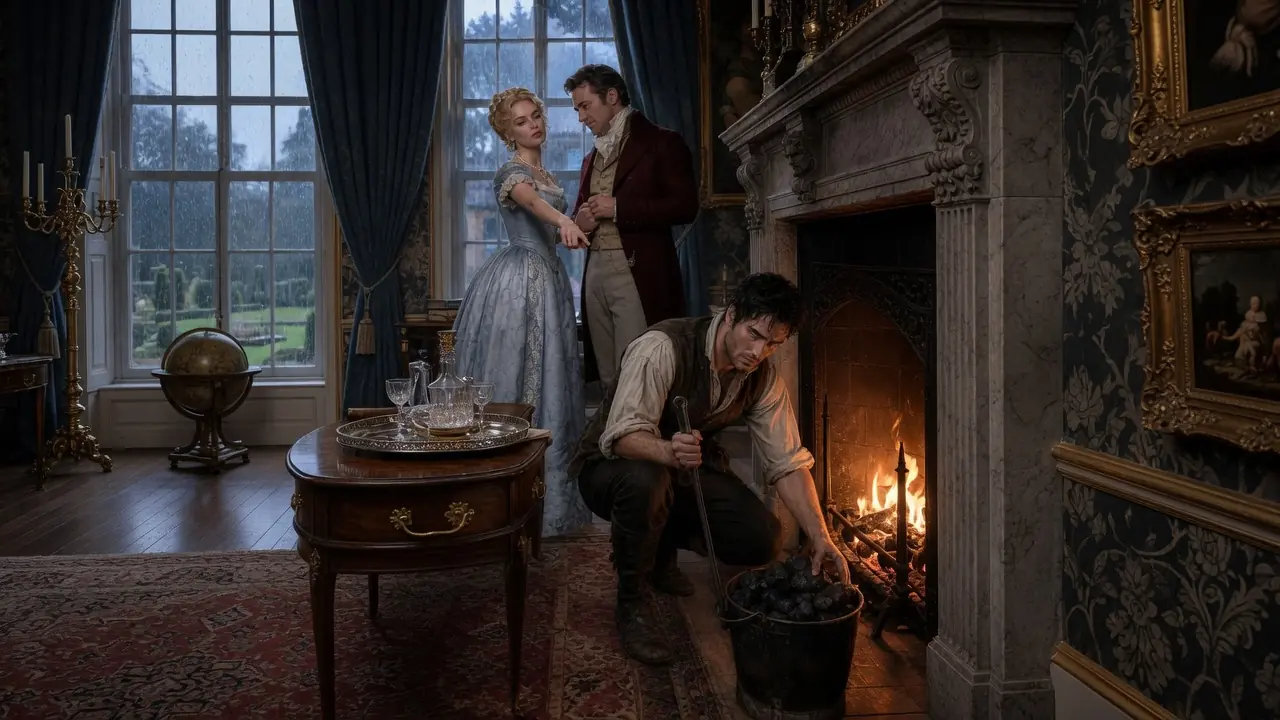
He expected vanity. He expected greed. But he never expected to hear the conversation that would shatter his world and turn his love into a cold, calculated war. The rain in London didn't wash away the grime.
It merely made the cobblestones slick and treacherous, much like the high society that Julian Thorne navigated daily. At 28, Julian was the Duke of Ashbury, a man whose net worth could likely purchase a small country. Yet he felt poorer than the beggars shivering on Fleet Street. He stood by the window of his study in Ashbury House, swirling amber brandy in a crystal glass.
The fireplace crackled behind him, casting long, dancing shadows against the velvet draped walls. You look like a man marching to the gallows, your grace. A voice came from the doorway. Julian didn't turn.
He knew it was Arthur, his valet, and the only man alive who dared to speak to him without the suffocating filter of deference. Marriage is a sentence of sorts, isn't it, Arthur? A life sentence. Most men would consider marriage to Lady Clara Vance a reward, sir.
She is considered the diamond of the season. Beautiful, accomplished, and from a family nearly as old as your own. Beautiful, yes, Julian muttered, taking a sharp sip of the brandy. But does she love me, Arthur?
Or does she love the Ashbury diamonds? Does she love the way duchess rolls off the tongue? It was the question that had rotted Julian's peace of mind for months. The engagement had been arranged by his late father and Clara's formidable mother, the Dowager Countess of Lynchfield.
On paper, it was a perfect union. In person, Clara was flawless. She smiled at the right times, laughed at his dry wit, and expressed all the appropriate affections. But Julian possessed a keen instinct for deception, a trait honed by years of managing an estate everyone wanted a piece of.
He felt a coldness behind Clara's sapphire eyes, a rehearsed quality to her touch. Does it matter? Arthur asked, stepping into the room to stoke the fire. It is the way of our world.
Love is a luxury for the poor. The peerage deals in alliances. I refuse to accept that, Julian snapped, turning around. His jaw was set, his dark eyes flashing with a sudden, reckless intensity.
My parents had affection. I remember it. I will not shackle myself to a statue made of ice and greed. Then, break the engagement.
And cause a scandal that would ruin both families? No, I need proof. I need to know who Clara Vance is when the Duke of Ashbury isn't in the room. Julian walked to his desk and slammed the glass down.
I have a plan, Arthur. But I will need your absolute silence. Arthur sighed, sensing a headache approaching. "What have you done?"
"The Vances are hiring." I saw the notice in the Times this morning.
They require a new under-footman for their country estate in Derbyshire, where Clara is spending the autumn before the wedding. Arthur's eyes widened. You cannot be serious. You are a peer of the realm.
You cannot polish silver and muck out stables. I can and I will, Julian said, a grin finally breaking his brooding expression. I've already sent the letter of application under the name Thomas Hill. The reference was forged by well, let's just say I have contacts who owe me favors.
I leave for Derbyshire in two days. You will tell anyone who asks that I have gone to the continent on urgent business regarding my vineyard investments. Sir, this is madness. If you are discovered If I am discovered, I will pass it off as an eccentric romantic gesture, Julian countered smoothly.
But if I am not, I will see the real Clara. I will see how she treats the staff. I will hear what she says when she thinks she is alone. If she is the woman she pretends to be, I will marry her with a glad heart.
If she is not, his voice dropped dangerous and low, then I will know exactly how to deal with her.
Two days later, the Duke of Ashbury ceased to exist. In his place stood Thomas Hill, a man in rough-spun trousers and a simple linen shirt carrying a battered leather satchel. He had rubbed dirt into his fingernails and let stubble darken his jaw.
He didn't take a carriage, he took the mail coach, squeezed between a farmer smelling of onions and a silent clergyman. The journey to Derbyshire was grueling, a stark reminder of the physical discomforts he usually paid to avoid. By the time he arrived at the gates of Lynchfield Manor, his back ached and he was starving. But as he looked up at the imposing stone facade of Clara's ancestral home, adrenaline surged through him.
He was directed to the servants' entrance, a side door he had never used in his life. The housekeeper, Mrs. Gable, was a stern woman with a face like a dried apple. She looked Thomas up and down with critical eyes.
Julian held his breath. He had calluses from fencing and riding, but they weren't the calluses of labor. "Soft. You've been in service before?" "Valet to a gentleman in London, ma'am.
He passed on. I preferred the country to the city, so I'm willing to start lower." Mrs. Gable huffed, seemingly satisfied. "Well, we run a tight ship here.
Lady Clara is preparing for her wedding to the Duke of Ashbury and her mother is in a permanent state of hysteria. You keep your head down, do as you're told and don't speak unless spoken to. Understand?" "Yes, Mrs. Gable." "Good.
Put your things in the bunkhouse. You start immediately. We have a dinner party tonight. Lord Grey is visiting.
Julian froze. Lord Silas Grey. He was a notorious rake, a gambler with a charm that ruined reputations, and one of Julian's least favorite acquaintances. Why was Silas Grey dining intimately with Clara and her mother while her fiancé was supposedly out of the country?
"Thomas, move," Mrs. Gable barked. Julian snapped to attention. "Yes, ma'am." As he walked through the narrow, dim corridors of the servants' quarters, the reality of his situation set in.
He was invisible here. He was no longer a person of consequence. He was a tool to be used. And that was exactly what he wanted.
His first test came sooner than expected. He was assigned to bring fresh coal to the drawing room before the guests arrived. He entered the room quietly, his head bowed. Lady Clara was standing by the window, wearing a gown of pale blue silk that cost more than a footman would earn in 10 years.
She looked breathtaking, her golden hair piled high in intricate curls. She was speaking to her maid, a young girl named Elise, who was on her knees adjusting the hem of the dress. "Ouch!" Clara yelped, pulling her foot back. Julian glanced up through his lashes.
Clara had kicked the girl hard. "You clumsy little idiot!" Clara hissed, her voice devoid of the musical lilt she used in London ballrooms. "You pricked me!" "I am so sorry, my lady. The pin slipped." Elise stammered, tears welling in her eyes.
"If you ruin this silk with your incompetence, I'll have the cost deducted from your wages for the next year. Now, get out of my sight before I strike you again. Elise scrambled up, clutching her sewing kit, and ran past Julian, sobbing quietly. Julian stood frozen by the fireplace, the coal bucket heavy in his hand.
His heart hammered against his ribs. He had seen Clara annoyed before, but never cruel, never physically aggressive. This was the first crack in the porcelain doll. Clara turned, her eyes landing on Julian.
For a second, he panicked. Did she recognize him? He had danced with her, held her hand, dined with her a dozen times, but Clara looked right through him. To her, he wasn't Julian Thorne.
He was furniture. You there, she commanded, snapping her fingers. The fire is dying. Fix it.
Lord Grey will be here any moment, and I won't have the room freezing. Yes, my lady. Julian mumbled, kneeling before the hearth. As he shoveled the coal, the heavy oak doors opened.
Lord Silas Grey, the butler announced. Silas sauntered in, looking dapper and predatory. As soon as the butler closed the door, the dynamic in the room shifted. Clara didn't curtsy.
She didn't offer a polite hand. She smiled, a smile that didn't reach her eyes, but one that suggested a familiarity that made Julian's blood run cold. Silas, she purred. You're late.
Hardly, my dear. I merely wanted to make an entrance. Silas walked over to her, taking her hand and kissing it, lingering far longer than propriety allowed. Is the old bat, I mean, your mother, downstairs yet?
She's having a migraine. We have a few minutes. Clara glanced at Julian's back. Don't worry about him.
He's new. A simpleton from the look of him. Julian gritted his teeth, gripping the iron poker until his knuckles turned white. A simpleton.
Good, Silas said, lowering his voice. Because we have much to discuss. The Duke is in Europe. We have a window of opportunity, Clara.
If we play this right, we'll have the Ashbury fortune in our pockets by Christmas. Julian's breath hitched. He stayed crouched, staring into the flames, forcing himself not to move, not to react. He had come looking for the truth, and within 2 hours the first devastating blow had landed.
But he had to know more. He had to know the extent of the rot. He finished with the fire and stood up, dusting off his hands. That will be all.
Clara said dismissively, waving him away without looking at him. Yes, my lady. Julian said. He backed out of the room, closing the door softly.
But he didn't leave. He pressed his ear against the cold wood of the door, his heart pounding a war drum in his chest. The game had begun. And Julian Thorne was no longer playing for love.
He was playing for survival.
Sleep did not come easily to Julian that night. The bunkhouse was drafty, smelling of damp wool and lye soap, a stark contrast to the feather mattresses and silk sheets of Ashbury House. But it wasn't the discomfort that kept him awake.
It was the conversation he had overheard. The Ashbury fortune in our pockets. The words echoed in the darkness, taunting him. The next morning began before dawn.
The life of a servant, Julian quickly learned, was a relentless grind of physical exertion. He hauled water, scrubbed boots, and polished silver until his fingers cramped. Every muscle in his body screamed in protest, but the physical pain was a welcome distraction from the rage boiling in his gut. Around mid-morning, he found himself in the scullery polishing a massive silver punch bowl.
Elise, the maid Clara had kicked the previous day, was nearby peeling a mountain of potatoes. Her eyes were red-rimmed, and she favored her left hand, which was wrapped in a crude bandage. "Does it hurt?" Julian asked quietly, keeping his voice low to avoid the wrath of Mrs. Gable.
Elise jumped, looking fearful. "I'm fine. It was my own clumsiness." "It wasn't." Julian said, his voice firm. "I saw what happened.
She kicked you." Elise went still, her knife hovering over a potato. She looked around to ensure they were alone, then whispered, "You must not say that. If the mistress hears you speaking ill of her, you'll be out on the street without a reference, or worse." "Does she do that often?" Elise let out a shaky breath. "Lady Clara, she has moods.
When there are guests, she is an angel. When the doors are closed, she is different. She hates mistakes. She says they are a sign of low breeding." Julian gripped the polishing rag.
"And the Duke, does she speak of him?" Elise looked at him with pity. "The Duke is her golden ticket. That's what she calls him. She laughs about how boring his letters are.
She reads them out loud to her mother. And they mock his his feelings. Julian felt a crack in his chest. He had poured his soul into those letters.
He had written about his loneliness, his hopes for a family, his desire to be a good husband. He had thought he was writing to a kindred spirit. Instead, he was providing entertainment for a viper's nest. "Thank you, Elise." Julian said, his voice tight, "for telling me." "Just be careful, Thomas." She warned.
"This house has ears." Later that afternoon, the opportunity Julian had been waiting for arrived. He was summoned to the library to move some heavy furniture. Lady Clara decided the feng shui was wrong and wanted the chaise lounge moved closer to the window. When Julian entered, Clara was lounging on the very chaise he was supposed to move, holding a glass of sherry.
Silas Grey was pacing the room, a quill in his hand. "Are you sure this is wise, Clara?" Silas asked, dipping the quill into an inkpot. "Stop worrying, Silas. Julian is a sentimental fool.
He eats this drivel up with a spoon. Just write what I say." Clara took a sip of sherry, her eyes narrowing as she saw Julian. "You. Wait until we are finished.
Stand in the corner and don't breathe too loudly." "Yes, my lady." Julian said, retreating to the shadows of the bookshelves. "Now." Clara continued, her voice taking on a sickeningly sweet tone as she dictated. "My dearest Julian, my heart aches with every mile that separates us. The countryside is beautiful, but it is gray and dull without the light of your presence.
Silas snorted, scratching the words onto the parchment. You are laying it on a bit thick, aren't you? Light of your presence? He loves it, Clara said with a dismissive wave of her hand.
He thinks himself a poet. I have to match his tedious romanticism. Continue. I spend my days dreaming of our future, of the children we will raise in the halls of Ashbury.
Julian felt the blood drain from his face. Children? She was using his desire for fatherhood, something he had confided in her during a vulnerable moment after his own father's funeral, as a weapon to manipulate him. And make sure you mention the wedding settlement, Clara added sharply, her voice dropping the act.
Tell him mother is worried about the costs of the trousseau and that an advance on the allowance would ease her fragile nerves. Silas chuckled. You are wicked, Clara. The man is already paying for the entire ceremony.
He has more money than God, Silas. Why should he hoard it? Besides, I need that advance. The dressmaker in Paris is threatening to hold the shipment if I don't pay the outstanding bill from last season.
Outstanding bill? Silas raised an eyebrow. I thought you said your debts were cleared. They will be.
Clara smiled, a predatory expression that made her beautiful face look grotesque. Once I say I do, once that ring is on my finger, I will have access to the Ashbury accounts. And then, my darling Silas, we won't have to scrounge for scraps anymore. Julian stood in the corner, his body rigid.
He was witnessing a crime in progress, the murder of his future. Every word was a dagger. She wasn't just indifferent, she was actively, maliciously calculating. She viewed him as a walking bank vault to be cracked open.
"Done." Silas said, sanding the ink. "Should I sign it?" "No. I have to forge the signature. His Grace knows my handwriting." Clara stood up and walked over to the desk.
She leaned over Silas, her hand resting intimately on his shoulder. "You are a useful man, Silas." "I aim to please." Silas murmured, turning to kiss her neck. Julian looked away, nausea rising in his throat. He wanted to step forward, to tear the mask off his face, and roar at them.
He wanted to see the color drain from their faces when they realized the simpleton in the corner was the man they were conspiring to rob. But he held back. It wasn't enough. He needed to know the full extent of the betrayal.
He needed to know if there was anyone in this house who was loyal, or if the entire Vances family was rotten to the core. "Move the chaise now." Clara commanded without looking at him, breaking the intimate moment with Silas. "And be careful. It's French velvet." Julian moved the furniture, his movements mechanical.
As he lifted the heavy frame, he made a silent vow. He would not just break the engagement, he would dismantle their schemes piece by piece. They wanted a game? He would give them a war.
Two days passed. Julian, now fully immersed in the role of Thomas, had become a ghost in the machine of Lynchfield Manor. He learned to walk silently, to blend into the wallpaper, gathering intelligence like a spy behind enemy lines. He knew the cook was stealing brandy.
He knew the butler was gambling on horse races. But mostly, he watched Clara. The more he watched, the more the image of the woman he loved disintegrated. It wasn't just the greed, it was the contempt.
She despised the very things that made Julian who he was, his quiet nature, his love for books, his dedication to his tenants. To her, these were weaknesses to be exploited.
The breaking point came on a stormy Thursday evening. The rain was lashing against the windows of the manor, a torrential downpour that mirrored the storm inside Julian's mind.
Dinner had been served, a lavish affair for just Clara, her mother the countess, and Silas. Julian was assigned to clear the table, but as he approached the dining room, he heard laughter. Loud, raucous laughter that echoed down the hall. He paused outside the door, balancing a heavy tray of dessert plates.
"Oh, stop, Clara. You'll kill me." Silas was gasping for air. "No, no, you have to hear the rest." Clara's voice was high with amusement. "Listen to this stanza.
It's tragic." Curiosity overruled caution. Julian stepped closer to the slightly ajar door. Through the crack, he could see them. They had moved to the parlor adjacent to the dining room.
Clara was standing by the fireplace, holding a piece of paper, a familiar cream-colored stationery with the Ashbury crest. Julian's breath hitched. It was the poem. Months ago, on the anniversary of his sister's death, Julian had written a poem.
It was raw, unpolished, and deeply personal. It spoke of grief, of the silence of a house that was too big, and the hope that love could fill the empty rooms. He had given it to Clara, trembling, thinking he was sharing the deepest part of himself. She had cried when she read it.
She had told him it was the most beautiful thing she had ever seen. Now, she was reading it to Silas and her mother as if it were a joke from a cheap tabloid. The silent halls do echo with the past of shadows long and memories cast. Clara read the lines with a mock dramatic trembling voice, throwing her hand over her forehead like a bad stage actress.
Her mother, the dowager countess, cackled, sipping her wine. Oh, lord. He sounds like a funeral director. Shadows long, the boy is positively morose.
It gets worse, mother. Clara giggled. But in your eyes, a light I see, a harbor safe for a ship at sea. Silas roared with laughter, slapping his knee.
A ship at sea? The man has never left England. He's a duke, not a sailor. It's pathetic, Clara.
Truly pathetic. I had to bite my lip to keep from laughing when he gave it to me, Clara admitted, tossing the paper onto the coffee table as if it were trash. He looked so earnest. I wrote this for you, Clara.
It took every ounce of my acting ability to squeeze out a tear. You deserve an award, darling, Silas said, wiping his eyes. Living with that bore will be a trial. A trial I will be well compensated for.
Clara said, her voice turning cold and hard. Once we are married, I'll make sure he stays at Ashbury, while I take a townhouse in London. I won't have to listen to his bad poetry or deal with his gloomy moods. I'll have his title, his money, and my freedom.
And me? Silas added, reaching for her hand. And you, Clara agreed. Julian stood outside the door, the heavy tray trembling in his hands.
A cold numbness spread from his chest to his fingertips. He had expected greed. He had expected infidelity. But this?
This was a desecration. That poem was the only piece of his late sister he had left alive in his heart. A bridge he had built to connect with Clara. And she had burned the bridge while laughing at the flames.
Something inside Julian snapped. Not a loud snap, but a quiet, irreversible fracture. The man who had come here hoping to be wrong, hoping to find a misunderstanding, died in that hallway. In his place, the Duke of Ashbury returned.
But not the gentle, lovesick Duke. This was the man whose ancestors had conquered lands and crushed rebellions. He didn't storm into the room. He didn't drop the tray.
He carefully lowered the tray onto a side table. His hands were steady now. His eyes were dry. He turned and walked back toward the servants' quarters.
He found Arthur, who had secretly followed him to the village and was staying at a local inn posing as a grain merchant, waiting by the back gate as planned for their nightly check-in. Arthur stepped of the shadows holding an umbrella. Sir, you look different. Did something happen?
Julian stepped into the rain letting the water soak his servant's clothes. He didn't feel the cold. It is done, Arthur. Julian said, his voice devoid of emotion.
I have seen enough. So, we are leaving? Shall I prepare the carriage? No.
Julian said, looking back at the dark silhouette of the manor. Leaving is too easy. Leaving allows them to spin a story that I abandoned her. Leaving lets her keep her dignity.
Arthur hesitated. Then what will you do? Julian turned to his valet, a terrifyingly calm smile playing on his lips. The engagement party is in two days.
Half the nobility of England will be there. Clara wants a wedding? I will give her a spectacle she will never forget. Sir, I'm not leaving, Arthur.
I'm going to serve them. Julian's eyes glittered in the darkness. I'm going to serve them exactly what they deserve. Go to the village.
Send a telegram to my lawyer in London. Tell him to bring the file on the Lynchfield estate's mortgages. And tell him to bring the diamond. The Ashbury diamond?
The engagement ring? Yes. But not for her finger. Julian said.
It will be part of the show. He turned back to the house. He had to go back in. He had to polish more boots.
He had to bow and scrape and call that woman my lady for 48 more hours. But every bow would be a countdown. Every yes, my lady would be a promise of retribution. The heartbreak was over.
The reckoning was about to begin.
The morning of the engagement ball dawned with a frantic energy that vibrated through the very stones of Lynchfield Manor. For the servants, it was a day of terror. For Clara and her mother, it was the culmination of a lifelong campaign for power.
Julian, still in the guise of Thomas, was up before the sun. He was assigned to the ballroom, polishing the sprawling expanse of parquet flooring until it shone like a mirror. His knees ached and his hands were raw, but his mind was razor sharp. Today was the day.
Around mid-morning, the chaos reached a fever pitch. Florists were hauling in massive urns of white roses, Clara's favorite, chosen specifically because they symbolized a purity she did not possess. Julian was on a ladder dusting the crystal chandeliers when Clara swept into the room, followed by her entourage of dressmakers and Silas, who was boldly lounging about the house as if he already owned it. "No, no, no!" Clara shrieked, pointing at the roses.
"I said white roses, not cream. These look like they've been left out in the sun for a week. Take them away." "But my lady," the head florist stammered, "these are the finest hothouse albas. There is no time to replace them." "Then paint them white for all I care," Clara snapped.
She spun around, her heavy skirts swishing, and nearly collided with the ladder Julian was perched on. She looked up, her face twisted in a sneer. "And you, be careful up there. If you drop so much as a speck of dust on my floor, I'll have you flogged before I throw you out.
Yes, my lady. Julian said, his voice steady. From his vantage point, he looked down at her. He saw the intricate braiding of her hair, the jewels at her throat, and the absolute hollowness of her soul.
It was strange. He felt no anger anymore. Only a cold, clinical detachment. He was a surgeon preparing to cut out a tumor.
As Clara stormed off to terrorize the kitchen staff, something fell from the folds of her sash. It fluttered to the ground unnoticed by her or Silas. Julian waited until the room cleared, then scrambled down the ladder. He picked up the object.
It was a crumpled ball of paper. He smoothed it out. It was his poem. The one she had read aloud and mocked two nights ago.
She hadn't even burned it. She had just stuffed it in a pocket and forgotten it. Treating his heart like a used handkerchief. He stared at the ink, his own handwriting looking back at him like a ghost.
But in your eyes, a light I see. He folded the paper carefully and placed it in the breast pocket of his rough linen shirt, right over his heart. It would be the fuel for what was to come. By late afternoon, the transformation of the house was complete.
The servants were exhausted, their faces gray with fatigue, but there was no rest. Mrs. Gable, the housekeeper, was marching up and down the kitchen line like a general. Thomas!
She barked. Where is Thomas? Julian stepped forward. Here, Mrs.
Gable. You are to man the front door tonight. You have the height for it. Put on the dress livery, the blue velvet with the gold braid, and for heaven's sake, shave that stubble.
You look like a convict. I'm afraid I cannot do that, Mrs. Gable, Julian said quietly. The kitchen went silent.
The cook stopped stirring the soup. Elise looked up from her corner, eyes wide. A servant did not tell the housekeeper what he could or couldn't do. Mrs.
Gable's face turned a shade of purple. Excuse me? Did you just refuse an order? I have a prior engagement, Julian said.
I must leave immediately. Leave? Mrs. Gable shrieked.
On the night of the engagement ball, you are fired. Do you hear me? You will never work in a decent house in England again. Get out, and don't expect a penny of wages.
I don't want your wages, Julian said. He reached into his pocket and pulled out a small velvet pouch, one he had hidden in his mattress. He walked over to Elise. The room was frozen in shock.
Julian took Elise's rough, red hand and pressed the pouch into it. It was heavy with gold sovereigns, more money than she would earn in five lifetimes. Thomas, she whispered, trembling. You have a kind heart, Elise, Julian said, his voice returning to the cultured, authoritative tone of the duke, though no one recognized it yet.
Don't let this house destroy it. Take this. Go to London. Open that bakery you told me about.
I I don't understand, she stammered. You will, Julian said with a sad smile. He turned to the stunned room, gave a slight mock bow to Mrs. Gable, and walked out the back door.
He didn't run. He walked calmly through the rain-soaked gardens, past the stables where the grooms were preparing the guest carriages, and into the dense woods that bordered the estate. A mile into the forest, a black carriage with the ducal crest covered in mud was waiting. Arthur stood by the door holding a heavy cloak.
"You cut it close, your grace." Arthur said, checking his pocket watch. "Guests are already arriving." "I had to make a final gesture." Julian said, stripping off the linen shirt and tossing it into the mud. The rain felt good on his skin, washing away the grime of servitude. He climbed into the carriage.
Inside, laid out on the velvet seats, was his salvation. A suit of midnight blue evening wear, cut by the finest tailor on Savile Row, a crisp white cravat, and the heavy gold signet ring of the Ashbury line. "Drive, Arthur." Julian commanded as he began to dress. "And don't stop at the servants' entrance this time.
We are going to the front door."
Lynchfield Manor was a beacon of light in the darkness. Hundreds of candles flickered in the windows, and the sound of a string quartet drifted out onto the wet driveway. Carriages lined up like a snake of polished wood and iron, delivering the crème de la crème of British society. Inside the ballroom, Lady Clara was in her element.
She wore a gown of ivory silk encrusted with pearls, the neckline plunging just enough to be daring but not scandalous. She held a fan of white feathers holding court near the fireplace. "Where is the duke?" Lady Weatherby, a notorious gossip with a beak-like nose, asked loudly. The invitation said 8:00.
It is now past 9:00. Oh, you know Julian. Clara laughed, the sound tinkling like broken glass. He is so deliberate.
He probably stopped to admire a sunset or rescue a stray cat. He is such a dear, simple soul. Silas Grey stood nearby, swirling a glass of champagne. He winked at Clara.
Perhaps he got lost. It is a long way from his ivory tower to the real world. The crowd chuckled. It was open season on the Duke.
Clara had done a marvelous job of painting him as a dull, socially awkward recluse whom she was tolerating for the sake of duty. I heard, whispered Lord Banbury, leaning in, that he prefers his library to the company of women. One wonders if he knows what to do on the wedding night. Clara covered her mouth with her fan to hide her smirk.
Oh, Lord Banbury, you are wicked. I'm sure I can teach him. Suddenly, the heavy oak doors at the far end of the ballroom swung open. The murmur of the crowd died down.
The music faltered and stopped. The herald, a man hired from London for the occasion, struck his staff against the floor three times. The sound echoed like a gunshot in the sudden silence. His Grace, Julian Thorne, the Duke of Ashbury.
A collective intake of breath swept through the room. Julian stood in the doorway. He was transformed. Gone was the stoop of Thomas the footman.
Gone was the stubble and the grime. He stood at his full height of 6'2", his posture commanding, his presence sucking the air out of the room. He wore his title like armor. His dark hair was swept back, revealing a face that was strikingly handsome, but hard as granite.
He didn't smile. He didn't wave. He simply began to walk. The crowd parted like the Red Sea.
Ladies curtsied low, their eyes wide. Men bowed, murmuring, "Your grace." Clara stood by the fireplace, her fan frozen in midair. She blinked. She had not seen Julian in 4 months.
In her memory, he was softer, more pliable. The man walking toward her looked like a predator stalking prey. But there was something else. A nagging familiarity that scratched at the back of her mind.
The way he walked, the set of his shoulders. No, she thought. It's impossible. Julian stopped 5 ft from her.
The silence in the room was deafening. Every eye was fixed on the couple. "Clara," Julian said. His voice was deep, resonant, and smooth, the voice of the duke.
But there was an edge to it. A subtle gravel that hadn't been there before. "Julian," Clara breathed, recovering her composure. She stepped forward, offering her hand to be kissed.
"You are late. We were beginning to worry." Julian took her hand, but he didn't kiss it. He held it, his grip firm, almost painful. He looked at her hand, then up into her eyes.
"I apologize," he said, his voice carrying to the corners of the room. I was detained. I was observing the condition of the estate. It is remarkable what one can learn when one looks closely at the things people usually ignore.
Clara frowned slightly, trying to pull her hand away, but he held it fast. Well, you are here now, and you look tired. Do I? Julian smiled, but it didn't reach his eyes.
Hard labor will do that to a man. Shoveling coal, polishing floors, carrying the weight of other people's lies. Clara's heart skipped a beat. Shoveling coal?
Why would he use that metaphor? Silas stepped forward, sensing the tension. Your grace, welcome back to civilization. We were just toasting to your health.
Julian turned his gaze to Silas. It was a look of such intense, icy loathing that Silas actually took a step back. Lord Grey, Julian said. I see you have made yourself at home.
I understand you have been helping Clara with her correspondence. Silas paled. I I don't know what you mean. Oh, I think you do, Julian said softly.
He released Clara's hand and reached into his breast pocket. The room watched, mesmerized. Was he reaching for the ring? Was this the moment?
Julian pulled out the crumpled piece of paper. He smoothed it out slowly, deliberately. Clara stared at the paper. Her blood turned to ice.
She recognized the cream stationery. She recognized the ink. I found this, Julian said, holding the poem up for the room to see. It seems to have been discarded.
A poem. The silent halls do echo with the past. Clara gasped. A murmur of confusion rippled through the crowd.
It's a poor poem, isn't it, Clara?" Julian asked, taking a step closer to her. "Sentimental?" "Morose?" "Pathetic, I believe, was the word used." Clara's face went white. "Julian, I How do you know that word?" Silas blurted out, panic rising in his voice. Julian turned to Silas, and then, for the first time, he let the mask slip.
He dropped the cultured accent of the duke and adopted the lower, rougher tone of the footman, the voice of Thomas. "Because, my lord," Julian said, his voice grating and deep, "the walls have ears, and sometimes the man pouring your wine is listening to you laugh at his soul." The realization hit Clara like a physical blow. Her eyes went wide, darting over his face. The dark eyes, the height, the hands.
She gasped, a sound of pure horror. "Thomas." The name hung in the air, a ghost summoned into the light. "Thomas is gone," Julian said, his voice returning to the icy calm of the duke. "He was fired this afternoon by your housekeeper for refusing to shave." He looked around the room, addressing the shocked crowd.
"You all came here for a spectacle," Julian announced, his voice booming. "You came to see the union of the Ashbury fortune and the Lynchfield beauty. You came to see a wedding announcement. He turned back to Clara, who was trembling, clutching Silas's arm for support.
But I am afraid," Julian said, "that the groom has decided to rewrite the script."
The silence in the ballroom was absolute. Even the rain, battering against the glass panes, seemed to hold its breath. Clara stood frozen, her face a mask of crumbling plaster. The realization that the man she had treated like dirt, the man whose hand she had refused to look at, whose presence she had ignored, was the man holding her future in his hands, was too massive to comprehend.
"You are joking." Clara whispered, her voice trembling. She looked around at the guests, forcing a desperate, jagged smile. "He is joking. It is a jest.
Julian has a a peculiar sense of humor." "There is nothing humorous about deception, Clara." Julian said, his voice slicing through her nervous laughter. He signaled to Arthur, who was standing by the entrance. Arthur stepped forward, carrying a thick leather portfolio. Julian took the portfolio.
"You see, while I was polishing your floors and tending your fires, I was also listening. I heard about your debts in Paris. I heard about your mother's gambling losses. And I heard your plan to use the Ashbury fortune to pay for your lover's lifestyle." He gestured to Silas Grey.
Silas, realizing the game was up, tried to edge toward the French doors leading to the garden. "Going somewhere, Lord Grey?" Julian asked without looking at him. "I wouldn't. The local magistrate is waiting in the library.
It seems there is a matter of a forged letter requesting an advance on a dowry. Forgery is a serious offense, Silas, even for a peer." Silas froze, his face draining of color. He looked at Clara with pure venom. "This was your idea.
I told you it was too risky." "Silence!" Clara shrieked, her poise shattering completely. She turned on Julian, her eyes blazing with the fury of a cornered animal. "So what? You spied on me.
You crept into my house like a rat. That is beneath your station, Julian. It is dishonorable." "Dishonorable?" Julian laughed, a dark, rich sound that echoed off the vaulted ceiling. "You speak to me of honor?
You, who kicked a maid for a mistake that was not hers? You, who mocked the grief of a man who lost his sister? You, who looked at a human being and saw only a bank draft?" He walked toward her, and for the first time Clara shrank back. "I came here to see if you were worthy of the title of Duchess," Julian said, his voice lowering to a deadly whisper that the front row of guests strained to hear.
"I was prepared to love you. I was prepared to give you the world. But you don't want the world, Clara. You just want the gold that plates it." He reached into his pocket and pulled out a small, black velvet box.
The room gasped. The engagement ring, the Ashbury diamond. It was legendary, a stone so large and pure it was said to have its own light. Clara's eyes locked onto the box.
Even in her terror, the greed was there. It was instinctive. It was incurable. Julian snapped the box open.
The diamond flashed under the chandelier light, blindingly beautiful. "It is exquisite, is it not?" Julian asked, holding it up. "Julian." Clara choked out, tears streaming down her face, tears of frustration, not remorse. "Please, we can discuss this.
I I was stressed. I didn't mean those things. I love you. You love this, Julian corrected, tilting the box.
And that is why you shall never wear it. He turned to the crowd. There will be no wedding. The engagement is terminated effectively immediately.
You can't do this, Clara screamed, grabbing his arm. You will ruin me. We are destitute. If you leave, we lose everything.
Julian looked down at her hand on his sleeve, the same hand that had slapped away Elise's apology. He gently but firmly removed her fingers from his coat. You are mistaken, Clara. You haven't lost everything just now, Julian said coldly.
He opened the leather portfolio Arthur had given him and pulled out a sheaf of papers. You lost everything yesterday. What? What is that?
These, Julian said, holding up the documents, are the mortgage deeds to Lynchfield Manor. My lawyers purchased them from the bank this morning. Your mother was 3 years behind on payments. The bank was all too happy to sell the debt to the Duke of Ashbury.
The Dowager Countess, who had been watching in stunned silence from her chair, fainted dead away. No one moved to catch her. Clara stared at the papers, her mouth opening and closing. You you bought my house?
My house, Julian corrected. I own the roof over your head. I own the chair you are standing next to. I own the bed you sleep in.
He tossed the papers onto a nearby table. They landed with a heavy slap. But do not worry, Julian continued, buttoning his jacket. I am not a cruel man.
I will not throw you out into the storm tonight. You may stay here until the end of the month. After that, well, I believe the scullery needs a new maid. I'm told the position of under footman is also vacant.
If you wish to apply, you may submit your reference to my steward. The crowd erupted. Whispers turned into shouts. It was the scandal of the century.
The Duke had not just broken the engagement, he had bought her existence and offered her a job cleaning it. Julian turned his back on her. "Julian, wait!" Clara wailed, falling to her knees, her silk dress pooling on the floor he had polished that very morning. "Please, have mercy." Julian paused.
He looked over his shoulder, his expression unreadable. "I am showing you mercy, Clara," he said softly. "I am teaching you the value of work. It is a lesson you desperately need." He looked at Arthur.
"Come, Arthur. The air in here is stale. Let us go home." As Julian walked toward the doors, the guests parted with a mixture of awe and terror. They had expected a sheep.
They had found a lion. Just before he reached the exit, Silas Grey lunged forward, desperation making him foolish. "You think you can just walk away? You think you can humiliate me?" Julian didn't even break stride.
He simply nodded to two burly men standing by the door, the local constables he had summoned earlier. "Take him," Julian commanded. As the constables grabbed Silas, dragging the screaming man away for fraud, Julian stepped out into the night. The rain had stopped.
The air was cool and clean. He took a deep breath, filling his lungs with the scent of wet earth and pine. He felt lighter than he had in years. The heavy burden of expectation of trying to please a woman who could not be pleased was gone.
He climbed into his carriage, where Arthur was waiting with a flask of brandy. Well, Arthur said, handing him the glass. That was dramatic. It was necessary, Julian replied, taking a sip.
Did you deliver the other package? I did, your grace. Just as you asked. Julian nodded, leaning his head back against the seat.
Good. Then it is finished. But as the carriage rolled away from Lynchfield Manor, leaving the weeping Clara behind, Julian knew it wasn't just an ending. It was a beginning.
Six months had passed since the night of the diamond, as the tabloids had dubbed it. The scandal had consumed London for weeks. Lady Clara and her mother had been forced to sell their remaining possessions and move to a small cottage in the north, far from the society that now shunned them. Silas Grey was awaiting trial in Newgate Prison.
Julian, however, had retreated to Ashbury. He spent the winter focusing on his estate, repairing cottages for his tenants, and actually reading the poetry he loved, no longer afraid of being mocked. He found that solitude was not the same as loneliness. Solitude was peaceful.
But there was one loose end.
On a crisp spring morning, Julian traveled to London. He didn't take his grand carriage. He walked through the bustling streets of the city, dressed simply, though not in disguise this time.
He was looking for a specific address on Fleet Street. He found it nestled between a bookshop and a tailor, a small bakery with a bright yellow sign that read the golden loaf. The smell of fresh bread and cinnamon wafted out the open door, warming the chilly air. Julian stepped inside.
The shop was modest but spotless. Baskets of crusty rolls and sweet pastries lined the wooden counters. Behind the counter, a young woman was arranging a tray of tarts. She wore a simple white apron, but her cheeks were rosy and her eyes were bright, a stark contrast to the terrified pale girl he had known in Derbyshire.
It was Elise. She looked up as the bell above the door chimed. "Good morning. Can I help?" Her voice cut off.
She froze, a tart slipping from her tongs. She stared at the tall man in the fine gray coat. She blinked, looking for the rough stubble, the dirt, the stooped shoulders of Thomas. But the eyes were the same.
"Thomas," she whispered, disbelief coloring her voice. "Hello, Elise." Julian smiled warmly. "Though I'm afraid Thomas is retired. My name is Julian." Elise's hand flew to her mouth.
"Your Grace." "I... the newspapers... they said... She hurriedly wiped her hands on her apron and dipped into a clumsy frantic curtsy. "I didn't know. I swear I didn't know. I treated you like a servant." "You treated me like a human being," Julian corrected gently, "which is more than anyone else in that house did." He walked up to the counter.
I wanted to see how you were managing. I trust the severance pay Thomas gave you was sufficient to start this place. Elise's eyes filled with tears. Sufficient?
Your Grace, you gave me a life. I was able to bring my mother here from the workhouse. We own this shop. I never thought I would be free.
You earned it, Elise. You showed kindness when you had nothing to gain from it. That is a rare quality. Julian looked at the tray of tarts.
May I try one? I hear they are the best in London. Elise laughed, a wet, happy sound. Please, take as many as you like.
Julian took a tart and ate it. It was delicious. Excellent. I shall have to order these for Ashbury House.
My cook will be jealous. He stayed for an hour, drinking tea, and listening to Elise talk about her business, her customers, her freedom. He didn't flirt with her. He didn't romance her.
That wasn't what this was. This was a different kind of connection, a recognition of shared humanity. As he prepared to leave, Elise walked him to the door. Thank you, she said softly.
Not just for the money, but for seeing me. People like Lady Clara, they look right through us. You saw me. And you saw me, Julian said.
You were the only one who saw the man, not the duke. He stepped out onto the street. The sun was shining. The city was alive with noise and chaos, but for the first time in his life, Julian Thorne felt like he belonged to it.
He wasn't searching for a duchess anymore. He wasn't searching for a perfect match to shore up a dynasty. He was just a man walking in the sun knowing that somewhere in a small bakery on Fleet Street there was one person who knew his true face and smiled. And that, he decided, was worth more than all the diamonds in England.