"Do not address me as though we are acquainted, Miss Wexford," the Duke of Blackmore said, while Celia's white-gloved hand tightened upon his sleeve. Levvenia stood beneath the blazing chandeliers of Blackmore House, with her Blackthorn fan closed so hard in her fist that the ivory ribs bruised her palm. Two nights before, Norton had lifted that same fan to his mouth and promised to speak to her guardian. Now he looked through her as if she were a stranger near the family silver. The ballroom had been loud.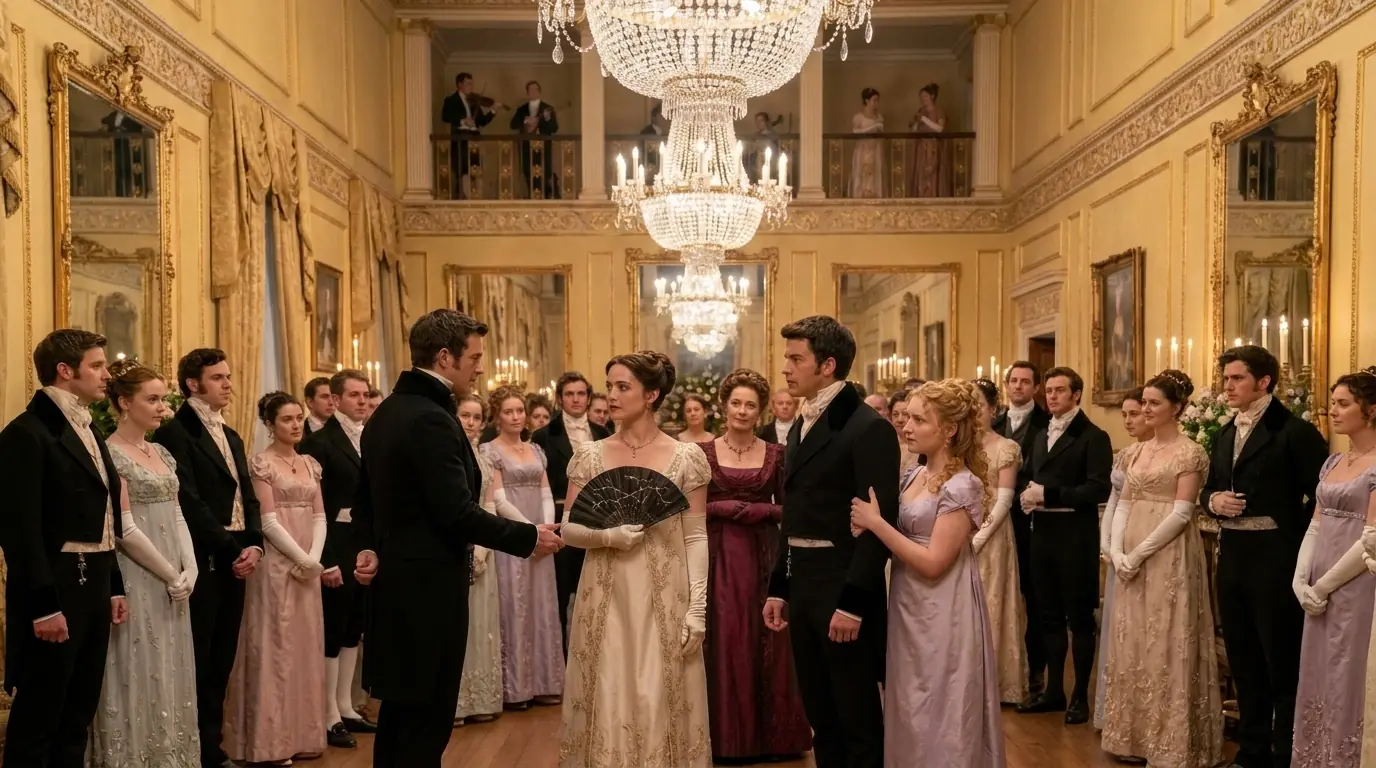
Now it was silent. Men who had never noticed Levvenia Wexford in ten years suddenly discovered her existence at the exact moment it could ruin her. On Norton's other side stood Celia, her younger half sister, dressed in pale violet silk, all golden curls and lowered lashes. Behind them, Cordelia Gresham watched with a thin smile that told Levvenia the trap had not only been set, it had been rehearsed. Celia was the bride Cordelia wanted for a duke.
Levvenia was the woman Norton had chosen in the dark and denied in the light. She did not step back. She did not let her eyes sting. Pride was a poor cloak, but it was all she owned. "My apologies, Your Grace," she said.
Her voice came out calm enough to sound borrowed from another woman. "I mistook you for a gentleman who honors his private words." A sharp breath moved through the room. Norton's jaw hardened. Something dark crossed his face, quick as a blade, leaving its sheath, then vanished behind ducal ice.
He did not explain himself. He did not correct her. He merely turned his head, giving her his profile, and in that small movement cut her from society as cleanly as if he had taken a knife to her name. Cordelia's smile widened by the breadth of a thread. Levvenia could feel what the room wanted.
Tears, flight, a broken plea that would make the story complete by supper. A plain, penniless woman of twenty-seven, had imagined too much and been put gently in her place. She gave them none of it. A shadow moved at the edge of the assembly. Tristan Granville, Lord Granville, stepped from the line of watching gentlemen.
He wore black without ornament, a stark figure against the bright gowns and gilded walls. His family lands bordered Blackmore's, and the feud between the two houses over the Marches' bridge was old enough to have its own ghosts. He did not look at Norton. He looked only at Levvenia. "Lady," he said, bowing with grave courtesy.
"Would you permit me the honor of escorting you from a room that has forgotten its manners?" Levvenia understood at once. Lord Granville was not a rescuer from a storybook. He was a rival who had seen a weapon placed within reach. Yet in his outstretched hand there was no mockery.
There was calculation, yes, but there was also respect. That was more than the Duke had offered. She placed her gloved hand upon Lord Granville's sleeve. "Thank you, my lord," she said. "The air here has grown stale."
She did not look back as they crossed the polished floor. Her fan remained shut in her fist. Her name lay bleeding behind her, but she carried herself as though she had not felt the wound. Before she reached the doors, she heard Norton take one step after her, only one. Then Celia's hand tightened again, and the Duke of Blackmore stayed where he was.
By dawn, the Welsh hills lay hard with frost, and Lord Granville offered Levvenia a marriage with no roses in it. They sat in his carriage outside a small inn near Monmouth, the windows clouded by cold and horse breath. Levvenia still wore the gown from the ball beneath her traveling cloak. Its gold embroidery looked foolish in the gray morning. Lord Granville coughed into a linen handkerchief.
The sound was deep and tearing. Everyone in the county knew he was ill, though no one said so in drawing rooms. "Cordelia will not forgive last night," he said. "She will call you unstable, or ungrateful, or worse. She will push you out of the house before gossip can settle into a shape she dislikes."
"You speak as though you wish to spare me," Levvenia said. "I speak as a man with too few months left to waste on pretty lies." He folded the stained linen away before she could look at it. "I want Blackmore's bridge secure from Blackmore. You want a door your stepmother cannot lock. As Lady Granville, you would have a house, a name, a jointure, and the legal right to protect the toll road until my trustees take their seats."
"A wife who will not faint at ledgers. A widow soon enough who will keep Cordelia Gresham from selling the Marches piece by piece."
"And yes," he added, his mouth twisting, "the pleasure of leaving Blackmore with a thorn he cannot pull free." It was not romance. It was a winter bargain made by two people society had already used.
Levvenia looked down at her hand. The mark from the fan ribs still reddened her palm. For ten years, she had copied estate letters, balanced household accounts, soothed creditors, and stepped aside when Celia entered a room. She had not minded being useful until usefulness became the only part of her anyone cared to see. Norton had seen more, or she had believed he had.
That was the worst of it. She closed her fingers over the bruise. "I will take your name, Lord Granville," she said, "but I will not be your revenge alone." For the first time, his expression softened into something almost kind. "No. Be your own first."
They married three days later in a stone chapel that held the cold like a secret. The vicar's breath smoked faintly as he read the service. Lord Granville's old steward stood witness. So did Amelia Sefton, a quiet widow from the next parish, the only woman brave enough to answer Levvenia's hastily written note. There were no flowers, no wedding breakfast, no kiss for display.
Lord Granville slid a heavy gold ring onto her finger with hands that trembled from weakness, not lack of feeling. When they signed the parish register, he wrote his name slowly, each letter jagged but proud. Afterward, in the chapel porch, he handed Levvenia the Blackthorn fan she had left in his carriage on the night of the ball. "Keep it," he said.
"I meant to return it."
"I know." A faint tired humor touched his eyes. "But it suits you. Pretty at a distance, punishing when gripped too tightly." Despite herself, Levvenia almost smiled.
Lord Granville's breath caught. He steadied one hand against the chapel wall before she could offer help. He would not accept pity any more readily than she would. "Keep it, Levvenia," he said again. "Even if you hate every man who ever steps into a ballroom."
She took the fan. The ivory felt heavier than before.
Fourteen months later, the Blackthorn fan rested against a widow's wrist. Lord Granville was dead. Levvenia returned to the Marches not as the disgraced Miss Wexford, but as Lady Granville, dressed in severe gray silk, and traveling with her own maid, her own papers, and her own seal. Mourning had thinned her face, but it had not bent her neck. She had come to settle Tristan's final charges, the bridge road, the toll house, the abandoned schoolroom near the chapel, and the small endowment her mother had once dreamed of restoring before she died.
The bridge mattered to men because of money and pride. The schoolroom mattered to Levvenia because girls who could read accounts were harder to cage. The toll house smelled of damp stone and old smoke. She sat at the scarred oak table comparing timber costs against toll receipts when a shadow filled the doorway. Norton stood there.
Dust marked his riding boots. His dark coat was wet at the hem. He seemed larger in the low room than he had beneath chandeliers, broader and more dangerous, yet older, too. The hard lines around his mouth had deepened. Levvenia did not rise.
She laid her pen down, aligning it with the ledger's edge, because her fingers needed something precise to do. "Levvenia," he said. The sound of her Christian name in his voice struck some hidden place before she could stop it. She looked at him over the ledger. "You made Miss Wexford a stranger before the county, your grace. Lady Granville will be sufficient."
His face tightened. She waited. He was a duke. Dukes expected rooms to rearrange themselves around their discomfort. This room did not.
"I came about the bridge," he said at last. The lower stones have shifted. If the autumn floods take the arch, three villages will lose the market road. "Then we should speak of stone, not ghosts." He stepped inside.
"You married my enemy."
"I married a man who offered me a carriage when you offered me shame." The words landed. She saw them hit. To his credit, he did not pretend they had not.
"I believed you had betrayed me," he said. Levvenia touched the ribbon that held the fan at her wrist. "Belief is a convenient thing when it excuses cruelty." A muscle moved in his jaw. The old Norton would have given an order or walked away.
This one stood still and took the blow. "If you have brought figures," she said, "we may compare them. If you have brought accusations, you are trespassing on Granville land." For one breath, the room held them both, as the ballroom had held them once. Then Norton removed his hat.
"I brought figures," he said. It was the first sensible thing he had said to her in fourteen months.
The inspection took place under a pewter sky. Rain had softened the ruts, and the wind worried at Levvenia's skirts. She walked with her hem gathered high enough to save it from the worst mud. Norton kept a measured distance at her side. The steward read out estimates.
Levvenia listened, asked for quantities. caught an error in the price of oak beams and corrected it before the man had finished clearing his throat. Norton watched her, not as men watched Celia, admiring the surface and inventing the rest. He watched as if trying to read a page he should have studied long ago. When the wind nearly stole the paper from her fingers, he caught it and handed it back without a word. The small act unsettled her more than any speech.
They reached a fallen branch, blocking the rut where carts would pass. Levvenia glanced at the mud, calculating the least undignified route around it. Before she moved, Norton stepped forward, seized the branch with both gloved hands, and dragged it into the ditch. He did not look back for praise. He simply returned to his place beside her.
She hated the small warmth that stirred in her chest. "He can clear a road," she told herself. "He cannot restore a name." The sound of wheels interrupted them. A carriage rolled down from the Blackmore side, lacquered black and bright against the muddy road.
Cordelia Gresham sat within it, wrapped in furs, though the day was mild enough. Celia sat beside her in pale pink, looking like a confection placed upon a battlefield by mistake. The carriage stopped. "Your grace," Cordelia called, and Lady Granville. "Inspecting mud now widowhood has given you unusual interests."
Celia's gaze flickered over Levvenia's plain gray gown. "You should take care, Levvenia. The wind makes you look very tired." There it was, the soft knife. Not ugly enough to rebuke, not kind enough to ignore.
Levvenia folded the estimate sheet once and held it against her fan. "The wind is honest, Celia," she said. "It does not pretend to be gentle while cutting." Norton turned his head toward Cordelia. "Mrs. Gresham."
Only that. Her name without warmth, without invitation. Cordelia's smile thinned. "How very grave you all are. It is only a road."
"It is three villages' road," Levvenia said. "And a schoolroom's coal, if the tolls are managed properly." For the first time, Norton looked down at the fan at her wrist. The black painted thorns curled over cream silk, his gaze fixed, sharpened. One of the ivory ribs was thicker than the rest, almost imperceptibly, except to someone who had once held that fan close enough to kiss it.
Something in his face changed. Levvenia saw the change and closed her hand around the fan. Cordelia saw it, too.
Two days later, rain trapped Levvenia and Norton inside the old bridge watchroom. The room had a smoky hearth, two benches, and a table that rocked on uneven legs. Rain struck the leaded panes until the world outside vanished. Levvenia sat with the Granville deeds open before her. Norton stood by the window, silent enough to be part of the wall.
She could endure silence. She had been raised in it. Then he spoke. "My brother Edmund died on this road." Levvenia's pen stopped.
The whole county knew Lord Edmund Blackmore had been killed by highwaymen, but Norton's voice held no performance now. It was bare. "He was carrying a dispatch to London," Norton said. "He left before dawn. The men were waiting near the lower bend. They knew the hour. They knew the route."
Levvenia looked up slowly. After the funeral, he continued, "Cordelia brought me a route note. It named Edmund's path and departure time. It was written in your hand." The rain seemed to grow louder.
"She said you had copied it from my desk and sold it to Granville for money, that you meant to secure yourself a dowry." Levvenia did not move. There was the accusation at last. Not flirtation betrayed, not pride wounded. Murder, treachery.
A brother's blood laid quietly at her feet. Her first feeling was not fear. It was a cold astonishment that he had once looked at her as if she mattered, and still believed she could sell a man to death for a purse. She should defend herself. Any sensible woman would.
Instead, she sat very still, because if Norton needed proof that she was not such a creature, then every tender moment between them had been thinner than paper. His eyes searched her face. He seemed to expect anger, tears, some desperate cascade of denial. She gave him her silence, not as surrender, but as judgment. It broke something in him.
Norton pulled off his riding gloves and set them on the table. No, he laid them down with care, as if loudness would be an insult. Without them, his hands looked strangely human, strong, scarred at the knuckles, empty. "Say something," he said. Levvenia rose.
The watchroom was small. Still, she made him feel the distance between them. "I copied many notes for Cordelia," she said. "She often preferred my hand to hers. It was neater."
His face drained of color. "I never saw the note you describe. I never sold a route. I never betrayed your brother." He closed his eyes.
But that is not what matters most, is it? Her voice lowered. It did not shake. What matters is that you believed I would. He opened his eyes again.
There was no ducal command in them now, only damage.
"Levvenia—"
"No." She picked up the Granville deeds and stacked them neatly. "Lady Granville." The correction struck him harder than an accusation. She moved to the door, but his voice stopped her before she opened it.
"What was Tristan to you?" She turned back. Rain shadowed the room, laying gray across his face. "A man who did not love me," she said, "but did not lie about my name." Norton flinched.
There was no satisfaction in seeing it.
Near dusk, after the rain had thinned to a cold mist, Levvenia walked to the ruined toll chapel because the watchroom held too much of him. The chapel stood beyond the bridge, roofless, its stones furred with moss. Her mother had once taught four village girls to read there before marriage, and illness took the choice from her. Inside Norton sat on a crumbling pew. He held a small brass button in his bare palm.
Dull, tarnished. "Edmund's," she guessed before he spoke. "Military issue."
"I was not with him," Norton said. Levvenia stayed in the doorway.
"He asked me to ride with him that morning. I refused." We had quarreled over the bridge, over Granville, over nothing worth remembering. His mouth twisted. "When they brought him back, I needed his death to have meaning—a villain, a plan, a reason."
"And I was convenient."
"No." His hand closed around the button. "You were unbearable because I wanted to believe you even then, and I hated myself for it," he said, his voice roughening. The chapel was very quiet.
Levvenia should have left. She had earned the right to walk away from his grief. Instead, she stepped inside, stopping at the end of the pew before his. "You did not need proof that I was guilty," she said. "You needed someone to blame more than you needed me to be innocent."
He bowed his head. The sight of him bent under truth did not heal her. It did something more dangerous. It made her remember the man in the library who had listened when she spoke of figures and roads. Her fingers found the fan at her wrist.
"I wanted to be chosen," she admitted so softly. The words almost failed. "Not because I was useful. Not because I could mend another woman's accounts, because someone had seen me and did not look away." Norton looked up.
She hated the naked pain in his eyes. She hated that some part of her still answered it. "When you denied me," she said, "I married the first honorable man who offered me a door and did not ask me to crawl through it." He reached toward the fan, then stopped before his fingers touched the silk. The pause mattered.
Once he would have taken the fan, as if memory gave him rights. Now he denied himself the comfort of touching what he had not earned. It was the first apology she believed. She left the chapel before forgiveness could take root too quickly.
That night in the toll house bedchamber, Levvenia sat with the Blackthorn fan in her lap. The room was small, the fire weak, the stones cold. Outside, water dripped steadily from the eaves. Levvenia turned the fan over. The thick rib had troubled Norton.
It had troubled Cordelia. She had noticed neither thing fourteen months ago because grief was a poor examiner of ivory. She pressed the carved top. A soft click answered. The rib opened.
Inside the hollow lay a tiny roll of parchment wrapped in thread. For the first time in more than a year, Levvenia's hands trembled. She loosened the thread and unrolled the paper. The Granville seal had been pressed at the bottom, cracked now, but legible. Folded inside it was a second scrap, the torn edge of a red wafer stamped with Cordelia Gresham's private mark.
Tristan's jagged hand filled the page:
Levvenia,
If you are reading this, I am dead, and Blackmore has at last begun to ask the question he should have asked before he broke you. The route note was forged. Cordelia Gresham brought it to me and offered toll rights for my silence. She meant to bury you beneath a lie and put Celia where she wanted her. I refused.
Do not mistake me for a saint. I wanted my bridge. I wanted to spite him. But I also knew the look of a person being buried alive. I took you instead.
You deserved a door. Use this when you choose, not when any man commands it.
T.
Levvenia read the letter twice, then a third time, because proof can be as cruel as accusation. It arrived too late to save the girl in the ballroom, too late to make Tristan more than a difficult, honorable ghost, too late to make Norton innocent of believing the worst, but not too late to save her name.
By morning, Cordelia had moved. The invitation arrived on thick vellum carried by a footman in Blackmore colors. It announced a grand ball to celebrate the end of mourning and the restoration of neighborly unity between Blackmore and the Wexford family. No one needed the second line written. The county would understand.
Norton would be expected to formalize his attachment to Celia, and Cordelia would use the evening to finish the tale she had begun. By noon, the village was already murmuring that Lady Granville had returned for revenge, had stolen the bridge, and had always served the enemy. An hour after the invitation arrived, Norton rode to the toll house. Rain darkened the shoulders of his coat, but he seemed not to notice. "You will not go," he said, striding into the parlor.
Levvenia stood beside the writing desk, Tristan's letter folded and hidden against her stays. "Good morning to you as well, Your Grace." His mouth tightened. "Cordelia means to ruin you before the whole county. I will stop the ball."
"You will do no such thing. If she accuses me publicly, I shall answer publicly." His control cracked. "I will not stand by and watch them cut you again." There it was, the old command wearing new tenderness.
It might have moved her once. It might even have tempted her now. But hidden protection was still hidden. "You do not get to rescue me in a private room from a lie you helped make public," she said. He went still.
"I know what you intend," she continued. "You would cancel the assembly, confront Cordelia behind doors, and spare me the unpleasantness. Then the county would whisper forever that you settled matters because you pitied me."
"I do not pity you."
"I know." Her voice softened by one dangerous degree. "That is why you will let me stand." For a long moment he said nothing. Then Norton bowed his head, accepting a command he had no right to resist.
"What do you require of me?" he asked. The question settled between them, unfamiliar and quietly enormous. Levvenia drew a breath. "Do not speak before I do unless they attack my right to be heard. Do not pull me behind you. Do not make my truth sound like your generosity."
A harsh breath left him. "And if they insult you, then remember you are a duke," she said. "Use your title to open the room, not to close it around me." His eyes held hers. "At last," he said, "an order worth obeying."
Later that afternoon, Celia came. She arrived without Cordelia, wrapped in a blue cloak and fear. She looked younger than her twenty years. A girl who had mistaken compliance for safety. "Levvenia, please do not go tonight," Celia said.
"Mother has letters. She says she will prove you were always false."
"Does she?" Celia twisted her gloves. "She says no one will believe Lord Granville over us. Over me."
Levvenia watched her sister's face. Celia had smiled in the ballroom. She had clung to Norton's sleeve. She had enjoyed for one ugly moment being chosen. But fear had eaten the triumph from her.
"Did you know?" Levvenia asked. Celia's eyes filled. "Not at first. I thought he had truly turned from you. Mother said you had imagined things. Afterward, she told me what to say if anyone asked."
Her voice shook. "She said you would destroy us all if you were not silenced." The old Levvenia might have reached for her, the useful Levvenia, the sister trained to smooth and forgive. This Levvenia stayed still. "You must choose your own courage, Celia. I cannot lend you mine."
Celia bowed her head, weeping quietly. Levvenia let the tears fall without rescuing her from them. "Tell Cordelia," she said, "that I shall wear gray."
Blackmore House looked exactly as it had fourteen months before. That was the cruelty of grand houses. They remembered nothing. The chandeliers blazed. The mirrors multiplied candlelight.
The musicians sat ready above the room. Gowns whispered. Fans lifted. Every person who had watched Levvenia be erased now waited to see whether the erasure could be made permanent. Levvenia entered in charcoal gray silk.
No jewels beyond her wedding ring, no ornament, but the Blackthorn fan closed in her right hand. The talk dropped away in waves. Across the ballroom, Norton stood near the dais, black-coated and unsmiling. Celia stood beside Cordelia, pale as milk. For one suspended instant, the scene matched the old wound too closely.
The Duke, the sister, the watching crowd, and Levvenia alone in the open. Then another figure moved. Norton left the dais and crossed the floor toward Levvenia. He stopped at her side, not before her, close enough to lend weight, far enough not to steal the ground beneath her feet. Cordelia saw it and struck at once.
"My lords and ladies," she called, sweeping forward. "We are gathered to restore what deceit has shaken. Blackmore has suffered from enemies without"—her eyes fixed on Levvenia—"and from those within who carried secrets to them." The room hissed with whispers. Cordelia lifted a folded paper.
"The Duke was wise not to know you last winter, Levvenia. You had already chosen his enemy." Norton's voice cracked through the room. "Enough." The words silenced even the musicians.
Cordelia's smile faltered. Norton faced the guests, and for the first time since Levvenia had known him, he used his power against himself. "I did know Levvenia Wexford," he said, each word clear. "I knew her intelligence. I knew her honor. I knew her better than I deserved. And I denied her before you because grief made me proud and pride made me cruel. A rustle passed through the crowd. He did not look away. Every person who heard me make a stranger of her will now hear me name my wrong." Levvenia's throat tightened. This was the debt from the first night paid in the same coin. Public words for public harm. But it was not the end. She stepped forward away from the shelter of his shoulder. Norton stopped speaking at once. Cordelia's eyes sharpened. "How touching! A duke's remorse! But remorse does not cleanse treachery."
"No," Levvenia said. "Truth does." She opened the Blackthorn fan. The snap of its ribs sounded through the ballroom. Several ladies started as if a pistol had fired. Levvenia pressed the hidden catch and drew the parchment from its hollow. The crowd leaned forward. "This letter was written by Lord Granville before his death," she said. "It contains his sworn account and the torn seal of the woman who brought him the forged route note." Cordelia laughed too loudly. "A widow's invention."
"Amelia Sefton," Levvenia called. From beside the wall, Amelia stepped forward in plain brown silk. Her hands trembled, but her voice carried. "I witnessed Lord Granville seal that letter inside the fan," she said. "He was ill, but of sound mind. He said Mrs. Gresham had offered him toll rights if he kept silent while Miss Wexford was blamed." Cordelia's face lost its color. Levvenia turned to Celia. She did not command. She did not plead. She merely waited. Celia looked at her mother, then at Norton, then at Levvenia, who had spent ten years fixing what Celia broke and would not do it again. Celia's lips parted. "Mother made me practice," she whispered. Cordelia spun toward her. "Be silent." Celia flinched, then lifted her head with the first true courage Levvenia had ever seen in her. "She made me practice looking away," Celia cried. She said, "If the Duke denied Levvenia before everyone, no one would ask why her handwriting was on the note." She said, "I must smile because a duchess does not look troubled." The ballroom erupted. Cordelia seized Celia's wrist. Norton moved instantly, one hard step forward. "Release her," he said. It was not a shout. It did not need to be. Cordelia let go. Norton did not touch Cordelia. He did not make the scene about his anger. He simply stood between violence and the women it had fed upon, his authority as cold and immovable as iron. Levvenia held up Tristan's letter. "I did not marry an enemy to punish Blackmore," she said. "I married the only man in that room who refused to let a lie own me." The noise fell again, this time into something like shame. Norton turned toward her. There was apology in his face, but no claim, no demand, no attempt to make her victory his own. "There will be no engagement to Miss Celia Wexford," he said to the room. "Not tonight, not ever. And any person who repeats the charge against Lady Granville will answer first to the truth and then to me." Levvenia looked at him. Only then, lower, for her alone, did he add, "If you permit it." She should not have smiled. She almost did.
The aftershock felt less like triumph than breath returning after a long-held pain. Cordelia's power broke quickly because power built on silence often does. Her own relations removed her from the Wexford household within the fortnight. Celia was sent to an aunt in Bath and wrote Levvenia a letter of apology in a blotched uncertain hand. Levvenia did not answer at once.
Some forgiveness needed distance before it could become honest. Perhaps one day, when Celia's fear no longer wore their mother's voice, Levvenia would write back. For now, silence was the cleanest mercy she could offer them both.
The first morning she woke at the toll house after the ball, there was no whisper waiting outside her door, no stepmother's bell, no sister's forgotten task placed in her hands, only the sound of water moving beneath the bridge, steady and unconcerned. She remained at the toll house through spring and summer. She signed the bridge papers in her own name, established the schoolroom under trustees she chose, and hired a school mistress who did not laugh when village girls asked whether sums were only for boys. The bridge was repaired stone by stone. Norton sent men timber and money through proper channels.
He did not arrive with gifts meant to soften her. He did not use the school as a stage for redemption. When he came, he came on foot, left his horse at the lower gate, and asked whether Lady Granville had time to receive him. Sometimes she did, sometimes she did not. He learned to take tea without command.
He learned that she preferred no sugar when thinking, and one spoon when angry. He learned not to touch the Blackthorn fan unless she placed it in his hand. In return, Levvenia learned that remorse could be steady instead of theatrical. Norton repaired what he could without asking to be praised for each stone. He spoke Edmund's name without turning grief into a weapon.
He read Tristan's final papers with her in the chapel, and did not pretend gratitude came easily. The first time he truly laughed, it was because Levvenia called his new steward a solemn turnip. The sound startled them both.
By early autumn, the bridge opened to carts. The schoolroom smelled of chalk and coal smoke, and the hills turned bronze under the evening light. Norton asked her to walk the road with him. No audience followed. Levvenia was a widow, and Lady Granville answerable to herself.
Still propriety had become habit, so her maid walked at a discreet distance behind them. At the bridge's center, Norton stopped. "I will not ask you to forget what I did," he said. "Good, I should refuse." A shadow of humor touched his mouth.
"I expected that." She looked over the parapet at the water moving below. Once the bridge had been a feud, a wound, a road men used to reach old hatred. Now carts passed over it toward market. Girls crossed it to reach the schoolroom.
It was still stone, but its meaning had changed. Norton drew a small object from his pocket. Not a ring, a folded paper. Levvenia raised one brow. "If that is another route note, I shall throw you over the side."
His mouth curved, and the warmth in it was hard-won. "It is a deed—the school endowment placed beyond Blackmore's reach as well as mine. It remains yours whether you marry me or send me away." Her chest tightened. There it was.
Not a plea, not a bargain. A door left open without a hand at her back. She took the paper. For a long moment, the only sound was water. She could walk away.
The thought came cleanly, without terror. She could keep the toll house, the bridge, the schoolroom, and the name she had rebuilt with her own hands. She could live without being chosen by any man, and still be whole. The knowledge steadied her more deeply than any vow could have done. Only after that did she look at Norton again.
She was not choosing him because she needed rescue. She was choosing him because he had finally learned to stand beside an open door and not push her through it. "Ask me now," she said. Norton's face changed. Not triumph.
Wonder restrained so carefully it nearly broke her. He bowed there on the bridge between their lands and their dead. "Levvenia Wexford Granville," he said, speaking each part of her name as though it mattered, because it did. "Will you allow me the honor of becoming the man who chooses you in daylight and spends the rest of his life worthy of having been chosen back?" The fan hung open at her wrist.
The painted thorns stirred in the wind. She thought of a ballroom and a wound, of Tristan's blunt kindness, of Edmund's button in Norton's palm, of girls in a schoolroom bending over slates that belonged to them. Then she looked at Norton, at the man who had once denied her, at the man who had learned to stand beside her. "Yes," Levvenia said, "but I will keep my fan." His eyes warmed.
"I would not dare ask otherwise."
They married in the small chapel near the bridge, with pine boughs at the door, and the school girls watching from the back pew in fierce delight. Levvenia wore deep blue, not white, not gray. Her ring from Tristan remained on her right hand. Norton's ring waited for her left. When the vicar asked for the vows, Norton turned to her in the hush.
He did not call her merely Duchess. He did not smooth away the names that had carried her through fire. "Levvenia Wexford Granville," he said softly. She smiled, then a real smile, unguarded and bright enough to make the stern Duke of Blackmore forget the next line of his vow. The school girls giggled.
Levvenia opened the Blackthorn fan between them, not to hide behind it, but to give him time to recover. Beneath the lifted silk, Norton's scarred fingers found her gloved hand. He did not seize it. He only touched the heavy gold ring Tristan had given her, then the new one, waiting at her left, as if honoring every name that had carried her here before he dared add his own. Levvenia let her fingers close around his, and for once, in a room full of witnesses, every eye saw her clearly.