The Lord Chamberlain's staff struck the marble twice, and the doors of the long gallery swung open on 400 candles. St. James's smelled of beeswax and hot house lilies, and the particular perfume of people who had spent a fortune to be looked at. Along the gallery, the great families of England stood in their order of rank, waiting to be spoken into existence by a man with a list.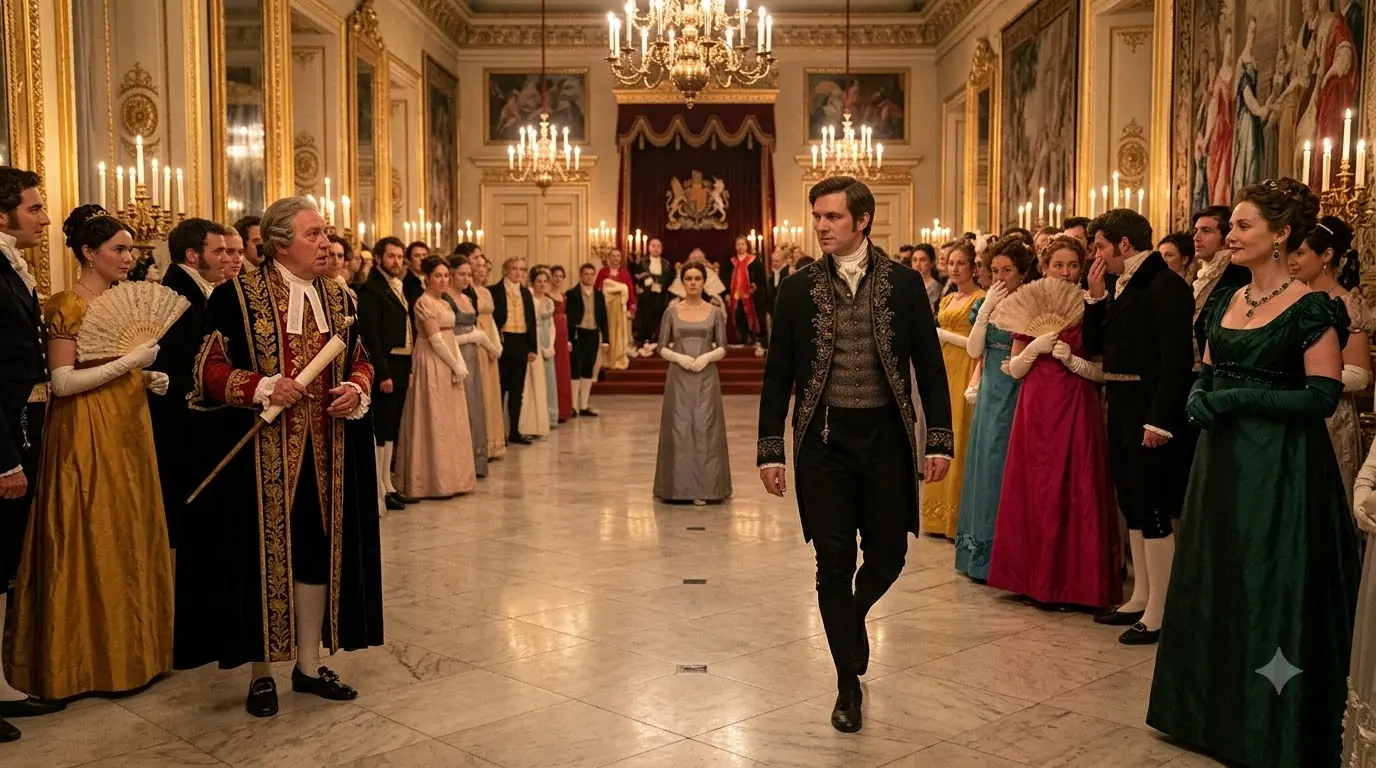
Isabel Fenwick, Duchess of Harrowfield, stood one pace behind her husband, holding her gloves. She had been told the pearls were too plain, that the gray silk made her look like a governess with ambitions, that it would be better for everyone if she said very little. She had said nothing at all.
"His Grace the Duke of Harfield?" the chamberlain read and lifted his eyes politely, the way a man does when he expects two people. "And her grace, the Duchess of—"
"My wife," said the Duke, "is not to be presented this evening."
He did not turn around when he said it. That was the part the room remembered afterward. He said it the way a man returns a dish at dinner. Somewhere behind them, a fan snapped shut, and the sound traveled further than it should have. The chamberlain hesitated exactly as long as courtesy allowed. Then his pen made a small black stroke through a line of writing, and Adrien Fenwick, 9th Duke of Harfield, walked forward alone into the light.
Isabel remained where she was. Nobody moved to speak to her. In that gallery, an unpresented woman was a hole in the air.
Lady Cassandra Vain drifted past on the arm of the Daaja Duchess, radiant in emeralds, and let her gaze travel over Isabel with the frank attention of a woman inspecting a chair she intends to have removed. "Don't stand so near the doors, my dear," Cassandra murmured. "People will think you're waiting for your carriage."
Isabelle did not weep. She did something stranger. She stepped out of the line, crossed to the wall beneath the tall windows, and opened the netted purse at her wrist. From it she drew a folded card, and held it unread against her palm. It was not a ball invitation. It was heavier than that and older, and it carried a seal in dark green wax that almost nobody in that gallery would have recognized.
But one man did. Halfway down the room, a gray-haired gentleman in a plain black coat, a man with ink on his fingers, who had no business standing so near the dais, and stood there anyway, glanced toward the windows, saw the green wax, and stopped as though someone had laid a hand on his chest. He looked at the card, then at the woman holding it, then at the empty space in the chamberlain's list where her name should have been. Then he turned and walked very quickly toward the throne.
Adrien Fenwick had spent 11 years believing he understood exactly what his wife was worth. He had another 20 minutes.
Now, let me take you back 3 years to a wet March in Lincolnshire and a marriage that began as a transaction. Harfield was drowning. Not dramatically. Estates rarely drown dramatically. The eighth Duke died, leaving 40,000 acres of Lincolnshire fen, a house with 91 rooms and debts quietly compounding since the regency began. His son inherited a title, a mother, and a bank in Lombard Street that had run out of patience.
6,000 of those acres were low ground. Black, rich, and underwater eight months of the year. The tenants called them the wash fields, and farmed the edges, the way men fish at the rim of a lake.
Adrien Fenwick was 31 when he became duke, and he was not a fool. He was something more dangerous, a proud man taught that his name was an argument. He tried the argument first. The bank was unmoved. So he did what men in his position had done for three centuries and looked for money in a marriage.
What he found was Isabel Gray. Her father, Thomas Gray, had been land agent to the Marquess of Wayburn for 26 years, and something rarer besides, one of that generation of practical Englishmen, who taught themselves engineering out of borrowed books, and drained 12,000 acres of Norfolk Marsh with catch drains and wind engines designed on the back of tithe maps. He had no title, a modest fortune, a stone house at Webburn, one daughter, and a reputation among a very small number of men who mattered enormously in the matter of English soil, and not at all in the matter of English society.
He had also taught his daughter everything. Isabelle had walked the Norfolk levels beside him from the age of nine, carrying the chain, learning to see water the way other girls learned to see lace. At 16, she kept his accounts. At 22, she was correcting his calculations, and he let her because he was more interested in being right than in being the one who was right. He died in the January before she married of a fever caught standing in a flooded ditch and left her £11,000, a house, and four crates of papers.
The Fenwicks wanted the £11,000. The Daaja Duchess Margarite negotiated the settlement herself over two afternoons in the Wayburn drawing room and made no pretense that she considered the arrangement anything but medicinal.
"You will find us civil," she told Isabelle, "you must not expect us to be delighted."
"I don't expect anything, madam," Isabelle said.
"That," said the daajger "is the most sensible thing anyone has said in this house."
They were married in April in the Harfield Chapel with 14 people present and no wedding breakfast worth the name. Adrienne was courteous the way a man is courteous to a physician who has come to set a bone. He said the words, kissed her hand rather than her mouth, and afterwards went out to look at the flooded south road because he could not bear to stand in that chapel a moment longer. He did not marry her out of cruelty. He married her because he was drowning too, and she was the rope, and he was ashamed of needing a rope. Shame is a slow poison. It works best in men raised to believe they are the ones who rescue.
Their wedding night was two glasses of wine and a conversation about the roof.
"You must find this a poor bargain," he said.
"I find it a clear one. That's better than most."