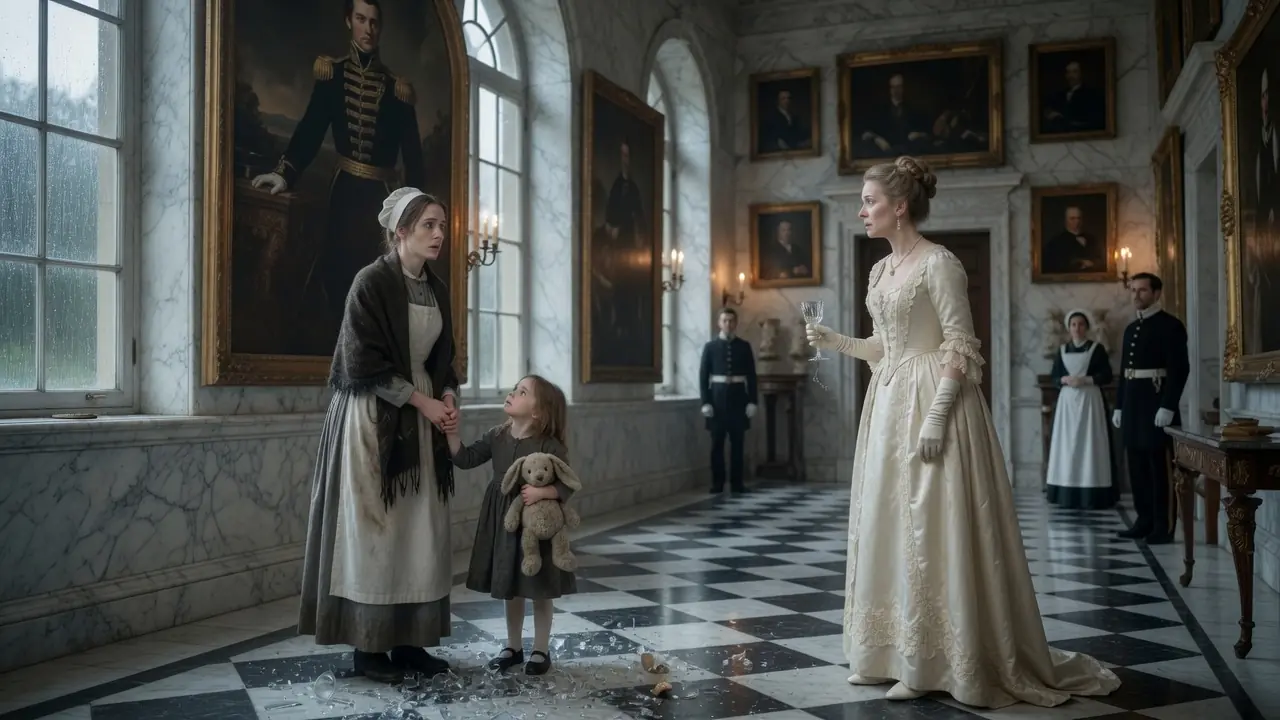
Lady Francis Waverly did not scream when the new housemaid stopped beneath the great family portrait.
She only turned, one gloved hand still resting upon the crystal glass she had been lifting, and looked down the length of the marble hall with the stillness of a woman long accustomed to being obeyed.
The maid’s child had slipped from her grasp first. A little girl of four, with untidy brown curls and a worn stuffed rabbit tucked beneath one arm, stared up at the gilded painting of the Duke of Ravensmere.
Then the mother spoke in a voice so soft it should not have carried, and yet it struck the hall like a pistol shot.
“My lady, why is my daughter’s father hanging in your portrait gallery?”
The glass shattered at Francis’s feet.
No one moved. Not the footmen at the far archway, not the trembling girl in plain servant’s gray, not the child who only tilted her head with solemn curiosity.
And in that innocent motion, she revealed the small dimple in her left cheek.
A Ravensmere dimple.
Francis felt the blood leave her face.
The man in the portrait wore black regimentals, silver braid, and the crimson sash of royal command.
His painted expression was every bit as cold as society believed him to be.
Julian Ashcombe, Duke of Ravensmere, feared in Parliament, desired in ballrooms, untouched by tenderness, if the ton were to be believed.
And yet the maid looked at that painted face as if she had once known the warmth beneath it.
Francis lowered her gaze to the young woman.
She was plainly dressed, though clean despite the road upon her hem. There was strain about her mouth, hunger in the sharpness of her cheeks, but not vulgarity, not calculation.
Only shock so deep it had made honesty leap out before caution could restrain it.
“What,” Francis said at last, each syllable precise as cut glass, “did you just say?”
The girl swallowed. Her eyes shone, but she held her ground.
“I said, my lady, that the gentleman in that portrait is the father of my child.”
Francis did not glance toward the servants who had gone rigid with fascination.
“Everyone out.”
They fled at once.
Within moments, the vast hall was emptied of all but the four of them: Francis, the maid, the child, and the painted duke who watched from his frame as though he had arranged this ruin himself.
“Come with me,” Francis said.
She turned without waiting.
The girl followed.
The morning room was smaller than the hall, though no less elegant. Pale green silk walls, a low fire, tall windows overlooking clipped yews and wet gravel paths silvered by recent rain.
Francis seated herself beside the hearth, every line of her posture composed.
She did not offer the maid a chair.
The maid sat anyway.
Francis noticed it at once.
Not insolence, exactly.
Desperation refined into courage.
The child remained standing beside her mother, clutching the rabbit and studying the room with grave, observant eyes.
“You have been in this house less than an hour,” Francis said, “yet you have already made a claim that could set this family ablaze. I advise you to understand what danger lies in falsehood.”
“It is not falsehood.”
“Proof is not the same as conviction.”
“No, my lady,” the girl said, voice steadier now, “but I have both memory and reason.”
Francis folded her hands.
“Your name?”
“Miss Eliza Hartwell.”
“And the child?”
“Clara.”
The name was spoken differently.
Softer.
Like prayer.
Francis studied her more closely.
“Begin at the beginning, Miss Hartwell. Omit nothing.”
Eliza drew one breath and obeyed.
She had been raised in a village two days east of London, daughter of a seamstress and a father too weak for loyalty.
She had worked since girlhood.
Four years earlier, she had been employed at a coaching inn on the Portsmouth Road, where one autumn, a gentleman traveling under the name of Mr. Teale had taken rooms for what was meant to be a single night.
He stayed six weeks.
“He said little at first,” Eliza said, “but he was kind in all the ways that matter most. He mended what was broken without being asked. He noticed when I was tired. He listened when I spoke, though no one of consequence had ever troubled to do so.”
Francis did not interrupt.
“He used his left hand for his glass,” Eliza continued quietly. “Always, even when it was inconvenient. And when he was deciding something difficult, he rubbed the back of his neck as though the truth sat there and troubled him.”
Francis’s fingers tightened once against the arm of her chair.
Julian had done both since boyhood.
Eliza went on.
A dawn departure. A promise to return.
No return at all.
Then the discovery, weeks later, that she carried his child.
Francis asked the next question before she could stop herself.
“How old is the girl?”
“Four years and three months.”
Francis turned to the child then, fully for the first time.
Clara stared back with unsettling calm.
Gray-blue eyes, not yet darkened with age or sorrow.
Julian’s eyes.
Julian’s stillness.
The room seemed to narrow around Francis’s breathing.
Julian was due back from the north in eleven days. Every old arrangement, every political expectation, every carefully managed future hanging upon his name, already unstable before this, now trembled over an abyss.
Francis rose.
“You will not repeat this to anyone in the household,” she said. “Not a syllable. You will remain in service until I decide otherwise. And tomorrow morning, Miss Hartwell, you will bring me every scrap of proof you possess.”
Eliza stood as well, one hand instinctively finding Clara’s shoulder.
“And if I do?” she asked.
Francis met her gaze.
“Then, before this month is out, the Duke of Ravensmere shall have to answer for the life he left behind.”
Eliza was shown into Lady Francis’s private sitting room before the rest of the house had fully stirred. Rain traced the windowpanes. A silver tray stood untouched between them.
Eliza laid her small bundle upon the table and unfolded it carefully, as though each object were made not of paper and brass, but of nerve.
A parish record naming Clara’s father only as Julian, no surname given.
A rough sketch Eliza had drawn from memory during the first winter after his disappearance.
And a dark brass button, worn at the edge, saved from the coat he had left hanging once upon the inn door.
Lady Francis examined each item in silence.
At last, she set down the sketch and asked, “Tell me something no portrait painter, no valet, and no court gossip would know.”
Eliza did not hesitate long.
“He could not sleep in overheated rooms,” she said. “Even in October, he opened the window before bed. He pretended it was for air, but it was habit. And when he read, he underlined only with the nail of his thumb, never with ink, as though he disliked leaving marks upon books.”
Lady Francis went still.
Julian had done that since Eton.
“He kept a faded blue ribbon in his coat pocket,” Eliza added softly. “He never explained it. I thought it must have belonged to someone he had once loved.”
For the first time, something unguarded crossed Francis’s face.
“It belonged to his sister,” she said before she could stop herself. “She died at twelve.”
Silence fell.
Not cold silence now.
A heavier one.
The silence of recognition.
Lady Francis rose and crossed to the escritoire near the window.
When she turned back, her expression was composed once more, but altered.
“You are to be reassigned,” she said. “The Duke’s apartments in the north wing have been closed since winter. You will clean them today, every room, every drawer left unlocked. If you find anything of note, you will bring it to me alone.”
Eliza understood at once this was no domestic duty.
It was permission or a test.
Perhaps both.
When she reached the north wing an hour later, the corridor was dim, lined with stern Ashcombe ancestors and shadowed gilt mirrors.
Mrs. Alden, the housekeeper, pressed a key into her hand without comment.
As the heavy lock turned, Eliza felt it, the strange tightening beneath her ribs.
She was no longer merely entering a duke’s rooms.
She was stepping into the secret half of a life that might once have been hers.
Dust lay untouched across the Duke’s apartments as though even time had been instructed not to intrude.
Eliza opened the tall windows first. Cold morning light poured in, revealing a life paused mid-thought.
Books left half withdrawn. A chair angled toward the hearth. A riding crop resting carelessly against the wall.
He had not left these rooms as a man who intended to abandon them.
He had been taken from them.
The thought settled quietly, dangerously.
Eliza moved with care, dusting, straightening, observing without seeming to observe.
Every object held weight now. Every detail spoke.
The outer sitting room was formal, polished, untouched.
But the study beyond was different.
The desk bore faint marks of use, a ring from a glass placed again and again in the same spot.
The wood was worn smooth where a left hand had rested over years of habit.
Her breath slowed.
She crossed the shelves and began her work there, one volume at a time.
Then her cloth caught on something tucked behind a row of ledgers.
A small leather journal.
Eliza froze.
For a long moment, she did not open it.
This was not curiosity.
This was trespass.
And yet her fingers tightened.
She opened it.
The handwriting struck her at once.
Not because she had seen it often, but because she had seen it once, and that had been enough.
A short note left on the end table.
Gone to market. Back before noon.
She had kept it until it fell apart.
This was the same hand.
Precise. Controlled.
But here, less guarded.
The pages spanned years. Eliza did not read fully. She could not.
It felt too intimate, too raw.
But her eyes caught fragments.
A line written harder than the rest. A page where the ink pressed too deeply.
A name.
Her name.
Appearing once, then again months later.
She closed the journal.
Her hands were steady, though she did not know how.
He had not forgotten.
The realization did not arrive as relief.
It arrived as something sharper.
Because if he had not forgotten, then he had been made to leave.
Eliza replaced the journal exactly where she had found it and stepped back from the shelf.
For a moment, she leaned against the desk, her eyes lifting toward the window.
The latch was worn smooth on the left side.
Always the left.
Her throat tightened.
Behind her, the door opened.
Eliza turned.
Lady Francis stood in the threshold.
She had not announced herself.
Her gaze moved once around the room, taking in the open window, the shifted books, the faint disturbance of a long-closed space.
Then it settled on Eliza.
“You found something,” she said quietly.
It was not a question.
Eliza hesitated only a fraction before answering.
“Yes, my lady.”
Lady Francis stepped inside, closing the door behind her with deliberate care.
“What was it?”
Eliza held her ground.
“A journal,” she said. “Hidden behind the ledgers.”
Francis’s expression did not change, but something beneath it did.
“Did you read it?”
“No.”
A pause.
Then, more honestly, “Not all of it.”
The silence stretched.
Lady Francis walked slowly to the desk. Her gloved fingers brushed the surface once, as though confirming something unseen.
“He writes when he cannot say things aloud,” she said almost to herself.
Then she turned back to Eliza.
“And what did you learn, Miss Hartwell?”
Eliza met her gaze.
“That he did not leave willingly.”
For the first time since their meeting, Lady Francis did not immediately respond.
Her composure held, but something in her eyes shifted.
Not shock.
Recognition.
Dangerous recognition.
“He returns sooner than expected,” she said at last.
Eliza’s breath caught.
“When?”
“Within days.”
The room seemed to tilt, not with fear, but with the sudden collapse of time she had believed she still possessed.
Lady Francis studied her carefully.
“You will not avoid him,” she said. “Nor will you seek him out. You will remain exactly where you were placed.”
Eliza nodded slowly.
“And the child?” Francis added.
Eliza’s voice softened.
“She is with a neighbor in the village.”
“Bring her here.”
The command was quiet, but absolute.
Eliza stilled.
“My lady?”
“If what you say is true,” Francis said, her voice lowering into something colder, more deliberate, “then the truth must not arrive half-formed.”
She stepped closer.
“When Julian Ashcombe walks through those doors, he will not be given time to doubt what stands before him.”
Eliza’s heart struck hard against her ribs.
Lady Francis held her gaze.
“Bring the child,” she repeated.
Then she turned and left the room without another word.
Eliza remained where she was, the quiet study pressing in around her.
Days, not weeks.
Days.
She looked once more toward the shelf where the journal lay hidden.
He had not forgotten.
And now he was coming back.
Clara arrived at Ravensmere under a sky the color of steel. The carriage wheels had scarcely stilled upon the gravel before Eliza was at the side gate, her breath unsteady, her hands trembling despite all her effort to quiet them.
Then the door opened, and Clara ran to her.
“Mama.”
Eliza dropped to her knees and gathered her close, pressing her face into the child’s hair as though anchoring herself to something certain at last.
The familiar scent of soap and sun-warmed linen steadied her in a way nothing else could.
“You came so quickly,” Eliza murmured.
“I always come quickly,” Clara said with grave importance, as though it were a personal virtue.
Behind her, Mrs. Renwick, the neighbor who had kept the child, offered a small nod and no questions.
She understood, as sensible women often did, when silence was the greater kindness.
Within minutes, Clara was installed in the small guest cottage on the southern edge of the estate, an arrangement Lady Francis had ordered without explanation.
The child stood in the center of the room, turning slowly.
“It is very large,” she said.
“It is,” Eliza replied.
“Does someone important live here?”
Eliza hesitated.
“Yes,” she said at last. “Someone very important.”
Clara considered this, then nodded as though filing it away for later judgment.
They had scarcely settled when a knock came upon the door.
Lady Francis entered without escort.
She was dressed more simply than Eliza had yet seen her, no jewels, no elaborate adornment, yet her presence filled the small cottage as completely as it did the great hall.
Her eyes found Clara at once.
The child did not shrink.
She stood still, her stuffed rabbit tucked beneath her arm, and regarded the lady of the house with the same quiet, unwavering attention she gave all new arrivals.
Lady Francis crossed the room slowly.
Then, with deliberate care, she lowered herself to the child’s height.
It was not a gesture of softness.
It was a decision.
Clara tilted her head, that small, unconscious turn.
And there it was again.
The dimple.
The Ashcombe dimple.
Lady Francis drew in a breath so slight it might have gone unheard had the room not been so very still.
For a moment, her hand lifted as though to touch the child’s cheek.
She stopped herself.
Clara, having completed her assessment, held out the rabbit.
“This is Biscuit,” she said. “She is very old.”
Lady Francis looked at the toy.
Then, slowly, she accepted it.
“I see that she is well cared for,” she said.
“I look after her,” Clara replied.
“I do not doubt it.”
The words were quiet, but something in them had changed.
Lady Francis rose and turned to Eliza.
When she spoke again, her voice had lost none of its control, but the blade within it had shifted.
“He returns this week,” she said.
Eliza stilled.
“This week?” she repeated.
“Yes. Not days. Not time to prepare. Soon.”
“Everything that follows,” Lady Francis continued, “will depend upon what occurs when he sees her.”
Her gaze flickered, just once, toward Clara.
“Do you understand the weight of that?”
Eliza’s fingers tightened at her sides.
“I do.”
Lady Francis studied her for a long moment.
Then, more quietly, “There is something you have not yet asked.”
Eliza’s brow furrowed.
“My lady?”
Francis’s eyes moved toward the window, toward the distant rise of the main house beyond the gardens.
“He was not free to choose when he left you,” she said. “But neither was I.”
The words settled between them like something long buried.
Eliza felt it then, that there was more to this than a father’s interference, more than a broken promise.
A deeper arrangement.
A design.
Before she could speak, Lady Francis continued.
“There were expectations placed upon him. Alliances carefully negotiated. Futures already decided.”
Her gaze returned to Eliza, steady and unflinching.
“And I was at the center of them.”
The meaning struck slowly.
Then all at once.
Eliza’s breath caught.
“You?” she began, but the words would not fully form.
Lady Francis did not look away.
“I am his betrothed.”
The cottage seemed to shrink.
The air thinned.
Eliza felt the ground shift beneath her, not with surprise alone, but with the cruel clarity of it.
The woman who had questioned her, tested her, decided her fate, was the woman Julian Ashcombe was meant to marry.
Behind them, Clara had settled upon the floor, arranging her rabbit and humming softly to herself, untouched by the storm gathering above her small, certain world.
Lady Francis spoke again, her voice lower now.
“That arrangement was not his choosing.”
Nor, Eliza understood, was it hers.
“But it remains unfinished.”
Silence stretched between them.
Two women bound not by friendship nor by rivalry, but by a man who had belonged fully to neither.
And now, perhaps, to both in ways society would not permit.
“When he arrives,” Lady Francis said at last, “you will be present.”
Eliza lifted her chin.
“I would not hide.”
A flicker of approval, perhaps, passed through Francis’s eyes.
“Good.”
She moved toward the door, then paused.
“And Miss Hartwell?”
Eliza looked up.
“For your sake,” Francis said quietly, “I hope he looks at you first.”
The door closed behind her.
Eliza stood very still in the center of the cottage.
Her daughter hummed softly at her feet, and somewhere beyond the gardens, beyond the hedges trimmed into unnatural perfection, the road curved toward Ravensmere, bringing with it a duke who did not yet know that the life waiting for him would demand everything.
He arrived without announcement.
No herald. No letter sent ahead. No formal procession to prepare the house for its master’s return.
Only the sudden grind of carriage wheels upon gravel, and the way the entire estate seemed to draw breath and hold it.
Eliza felt it before she heard it.
A shift in the air, a tension that moved through walls and corridors like a warning.
She was standing near the cottage window when the sound reached her.
Clara looked up from the floor.
“Someone has come,” she said.
Eliza’s throat tightened.
“Yes.”
She did not move.
She could not.
All the careful composure she had built over the past days, the measured breaths, the rehearsed calm, unraveled in an instant.
Then, footsteps on the gravel.
Not hurried. Not uncertain.
A man who had never needed to rush toward anything.
A knock sounded at the door.
Not loud. Not hesitant.
Certain.
Eliza crossed the room and opened it.
For a moment, she did not recognize him.
Not because he had changed beyond knowing, but because memory had softened him, and reality had not.
Julian Ashcombe stood before her in dark traveling clothes.
The dust of the road still clung to his coat. His hair was slightly longer than fashion preferred, his jaw tighter.
His eyes, those gray-blue eyes, found her at once and did not move.
Everything else fell away.
The years.
The silence.
The unanswered questions.
There was only that look, as if he were seeing something he had once lost and had been told never existed at all.
“Eliza,” he said.
Her name spoken low, careful, as though it might break.
She did not answer.
Behind her, Clara shifted.
The small scrape of chair legs across the floor.
Julian’s gaze moved slowly, unwillingly, past Eliza’s shoulder to the child.
Clara had turned in her seat.
She regarded him with composed curiosity, one hand resting upon the table, the other holding her rabbit.
Julian went very still.
It was not shock that crossed his face, not at first.
It was recognition.
Deep. Immediate. Unmistakable.
Clara tilted her head, that small instinctive motion, and the dimple appeared.
His breath left him.
Not sharply. Not dramatically.
Quietly, as though something held tight within his chest for years had finally loosened.
“My God,” he murmured.
Eliza stepped aside.
She did not invite him in, but she did not bar him, either.
Julian entered slowly, as though the threshold itself required permission.
The cottage seemed too small for him.
Too fragile.
He removed his gloves, but not his coat.
His hands remained at his sides, controlled, but not steady.
Clara watched him.
Then, with perfect seriousness, she said, “You are looking at me.”
A faint, disbelieving sound escaped him.
“Yes.”
“Why?”
The question was simple.
The answer was not.
Julian’s gaze flickered once to Eliza, then back to the child.
“Because,” he said carefully, “I think I have been waiting to.”
Clara considered this, then nodded as though it were a reasonable explanation.
She turned back to her drawing.
The moment broke, but not entirely.
Julian crossed the room and sat in the chair near the hearth.
He did not take his eyes off her.
“I was told you had gone,” he said at last.
His voice was controlled, but something beneath it strained.
“I was told you had left the village, that you had chosen another life.”
Eliza folded her hands.
“I remained for two months after you left,” she said. “I did not go anywhere.”
Silence.
Something hardened in his expression.
“Then he lied.”
“Who?”
“My father’s steward, Hartwell.”
The name landed between them like a weight.
“I was summoned back to Ravensmere under false urgency,” Julian continued. “By the time I returned, everything had been arranged, every path closed, every question answered for me.”
Eliza’s voice was steady.
“And you believed it?”
His jaw tightened.
“I tried not to.”
A pause.
“I searched,” he said more quietly. “When I could, without permission, without help. But I had only your name and a village that no longer spoke of you.”
Eliza thought of the years she had waited, of the silence, of the child she had raised alone.
“You stopped,” she said.
Julian did not deny it.
“Yes.”
The truth of it settled heavily between them.
Behind them, Clara began humming softly to herself, absorbed once more in her world.
Julian’s gaze shifted again.
He watched her, longer this time, more carefully.
“Then how old is she?” he asked.
Eliza held his eyes.
“Four years.”
Another silence.
“And her name?”
“Eliza,” Clara said suddenly, without looking up. “You have not told him.”
Julian blinked.
The smallest flicker of something, something almost like astonishment, passed across his face.
Eliza’s voice softened despite herself.
“Clara.”
He repeated it under his breath.
“Clara.”
As though committing it to something deeper than memory.
The fire cracked softly behind him.
Outside, the estate stood vast and watching.
Inside, three lives sat in a fragile alignment that could not yet hold its own weight.
Julian leaned forward slightly, his hands clasped together, and for the first time, there was no duke in his posture.
Only a man standing at the edge of something he could not yet claim.
“I need to know,” he said quietly.
Eliza did not look away.
“What is it you think you need to know?”
His voice dropped.
“Whether I have come too late.”
The question lingered.
Not answered.
Not dismissed.
Only felt.
The storm broke that evening.
Not in the sky, but in the grand ballroom of Ravensmere.
Lady Francis had ordered a private gathering.
No orchestra. No dancing.
Only a handful of carefully chosen guests, relations, advisors, those whose opinions shaped the quiet machinery of aristocratic power.
Candles burned in tall crystal stands, their light trembling across polished floors and painted ceilings.
Eliza stood near the far wall.
She did not belong in such a room.
Every whisper confirmed it.
The maid brought into the house.
Quite improper.
And the Duke returning early.
The words moved like silk-wrapped knives.
Clara sat beside her on a cushioned chair, her small feet not reaching the floor, her rabbit in her lap.
She watched everything with solemn attention, untouched by the venom she could not yet understand.
Eliza felt every glance.
Every judgment.
But she did not move.
At the far end of the room, Julian stood beside Lady Francis.
They had not touched.
Not once.
But the distance between them was not distance at all.
It was history.
Expectation.
A future that had been written long before Eliza had ever existed within it.
Francis spoke first. Her voice did not rise, yet the room stilled at once.
“The purpose of this gathering,” she said, “is to address a matter that concerns the integrity of the Ravensmere name.”
Eyes turned.
Toward Eliza.
Toward the child.
Toward the Duke.
Julian did not step forward.
Not yet.
Francis continued.
“There are those who believe that lineage must remain unchallenged, that certain truths, when inconvenient, are best dismissed.”
A pause.
“Then I do not share that belief.”
A ripple of unease passed through the room.
Julian’s gaze shifted briefly to her.
Something unspoken moved between them.
Then Francis turned, not to him, but to Eliza.
“Miss Hartwell,” she said, “bring the child forward.”
Eliza’s heart struck hard.
This was no longer private.
This was exposure.
But she took Clara’s hand and walked.
Each step echoed.
Each breath measured.
When they reached the center of the room, Clara looked up at her.
“Are we in trouble?” she asked softly.
Eliza bent slightly.
“No,” she said. “We are being seen.”
Clara considered that, then nodded.
Julian stepped forward at last.
The room held its breath.
He looked at the child, not briefly, not cautiously, but fully, as though allowing himself no distance at all.
Clara looked back.
Then, slowly, she tilted her head.
That small, unguarded gesture.
The candlelight caught her cheek.
The dimple appeared.
A murmur spread through the room.
Julian did not react to them.
He only knelt.
A duke kneeling on polished ballroom floors before a child.
“Clara,” he said quietly.
She blinked.
“You know my name.”
“Yes.”
“How?”
His voice softened.
“Because I should have known it long ago.”
She considered this with careful seriousness.
“Then are you my father?” she asked.
No hesitation. No fear.
Only truth.
The room seemed to tilt.
Julian did not look away.
“Yes,” he said.
The word did not echo.
It settled.
Heavy.
Irreversible.
A collective breath moved through the room.
Shock. Disbelief. Calculation.
Julian rose slowly.
He turned not to the guests, but to Lady Francis.
For a moment, neither spoke.
“Then I will not deny her,” he said.
His voice carried now.
Not raised, but absolute.
“I will not deny either of them.”
Silence.
Francis held his gaze, and something in her expression, something long restrained, shifted.
“You understand what this means?” she said.
“Yes.”
“You understand what you lose?”
His answer came without pause.
“I understand what I have already lost.”
A flicker.
Pain.
Recognition.
Francis looked toward Eliza, then to Clara, then back to Julian.
The room waited for scandal, for refusal, for preservation of order.
Instead, Lady Francis stepped aside.
The movement was small, but it changed everything.
“You will do as you believe is right,” she said quietly, “but you will do it fully.”
Julian inclined his head once.
Not as a duke.
As a man receiving permission he had not expected.
He turned back to Eliza.
Their eyes met across the space.
No grand declaration. No sudden resolution.
Only the truth, finally standing where it could not be hidden.
And yet the room had not finished with them.
A voice cut through the silence.
“Your Grace,” one of the older men said sharply, “you cannot possibly intend—”
Julian turned slowly.
The full weight of his title settled back into place, not as a shield, but as a weapon.
“I intend,” he said, “to decide my own life.”
The man faltered, but the tension did not break.
It sharpened.
Because what Julian had claimed, he had not yet secured.
And what he stood to lose had not yet been taken from him.
Eliza felt it.
The storm had not passed.
It had only begun.
The following morning, Ravensmere woke to silence.
Not the peaceful silence of routine, but the strained, watchful quiet of a house that understood something irreversible had occurred within its walls.
No one spoke openly of the ballroom, but everyone knew.
Eliza stood by the cottage window, Clara beside her, watching the frost settle across the gardens.
“He said it in front of everyone,” Clara murmured, as though testing the memory.
“Yes,” Eliza said softly.
“Does that mean it is true now?”
Eliza hesitated.
“Then it means he chose it to be true.”
Clara seemed satisfied with that.
Behind them, the door opened.
Julian entered without ceremony.
He had not slept. It showed in the sharpness of his jaw, in the quiet tension beneath his composure.
But his eyes, those steady gray-blue eyes, went first to Clara, always to Clara, then to Eliza.
“There will be consequences,” he said, not as warning, but as fact.
Eliza nodded.
“I expected nothing less.”
He crossed the room slowly.
“I have received letters already,” he continued, “from London, from my family, from men who believe they have authority over my decisions.”
A faint, humorless breath left him.
“They are mistaken.”
Eliza studied him carefully.
“And what will you do?”
He met her gaze.
“What I should have done four years ago.”
A pause.
“Choose without permission.”
The words settled between them.
Simple, but they carried the weight of everything that had been denied before.
Clara slipped her hand into his.
Not uncertain. Not hesitant.
As though she had already decided.
Julian looked down at her small fingers wrapped around his own.
Something in him shifted.
Not breaking, but softening in a way that made strength feel different.
He turned back to Eliza.
“There is more,” he said.
Her breath stilled.
“I have begun proceedings to relinquish the title.”
The room fell quiet.
Even Clara looked up.
Eliza stared at him.
“You would give it up?”
“I would give up anything that demands I deny them.”
His gaze moved first to Clara, then back to her.
“I was raised to believe duty was everything. That legacy mattered more than life itself.”
A small, bitter edge touched his voice.
“But legacy is nothing if it requires you to live a lie.”
Eliza’s chest tightened.
“This will not be simple,” she said.
“No,” he agreed. “It will not.”
There would be resistance. Political maneuvering. Whispers that would not fade. Doors that would close.
But he did not look uncertain.
Only decided.
Behind them, footsteps approached.
Lady Francis entered.
She had not come in silk or jewels, only in quiet authority.
Her gaze moved first to Julian, then to Clara, and finally to Eliza.
“I have been informed of your decision,” she said.
Julian inclined his head.
“I expected you would be.”
A pause.
Then Francis stepped further into the room.
“You are dismantling generations of expectation,” she said.
“Yes.”
“And for what?”
Julian did not hesitate.
“For something that is mine.”
The answer did not waver.
Francis studied him.
Long.
Carefully.
Then her gaze shifted to Clara.
The child looked back at her, serious as ever.
After a moment, Clara held out her rabbit.
An offering.
Uncomplicated.
Francis looked at it.
Then slowly, she accepted it.
Something in her expression changed.
Not warmth.
Not quite.
But something no longer guarded.
“You have made your choice,” she said at last.
Then, more quietly, “So now I shall make mine.”
Eliza felt the weight of those words before they fully landed.
Francis turned to her.
“You will not leave this estate as a servant,” she said.
Eliza stilled.
“You will leave it under protection.”
A pause.
“And with your dignity intact.”
Julian’s gaze flickered surprise, but not questioning.
Francis continued.
“The world will speak,” she said. “It always does. But it will not decide the outcome of this matter.”
Her voice lowered.
“I will see to that.”
Silence followed.
Not empty, but full of something newly formed.
Not alliance, not forgiveness, something more complex.
And perhaps stronger for it.
Outside, the frost began to melt under the pale morning sun.
Inside, the shape of their future stood uncertain, but chosen.
Clara climbed into Julian’s lap without asking permission.
He did not hesitate.
He held her as though learning the shape of something he had been missing all his life.
Eliza watched them.
Not with disbelief.
Not with fear.
But with a quiet, steady understanding.
This would not be easy.
There would be days that tested them, conversations that reopened old wounds, a world that would not forget what they had defied.
But for the first time, nothing about this felt unfinished.
Julian looked up at her.
No titles. No distance.
Only truth.
“I am not too late,” he said quietly.
Eliza met his gaze.
“No,” she answered. “You are exactly where you should have been.”
The fire burned steadily.
The cottage, once temporary, now held something far more permanent.
Not perfection.
Not ease.
But choice.
And that was enough.