The dog would not stop barking at the fence. Duke Weston Hale stood at his bedroom window at 5:00 in the morning, watching Bramble claw at the old iron gate near the tree line. This was the fourth night in a row. The hound had never acted this way before, not once in 8 years, not even during storms.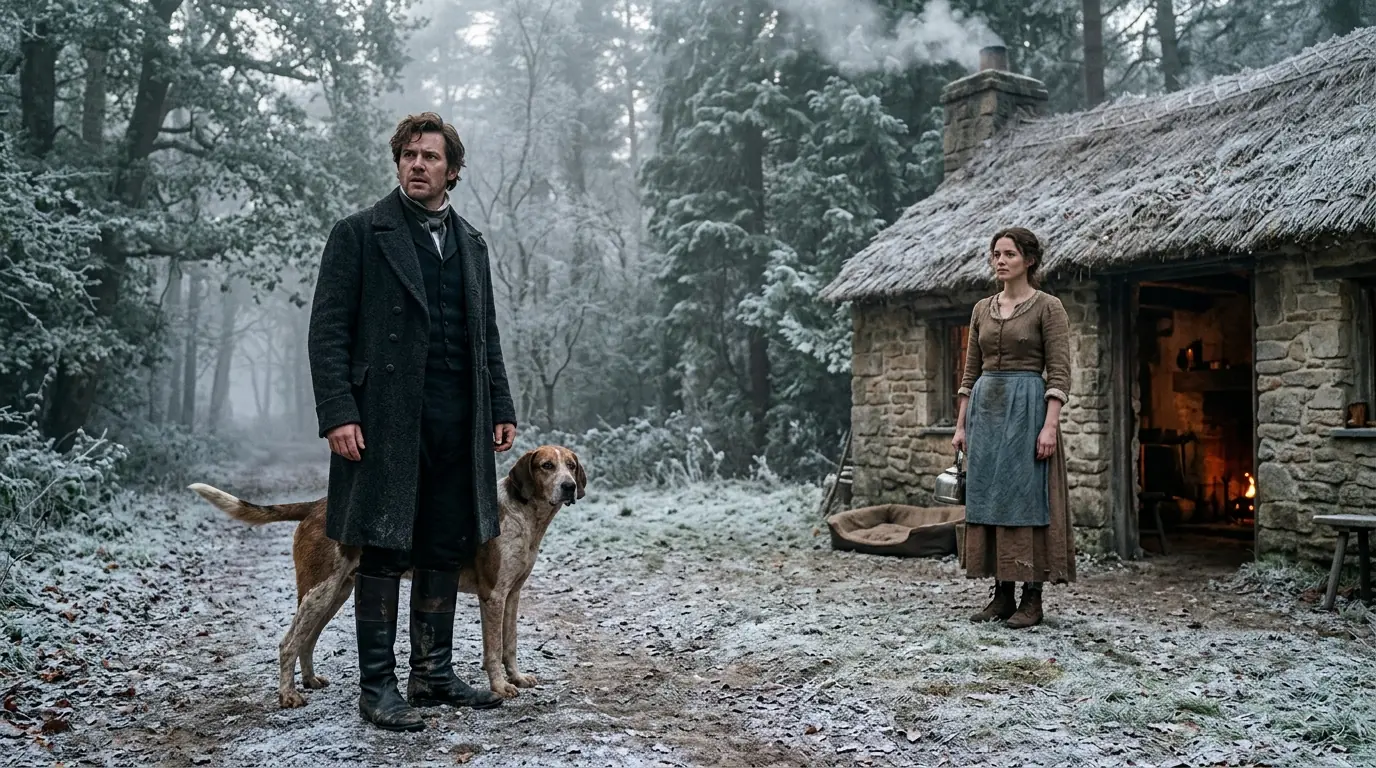
Weston pulled on his boots without thinking and walked out into the cold, his breath rising in thin clouds ahead of him. The estate around him was silent except for the dog. Frost covered the grass. The manor behind him held 40 rooms and not one person awake inside it. His wife, Eleanor, had died 11 months earlier, and since then the house had felt larger every single day, as if the walls kept stepping backward from him.
Bramble scratched at the gate again, whining low in his throat. Weston reached the fence and studied it closely. Rust covered every hinge, yet the latch moved easily under his hand, far too easily for something meant to have stayed shut for two generations. Someone had opened this gate recently. Someone had walked this path before him.
He looked back once at the sleeping house, then pushed the gate open and stepped through. The trees on the other side grew close together, planted in tight deliberate rows that no wild forest would ever form naturally. His grandfather had planted these. He remembered now, decades ago, calling it a boundary line, never explaining what it was meant to keep out or keep in. Weston had walked past this fence his entire life and never once asked why it existed. Nobody had.
Bramble ran ahead, tail low, nose to the ground, moving with a purpose Weston had never seen in him. Branches caught at his coat sleeves. The air grew colder under the canopy, and the manor lights disappeared behind him within a few dozen steps, swallowed by the dark wood as if they had never been there at all.
He followed the dog for nearly 10 minutes, his boots sinking into wet earth, his mind turning over quiet, uneasy questions. Why plant a private forest inside your own land? Why fence it off from the family that owned it?
Then the trees opened into a clearing, and Weston stopped walking. A thin line of smoke rose from somewhere ahead, gray against the dark sky, curling upward from a chimney he did not know existed. Bramble was already sitting at the edge of the clearing, tail wagging now, calm, as though he had finally arrived somewhere he had been trying to reach for weeks.
Weston stared at the smoke for a long moment, his heart beating harder than the short walk should have caused. Someone lived out here. Someone had been living on his land, hidden behind a fence his own family built, and nobody had ever told him. He took a slow breath, steadied himself, and stepped forward into the clearing, toward whatever waited for him inside that small stone cottage glowing faintly in the early morning light.
The cottage door opened before Weston could knock. A woman stood in the frame, her sleeves rolled to the elbow, a kettle in her hand as though she had been expecting a visitor all along. She looked to be in her 30s, with dark hair pulled back and dirt still under her fingernails from early morning work. She did not look surprised to see him. She did not look afraid, either.
"You took longer than I thought you would," she said.
Weston stood frozen at the edge of her small garden. "Who are you?" he asked. "Why are you living on my land?"
"My name is Nell," she answered simply. "And this stopped being just your land a long time ago, even if nobody told you that."
She stepped aside and gestured for him to come in, as if this conversation had been arranged weeks ago rather than beginning that very second. Bramble trotted past her legs and settled by the fireplace, comfortable, familiar, clearly not a stranger to this cottage at all. Weston noticed a worn dog bed near the hearth and his stomach tightened. His own dog had a second home he knew nothing about.
Inside the cottage was small but lived in fully. Shelves lined with books, a single chair by the window, herbs drying above the stove. Nothing about it looked temporary.
"How long have you been here?" Weston asked, his voice quieter now.
"11 months," Nell said, "since shortly after your wife passed."
The name landed heavier than Weston expected. He lowered himself into the chair without being asked, his legs suddenly unwilling to hold him standing any longer.
"Eleanor knew you were here," he said. It was not a question.
Nell nodded once. "She's the reason I came at all. Your solicitor knows, too. So does your wife's sister. I assumed, given time, someone would tell you. Nobody did."
Weston stared at the fire, at his own dog resting there so easily, at a woman he had never met who apparently knew more about his wife's final months than he did. Anger rose first, sharp and immediate, but underneath it something colder settled into his chest, something closer to grief returning in a new shape he did not recognize.
"Why?" he asked simply. "Why were you hiding out here?"
Nell set the kettle down and looked at him directly, her expression steady, careful, as though she had rehearsed this moment many times without ever expecting to actually need it.
"Because your wife asked me to wait," she said. "She wanted to tell you herself. She ran out of time before she could."
The fire cracked in the silence that followed. Weston did not move. He simply sat there, staring at a woman living secretly inside his own inherited land, waiting for whatever came next.
Nell disappeared into the back room and returned carrying a small wooden box, its corners worn smooth from years of handling. She placed it gently on the table between them, as though it weighed far more than its size suggested.
"These are hers," she said. "Your wife's. She wrote them during her last year when she was still strong enough to hold a pen."
Weston opened the lid slowly. Inside sat a stack of letters tied with faded ribbon, each one addressed simply to Nell, dated across months he remembered as some of the hardest of his life, months he had spent sitting beside a hospital bed, watching Eleanora grow thinner each week.
He unfolded the first letter, and Eleanora's handwriting hit him instantly, familiar and sharp, like hearing her voice again after a long silence. The letter spoke of a daughter given up at 19 before Weston had ever known her, a choice made under pressure from a family that valued reputation over everything else. It spoke of years of silence, guilt carried quietly, and a final decision to reach out before it became too late to try.
Weston read the words twice before looking up. "You are her daughter," he said slowly, testing the sentence as though it might collapse under its own weight.
Nell nodded. "I found her again 2 years ago. We wrote for months before I ever came here. She wanted me close before the end. She wanted to tell you the truth herself in person. When she felt ready."