The word crossed the table like a stone dropped into still water, and every conversation, every clink of silver, every murmur about the weather and the roads and the early promise of the harvest ceased at once. Kit had said it clearly, not mumbled, not half-formed the way small children sometimes try words and abandon them. He had looked across the white linen and the arrangement of late peonies and the four tall candles in their silver branches, and he had said it to Genevieve Astley with the plain confidence of a child who has never been taught to doubt what he knows.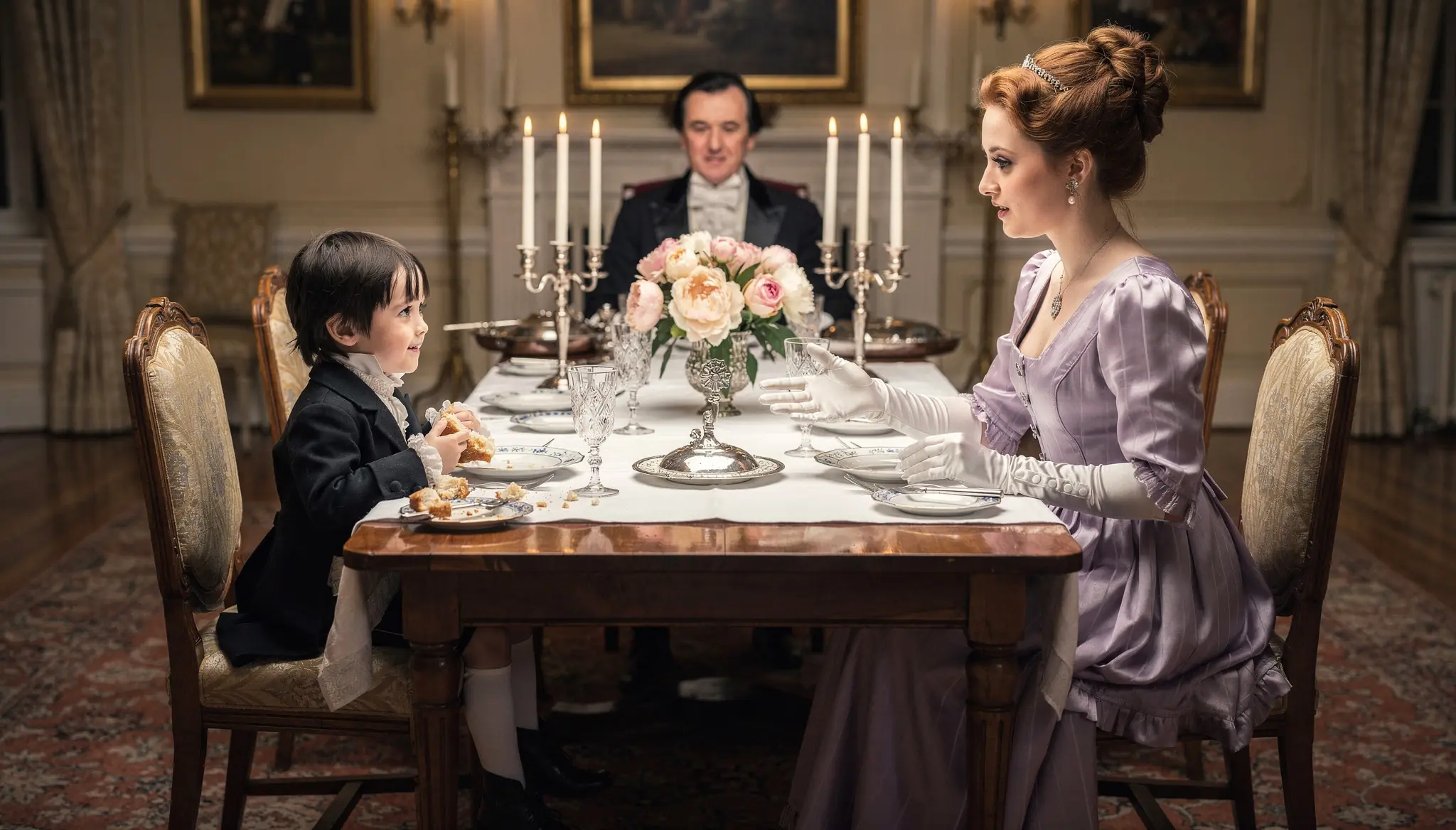
“Mama.”
Twelve guests heard it. Lord Selwyn, who had been mid-sentence about a motion before the House of Lords, set his wine glass down without finishing the thought. Mrs. Elwood, standing near the serving door, pressed her hands together beneath her apron. Lady Sefton, seated directly opposite Genevieve with a strand of pearls at her throat and her daughter's gray eyes watching from behind her own, did not move at all. And the Duke of Allerdale, at the head of the table, looked at no one but Genevieve.
She had not expected it. That much was visible in the way her gloved hand paused above the stem of her glass, the way her lips parted without sound, the way the candlelight caught the sudden brightness at the edges of her eyes. She wore pale lavender silk that evening, a color she had chosen without knowing it was the same shade Isabel had worn to her last dinner in this room, and her long gloves were ivory, buttoned to the elbow in the fashion of the season, and she sat very still as the silence thickened around her. Kit was not troubled by the silence. He was four years old and had been brought down to the dining room for the first quarter hour of the meal, as was done occasionally in houses such as these.
The child was presented to the guests, admired briefly, and returned to the nursery before the second course. He wore a miniature tailcoat that Mrs. Elwood had pressed that afternoon, and his dark hair had been combed severely to one side, and he'd been very good sitting on the cushioned chair that Osborne had placed beside his father, eating his bread roll in careful pieces, exactly as Mrs. Elwood had taught him. He had said good evening to every guest and bowed correctly, and answered Lord Selwyn's question about his pony with a solemnity that had made the whole table smile. And then he had looked across the table at Genevieve and said the word that changed the shape of the evening, and as it happened, the shape of everything that followed.
To understand why, it is necessary to go back seven months. Isabel Caulfield had died in the November of the year before last, a fever that arrived without warning and ended in four days, taking with it a woman of twenty-six who'd been perfectly well the previous Sunday. The household had moved through the shock and into the long gray aftermath, and the Duke had done what men of his position and temperament do when grief exceeds the language available to contain it. He had retreated.
Not dramatically.
Not with any display that might have invited sympathy or talk. He had simply stopped. Stopped entertaining. Stopped accepting invitations. Stopped attending the House of Lords, where his seat had been occupied every session since he had inherited the title at twenty-two.
The boy had been two when Isabel died. Old enough to look for her, young enough that the looking had gradually faded into something Mrs. Elwood could manage with routine and warmth, and the particular, steady presence that she provided without ever being asked. The Duke saw Kit each morning and each evening. He read to him. He walked with him to the stables and lifted him onto the fence to watch the horses.
But there was a quality to these encounters that even Mrs. Elwood, who had known the Duke since he was a boy himself, found difficult to name. As though he were performing the duties of fatherhood from behind a pane of glass, present in every observable respect, and yet not quite touching any of it. Lady Sefton came monthly. She arrived from her house in Surrey in a carriage that was always the same shade of deep green. And she spent two days with Kit, and she brought him gifts, wooden soldiers, a painted drum, a book about the constellations that he was too young to read but liked for the illustrations, and she held him on her lap and told him about his mother.
How Isabel had loved the garden, how she had played the pianoforte beautifully but sang terribly and had known it and laughed about it. How she had once beaten the Earl of Sefton at chess three times in a single afternoon and never mentioned it again. Lady Sefton performed this work with the discipline of someone who understood that memory, left unattended, dies a second death.
And she would not permit it.
Not for Kit.
She owed Isabel that, and she paid the debt every month without fail. The Duke bore these visits with courtesy that bordered on gratitude. He understood what Lady Sefton was doing and why, and he did not interfere. And when she left, he stood on the front steps and thanked her and watched her carriage down the drive, and then he returned to his study and closed the door. Genevieve arrived in their lives without announcement or design.
Her father, Sir Cedric Astley, held a modest baronetcy and an estate that bordered the Duke's land to the east, a property of comfortable size, well-managed with a trout stream and an orchard and a library that was better stocked than its shelves could comfortably hold. Genevieve was his only surviving child, twenty-three, unmarried not from any deficiency of person or character, but from the particular circumstance of having nursed her mother through a long illness and emerged from it at an age when most of the men her family might have introduced her to had already married someone else. She did not appear to regard this as a tragedy. She rode well, read widely, managed her father's household with a competence that the neighboring families regarded as slightly intimidating, and had a manner so direct and so entirely free of artifice that she was considered by the sort of women who measured such things to be lacking in feminine refinement.
She had encountered Kit first, not the Duke. It had happened in the lane that ran between the two properties, a path bordered by hawthorn and used mainly by the tenants of both estates. Kit had been walking with Mrs. Elwood, who had stopped to speak to a tenant's wife, and Kit had wandered ahead and found Genevieve sitting on the stone wall reading a book. He had asked her what it was about. She had told him.
He had asked if the story had a horse in it. She had said it did not, but that she knew one that did, and she had described it to him with such vividness, the horse black, the rider lost, the forest dark and full of sounds, that by the time Mrs. Elwood caught up, Kit was sitting beside Genevieve on the wall with his legs swinging and his face turned up toward hers with the absolute attention that children reserve for the people they have decided to trust. Mrs. Elwood had noted it and said nothing.
It happened again a week later.
Then again.
Then it became a pattern that neither woman discussed but both understood. Genevieve would be in the lane or in the meadow beyond the orchard or walking back from the village with a basket of books she had ordered, and Kit would appear with Mrs. Elwood, and the hour would pass in conversation that ranged from horses to stars to whether frogs could swim. Kit's position was that they could not and should not, a position Genevieve debated with a seriousness that Mrs. Elwood found both absurd and deeply moving. The Duke learned about it from Osborne, who mentioned it in the course of a land matter. Miss Astley had been seen frequently near the eastern boundary, and Osborne had added with the measured neutrality of a steward who knows what he is doing, that young master Kit appeared very fond of the lady.
The Duke had said nothing.
But the following Sunday, standing at the window of the upstairs gallery that overlooked the eastern path, he had seen them. Genevieve on the low stone wall, Kit beside her, their heads bent together over something she was showing him, a leaf, a feather, some small piece of the natural world that she had found and judged worthy of a four-year-old's attention. The boy was laughing. Not the careful, well-behaved laughter he produced for guests, but the helpless sort, the kind that comes from the stomach, the kind that the Duke had not heard from him since before November. He had watched for a long time, and then he had turned from the window and walked down the corridor and into his study, and sat at his desk for nearly an hour without opening a single document.
Over the months that followed, the acquaintance was permitted to develop with a care so deliberate it might have been choreographed. The Duke called on Sir Cedric about a shared fence line. Sir Cedric invited the Duke to shoot in September. The Duke invited Sir Cedric to dinner, and Genevieve came with him, and she sat at the long table in the dining room where Isabel's portrait still hung above the mantelpiece, and ate her meal with a composure that the Duke watched from the far end of the table without once being seen to watch.
Kit was not present at that dinner.
But afterward, in the drawing room, the Duke had mentioned, with a sort of careful casualness that deceives no one, that Kit spoke of Miss Astley often. Genevieve had colored slightly. "He is a remarkable child," she said.
"I am very fond of him." "He is fond of you," the Duke replied, and left it there. And the silence between them had held something that neither addressed, and neither forgot. By the spring, Genevieve was visiting Allerdale Park openly, invited by the Duke, received by Mrs. Elwood, attached to Kit in a manner that the household understood before either of the adults involved had found the words for it. She read to him in the nursery.
She walked with him in the garden. She taught him the names of birds from a book her mother had given her as a child, and Kit repeated them with the gravity of a scholar until he reached the word nuthatch, which he found so funny that he collapsed into laughter every time and could not continue. The Duke observed this. He observed it from doorways and from the ends of corridors and from the bench beneath the copper beech, where he sat with papers he did not read. He observed the way Genevieve handled the boy, not with a cautious sweetness of a woman performing for an audience, but with the plain directness that characterized everything she did.
She told him when he was wrong. She praised him when he was clever. She let him fail at things and helped him try again. When he fell in the garden and cut his knee and cried, she did not rush to gather him up, but knelt beside him and said calmly, "Show me." She examined the cut and said, "That is very small for such a great deal of noise."
And Kit had laughed through his tears and shown her the cut twice more, each time with increasing pride. It was after this incident that the Duke had spoken to Mrs. Elwood. "Miss Astley is good with him," he said in a voice that did not invite discussion.
"She is, Your Grace," Mrs. Elwood replied. And then, because she had known him since he was Kit's age and had earned the right, "He needs what she gives him." The Duke had looked at her for a moment, and something had moved behind his expression, not pain exactly, but the kind of recognition that arrives when a truth you have been circling finally permits you to land on it. And he had nodded once and said nothing else. That had been three weeks before the dinner.
The dinner itself had been the Duke's idea, the first formal entertainment he had hosted since Isabel's death. Osborne had overseen the preparations with the quiet satisfaction of a man who has waited eighteen months for a house to remember what it was built for. Mrs. Elwood had supervised the silver and the flowers and the arrangement of the table with an attention to detail that Osborne noted but did not comment upon. Twelve guests. Lord Selwyn and his wife, Sir Cedric Astley and Genevieve, three neighboring families whose names had been on every guest list at Allerdale for two generations, and Lady Sefton, who had been invited with a warmth that surprised her, and accepted with a caution that did not surprise the Duke at all.
Lady Sefton had arrived that afternoon and gone directly to the nursery, where she had found Kit wearing his good coat and practicing his bow. She had held him and asked him about his pony, and given him a set of tin soldiers she'd found in a shop in Bath, cavalry officers beautifully painted, and Kit had thanked her and lined them up on the nursery floor and played with them for precisely four minutes before looking up and asking when Miss Astley was coming. Lady Sefton had not replied at once. She had looked at Mrs. Elwood, who was standing in the doorway, and Mrs. Elwood had looked back with an expression of such carefully maintained neutrality that it confirmed everything Lady Sefton suspected and several things she feared.
"Miss Astley will be at dinner," Lady Sefton said evenly, "as will many other guests." "She knows about caterpillars," Kit said, returning to his soldiers, "and she reads the voices differently. The dragon voice is very good." Lady Sefton sat very still for a moment, her hand on the arm of the nursery chair, and then she rose and went to her room to dress for dinner and did not come down until the gong sounded.
And now the word was in the air.
“Mama.”
It is necessary to understand what Genevieve did next because it was the act that decided everything. Not through calculation, not through any awareness of what it would mean or who was watching, but through the simple mechanism of instinct which reveals character more accurately than any speech or gesture made for effect. She reached for him. Not across the table. They were too far apart for that.
But her hand moved. It lifted from her lap and extended toward Kit in a motion that was entirely involuntary. The way one reaches for a child who has stumbled, the way one reaches for something precious that is falling. Her face held no composure in that moment. The careful poise with which she had navigated the evening, the conversation about the gardens, the compliment to Lady Selwyn's brooch, the question to Lord Selwyn about the House of Lords debate on the poor law, all of it dissolved and what remained was something unguarded and raw and so plainly tender that Mrs. Elwood, watching from the serving door, pressed the back of her hand to her mouth.
"Kit," Genevieve said softly. Just his name. Not a correction. Not, “I am not your mother.” Just his name spoken in a voice that held everything she felt and nothing she had planned. The boy smiled at her.
The wide uncomplicated smile of a child who has stated a fact and sees no reason to doubt it. He had a piece of bread roll in his hand and crumbs on his miniature lapel and his dark hair had begun to escape the severe combing Mrs. Elwood had imposed and he smiled at Genevieve as though the silence of the room were not silence at all, but simply the world agreeing with him. Lady Sefton's hand found the edge of the table. Her knuckles whitened around the linen and her face, which had been composed throughout the evening with the practiced restraint of a woman who has survived a grief that no etiquette book addresses, went very still in a way that was different from composure.
It was the stillness of someone absorbing a blow, not from cruelty, not from malice, from a four-year-old boy who loved who he loved and did not understand that love could be a wound to someone sitting four feet away. Lord Selwyn cleared his throat with the gentleness of a man who has attended enough difficult dinners to know that the next thirty seconds will determine the character of every person at the table. The Duke spoke.
"Mrs. Elwood," he said, his voice steady and unhurried, "would you take Kit up to the nursery, please? He's been very good this evening." Mrs. Elwood came forward. She lifted Kit from his cushioned chair with the ease of long practice, and Kit went willingly. He was tired, his eyelids heavy, but as he passed Genevieve's chair, he reached out and touched her sleeve, just briefly. His small fingers closing on the lavender silk for a moment before Mrs. Elwood carried him past and through the doorway and into the corridor, where the candlelight from the hall sconces caught his dark hair as they turned toward the stairs.
The table remained silent.
Lady Sefton had not moved. Her wine glass stood untouched. The strand of pearls at her throat caught the candlelight each time she breathed, which was the only indication that she was breathing at all. Genevieve had lowered her hand to her lap. She sat very straight in her chair, her eyes bright, her expression held together with a discipline that cost her visibly.
She did not look at the Duke. She did not look at Lady Sefton. She looked at the peonies in their crystal vase and breathed. Sir Cedric Astley, seated midway down the table, watched his daughter with an expression that anyone who knew him would have recognized. The quiet, fierce pride of a man who understands that his child is navigating something enormous and is managing it with a grace he could not have taught her.
"Well," said Lady Selwyn with the practiced brightness of a woman who has never met a silence she could not fill. "What a charming boy. Lord Selwyn, I believe you were telling us about the motion." "In a moment," the Duke said. The table turned to him. He was not standing.
He had not raised his voice. He sat at the head of his table in his dark evening tailcoat, his hands resting on either side of his plate. And he looked at Genevieve with an expression that Lord Selwyn would later describe to his wife in the privacy of their carriage home as the most undefended thing he had ever seen on a man's face.
"Miss Astley," the Duke said. "I owe you an apology. I ought to have spoken before tonight. I've let a child say publicly what I have not yet had the courage to say privately and that is a failure of mine and not a burden that should have fallen on you." Genevieve looked at him. Her eyes were very bright. She said nothing.
"Kit knows what I've known for some time," the Duke continued, his voice quiet, his words addressed to her though every person at the table heard them. "He knows that you have given him something I could not give him alone. He knows that the hours in the garden, the stories about horses, and the walks in the lane have been—" He paused, not for effect, but for control. "They have been the return of something I thought this house had lost." He stopped. He looked at the candles, then at the table, then at her.
"I am asking you before these people who have known me all my life and whose judgment I trust whether you would permit me to call on your father tomorrow." Genevieve Astley, daughter of a baronet, mistress of no great fortune, possessor of a reputation for directness that the county found either admirable or alarming depending on whom you asked, looked at the Duke of Allerdale across the crystal and the silver and the late peonies, and she said, "You may call on him tonight if you wish. He is sitting right there." Sir Cedric made a sound that might have been a laugh or might have been the beginning of tears and settled for neither. Lord Selwyn reached for his wine glass with what those seated near him recognized as profound relief.
Lady Selwyn clasped her hands together beneath the table. The three neighboring families exchanged glances that held twenty years of dinner party attendance and the shared understanding that they were witnessing something they would describe to their own households before the candles were out. And Lady Sefton rose from her chair. The table watched her. Genevieve watched her.
The Duke watched her with something in his expression that was not weariness but recognition, the understanding of someone who knows what grief does when it is confronted with replacement. Lady Sefton stood very straight. She was a handsome woman of fifty-five dressed in dark gray silk with Isabel's cameo pinned at her collar, the only piece of Isabel's jewelry she had asked for, the only thing the Duke had given without hesitation. Her face held the careful architecture of a woman who has learned to contain her losses in public spaces, and for a moment it seemed she might speak, and the room braced for whatever she might say. She walked to Genevieve's chair.
She stopped beside her. And she said, in a voice that carried to every corner of the room because she intended it to, "My daughter would have liked you very much." Then she placed her hand briefly on Genevieve's shoulder and returned to her seat and reached for her wine glass and drank. Genevieve's composure broke. Not dramatically, not with sobs or trembling, but with two tears that fell without permission and were wiped away with ivory gloved fingers before the dessert plates arrived.
She did not apologize for them. She did not need to. The rest of the dinner passed in the particular warmth that follows a held breath released, conversation resuming, laughter returning, Lord Selwyn recovering his anecdote about the House of Lords with the gratitude of a man given something safe to talk about. The Duke ate little and said less, but he watched Genevieve throughout the evening with an attention that was no longer hidden and no longer needed to be. Sir Cedric drank more wine than he customarily permitted himself and appeared entirely untroubled by it.
Lady Sefton spoke to her neighbor about the early roses in her Surrey garden and did not mention Isabel again. And her silence on the subject was not coldness, but the particular discipline of a woman who has decided to let the living have their portion. Afterward in the drawing room, when the party had separated and re-gathered and the footmen had brought coffee and the candles had burned to their midpoints, the Duke stood beside Genevieve near the window.
"I handled that badly," he said quiet enough that only she could hear. "You handled it honestly," she replied, "which is better." "Kit meant it."
"I know he meant it. So did I." She looked at him. The candlelight from the drawing room's twin chandeliers, twenty-four candles each, beeswax, the particular amber warmth that only beeswax produces, caught the lavender silk at her shoulder and the brightness at the edges of her eyes.
"I am not Isabel," she said, not defensively, as a fact offered gently. "No," the Duke said, "you are not and I'm not asking you to be." They stood in the silence for a moment and then Genevieve said, "He asked me once whether caterpillars know they will become butterflies. I told him I did not think they did. He said that was probably better because if they knew, they would be too nervous to eat." The Duke made a sound that was not quite a laugh, but lived in the same neighborhood. And Genevieve looked at him with an expression that held no performance and no reserve.
And what passed between them in that moment was witnessed by no one and required no witnesses. The courtship proceeded with a formality that satisfied the county and a certainty that surprised no one who had been at the dinner. The Duke called on Sir Cedric the following morning as Genevieve had suggested. Sir Cedric, who had spent the night rehearsing his response to an offer he had not been certain would come, delivered his prepared remarks with great dignity and only stumbled once over the word settlements, which he pronounced with the particular emphasis of a man who has practiced it in front of a mirror. The engagement was announced quietly, a notice in the appropriate papers, letters to the appropriate families, the information passed through the county with the speed and efficiency that such news always travels.
Kit was told by his father in the nursery on a Tuesday morning. "Miss Astley's going to live with us," the Duke said. "She will be my wife and she will be here always." Kit considered this.
"Will she bring her books?" "I expect so." "The ones about the horse?"
"Those as well." Kit nodded with the satisfaction of a negotiator who has secured his essential terms and returned to his tin soldiers and the Duke sat on the nursery floor beside him for nearly an hour, saying very little, doing nothing in particular, simply being present in a way that Mrs. Elwood, passing the open door, noted was different from before. Not the careful glass-paned presence of the past eighteen months, but something warmer, something that had weight and texture, something that touched. Lady Sefton wrote a letter. It arrived three days after the engagement was announced, a single page, her handwriting precise, her words few.
She wished the Duke happiness. She asked that Kit be permitted to continue knowing about his mother. She expressed no objection to the marriage, but noted with a restraint that cost her more than any word in the letter revealed that she hoped she might continue her monthly visits. The Duke replied the same day. He said the visits were not merely permitted, but wanted.
That Isabel's memory was sacred to his household and would remain so. And that he considered Lady Sefton family, not former family, not the remnant of a connection that death had severed, but family present and continuing.
He meant it.
Genevieve, who read the letter before it was sent, added a single line in her own hand at the bottom. It said, "Kit asks if you will bring more cavalry officers. The ones you gave him have defeated all opponents and require reinforcements." Lady Sefton received this letter in her Surrey drawing room on a Thursday afternoon. Her housekeeper found her twenty minutes later sitting in her chair by the window with the letter in her lap and her eyes closed. And when the housekeeper asked if she was well, Lady Sefton said, "Perfectly well. Perfectly."
She folded the letter, placed it in the drawer where she kept Isabel's last correspondence, and went upstairs to dress for dinner. The wedding took place in the chapel at Allerdale on a morning in late June with the windows open and the scent of the lime walk drifting through the nave.
Kit stood beside his father.
Genevieve wore cream muslin with a spencer of pale gold silk, and her hair was dressed simply, and she carried peonies from the garden because Kit had insisted on choosing the flowers and had chosen the ones he liked best. Sir Cedric gave her away with a steadiness that impressed everyone who knew how close he had come to weeping. Lord Selwyn served as witness. Mrs. Elwood stood at the back of the chapel and wept without apology. Osborne, stationed near the door in his best coat, did not weep, but was seen afterward in the pantry corridor with his handkerchief pressed to his face, and no one mentioned it.
Lady Sefton sat in the second pew. She wore dove gray, not black. When the vows were spoken, she closed her eyes briefly and opened them again, and her face held something that was not grief and not joy, but the place where the two meet and agree to share the room. The years that followed moved with the quiet certainty of a household that has found its center. Genevieve did not attempt to replace Isabel.
She did not rearrange the drawing room, did not remove the portrait above the dining room mantelpiece, did not alter the garden that Isabel had planned and Mrs. Elwood had maintained.
She added to what was already there.
New books in the library, a telescope in the upper gallery because Kit had developed an interest in the moon, a writing desk in the morning room where she managed the household correspondence with a directness that Osborne privately admitted was more efficient than his own. She oversaw the estate through Osborne and the tenant relations through careful attention, and the tenants who had liked Isabel and mourned her came to regard Genevieve with the particular respect that is earned, not inherited. Kit called her mama from the day of the dinner and never wavered, and Genevieve received the name each time with the same quality of attention she had shown at the table, not performing the role, but inhabiting it the way one inhabits a room that was always meant to be lived in. A daughter arrived in the second year, small, red-faced, furious at birth, whom they named Isabel without discussion because the name had presented itself to both of them independently and neither questioned it.
Lady Sefton held the baby at the christening and said nothing for a long time, and when she finally spoke, she said, "She has Kit's chin." Which was not true, but was the kindest thing she could think of, and Genevieve, who understood what it cost, squeezed her hand and did not correct her. The Duke returned to the House of Lords the autumn after the wedding. He sat through the session on the Corn Laws with the attention of a man who has remembered that the world extends beyond his own gates. And he came home afterward and found Genevieve reading to Kit and the baby asleep in the cradle by the fire.
And he stood in the doorway of the nursery for a long moment looking at the scene, the candlelight, the book, the boy's face turned up toward his mother's. And what he felt was not the ache of what had been lost, but the weight, the full and settled weight of what had been found. Twenty years later, on an evening in September in the same dining room where it had all begun, Kit Caulfield stood at the head of the table at his own wedding breakfast. He was twenty-four, tall, dark-haired with his father's steady gaze and his mother's directness, and by his mother he meant Genevieve, and had always meant Genevieve, and the word carried no caveat and no qualification.
His bride sat beside him, laughing at something Lord Selwyn had said. His father sat at the far end of the table, older, grayer, watching his son with the quiet attention that had characterized him all Kit's life. Lady Sefton, eighty and magnificent in dark blue silk, sat in her customary place and held a glass of champagne she had no intention of finishing. And Genevieve, the Duchess of Allerdale, who had been a baronet's daughter reading on a stone wall when a small boy asked her about a book, sat midway down the table in a gown of silver gray, her hair threaded with white, her hands folded in her lap, and waited for her son to speak. Kit raised his glass.
The table quieted. "I am told," he said, "that it is customary at these occasions to thank one's parents. I shall do so briefly because my mother taught me that the most important things require the fewest words." He looked at Genevieve.
"I was four years old when I decided you were my mother. I've spent twenty years confirming that I was right." He paused. His voice was steady, but his hand around the glass was not.
"Thank you for reading me the stories with the horse. Thank you for explaining that caterpillars do not, in fact, know. Thank you for every morning and every evening and every name of every bird in the garden. I have forgotten most of the birds. I have forgotten nothing else." Genevieve did not weep. She looked at her son with the same expression she had worn on the night he first called her Mama. Unguarded, raw, entirely present. And she pressed her lips together and breathed.
And her composure held because it always had, and because the love that filled it had never needed display to be understood. The Duke reached beneath the table and took her hand, and she held it. And neither of them looked away from their son as the room rose in applause. Lady Sefton set down her champagne. She touched the cameo at her collar, Isabel's cameo, worn to every occasion for twenty years.
And she nodded once, very slightly, and the nod contained everything she had carried and everything she had permitted, and the particular grace of a woman who had learned that love is not a finite quantity, that a child's heart is not a territory to be divided, and that her daughter's memory was safest precisely where it had been placed, in a house that had learned to hold both what was lost and what was found without asking either to diminish. The candles burned low. The laughter continued. The September dark pressed gently against the windowpanes. And somewhere in the heart of the house, in the nursery that now held Kit's childhood things in careful arrangement, the tin soldiers, the book about constellations, the painted drum, the shelves also held a set of bird books with Genevieve's annotations in the margins, and a child's drawing of a horse labeled in a four-year-old's hand with the single word Mama.
And these things existed side by side with Isabel's portrait and Isabel's garden plan and the pressed flowers from Isabel's last summer. And nothing was replaced, and nothing was diminished, and everything was kept. They remained there, like a name spoken without hesitation whenever it was needed.