The morning smelled of wet ash, and something sweet underneath it—the way a bakehouse smells when the fire has been banked overnight, and the sugar from the day before still clings to the bricks.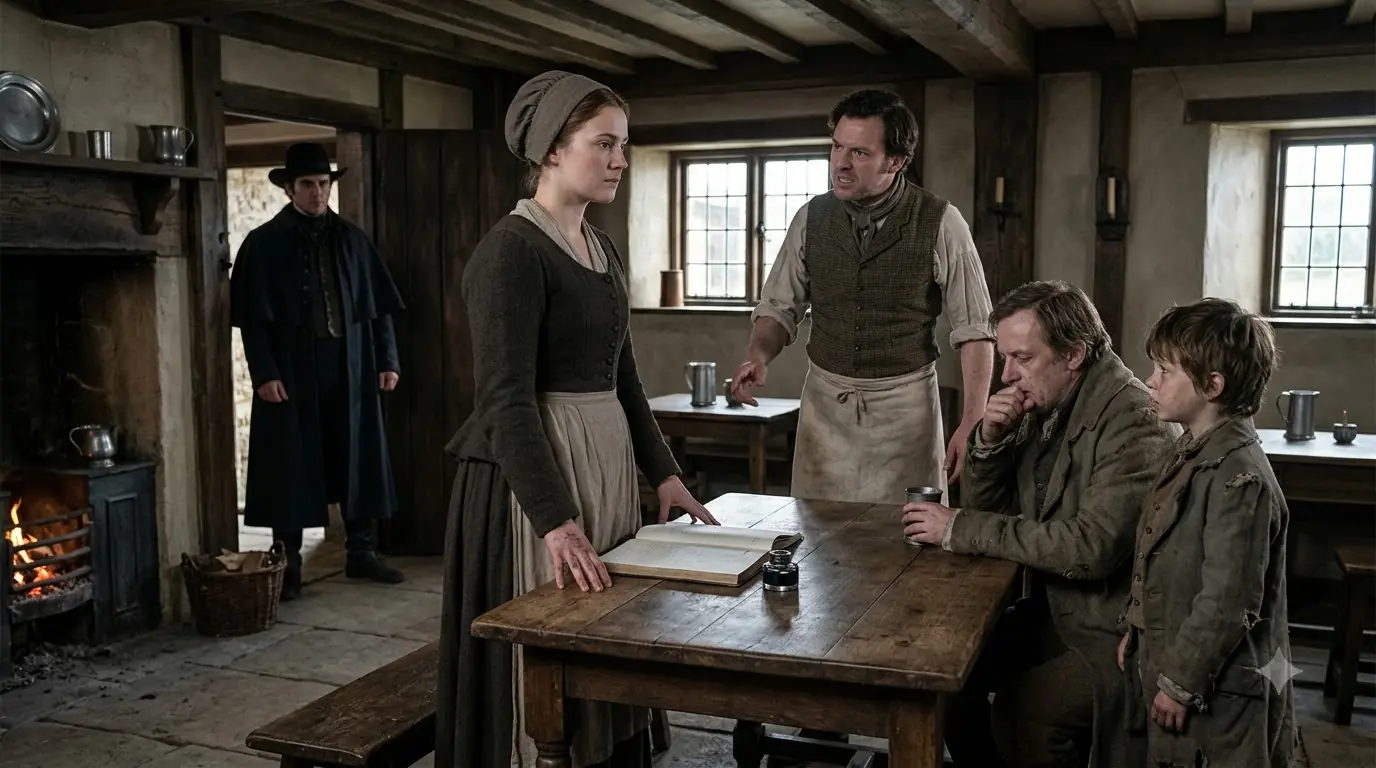
The village of Harwell Cross had one bakehouse, one pump, and one inn. And the inn had been in the Dallow family for 30 years, which was the only reason Cecily Dallow still had a roof.
She was not beautiful. She had never been beautiful, and she had stopped minding it sometime around her 20th year, which was 5 years past now. What she had was a pair of hands that could do anything asked of them, and some things that were not. She could mend a harness, set a broken shutter, read a column of figures without moving her lips. She had kept the inn's books since she was 16, and the inn had not failed yet, though it had come close.
It came close every winter.
This winter was no different. The snow had not fallen yet, but the cold was the kind that smelled like it intended to. The pump had frozen three mornings running.
Cecily was on her knees beside it, wrapping it in an old horse blanket, when she heard the sound from the yard. It was not a loud sound. It was the kind of sound that a person almost misses, which is the kind of sound that turns out to matter most.
A boy was sitting in the corner of the yard, where the fence met the stable wall. He was perhaps 7 years old, though he looked younger, the way children look younger when they have not eaten. He had his arms around his knees, and his face pressed into them, and he was not crying loudly. He was crying the way people cry when they have learned that crying does not help.
Cecily stood up. She looked at him for a moment. Then she went inside.
She came back out with a heel of bread, a wedge of hard cheese, and a cup of something hot. She did not ask the boy his name. She sat down beside him on the cold ground and held out the bread. And when he did not take it, she set it on his knee and looked away, as if she had only stopped to rest and the bread had ended up there by accident.
He ate it. He ate the cheese. He drank the hot thing, which was barley water with a scrape of honey, because that was what she had.
Then he said very quietly that his father was inside the inn and could not walk out.
She went inside.
The man at the corner table was ill—plainly and severely ill, the kind of ill that anyone could see. He had a coat that had been good once. He had a cough that had not been good for some time. He owed for two nights' lodging and had nothing to pay with. And her cousin Aldous, who managed the front of the inn when Cecily was occupied elsewhere, was standing over him with the expression Aldous always wore when he was preparing to do something he would later find a reason to call practical.
She did not look at Aldous. She looked at the man in the corner.
She told Aldous that the gentleman and his son would stay another night, and that she had entered it in the book, and that he could take the matter up with her if he wished.
Aldous wished. But Aldous was also a practical man, and practical men chose their battles. And Cecily had been keeping the books long enough that the battle was not one he wanted.
She did not know then that the man standing in the doorway of the taproom, still in his riding coat and plainly dressed and not yet spoken to by anyone in the inn, had seen all of it. She did not know that he had stopped at Harwell Cross because his horse had thrown a shoe on the Thornfield road, and that he had walked the last half mile, and that he had heard the boy before she had and watched to see what the woman on her knees by the pump would do.
She did not know that he had been watching for 11 minutes, and that in those 11 minutes he had made a decision.
His name, for the purpose of the inn's ledger, was Mr. Carrow. He paid for a room and a meal and said nothing beyond what was necessary. He had dark hair and the kind of face that had been harder than it needed to be: bones too pronounced, a jaw that suggested old arguments. His eyes, when they landed on a thing, landed with the quality of a man who was used to not being questioned about what he looked at.
He ate his supper. He watched the room. He watched from the corner of his eye the woman who moved through it.
She was not what anyone would have called remarkable. She was plain and competent and quiet in the way snow settles on a wall: slow and heavy and sure. She did not fuss. She did not angle for notice. When the man in the corner coughed until the cup rattled, she was beside him before anyone else had turned.
He had given a false name before. He was better at it than this. Something about the straightness of her back had made him careless.
In the morning, she found that the man in the corner, whose name was Fenwick, and whose boy was called Sam, had been quietly settled. She found this out from Mary, the upstairs maid, who said only that someone had spoken to Mr. Aldous in private, and that Mr. Fenwick's account had been cleared. And that she did not know who had done it, because the someone had asked not to be named.
Cecily thought about it for a moment. Then she went back to the books.
A week later, a letter came. It was not addressed to her. It was addressed to Mr. Aldous Dallow, proprietor, and it offered to purchase the inn at a price that was, by any reasonable measure, impossible. The offer was made by a solicitor in London, whose letter was on very fine paper, and said very little beyond the number, which was three times what the inn was worth on its best day.
Aldous wanted to sell. Aldous had always wanted to sell. He had wanted to sell for four years, and had not been able to find a buyer. And the arrival of a buyer who paid three times the asking price struck him as the hand of God, or something near enough.
Cecily said nothing for a long moment. Then she said that she would like to know who was buying.
The solicitor's letter did not say. It said only that the purchaser wished to remain anonymous for the present, and that all terms would be discussed at a meeting in Thornfield at the buyer's convenience.
She told Aldous she would go to the meeting in his place.
He did not argue. He was, in the end, a practical man.
The meeting was at an address in Thornfield that turned out to be a very good house. Not a townhouse—a house of the kind that had been built when someone had a great deal of money and no particular need to be modest about it.
The door was opened by a butler who had been a butler long enough that his face did not show anything. She was shown into a study. The study smelled of leather and old paper, and something she could not name: a kind of mineral cold that came with stone floors and very old stone walls.
The man behind the desk stood when she entered. He was the man from the inn.
She stood still. She did not say anything for a moment.
He said, "Miss Dallow."
She said, "You were at Harwell Cross."
"I was."
"Your name is not Carrow."