Lady Saraphina Ashworth had never once done what was expected of her. In a house where every rule was written in gold letters, she was the one line that refused to stay straight.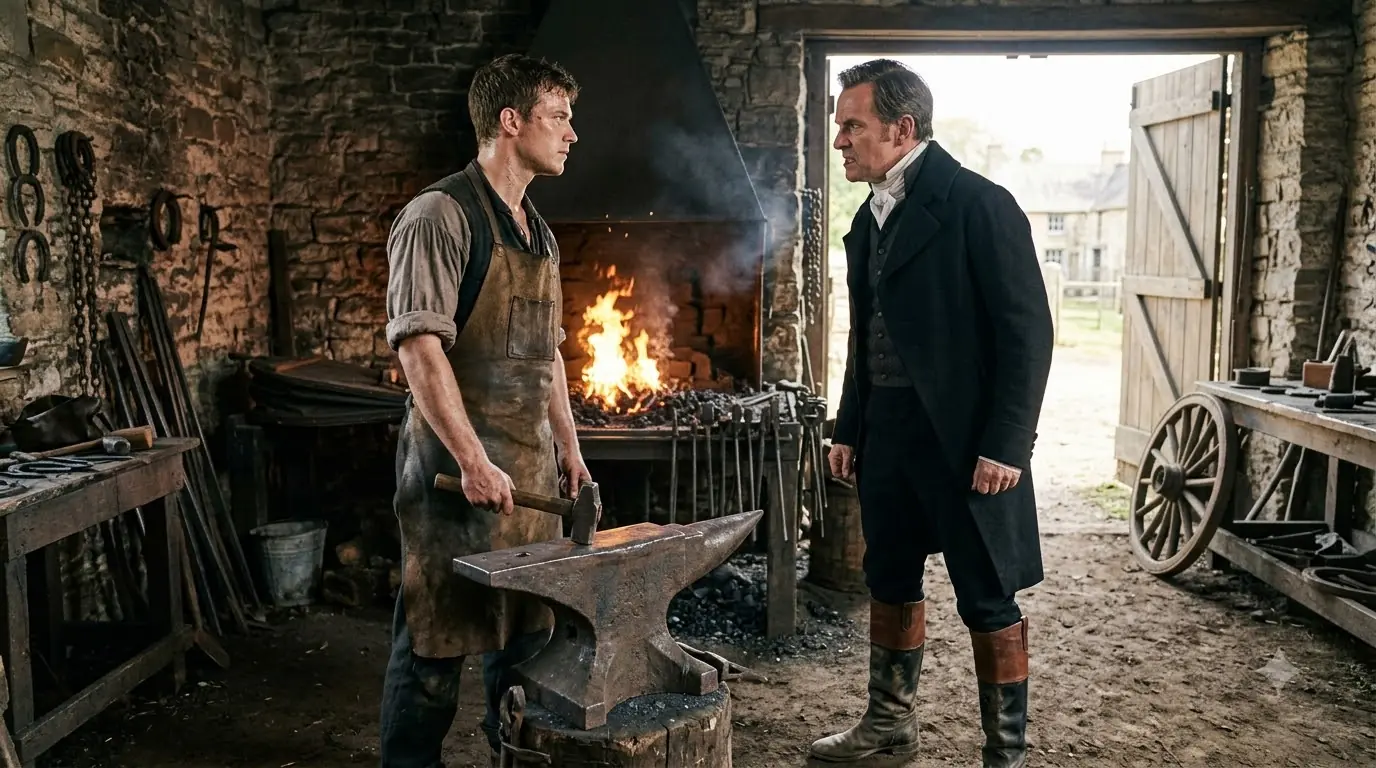
She rode horses at full speed with her hair loose in the wind. She spoke her opinions at dinner parties where young ladies were meant to smile and stay silent. She had turned down four proposals from four different lords, each one richer and more polished than the last. And each time, her father had groaned and asked the heavens what he had done to deserve such a daughter.
The Duke of Camden loved his daughter fiercely, but he did not understand her. He had built his life around order, titles, and careful decisions. Saraphina seemed to have been built from something else entirely—fire, perhaps, or wind. She could not be planned for; she could not be controlled.
And so, when whispers began to spread through the estate that the Duke's wildest daughter had fallen in love with a blacksmith's son, the Duke was furious, but he was not surprised.
His name was Thomas Hale. He worked at the smithy near the edge of the Camden estate: fixing wheels, shaping horseshoes, and repairing the metal gates that guarded the grand house he would never be allowed to enter through the front door. He was quiet, steady, and careful with his hands and his words. He had broad shoulders from years of hard work, and kind eyes that never seemed to demand anything from anyone.
Saraphina had met him by accident on a spring morning when her carriage wheel cracked on the road just past the old stone bridge. She had climbed down from the carriage before her driver could stop her, marched straight to the smithy, and demanded that someone fix it immediately.
Thomas had looked up from his work, wiped his hands on his apron, and told her quite calmly that shouting would not make the wheel repair itself any faster.
No one had ever spoken to her that way before. She had opened her mouth to argue, and then, to her own surprise, she had laughed instead.
That laugh changed everything.
She began finding reasons to pass by the smithy: a loose shoe on her horse, a creaking wheel that did not really creak, a message she claimed needed delivering. Thomas noticed, of course, but he never said a word about it, and he never asked for anything more than her company. He did not seem interested in her title or her father's wealth. He asked about the books she read, the places she wished to see, and the dreams she kept hidden beneath her sharp tongue and reckless habits. For the first time in her life, Saraphina felt like she was being seen for who she was, not for what she represented.
Within a year, what had started as accidental visits became secret meetings. They met at the old mill by the river in the early hours before the household woke, and beneath the shade of the willow trees that lined the eastern fields. Saraphina began to imagine a life far from the ballrooms and expectations of her father's world—a simple life built on trust rather than titles. She knew what her father would say if he ever found out; she decided quite plainly that she did not care.
The Duke, however, was not a man who remained unaware for long. A servant, hoping to please him, mentioned seeing Lady Saraphina walking alone near the mill at dawn, speaking closely with a young man from the smithy. The Duke's first reaction was disbelief; his second was anger. By the time he learned that his daughter intended to run away and marry Thomas Hale within the week, his anger had turned into something colder and more dangerous: a determination to end the matter before it could ruin his family's name.
He rode to the smithy himself without warning, without his usual guards, and without patience. He intended to offer the boy money to disappear, or if that failed, to threaten him with consequences no blacksmith's son could survive. He had done this before in different ways to different men who had dared to reach above their station. He expected this to be no different.
He found Thomas alone, hammering a piece of iron into shape, sweat on his brow, and his sleeves rolled to the elbow. The Duke did not waste time with formalities.
"I know what you intend to do with my daughter," the Duke said, his voice low and sharp. "I have come to end it."
Thomas set down his hammer slowly. He did not flinch, and he did not look afraid, which unsettled the Duke more than he expected.
"I love her," Thomas said simply. "I have never asked her for anything, and I never will. If you have come to buy me away from her, you may keep your money. It means nothing to me."
The Duke studied him closely then, as though seeing him for the first time. Something about the shape of his jaw, the steadiness of his gaze, and the quiet dignity in his voice struck a memory the Duke had spent years trying to bury. He stepped closer, ignoring the heat of the forge, and looked hard into the young man's face.
"What is your father's name?" the Duke asked suddenly.
Thomas hesitated. "I never knew him. I was raised by the blacksmith, Old Samuel, after my parents died when I was a boy. He took me in and taught me his trade. I do not remember much before that."
The Duke's face went pale. He asked another question, and then another, each one more urgent than the last, until the truth began to surface like a stone rising from beneath still water.
Thomas's real name, buried beneath years of hiding and a borrowed surname, was Thomas Whitmore—the presumed dead heir of a noble family the Duke had wronged more than two decades earlier.
The Whitmore family had once held land bordering the Camden estate, land the Duke had claimed through a legal dispute that was, in truth, built on manipulation rather than justice. The scandal that followed had ruined the Whitmore name, stripped the family of its title, and driven Thomas's father to an early grave from grief and shame.
The mother, fearing further ruin, had fled with her infant son and vanished from society entirely, leaving behind whispers and a story that most had long forgotten. It was said the boy had died along with her, lost to fever during their journey.
But he had not died. He had been found half-starved and alone by a kind blacksmith who asked no questions and gave him a new name, a new trade, and a life far from the ruin that had swallowed his family whole.
The Duke stood in stunned silence, the weight of his past pressing down on him harder than it ever had. The boy he had come to threaten was the very boy whose family he had destroyed. And that same boy, without knowing any of it, had fallen in love with his daughter.