The Duke of Hartmere said, “This is not the bride my solicitor described.”
Lydia Fairborne had been standing in the entrance hall of Hartmere Court for less than three minutes, and already she understood three things.
First, the house was richer than it wished to appear. The marble floor was old, not fashionable, but old in the way only inherited wealth could be old. The carved staircase had been polished by generations of hands. The portraits on the wall did not ask to be admired because they had long ago stopped caring whether anyone admired them.
Second, no one in the household had expected her.
The footmen stared. The housekeeper had gone still halfway down the stairs with a folded shawl in her hands. The steward, a sharp-faced man in a black coat too fine for his station, looked not surprised, but alarmed.
Third, the Duke had not meant to insult her.
That did not make the sentence less insulting.
Lydia had traveled three days in a rented carriage with one cracked window, one unreliable driver, and one trunk that had been searched before it left her uncle’s house. She had arrived in a gown that had once been blue but was now the color of weather, with road dust at her hem, one glove mended at the thumb, and a headache sitting behind her eyes like a creditor.
She looked at the Duke across the long hall.
He was tall, dark-haired, and grave in a way that did not seem rehearsed. He was perhaps thirty-three. His face was not handsome in the easy way men in London liked to be handsome. It was too severe for that. The bones were strong, the mouth unsmiling, the eyes a cool gray-green that gave the impression of seeing accounts rather than faces.
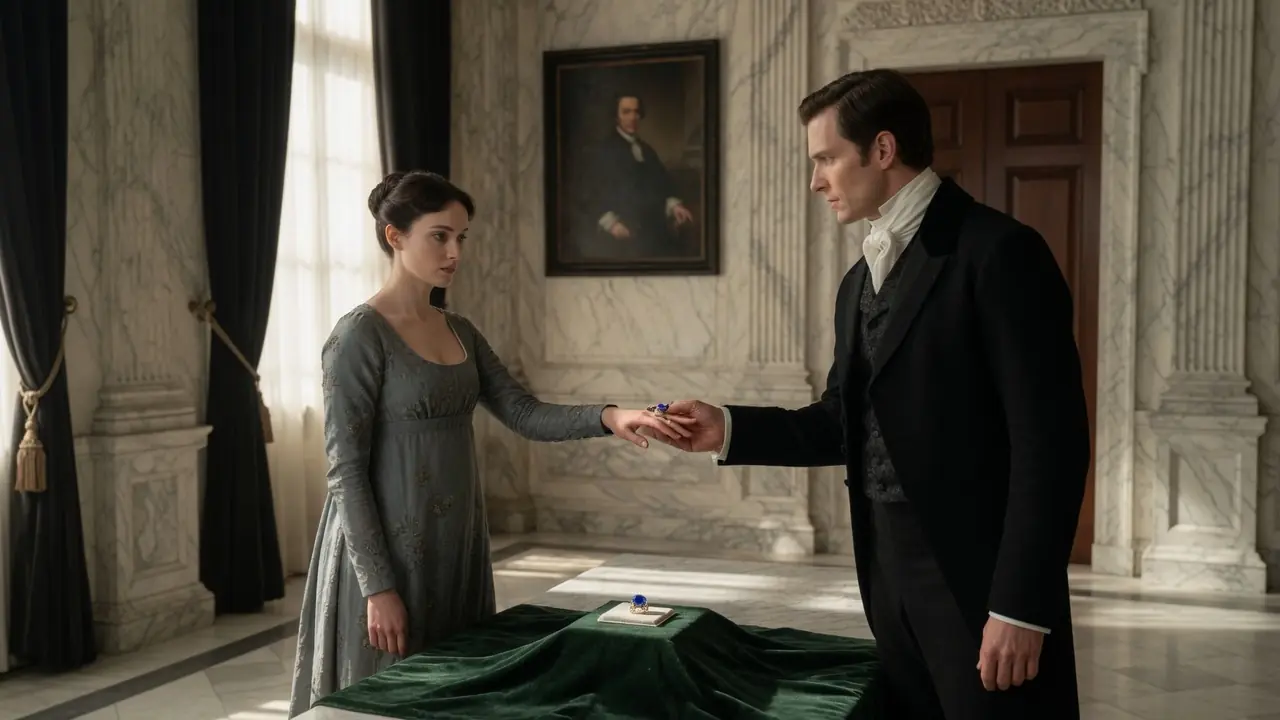
On the table between them lay a ring.
A wide gold band set with a sapphire the color of deep water. It rested on a folded square of white velvet like a verdict.
Lydia reached for neither the ring nor the velvet.
Instead, she took off her bonnet.
The motion was slow because her fingers were stiff from the journey, and because she wanted every person in that hall to understand that she was not flinching.
“If I am not the bride your solicitor described,” she said, “then perhaps you should send for your solicitor and ask him why he described someone else.”
The steward inhaled sharply.
The Duke’s eyes changed.
Not softened. Not warmed. But focused.
“You are Miss Fairborne?”
“I am Lydia Fairborne.”
“Of Alderwick?”
“Of whatever remains of Alderwick, yes.”
The steward stepped forward. “Your Grace, if I may—”
“You may not,” the Duke said.
The steward stopped.
Lydia noticed that too.
The Duke turned back to her. “I was told Miss Fairborne was nineteen, fair-haired, accomplished in music, and accustomed to society.”
“My cousin Isabel is nineteen, fair-haired, accomplished in music, and accustomed to spending money she did not earn.”
A silence opened.
Somewhere above them, the housekeeper slowly resumed her descent by one step.
The Duke looked at the ring. Then at Lydia. “You were sent in her place.”
“I was put in a carriage,” Lydia said. “I was told I was to meet the Duke of Hartmere. I was told to be grateful. I was not told I had been placed in someone else’s portrait.”
His jaw tightened.
“Did you consent to this negotiation?”
“No.”
“Did you read the settlement?”
“No.”
“Were you told the terms?”
“No.”
The Duke’s expression grew colder with each answer, though not, Lydia thought, at her.
The steward moved again, not toward the Duke this time, but toward the table where the ring lay.
Lydia saw it.
The Duke saw it too.
“Do not touch that,” he said.
The steward’s hand froze above the velvet.
The housekeeper reached the bottom stair and stood very quietly, shawl in her arms, eyes lowered but ears clearly open.
The Duke spoke without taking his gaze from Lydia. “Mrs. Rowan, see that Miss Fairborne is given a room, hot water, food, and a maid. Mr. Selwick, bring me every letter from Mr. Darnley concerning the Fairborne negotiation.”
The steward’s mouth tightened. “At once, Your Grace.”
Lydia did not move.
The Duke looked at her. “You have traveled three days. You will rest before we discuss what has been done.”
“No,” Lydia said.
The word struck the hall harder than she expected.
The Duke went still.
She lifted her chin. “I have spent three days being carried from one decision I did not make toward another decision I was not allowed to read. I will not be put into a room to wait while men discover how I have been handled.”
The housekeeper’s eyes flicked upward.
The Duke studied Lydia for a long moment.
Then he reached for the velvet cloth, folded it once over the sapphire ring, and put it into his coat pocket.
“Very well,” he said. “Then we begin now.”
They went to the library.
Not the drawing room. Not the morning room. The library.
That was the fourth thing Lydia noticed.
Men who intended to soothe women chose rooms with flowers and painted screens. Men who intended to tell the truth chose rooms with desks.
Hartmere’s library was long, dark, and full of old leather. A fire had been lit, though badly. Smoke leaned into the room instead of up the chimney. The Duke crossed to the hearth, adjusted the iron screen himself, and opened the flue wider with the brisk competence of a man who had never considered incompetence decorative.
Lydia stood near the table and waited.
He placed it on the table.
Too carefully.
The Duke opened it.
Lydia watched his face as he read.
The first letter was brief. The second longer. The third contained the description he had repeated in the hall: nineteen, fair-haired, musical, suitable. Beside the name Miss Fairborne, a smaller line had been added in a different hand.
Isabel.
The Duke read it twice.
Then he laid the page flat on the desk.
“Who added this?”
The steward looked offended. “Your Grace?”
“Who added the name Isabel?”
“I cannot say.”
“Cannot or will not?”
Lydia looked from the steward to the page. “May I see?”
The Duke turned the letter toward her.
The altered word was neat. Tidy. Confident. The sort of hand that expected no one to compare ink.
Lydia bent closer. “This was not written by my uncle.”
The steward’s eyes moved to her.
The Duke noticed.
“How do you know?” he asked.
“My uncle forms his capital I like a hook. He also presses too hard on every downward stroke. This hand is lighter.”
She looked at the steward.
“This hand was trained in an office.”
The silence was small but useful.
The Duke looked at Mr. Selwick. “Leave us.”
“Your Grace, I must protest—”
“You may protest from the corridor.”
The steward bowed stiffly and withdrew.
The door closed.
Lydia let out a breath she had not known she was holding.
The Duke waited until her shoulders lowered.
Then he said, “You are observant.”
“I have had very little else to do.”
“Why would your uncle send you instead of your cousin?”
Lydia laughed once.
It was not a happy sound.
“Because Isabel changed her mind.”
“About me?”
“About being buried in the country with a man she had not yet learned to manage.”
The Duke’s mouth almost moved.
Almost.
“And you were easier to dispose of?” he asked.
Lydia looked down at her gloves. “I am twenty-five. My father left me a small inheritance that my uncle has been administering since his death. I was once useful at Alderwick because I could read accounts, manage tenants, and stretch money further than it wished to go. Then my uncle remarried, Isabel became the household’s future, and I became a reminder that not everything in his care belonged to him.”
The Duke said nothing.
She looked up. “So yes. I was easier to dispose of.”
He walked to the window.
Outside, rain had begun again, fine and silver over the lawns.
“My father arranged this match before he died,” the Duke said.
Lydia did not answer.
“My solicitor reopened the matter after I inherited. I was told the Fairborne girl had a dowry large enough to settle a debt my father left unresolved.”
“There is no Fairborne girl with a dowry large enough to settle ducal debt.”
He turned.
“No?”
“No. There is Isabel’s portion, which is respectable. There is my inheritance, which is smaller but inconveniently protected. And there is Alderwick, which my uncle cannot sell unless I marry and sign away certain claims.”
His face hardened.
“There it is,” he said softly.
“There what is?”
“The reason you were put in the carriage.”
Lydia knew it before he said it.
Perhaps she had known it since the first hour of the journey and refused to name it because naming a trap while inside it does not open the door.
The Duke came back to the table.
“Your uncle intended you to marry me, sign the settlement, and release your claim on Alderwick.”
“Yes.”
“And my steward intended me to believe I was receiving your cousin.”
“Why would your steward care which Fairborne arrived?”
The Duke looked at the door through which Selwick had left.
“That,” he said, “is exactly the question.”
Mrs. Rowan put Lydia in the east blue room.
It overlooked the kitchen garden and the long glasshouse beyond it, where orange trees stood in tubs and rain patterned the roof. The room was not grand, but it was warm. There was water steaming in the basin, a fire already burning properly, and a tray of soup and bread on the small round table.
The maid assigned to her was named Anna and had the nervous efficiency of someone recently promoted.
“Mrs. Rowan said you were to have anything you asked for,” Anna said.
“Did she?”
“Yes, miss.”
“Then I should like ink, paper, a sharp knife, and every local directory in the house.”
Anna blinked.
Lydia removed one glove. “Also tea.”
Anna went.
Lydia washed. Ate. Repaired the tear at her cuff with thread from her travel case. Then she sat at the small table and began writing down everything she knew.
Her uncle, Sir Martin Fairborne, had debts he disguised as improvements. Her cousin Isabel had been promised to at least two men before Hartmere. Alderwick’s west farms were still legally tied to Lydia’s mother’s marriage settlement. If Lydia married and signed the wrong paper, Sir Martin could fold her inheritance into the estate, pay his creditors, and leave her with gratitude as compensation.
She had no proof.
Not enough.
Proof was always the difficulty.
Men could lie in public and be called persuasive. Women required documents.
At eight o’clock, a knock came at the door.
Not Anna’s light tap.
A measured sound.
Lydia opened it herself.
The Duke stood in the corridor holding a stack of folded papers.
“May I come in?”
The question startled her.
Not the presence. The permission.
She stepped back.
He entered and placed the papers on the table.
“Selwick has disappeared.”
Lydia looked at him. “Disappeared?”
“His room is empty. His horse is gone. The earliest letters concerning the Fairborne match are missing.”
“That is inconvenient.”
“Deeply.”
She sat down and pulled the papers toward her.
The Duke remained standing.
Lydia looked up. “If you expect me to read, you will need to sit. Looming makes men feel powerful and women feel tired.”
He stared at her.
Then, slowly, he sat.
The papers were copies. Recent ones. Enough to show the negotiation’s outer shape, not its origin. Lydia examined each page, each date, each ink change.
After ten minutes, she pointed to one line. “This phrase appears three times.”
The Duke leaned closer.
Their shoulders nearly touched.
She pretended not to notice.
“What phrase?”
“Suitable substitution.”
His eyes moved over the page. “I assumed that referred to alternate settlement terms.”
“No. It refers to a person.”
“How can you be sure?”
“Because my uncle uses that phrase when he replaces one obligation with another and wants everyone to think nothing has changed.”
She turned the page.
“Here. Again. Suitable substitution pending confirmation. That was dated six weeks ago. Before I was told to travel.”
The Duke’s jaw tightened. “They planned this.”
“Yes.”
“Together.”
“Yes.”
Lydia sat back.
The fire cracked softly.
Rain tapped the windows.
The Duke looked at the papers as if they had personally offended him.
“You are very calm,” he said.
“I am not.”
“No?”
“No. But I dislike giving my uncle the satisfaction of affecting my posture at a distance.”
That time, the Duke smiled.
Not much.
But enough that the room altered.
“My name is Adrian,” he said.
Lydia’s fingers stilled on the page.
“I beg your pardon?”
“My name is Adrian. If we are to uncover a fraud conducted jointly by your uncle and my steward, Your Grace will become tiresome.”
“Lydia,” she said.
“I know.”
“You may use it.”
He looked at her.
Something quiet passed between them.
“Lydia, then.”
The next morning, Lydia went to the glasshouse.
She found it by following the scent of damp earth and orange leaves. The place was older than the house’s south wing, iron-framed and elegant, though neglected at the corners. Some panes were cracked. One door did not close properly. Half the plants needed pruning.
But beneath the neglect, it was alive.
That comforted her.
She was examining a row of lemon trees when she heard footsteps.
The Duke entered without coat or hat, shirtsleeves rolled beneath a dark waistcoat, a ledger under one arm.
“You rise early,” he said.
“So do you.”
“I did not sleep.”
“Neither did I.”
“Then we are both inefficient this morning.”
She looked at the ledger. “What is that?”
“Stable accounts.”
“Do they matter?”
“Everything matters when Selwick is involved.”
He was right.
By noon, they had found the first payment.
Not in the marriage papers.
In horse feed.
A recurring payment to a Mr. H. Vale for “special grain transport.” The same hand had approved it every month. Selwick’s hand.
Lydia followed the amounts across three years.
The payments increased whenever a letter from Sir Martin arrived.
Adrian sent for the head groom.
The groom, Mr. Peters, arrived smelling of hay and suspicion.
“Mr. H. Vale,” Adrian said. “Who is he?”
The groom frowned. “Never heard of him, Your Grace.”
“Special grain transport?”
“We buy grain from Miller’s Crossing. Same as always.”
“Through whom?”
“No one. I send Tom with the wagon.”
Lydia turned the ledger toward Adrian.
“There is your connection.”
“Between Selwick and a false supplier.”
“And likely my uncle.”
Adrian looked at the figures. “Why hide marriage fraud in stable accounts?”
“Because gentlemen notice brides. They rarely notice oats.”
Peters coughed.
Adrian looked at him. “Something to add?”
The groom hesitated. “Only that Mr. Selwick came to the stables often enough for a man who didn’t like horses.”
“When?”
“Late. Sometimes after dark. Went into the old tack room.”
Adrian stood.
The old tack room was behind the carriage house, half-used for broken harness, moldy saddle cloths, and the sort of objects households keep because throwing them away would require a decision.
The lock had been recently oiled.
Adrian noticed.
Lydia noticed that he noticed.
Peters produced a key.
Inside, beneath a shelf of cracked leather, they found a small iron box.
Inside the box were letters.
Not many.
Enough.
Sir Martin to Selwick. Selwick to Sir Martin. Copies of altered contracts. A draft marriage settlement with Isabel’s name. Another with Lydia’s. One page listing the value of Alderwick’s west farms. One receipt for two hundred pounds paid to Selwick upon “successful correction of the intended bride.”
Lydia read that line twice.
Successful correction.
As if she were a clerical error.
She did not realize her hand had started shaking until Adrian reached out and covered the page with his palm.
“Enough,” he said.
“No.”
“Lydia.”
“No. I will finish reading what was done to me.”
He withdrew his hand at once.
That was another thing she noticed.
He did not mistake concern for authority.
She read every page.
Then she folded them in order.
When she finished, she looked up.
Adrian stood across from her in the dim tack room, shoulders rigid, face controlled.
“I am sorry,” he said.
“For what?”
“For being the house that received the fraud.”
She looked at the iron box.
Then at him.
“That is not the same thing as committing it.”
“No.”
“But you were meant to benefit from it.”
His expression changed.
A small flinch.
“Yes.”
The honesty hurt more than denial would have.
She respected it anyway.
“And now?” she asked.
“Now I send for a magistrate.”
“And my uncle?”
“Will be given one chance to answer before charges are placed.”
“No,” Lydia said.
Adrian paused. “No?”
“No. My uncle has spent years making certain every conversation happened in rooms where I had no proof and no witness. I will not send him warning. I will send him an invitation.”
His eyes narrowed. “To Hartmere?”
“To dinner.”
The Duke looked at the letters.
Then at her.
“You want him at your table.”
“I want him comfortable. Men confess more when they believe they are winning.”
“That is dangerous.”
“So is ignorance.”
For a long moment, the Duke said nothing.
Then he asked, “What do you need?”
Lydia looked down at the letters, at the evidence of her own attempted erasure, and felt the first clean edge of anger.
“A blue gown,” she said. “A good solicitor. Three witnesses. And every account book from Alderwick that my uncle believes lost.”
Adrian’s mouth almost smiled again.
“I can provide three of those.”
“And the fourth?”
“The gown,” he said. “Mrs. Rowan will provide that.”
The dinner took place six nights later.
Sir Martin Fairborne arrived at Hartmere Court with Isabel at his side and confidence restored to his face. He was a handsome man in his late fifties, silver-haired, broad-shouldered, with the hearty manner of someone who had learned that charm could often stand in for money.
Isabel was beautiful.
That was not an insult. It was a fact, and Lydia had never found facts useful to resent. Her cousin was fair-haired, blue-eyed, graceful, and arranged in pale pink silk with the effortless cruelty of someone who had always been forgiven for being pretty first and everything else afterward.
She kissed the air beside Lydia’s cheek.
“Dear cousin,” Isabel said. “How changed you are.”
“I have been away six days.”
“It feels longer.”
“To some of us, yes.”
Adrian stood beside Lydia in the great hall. Not in front of her. Not behind. Beside.
Sir Martin’s eyes moved between them.
“I hope,” he said, smiling, “that our little misunderstanding has been resolved.”
“Entirely,” Adrian said.
Sir Martin relaxed.
That was his first mistake.
Mrs. Rowan had arranged the dining room with brutal elegance. Six places. Lydia, Adrian, Sir Martin, Isabel, Mr. Greaves the magistrate, and Mr. Ellery, Adrian’s solicitor. No excessive flowers. No distracting music. No extra guests to soften the purpose.
The first course passed politely.
The second brought wine.
The third brought Sir Martin’s confidence into full bloom.
He spoke of Alderwick’s condition. Of Isabel’s accomplishments. Of Lydia’s unfortunate tendency toward seriousness. Of the difficulty of managing young women without fathers. Of the necessity of practical arrangements.
Lydia let him speak.
Adrian did not interrupt.
Isabel looked increasingly bored.
When the plates were cleared, Lydia set down her glass.
“Uncle, when did you first decide to send me to Hartmere instead of Isabel?”
Sir Martin chuckled. “My dear girl, must we begin all that again?”
“Yes.”
Isabel’s gaze sharpened.
Sir Martin looked at the Duke, seeking masculine sympathy. “Your Grace, you see what I mean. Lydia has always had a taste for uncomfortable questions.”
“One of her finest qualities,” Adrian said.
Sir Martin’s smile faltered.
Lydia turned to Isabel. “Did you refuse to come?”
Isabel lifted one pale shoulder. “I had concerns.”
“About the Duke?”
“About the country.”
“That was your concern? The landscape?”
“The match did not suit me.”
“But it suited me?”
Isabel’s mouth tightened. “You always wanted useful things to do. You should be pleased.”
Mr. Ellery looked down at his plate.
The magistrate’s brows rose.
Adrian’s hand rested lightly on the table beside Lydia’s. Not touching. Near enough.
Lydia looked at her uncle. “And Alderwick’s west farms? Did they suit you?”
Sir Martin went still.
There it was.
The first crack.
“I do not know what you mean,” he said.
“Of course you do.”
Mr. Ellery opened the leather case beside his chair and removed the first bundle of letters.
Isabel sat up straighter.
Sir Martin looked at the bundle.
Not with confusion.
With recognition.
That was his second mistake.
Lydia took the top letter and unfolded it. “This is your letter to Mr. Selwick, dated March twelfth. It discusses the need for a suitable substitution. This is the altered marriage settlement. This is the receipt for two hundred pounds. This is the list of Alderwick assets that would be released upon my marriage.”
Sir Martin’s face had gone pale beneath its polished color.
Isabel whispered, “Papa.”
Not uncle.
Papa.
Lydia froze.
The room changed.
Adrian saw it too.
Sir Martin closed his eyes briefly.
Isabel covered her mouth with one hand.
Lydia looked between them.
“Papa?” she repeated.
No one spoke.
Then Isabel began to cry.
Not prettily. Not strategically. Truly.
“I thought you knew,” she whispered.
Lydia felt the floor vanish beneath the chair.
Adrian’s hand found the edge of the table, but still he did not touch her without permission.
Sir Martin said sharply, “Isabel, silence.”
“No,” Lydia said.
Her voice sounded distant.
Very distant.
“No. She will not be silent.”
Isabel looked at Lydia with wet eyes and a terror Lydia had never seen in her before.
“You are his daughter,” Lydia said.
Isabel nodded.
The fifth thing Lydia understood was that some truths did not arrive like lightning.
Some arrived like a key turning inside a lock you had not known was there.
“My aunt?” Lydia asked.
Sir Martin said nothing.
Isabel answered. “My mother knows.”
“And my father?”
“Did not,” Sir Martin said at last.
His voice had changed. The charm was gone.
Lydia looked at him. “You had a child with your brother’s wife?”
His jaw tightened.
“Before their marriage,” he said. “Your aunt married my brother already carrying Isabel. He knew nothing. No one knew.”
“Except you.”
“Yes.”
“And my mother?”
Sir Martin flinched.
Lydia leaned forward. “My mother knew.”
The silence answered.
The plot unfolded in her mind with hideous clarity.
Her mother’s settlement. Her father’s illness. Alderwick’s accounts. Sir Martin’s guardianship. Isabel’s portion larger than it should have been. Lydia’s inheritance smaller than it ought to have become.
“You stole my mother’s trust,” Lydia said.
Sir Martin stood. “Enough.”
Adrian stood too.
The room stilled.
The Duke did not raise his voice. “Sit down.”
Sir Martin hesitated.
Then sat.
Lydia looked at Mr. Ellery. “The old household account books. Bring them.”
Mr. Ellery opened a second bundle.
Sir Martin stared at it as if it were a ghost.
Adrian spoke quietly. “They were not lost. Your former housekeeper kept them. Mrs. Rowan found her in Winchester.”
Lydia turned the first page.
Her mother’s handwriting appeared in the margins.
Not much. Small notes. Corrections. Dates.
One line, underlined twice, made Lydia’s breath stop.
M.F. has taken again for the child. If I accuse him, he will ruin us all. L must be protected.
L.
Lydia.
Another page.
Isabel’s portion transferred from Lydia’s maternal trust under a false medical expense.
Another.
Alderwick repairs paid from Lydia’s inheritance while Isabel’s dowry remained untouched.
Another.
Sir Martin had not only tried to marry Lydia off to release the west farms.
He had spent years using her money to maintain the life of the daughter he could not publicly claim.
Lydia closed the book.
For a moment, she heard nothing.
Not the fire.
Not Isabel crying.
Not Adrian breathing beside her.
Only the soft, awful click of understanding.
Her whole life had been rearranged around a secret that was not hers.
“Lydia,” Adrian said quietly.
She looked at him.
The room steadied around his face.
“You do not have to continue tonight.”
“Yes,” she said. “I do.”
She turned to Sir Martin.
“You will sign a full confession tonight. You will restore every pound removed from my mother’s trust. You will transfer Alderwick’s west farms into my legal control before the week ends. You will make a separate provision for Isabel from your own property, not mine. And you will never write to me again unless through a solicitor.”
Sir Martin’s face twisted. “You would ruin your own family?”
Lydia looked at Isabel.
Then back at him.
“You did that when you decided blood mattered only when it benefited you.”
Isabel sobbed softly.
Sir Martin tried one more time, turning to Adrian. “Your Grace, surely you see this is a private family matter.”
Adrian’s face was cold. “You attempted to defraud my house, bribe my steward, manipulate a marriage contract, and dispossess the woman you sent here. Nothing about this remains private.”
The magistrate rose.
“I believe,” Mr. Greaves said, “we should continue this discussion in writing.”
Sir Martin signed before midnight.
Isabel left with him at dawn.
But before she entered the carriage, she came to Lydia in the hall.
She wore no pink now. Only a plain cloak. Without her usual arrangement, she looked younger. Almost frightened enough to be honest.
“I am sorry,” Isabel said.
Lydia did not know what to do with the apology.
So she did the only thing she could.
She answered the truth.
“I believe you.”
Isabel began to cry again.
“But belief is not forgiveness,” Lydia said.
“I know.”
“You knew some of it.”
“Yes.”
“But not all.”
“No.”
Lydia looked at the carriage waiting outside.
“You should get your own solicitor.”
Isabel blinked.
“My own?”
“Yes. Before your father uses your silence against you too.”
Isabel stared at her.
Then nodded.
That was the beginning of something.
Not sisterhood.
Not affection.
Something thinner. Stranger. Perhaps, one day, enough.
When the carriage left, Lydia remained in the hall.
The same hall where Adrian had first said she was not what he ordered.
The sapphire ring had returned to the table, still wrapped in velvet.
She looked at it.
Adrian stood several feet away.
He had not touched it.
He had not touched her.
He had waited through the entire long night as if waiting were a form of apology.
“Lydia,” he said.
She looked at him.
“I will not ask today.”
“Ask what?”
“You know.”
She did.
The rain had stopped. Morning light entered the hall, soft and gold, touching the marble floor where the ring had once thrown a blue shadow.
“You still need a wife,” she said.
“I need many things.”
“And money?”
“Yes.”
“And a duchess?”
“Yes.”
“And me?”
He went very still.
The honesty, when it came, was quiet.
“Yes.”
Lydia’s heart shifted.
Not safely.
Nothing about this man felt safe in the simple sense. But he felt truthful in a way she had begun to need more than safety.
“You said I was not what you ordered,” she said.
His face tightened. “I did.”
“You were right.”
“I was rude.”
“You were also right. I am not what anyone ordered. Not my uncle. Not your steward. Not my cousin. Not even your father, whatever he may have intended.”
“No,” Adrian said. “You are not.”
She picked up the velvet bundle.
The sapphire ring was heavy in her palm.
“I will stay at Hartmere for four months,” she said. “As your estate consultant. Paid. Publicly. With my own rooms, my own maid, and access to every account touched by Selwick.”
His eyes warmed.
“And after four months?”
“If you ask me then, I may answer.”
“May?”
“Yes.”
“What should I do in the meantime?”
Lydia folded the velvet over the ring again and placed it in his hand.
“Earn the question.”
He bowed his head.
Not playfully.
Not dramatically.
With the grave respect of a man accepting terms.
“I will.”
Four months changed Hartmere Court.
Selwick was arrested two weeks after Sir Martin’s confession. His accounts revealed smaller thefts, older tricks, favors sold and debts hidden in lines no one had thought to read. Lydia read them.
Every one.
She moved through the estate like weather after drought. Tenant rents were corrected. Repairs long delayed were begun. The glasshouse was restored, pane by pane, because Lydia said any house that could afford ancestral portraits could afford to keep its oranges alive.
Adrian listened.
Not perfectly at first.
He was still a duke. Worse, he was a man accustomed to being obeyed quickly. He interrupted. She corrected him. He assumed. She made him read the figures aloud until assumption embarrassed him.
By the second month, he had learned to ask before deciding.
By the third, he brought her ledgers before she requested them.
By the fourth, he no longer entered the estate office without tea for two.
They spoke of drainage, schools, rents, wheat prices, broken bridges, tenant widows, and whether the west glasshouse should house lemons or figs. They argued over a mill lease for three days. They agreed on a new steward only after Lydia interviewed the man twice and made him explain one column of figures backward.
At night, when the house grew quiet, they often sat in the library.
At first, with accounts between them.
Then with books.
Then sometimes with nothing at all.
One evening in late August, Lydia found Adrian standing beside the table where the sapphire ring had first lain.
The windows were open. The last of the summer air moved through the hall. Somewhere outside, a groom was leading horses back from the water trough.
“The four months ended yesterday,” he said.
“I know.”
“I waited a day.”
“How restrained of you.”
“I am learning.”
She smiled despite herself.
He reached into his coat.
Not for the sapphire ring.
For a narrow gold band set with a small green stone.
Lydia looked at it.
“It was my mother’s,” Adrian said. “Not the duchess ring. That one is for portraits and visiting ambassadors and other forms of organized discomfort. This is the one she wore when she walked the fields with my father.”
The stone caught the evening light.
Not emerald.
Peridot, perhaps.
Green as early leaves.
“I would like to ask,” Adrian said, “not because my father intended it, not because your uncle tried to prevent it, not because my estate needs a duchess, though it does, and not because your money would be useful, though it would.”
Lydia laughed softly.
His mouth curved.
“I would like to ask because Hartmere is better with you in it. Because I am better with you in it. Because you entered this house as someone else’s fraud and became the only honest thing in it.”
Her throat tightened.
“Adrian.”
“Lydia Fairborne,” he said, “will you marry me?”
She looked at the ring.
Then at the man.
Then at the hall where she had once arrived unwelcome and dusty and unwanted by every scheme that had carried her there.
“Yes,” she said. “But I have terms.”
His smile deepened. “I expected nothing less.”
“I keep the estate office.”
“Done.”
“My signature remains on the tenant accounts.”
“Done.”
“Isabel is permitted to write if she does so honestly.”
A flicker of surprise crossed his face.
Then respect.
“Done.”
“And if you ever again say I am not what you ordered, I shall remind you that I am precisely what you failed to deserve.”
He took her hand.
“Done,” he said softly.
They were married in September, in the village church with the doors open to the mild air.
No London crowd. No false portrait. No steward arranging the wrong bride behind polished doors.
Mrs. Rowan cried into a handkerchief she claimed was only for dust. The new steward stood solemnly beside the churchwarden. Isabel sent flowers, white roses and orange blossoms, with a note in a plain hand.
I am learning to be honest. I hope one day to deserve a longer letter. I.
Lydia kept the note.
She did not answer it immediately.
Some things took time.
At the wedding breakfast, Adrian placed the sapphire ring beside her plate.
Lydia looked at it. “I thought we agreed.”
“We did.”
“Then why is it here?”
“I thought we might decide what to do with it together.”
She picked it up.
The sapphire was beautiful. Too large. Too cold. A ring meant to announce possession rather than partnership.
“Sell it,” she said.
“For what?”
She looked out toward the village road, where the schoolhouse roof sagged slightly over the eastern corner.
“A roof,” she said. “Books. A salary for another teacher. Something useful.”
Adrian leaned back, watching her with that expression she had learned to read over the months: admiration disguised as consideration.
“The Duchess of Hartmere has spoken.”
“Do not sound so pleased. It is undignified.”
“I am discovering I prefer undignified things.”
“You are improving.”
“I had excellent instruction.”
The sapphire was sold by Michaelmas.
By winter, the village school had a new roof, two new windows, and a shelf of books Lydia personally selected. The glasshouse oranges survived the frost. Alderwick’s west farms were legally restored to her. Sir Martin retreated to a smaller house in Surrey and found fewer dinner invitations waiting for him each month.
In December, Lydia stood in Hartmere’s entrance hall while snow fell beyond the windows.
The marble floor was cold beneath her slippers. The portraits looked down in their usual long silence. The table near the staircase was bare now, except for a vase of winter greenery and a bowl of oranges from the glasshouse.
Adrian came to stand beside her.
“You are remembering,” he said.
“Yes.”
“The day you arrived?”
“Yes.”
“I was unforgivable.”
“No,” Lydia said. “You were badly informed, tired, proud, and rude.”
“That is a generous distinction.”
“It is an accurate one. I have become fond of accuracy.”
He took her hand.
This time, neither of them had to ask whether the gesture was welcome.
“I am glad you were not what I ordered,” he said.
She looked up at him.
There was snow on the window glass. Firelight on the marble. His mother’s ring on her hand. Her own reflection beside his in the dark pane.
“So am I,” she said.
Then she smiled.
“Though you should know, Your Grace, I am still not what you deserve.”
His thumb moved once across her knuckles.
“No,” he said. “You are considerably better.”
Outside, the snow settled over Hartmere Court, over the village schoolhouse with its new roof, over the glasshouse where oranges held their color against winter, over the road she had once traveled unwillingly and would now, if she ever left, leave by choice.
Lydia Fairborne had arrived as the wrong bride.
She remained as the right woman.
And somewhere in the quiet of that old house, beneath portraits and ledgers and the softened echo of past mistakes, the future rearranged itself around the simple fact that she had not been ordered at all.
She had been chosen.
And this time, she chose back.