The bread was ready at six o’clock. That was the rule of the bakery, and it had been the rule since before Nell Marsh could remember, since before her father had handed the bakery to her, and before his father had handed it to him, back through the generations of Marsh bakers who had all risen before four, and fired the ovens in the dark, and had the first loaves out by six, because the village woke at six o’clock, and the village needed bread, and the bread needed to be there when the village arrived for it. Nell had been rising before four since she was old enough to be useful in the bakery, which her father had decided was seven, and she had been rising before four on her own account since she was twenty-two, which was when her father died, and left her the bakery, and the ovens, and the rule about six o’clock, and a business that was sound but not generous, which meant it would stay sound only as long as she worked it soundly, and she was not going to let it be otherwise. She was twenty-six now.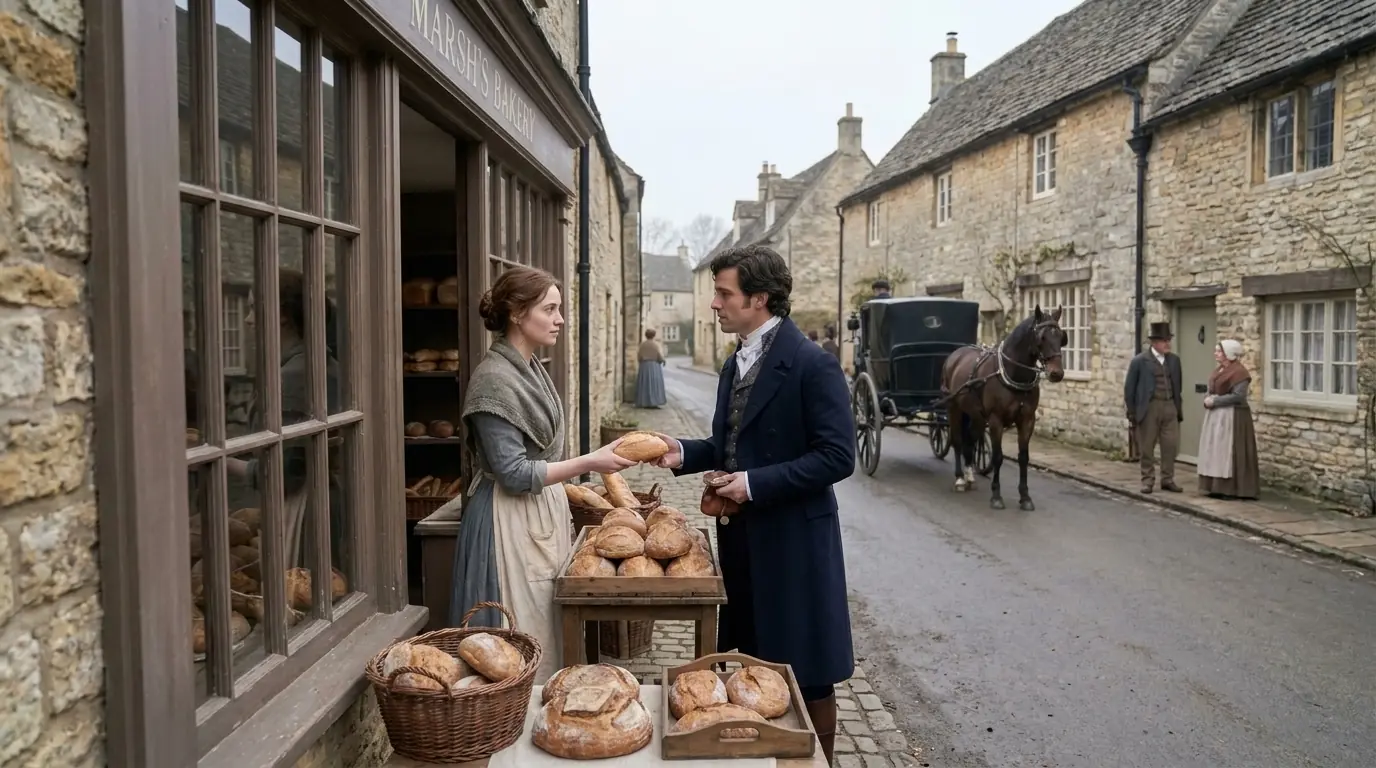
She had been running the bakery alone for four years, which was not quite true because she had a girl named Peg who came in at five to help with the shaping and the second bake. But the alone was true in all the ways that mattered, which was the decisions and the accounts and the sourcing of the flour, and the managing of the oven, and the early rising in the dark before Peg arrived, which was the part of the day that belonged only to her, the hour before five, when the bakery was warm and dark and smelled of yeast and woodsmoke, and she was the only person in it, and she would not have traded that hour for anything the world was likely to offer her. The bakery was on the main street of Halwick, which was a village large enough to have a main street, and small enough that the main street contained nearly everything the village needed, and the bakery was the thing the main street could least afford to lose, which Nell knew, and which gave her a steady, quiet satisfaction that she did not talk about, because the kind of pride that comes from being necessary is the kind that does not need an audience. Her bread was good.
She said this to herself plainly and without vanity because it was a plain fact and vanity had nothing to do with it. She had learned the bread from her father, and she had improved on what she had learned in the four years since because she had the kind of attention that is always looking for the place where a thing could be better, and the kind of patience that is willing to try the better thing twenty times before deciding whether it is actually better, and her bread reflected both. The village knew it. The village had been buying bread from the Marsh bakery for three generations and intended to go on doing it, and Nell intended to give them the reason to.
The stranger appeared on a Tuesday in November. She knew he was a stranger because she knew everyone who came through the bakery door in the ordinary run of the week. And this was not someone she knew. And she knew he was not from the village because he came in at seven, which was when the serious morning custom was done, and the bakery was in the quieter middle part of the morning, when the occasional customer drifted in, and Nell restocked the shelves, and thought about the afternoon bake. He came in the way people come into small shops when they are not certain of their welcome, which is carefully, and he stood inside the door for a moment, looking at the shelves with the look of a man who is reading what is available before deciding what he wants.
And she thought nothing more about it because a stranger buying bread on a Tuesday in November was not an unusual event in a bakery on a main street and did not require further thought.
He came back on Wednesday. She knew him from the coat and from the way he came in at the same time, seven, and stood in the same place inside the door and looked at the shelves in the same way. "The brown again?" she asked. He said, "Yes, and another thing if you have it." He looked at the shelf behind her.
He said, "What is that?" She said, "A spiced loaf, dried fruit, and a little nutmeg made on Tuesdays and Wednesdays when I have the fruit for it." He said, "I will try one of those as well." She wrapped both and gave him the price, and he paid it and went out. She thought: two days running. That was the beginning of a pattern, and patterns in a bakery were things she paid attention to because patterns were what a bakery ran on. He came back Thursday. He came back Friday. He came back on the Saturday, which was the busy morning when the village came for its weekly bread, and Nell and Peg were both behind the counter and moving quickly.
And he came in at the same time, half past seven, and waited at the back of the small queue without any sign of impatience. And when he reached the counter, he said, "The brown." And Nell said, "Anything else?" And he looked at the shelf and said, "What is new this week?" And she said, "A honey loaf, first time I have made it. Tell me what you think." And she wrapped it with the brown and gave him both for the price of one because she meant it about wanting to know what he thought. And he looked at her for a moment as though this had surprised him and said, "Thank you," and went out.
He came back Monday. He came back Tuesday, which was the end of the first full week. He came back every day for the second week and the third, and by the end of the third week, he was the most consistent customer the bakery had, more consistent than old Mr. Pruitt, who came every morning for his small tin loaf, and had done for twenty years, and Nell had begun to think about him in the way she thought about the bakery's patterns, which was observational and without drawing conclusions. What she observed was this.
He always came at seven. He always bought the brown loaf and whatever else was new or different that day. He always paid without comment and without haggling, which was not unusual, but was consistent. He looked at the shelves with the same attention every time. The attention of a person who is genuinely reading what is there and not simply confirming what they already know is there.
And this attention she found interesting because it was the same kind of attention she gave the bread herself, which was the attention of someone who cares about the object rather than the transaction. He asked questions, not many and not personal, but about the bread itself, about what made one loaf different from another, about the flour she used and where she sourced it, about the spices in the Tuesday loaf, and why she used nutmeg rather than cinnamon. She answered the questions plainly because they were plain questions and because she liked being asked about the bread, which was a thing she had in common with most bakers and most makers of things, which was that the making is better when someone is genuinely curious about it. She did not ask him questions in return.
That was not her habit with customers, and she did not break it for him. But she noted what she could see without asking, which was that he was not from Halwick, and was probably not staying at any of the lodgings in the village, because the lodgings were few, and she knew the landladies, and any of them would have mentioned a regular guest of his description before now. He was coming from somewhere else, which meant he was making a specific journey to the bakery on the main street of Halwick at seven every morning of the week, including Saturday, and the journey was for bread that was good, but was, she was honest enough to admit, not so exceptional that a journey was obviously warranted, unless the journey was not for the bread.
She thought about this on a Wednesday in the fourth week while she was shaping the morning loaves in the quiet hour before Peg arrived.
She thought about it the way she thought about everything in that early hour without rushing it, letting it take the shape it would take. She was not a vain woman, and she was not a foolish one, and the conclusion she reached was not one she would embrace before it had more evidence behind it. But the evidence was there in the form of a man who came every morning at seven and asked about the nutmeg and paid without comment and looked at the shelves as though he was genuinely reading them. And Nell Marsh was a woman who could read a pattern when she was standing inside one.
She said nothing. She waited, which was what she did when a thing was not yet ready. The same patience she gave the bread. He came on Thursday, and she said, "The brown and the honey loaf." She had made more of the honey loaf because she was still refining it and wanted more tries at it. He said, "Yes." And then he said, "The honey loaf last week was different from the one the week before." She said, "Lighter. I adjusted the proving time." He said, "It was better." She said, "I thought so too, but I wanted another opinion." He said, "It is definitely better." She said, "Good." She wrapped the bread. She said, "Where are you coming from, if you do not mind my asking?" He paused. He said, "The far side of the Halwick Road." She said, "That is five miles." He said, "Yes." She said, "For bread?" He said, "For good bread." She looked at him. She said, "There is a bakery in Dunmore, which is three miles closer to the far side of the Halwick Road." He said, "Yes." She said, "Their bread is adequate." He said, "Adequate is not the same as good." She said, "No, it is not." She said it without false modesty and without performance.
And he looked at her with an expression that she filed in the part of her mind where she kept things that required more looking at. She said, "You have been coming five miles each way every morning for four weeks." He said, "Yes." She said, "That is a considerable distance for bread, however good." He said, "It is a considerable distance." He said, "The bread is worth it." He said it simply and without any suggestion that he was saying anything other than the plain truth of his assessment of the bread. And she received it as the plain truth of his assessment of the bread. And if there was something else in it that she was not quite ready to name, she was not going to name it before she was ready.
She said, "I am trying a new loaf on Friday, a rye with caraway." He said, "I will be here at seven." She said, "I know." He went out. She stood for a moment behind the counter and Peg came in from the back and said, "Who was that?" And Nell said, "A customer." And Peg said, "He comes every day." And Nell said, "Yes, he does." Then she went to start the afternoon shaping. And she thought about five miles each way and adequate versus good and the specific attention he gave the shelves each morning. And she thought that the bread was good, but the bread was not why he was coming.
And she thought she was going to have to decide what to do with this knowledge. And she decided to wait and let it develop further before she decided because that was always the right approach with things that were not yet finished.
The Friday rye loaf was one of the best things she had made in a year. She knew it when it came out of the oven, and she knew it when she cut the test slice at six and tasted it. And she set three of the rye loaves on the shelf at the front and waited.
He came at seven and she said, "The rye is on the shelf." And he looked at it and said, "It smells different from the white and the brown." And she said, "Caraway." And he said, "I have not had caraway bread before." And she said, "Then this is the right morning for it." And he bought one and the brown and went out. And he came back at nine, which he had never done before, which was outside the pattern. And Peg looked up from behind the counter and Nell came out from the back where she had been working on the accounts and he said, "The rye loaf?" She said, "Yes." He said, "It is the best bread I have had in twenty years." She looked at him. She said, "Twenty years is specific." He said, "I have a good memory for bread." She said, "Most people do not." He said, "Most people do not pay enough attention to it." She said, "Most people eat it without thinking about it." He said, "That is a waste of good bread." She said, "Yes." He said, "I wanted to tell you before it was gone and I could not properly describe it." She said, "It will not be gone today." He said, "I know." He said, "I wanted to tell you while the taste was still exactly as it was this morning." She stood behind the counter and looked at him.
This man who came five miles each way for bread that was worth the coming. Who remembered bread across twenty years. Who came back at nine to tell her that the rye loaf was the best he had eaten in two decades before the taste had time to settle into the general memory of good things eaten. She said, "Would you like another loaf?" He said, "Yes." He said, "And I have a question if you do not mind." She said, "Go on." He said, "Do you make the same loaves every week?" She said, "The staples? Yes. The specials change." He said, "The spiced loaf on Tuesdays and Wednesdays?" She said, "Yes." He said, "The honey loaf?" She said, "Thursdays." "Now that I have the recipe where I want it," she said. He asked, "And the rye?" "Fridays. I think I will try it again next week and see." He said, "I will be here." She said, "I know." She said it the way she had said it before plainly. And he heard it the same way he heard everything she said which was completely.
And they looked at each other across the counter with the morning bakery around them. The smell of the bread and the warmth of the ovens and the light coming in through the front window. And she thought that she had been standing behind this counter for four years and had handed bread across it to every kind of person the village produced. And this was not like any of those other mornings, and she was not going to pretend it was. She said, "Where do you stay when you come to Halwick?" He said, "I do not stay in Halwick." She said, "You come five miles each way and you do not stay." He said, "No." She said, "And the business that brings you to this side of the Halwick Road?" He said, "It is on this side of the road." She asked, "In Halwick?" He said, "Near Halwick." She said, "And it brings you here every morning of the week?" He replied, "Not the business." She asked, "Then what brings you here every morning of the week?"
He said, "I think you know." She said, "I think I do." She said, "I would like you to say it." He said, "The bread?" She looked at him. He said, "Also not only the bread." She said, "I know it is also not only the bread." She said, "I have known it for two weeks." He said, "I suspected you had." She said, "Then why did you not say so?" He said, "Because the bread was also real, and I did not want to say the other thing until I was certain the bread was sufficient reason on its own, because the other thing is more than I can ask of a woman who does not know me, and the bread is the thing I can offer that has nothing to do with anything else." She thought about this. She thought about a man who came five miles each way to tell her the rye loaf was the best bread in twenty years, who paid for a honey loaf so she would have another opinion on the proving time. Who stood inside the door every morning and read the shelves the way she read them with the attention of someone who cared about what was there.
She said, "You are not from Halwick." He said, "No." She said, "And your name?" He said, "William." He said, "William Ashby." She said, "Ashby." She said the name and turned it over and it landed in a place in her mind with a sound she recognized. She said, "There is a family named Ashby with land north of Halwick." He said, "Yes." She said, "Significant land." He said, "Yes." She said, "The estate of Rentham." He said, "Yes." She said, "You are from Rentham." He said, "Yes." She said, "Then you are the Duke of Rentham."
He said, "Yes." He said it without apology and without the defensive quality of a man waiting to be accused of something, only plainly as a fact. She said, "And you have been coming to my bakery every morning for four weeks." He said, "Yes." She said, "And you told me your name was William Ashby." He said, "It is my name." He said, "The title is also mine, but it is not my name." She said, "That is a distinction some people would not make." He said, "I make it." He said, "I came to your bakery the first time because I had been riding and I needed bread and yours was the nearest." He said, "I came back the second time because the bread was better than I expected." He said, "I came back the third time because I wanted to ask about the spiced loaf, and I had not thought to ask the first two times." He said, "I came back every morning after that because the bread was good and the conversation was better, and because I have a great deal of bread at Rentham that is adequate. And I had not understood until I walked into your bakery what the difference between adequate and good felt like from the inside, which is not a statement about bread."
She said, "I know it is not a statement about bread." He said, "No." She said, "You are the Duke of Rentham and I make bread on the main street of Halwick." He said, "Yes." She said, "The distance between those two things is not a small one." He said, "No." He said, "I am not asking you to make it smaller." He said, "I am telling you what I have been coming here for and asking whether it is welcome. And if it is not welcome, I will buy the brown loaf and the rye and go back to Rentham, and I will have had four weeks of the best bread I have eaten in years, and the memory of it, and that is not nothing, but I would rather know now than come for another four weeks under a false understanding." She looked at the bread on the shelves, the brown loaves and the honey loaves, and the three rye loaves of which one was already gone. And she looked at the man on the other side of the counter, who had come five miles each way every morning for a month, because the bread was good, and the conversation was better, and who said that adequate was not the same as good, as though it were a principle and not just a preference. She said, "The bread at Rentham." He said, "Yes." She said, "Who makes it?" He said, "The house cook who is very competent and whose bread is exactly what I said it was, which is adequate." She said, "Has it always been adequate?" He said, "For as long as I can remember." She said, "And you have been eating it for how long?" He said, "Thirty years." She said, "Thirty years of adequate bread. And then one morning in November, you rode past Halwick and needed bread."
He said, "Yes." She said, "And you came in and bought the brown." He said, "Yes." She said, "And it was not adequate." He said, "It was the opposite of adequate."
He said, "It was the first loaf of bread I have eaten in thirty years that reminded me what bread is for." She said, "What is bread for?" He said, "It is not a complicated answer. Bread is for eating and for feeding people, and for being in a warm room where someone made something good and is offering it across a counter, and for the specific taste of something that was made with attention and with care and that shows the attention and the care in every bite. Your bread shows it." She said, "I know." She said it the way she said that without vanity, as a plain fact. He said, "I came back every morning because I did not want to stop being in the room where that was happening."
She was quiet for a moment. The bakery was warm, and the bread was on the shelves, and the morning light was the particular light of a November morning in a room with a warm oven. And she thought about four years of early rising, and adequate and good, and the distance between them, and about a man who came five miles each way, and said it was worth it, and meant the bread, and meant more than the bread, and had not tried to obscure the difference. She said, "William." He said, "Yes." She said, "Come behind the counter." He said, "I beg your pardon." She said, "Come behind the counter." She lifted the hinged section, and he came through it tall in the small bakery, the warmth of the ovens closer now, and she pointed to the shelf behind her and said, "Reach that tin on the top shelf, the one on the right." He reached it down.
It was a square tin with a tight lid. She said, "Open it." He opened it. Inside was a small loaf, a test loaf, the shape a baker makes when she is trying a new thing and is not ready to put it in the front window yet. She said, "I have been working on a new loaf for three weeks. I have not been satisfied with it yet." She said, "I got closer this morning." She broke a piece off the test loaf and held it out to him.
He took it. He ate it the way he ate everything with the attention of a person who is actually tasting. And she watched his face and she knew what she would see. And she saw it, which was the thing a baker looks for. The look of someone tasting something for the first time.
"That is exactly what it should be," he said. "What is it?" She said, "A milk loaf with a little honey, and the proving time extended by half an hour past what the recipe says." He said, "It is extraordinary." She said, "It is not finished. I need one more try at it." He said, "It is already extraordinary." She said, "It will be better next week." He said, "I will be here." She said, "I know." She said it for the third time, and he heard it for the third time.
And this time he looked at her when she said it, and she looked back, and the bakery was warm, and the bread was on the shelves. And outside Halwick was waking up and doing what it did. And she thought that she had been in this bakery for four years and had thought she knew all its mornings, and it turned out she had not known this one, which was not the kind of morning she could have expected, and which was also, she admitted to herself as she stood in her own bakery handing a piece of test loaf to a duke, exactly the kind of morning she would have wanted if anyone had asked her what she wanted which nobody had and which he had in his own way by coming back every day until she understood what the question was.
She said, "The bread at Rentham." He said, "Yes." She said, "Your cook." He said, "Yes." She asked, "Does she know what she is doing wrong?"
He said, "I have not told her because I did not know until four weeks ago what good felt like well enough to describe the difference." She said, "I could tell her." He said, "I think she would be glad to hear it." She said, "And the kitchen at Rentham?" He said, "It is a large kitchen." She asked, "And the ovens?" He said, "There are three, and they have not been fired to full heat in some years because there is only one cook and it is not worth the wood for one cook's purposes." She looked at him.
She said, "Three ovens." He said, "Yes." She said, "That is a considerable kitchen for one cook making adequate bread." He said, "Yes. It has been waiting a long time for someone to find a use for it."
She said, "I see." She said it quietly, and he said nothing. And the morning light moved in the bakery window, and Peg came through from the back and stopped in the doorway, and looked at the tall man behind the counter with the test loaf in his hand, and at Nell, who was looking at him, and Peg had the good sense of a girl who recognizes a moment that is not hers, and went back through the doorway without a word. Nell said, "The milk loaf needs one more week." He said, "I will be here." She said, "I know you will." She said, "You have been here every morning for four weeks." He said, "I will be here for as many mornings as you will have me." She took the tin from his hands and put the test loaf back in it and put the lid on and put it back on the high shelf.
And she said, "The brown loaf and the rye." He said, "Yes." She wrapped them. She gave them to him across the counter, from the right side of it to the left, the way she had given bread across this counter for four years. And he took them the way he took everything she offered with both hands and with attention. And he paid, and she said, "At seven tomorrow." And he said, "Yes." And she said, "The milk loaf will not be ready until next week." And he said, "I am not coming for the milk loaf." And she said, "I know."
And he went out into the November morning with his bread.
And she stood for a moment in the warmth of the bakery, and thought about thirty years of adequate, and one month of good, and three ovens at Rentham that had not been fired to full heat in years, and about a test loaf on a high shelf that needed one more week. And she thought that one more week was not a long time, and that she had been rising before four in the dark for four years, and was not going to stop, and that when the milk loaf was ready, she would know it, and she would hand it across the counter at seven, and he would eat it with the attention of a man who is actually tasting, and she would watch his face, and she would know. And that was the next thing. And the next thing was enough for now.
And she went back to the afternoon shaping, and the ovens were warm, and the bread was on the shelves, and the morning had been what it had been, which was the best morning the bakery had seen in four years, and which she was not going to pretend otherwise, because she was Nell Marsh, and she did not pretend things that were not true and never had, and was not going to start now, because a duke had come in from the cold and said her bread was good. It was good. She had always known it was good. It was the other thing she had not known was coming and which had come anyway, and she thought her father would have said something dry and fond about it if he had been there to say it.
And she thought he would have approved of the rye loaf and of the man who said it was the best bread in twenty years, and came back at nine to say so, while the taste was still exactly as it had been. And she thought that the three ovens at Rentham had been waiting a long time, and that bread made in a kitchen that size to its full capacity, would be something worth waking before in the dark to see. And she thought about all of this while she shaped the afternoon loaves with her father's hands and her own attention, and the bakery was warm, and the day was good, and the milk loaf would be ready next week. And she was for the first time in four years of early mornings and adequate and good and the long distance between them entirely content with the morning she was in.