What would you do if the aristocrat who mocked you in public offered you a crumbling estate for a single pound, expecting you to fail, only to discover you had transformed his family's greatest shame into their most valuable secret?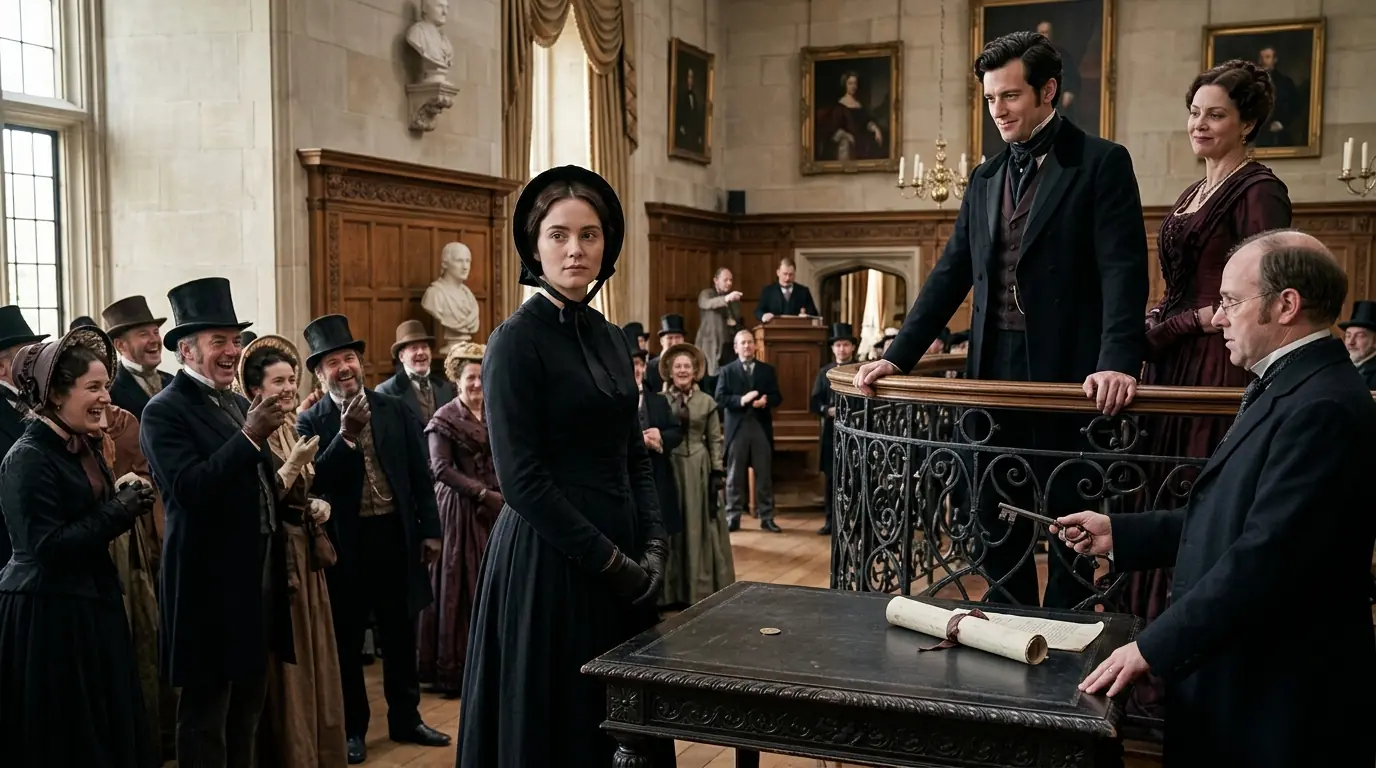
For 23-year-old Eleanor Ashford, this was no idle question.
In the spring of 1862, at a public auction held in the grand hall of Blackwood Estate, she stood before a room of sneering gentry and placed a single worn pound coin on the auctioneer's table. The price, as decreed by the seventh Duke of Ravensmere, for the derelict manor known as Grey Hollow, a place so forsaken it had been struck from the family's official records.
The Duke himself, a man whose arrogance was matched only by his disdain for those he deemed beneath him, had watched from the gallery with cold amusement as she signed the deed. But the truth waiting in the overgrown gardens and sealed chambers of that forsaken place was a legacy worth more than all the Duke's land combined. And it would bring him back to her door, humbled and astonished, exactly one year later.
Settle in and let us travel back to the moors of Yorkshire in 1862, to a story of quiet defiance and a manor that remembered what its masters had forgotten.
The journey to Grey Hollow was a punishment delivered in the language of rain and rutted roads. Eleanor Ashford sat alone in the hired cart, her single trunk lashed down with fraying rope, her black mourning dress already mud-splattered from the wheels. She had been a governess for 3 years, a schoolmaster's daughter for all her life.
The memory of the auction was still sharp as broken glass. The Duke of Ravensmere, standing in his fine tailored coat, had addressed the assembled crowd with theatrical contempt.
"To Miss Eleanor Ashford," he had announced, his voice dripping with mockery, "I bequeath Grey Hollow Manor, that monument to my family's most regrettable eccentricities, for the sum of £1. May she find it suits her station."
Laughter had rippled through the hall, the cruel, delighted laughter of those who enjoy watching others be put in their place.
Eleanor had not argued. She had not wept. She had simply walked to the table, placed her coin down with steady fingers, and taken the iron key the solicitor offered with visible embarrassment.
The Duke's cousin, a pinch-faced woman named Lady Margaret, had whispered loudly enough for all to hear, "The girl hasn't the faintest idea what she's taken on. Grey Hollow will swallow her whole."
Now, as the cart crested the final hill and the manor came into view, Eleanor understood what they had meant. Grey Hollow was not a house, it was a ruin in waiting.
The stone facade was choked with ivy so thick it obscured half the windows. The roof sagged ominously over the east wing, and one of the chimneys had collapsed entirely, its bricks scattered across the overgrown courtyard like broken teeth. The iron gates hung open on rusted hinges, and the drive was lost beneath a sea of waist-high weeds and brambles.
For a long moment, Eleanor simply sat in the cart, the rain plastering her dark hair to her pale cheeks, and let the sheer enormity of the place wash over her.
This was their final insult. This was what they thought she was worth.
She thought of her father, dead these six months, who had taught her that knowledge was the only inheritance that could not be taken away. She thought of the Duke's smirk, of Lady Margaret's whisper, of the solicitor's pitying glance.
Taking a slow, steadying breath, she climbed down from the cart, her boots sinking into the mud. The driver, a grizzled man named Tobias, who had said perhaps 10 words the entire journey, handed down her trunk with a grunt.
"You'll not last the week, miss," he muttered, not unkindly. "This place has a reputation. They say the old Duchess went mad here."
"Then I shall have to prove more resilient than a Duchess," Eleanor replied quietly.
She paid him the last of her traveling money, shouldered her bag, and walked alone through the broken gates toward the house that was meant to be her exile.
The door was not locked. It was simply swollen shut from years of damp. It took all Eleanor's strength, her slight frame braced against the weathered oak, to force it open with a groan of tortured wood.
The entrance hall beyond was a cavern of shadows and dust. A grand staircase, its balustrade carved with intricate scrollwork, rose into the gloom. Portraits lined the walls, their subjects' faces obscured by grime and cobwebs. The air smelled of mildew, old stone, and something faintly sweet. Rot, perhaps, or the ghost of long-dead flowers. Rain dripped steadily through a hole in the ceiling, forming a black pool on the marble floor.
There was no furniture to speak of. A few broken chairs lay scattered about like the bones of some forgotten feast. The hearth was cold and choked with debris. This was not a home. It was a mausoleum.
Eleanor set down her trunk and walked slowly through the hall. Her footsteps echoing in the emptiness. She was alone, forgotten, and housed in a ruin that the Duke had given her as a joke. But as she stood there in the failing light, something caught her eye.
Beneath the grime of the largest portrait, a stern-faced woman in Elizabethan dress, there was a small brass plaque, nearly invisible under layers of dust. Eleanor pulled a handkerchief from her pocket and wiped it clean.
The inscription read: "Duchess Thomasina Ravensmere, 1580 to 1642. Botanist, healer, builder of the gardens."
Eleanor stared at the words. A Duchess who was a botanist? In the 16th century? She looked around the hall with new eyes. The carved scrollwork on the balustrade was not decorative. It was a repeating pattern of leaves and vines, each species rendered with botanical precision. The faded frescoes on the ceiling, barely visible through the water damage, depicted not mythological scenes, but cultivated gardens labeled in faint Latin script.