You there, girl, take my coat and tell your mistress the Duke of Grantmere is waiting and that he does not wait long. The young woman on the step of Renfield House looked at him for a moment with an expression he could not read at all, and then she took his coat. Yes, sir, she said. Ambrose Vane, seventh Duke of Grantmere, was in a foul humor, and being in a foul humor had always made him worse than he meant to be. He had driven forty miles in the rain because his sister had begged him to.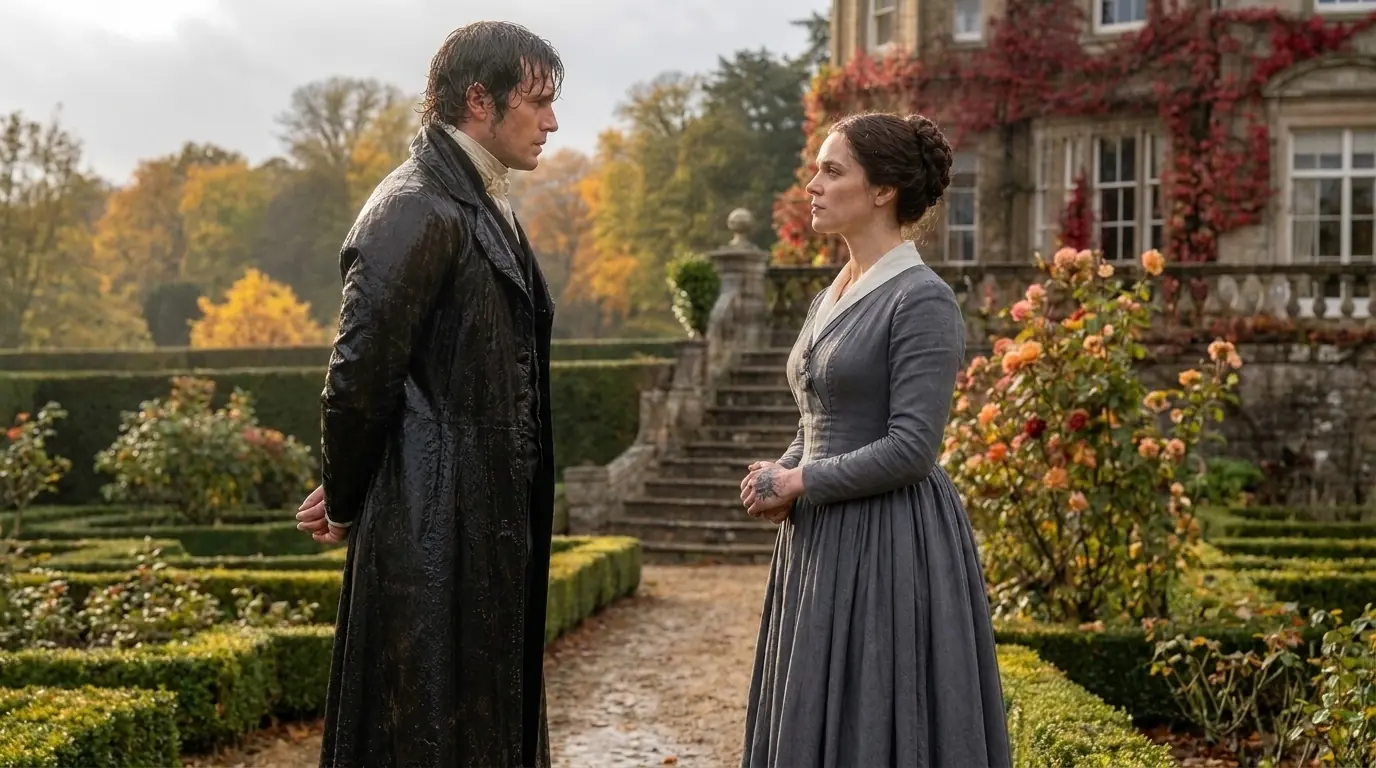
He had come to a house he had never heard of in a county he despised to look at a stud farm he had no intention of buying at the invitation of a proprietor whose name he had not troubled to learn some widow presumably or some cit's daughter with more money than breeding and the drive had been washed out at the ford and his offside leader had thrown a shoe and he had walked the last mile and a half in a downpour so he did not look at the woman who took his coat he looked at the hall and the hall stopped him where he stood. It was not grand. That was the strange thing. Grantmere Abbey had 200 rooms and a marble staircase that had cost £11,000. And Ambrose had never once thought about it.
This hall was perhaps thirty feet square, paneled in old oak polished to the color of dark honey, with a stone floor scrubbed white and a fire of applewood burning at one end, and a great blue and white bowl of late roses on a table by the stairs. There was a smell of beeswax and apples and woodsmoke. Somewhere overhead a clock ticked unhurriedly as though it had all the time in the world. Ambrose Vane, who had been cold for eleven years and did not know it, stood dripping on that scrubbed floor and felt something in the back of his throat that he could not name and did not care for. Well, he said more sharply than he intended.
Your mistress, go and fetch her. The girl, the woman, she was not a girl. She was perhaps eight-and-twenty. She hung his coat over her arm with great care. May I take your gloves, sir?
You may, and be quick. She was not quick. She was unhurried precisely as the clock was unhurried and it maddened him. She took his gloves and set them on the settle to dry. And she looked at his boots, which were ruined, and at his hat, which was worse, and she said, You walked from the ford.
I did. The ford is bad in October. It has been mended twice, and it wants doing properly, but the parish will not, and I have not the leave to do it myself, she said it perfectly evenly. Will you have brandy or tea, sir? I will have my host, said Ambrose, and I will have her within the quarter hour, and if she is not accustomed to keeping dukes standing in wet boots in a hallway, she may begin as she means to go on.
The woman looked at him then. She had a plain gown of gray stuff, a white collar, no jewelry whatever except a small watch pinned at her breast. Her hair was brown and pinned back without a curl in it. Her hands were capable and ink stained at the first finger. She was not a beauty.
There were books on the table under the window, not ornamental books, used ones with the corners soft. There was a ledger open in a small clear hand with columns ruled in red ink. There was a great map of the estate pinned to the paneling by the door, with a dozen little annotations in pencil: drainage; hedge to be laid, May 14th. On the mantel stood a china dog of surpassing ugliness. Ambrose was still looking at the china dog when a manservant came and said, Your Grace, I beg your pardon. The mistress will see you in the estate room.
Ambrose Vane walked into the estate room of Renfield House and found the girl who had taken his coat sitting behind the desk. She had not changed her gown. She had not put up her hair or pinned on a brooch or made a single concession to him. She sat behind a broad oak desk with a ledger open in front of her and a pen in her hand. She rose.
Your Grace, she said. I am Tabitha Ren. Renfield is mine. Will you sit down? There was a silence of some length. Ambrose Vane had faced a Commons committee, a duel at nineteen, and his own father. He had never in his life wished so entirely to be somewhere else.
You, he said, took my coat. You held it out to me. You allowed me. He stopped. He was aware with horrible clarity of every word he had said in that hall, and of the tone in which he had said them, and of the fact that this woman had heard all of it, and had gone away with a smile on her face, and had spent 20 minutes doing, he now understood precisely nothing at all, except letting him stand in his own wrongness like a man in the rain.
You allowed me to believe you are a servant. You did not require any allowing, said Tabitha Ren. You did it entirely without assistance. I only declined to interrupt you. She sat down and gestured to the chair opposite and after a moment stiffly he took it.
Do not be too hard on yourself. Your Grace. Nine gentlemen in ten do the same. They arrive. They see a plain woman in a gray gown who is not being idle.
And they conclude. It is a very restful thing to be concluded about. One learns a great deal. You are laughing at me. I am not.
She looked up and her eyes brown, unremarkable, and steadier than any he had met in 20 years, held his without the smallest apology. If I were laughing at you, Your Grace, you would know. I am doing something you will like a great deal less. I am declining to be embarrassed. Ambrose stared at her.
I do not embarrass easily, Tabitha Ren went on, dipping her pen. I was a governess for six years and a bailiff's clerk for four and I have been shouted at by better men than you and worse ones and I have found that the shouting is never really about me. Now you have come about the stud. You have driven forty miles in the rain. You have ruined a very good pair of boots and I do not think you want a horse at all.
Shall we save each other's afternoon? Why are you here? My sister, Ambrose said before he had decided to say anything, is dying. The pen stopped. He had not meant to say it.
He had not said it aloud to anyone. Not to his steward, not to his physician, not to Cecily herself. It had sat in his chest for five months like a stone in a shoe. Tabitha Ren set the pen down. I am sorry, she said.
Nothing else. No fluttering, no exclaiming, no small hot rush of pity. She simply put down the pen and said it and let it be true. She is nine-and-twenty. Ambrose heard himself say she has a wasting of the lungs and the doctors give her a year and are lying and she has one thing left that she wants which is a gray mare.
She had a gray mare when she was 15. It was sold when my father died along with a good deal else and she has never said one word of reproach to me about it in 14 years. His jaw was tight. There is a gray at Renfield out of Sorrow by Lucifer. She saw it in a catalog.
So, I have come to buy it, and I do not care what it costs, and I have been abominably rude to you, madam, and I find I have no defense to offer except that I have not slept properly since June. The rain went on against the windows. Tabitha Ren rose and went to the door, and said to somebody outside, The brandy, and the good glasses, and tell Hobbes to put his grace's team up for the night, and send to the ford for the carriage. Then she came back and sat down and folded her hands. Her name is Silverwood.
She is five years old and she is the best-mannered mare I have ever bred and she will stand like a rock for a rider who is not the strength she once had. She is not for sale. Ambrose's head came up. Madam, she is not for sale, said Tabitha Ren, because I will not sell a horse to a man who has not seen her on a day when he is too deep in grief to judge clearly. You would give me £1,000 this afternoon and hate me by Christmas.
She met his eyes. Stay until tomorrow. Look at her. Sit on her. If she is right for your sister, you shall have her for what she is worth, and not a shilling more.
And if she is wrong, I will find you one that is right, if it takes until spring. And if you are going to shout at me again Your Grace, kindly do it now, so that we may have it over before the brandy comes. Ambrose Vane looked at the plain woman behind the oak desk for a long, long moment. No, he said at last, and his voice was not quite steady. No, I do not think I shall shout at you again.
He stayed until the next day. Then he stayed until the day after that. The mare was gray as a winter sea and stood 16 hands and turned her head to the gate when Tabitha Ren whistled and Ambrose, who had ridden all his life and been bored by horses since he was 30 stood in a wet paddock in borrowed boots and watched a woman in a gray gown put a 5-year-old mare through her paces on a leading rein and thought that he had never seen anything done so well by anybody. She was born in that box behind you. Tabitha said at two in the morning in a snowstorm and I sat up with dam for 9 hours and got frostbite in two toes for my trouble.
The dam, Sorrel, would have died. I did not let her. She rubbed the mare's nose. Everything at Renfield was born here or came here half dead. It is the only kind of stock I can afford.
Where did the money come from? Ambrose asked. He expected her to bristle. She did not. Me?
Where else? she said. He learned it in pieces over 5 days because she did not tell stories about herself and had to be quarried. Her father had been a country attorney who died owing more than he owned. At 17, she had gone out as a governess to a family in Yorkshire who paid her £22 a year and once memorably forgot her at an inn for a day and a half.
At three-and-twenty, she had taken a place as clerk to a land agent because she could keep a ledger better than any man in the office, and the agent was too idle to care what she wore. She had learned drainage. she had learned entails, enclosure, and the price of a ton of lime laid down at the field gate. And at seven-and-twenty she had taken every penny she had, £311, saved shilling by shilling over 10 years, and bought the bankrupt lease of a ruined farm called Renfield with a leaking roof, 40 acres of couch grass, and a good spring. That had been 8 years ago. Renfield now ran to 1,100 acres.
It bred nineteen horses a year and sold every one of them, and it employed forty people, and it had, Ambrose discovered, by looking at the ledgers she left lying open in front of him with what he was fairly sure was deliberate carelessness, cleared £4,000 in the previous twelve months. You are the best land agent in England, he told her on the fourth evening in the hall by the applewood fire. I am the best land agent in this county, said Tabitha Ren, and it has done me no good whatever, because I am a woman, and so I am not a land agent at all. I am a curiosity. Lord Breakwell up the valley will not deal with me directly.
He sends his steward, and his steward calls me the Ren woman in the inn. And last spring three gentlemen who wanted the ford mended refused to sit at a table where I was because of no husband and no rank, and I once, God forgive me, worked for wages. She poured his brandy. It is not tragic. It is only tiresome.
I have a fire and a good horse, and I have never once had to ask a man's leave for anything, and I would not trade that for a coronet, Your Grace. So do not look at me as though I ought to be pitied. I was not pitying you, said Ambrose. Then what were you doing? He was in fact watching the fire light move on her plain brown hair and thinking that he had spent his whole life in rooms full of beautiful women and could not at that moment have described the face of a single one of them. Counting, he said.
Counting what? The number of things I said in that hall on Monday, said Ambrose Vane, that I would give a great deal to have back. Tabitha Ren looked at him over the rim of her glass, and for the first time in 5 days, she did not have an answer ready. He wrote to Cecily. He wrote every night in the estate room with Tabitha working across the desk from him, and it became a habit so quickly that he did not notice it becoming one.
He wrote about the mare. Then he wrote about the ford and about a bad-tempered colt called Havoc and about a dairy maid who had put a frog in the churn. And then one night, without knowing quite why, he wrote, There is a woman here who is not afraid of me. I do not think I have ever met one before. She is not beautiful, and she is not young, and she has been rude to me four times, and right on every occasion, and I have not felt so much like a man, and so little like a monument since before our father died.
Cecily's answer came back in a week in the shaky hand that broke his heart every time he saw it. Bring her. He did not bring her. He brought the mare. He came back to Grantmere Abbey in November with Silverwood led behind the carriage.
And he took his sister out in her chair to the mounting block in the pale sun. And Cecily Vane put her thin hand on that gray neck and cried and did not stop crying and laughed while she did it. And Silverwood stood like a rock exactly as she had been promised to. She is perfect, Cecily said. Ambrose, she is perfect.
Who chose her? Miss Ren chose her. Then why? said his sister. Is Miss Ren not here? He went back at Christmas.
He told himself it was about the ford. He paid for the ford. It cost him £240, and he had it done properly in stone. And he did it through the parish so that no one should say she had been bought. And Tabitha Ren found out inside a fortnight and rode eleven miles in sleet to tell him exactly what she thought of a man who did a woman a kindness behind her back. She stood in his own courtyard at Grantmere Abbey with her habit soaked to the knee and her hair coming down and told him he was high-handed, patronizing, and incapable of distinguishing between generosity and control, and that if he ever again mended anything of hers without asking, she would send him the bill for it.
And Ambrose Vane stood on the steps of a house with 200 rooms and listened to her with his heart going like a hammer and thought that this was the thing he had been waiting the whole of his life for and had never once known the name of. Are you finished? he said when she had run out of breath. No, take as long as you like, said Ambrose. only come inside first because you are soaked through and my sister has been asking for you since November and if you catch cold in my courtyard being magnificent at me I shall never forgive myself. Tabitha Ren stayed at Grantmere Abbey for three weeks. She and Cecily were thick as thieves inside two days.
He would come into the long gallery and find them with their heads together over a stud book or a novel or once the household accounts of Grantmere Abbey which Tabitha had gone through with a red pencil and about which she had a very great deal to say. Your steward is not dishonest. She told him he is worse. He is comfortable. You are being charged one shilling and three pence a bushel over the market for oats because nobody has asked the price of oats at Grantmere since the year '06.
And the reason nobody has asked is that you are a duke and nobody asks you anything and you have let them. And what do you propose? I propose that you get up at six tomorrow, said Tabitha Ren. And come round the home farm with me, and that you look at your own drains with your own eyes for the first time in your life. He got up at six.
He was 39 years old, and he had never in his life been happy at six in the morning. He walked the home farm of Grantmere Abbey in the frost with a woman in a plain gray habit who told him what was wrong with it and he laughed aloud twice and Cecily watched them come back across the park from the window of the long gallery and said nothing at all and smiled. It was Cecily who forced it in the end she had a year and she knew it and she had no patience left for anything but the truth. You are in love with her, she said on a black afternoon in February, with the fire built up and her hands cold in his. Do not tell me you are not Ambrose. I've not the time.
She is a farmer. She is a horse breeder. She was a governess. She has no family, no rank, no fortune to speak of, and she has been in service. Yes, said Cecily.
Ambrose Vane sat by his dying sister's chair and could not for the life of him produce an end. They will cut her, he said at last quietly. That is the whole of it, Cecily. It is not what I think. I do not give a straw what she was.
But if I marry her, they will make her pay for it every day of her life, every drawing room in England, every dinner, every damned county ball. She has built something out of nothing with her own two hands, and she is prouder of it than any man I know has a right to be of anything. And I will not, his voice cracked, and he mastered it. I will not put her in a room where she is looked at as I looked at her on that first day. In her own hall, there was a silence.
Ambrose Vane, you great fool, Cecily said. You are the Duke of Grantmere. You cannot stop them from looking. She squeezed his hand with what strength she had.
But you can stand next to her while they do it. That is all a woman ever wanted from a man in this world, not to be protected from the room, to be stood beside in it. He went to Renfield in March. He got as far as the ford, the new one, the good stone one that he had paid for and been shouted at for. And there he found Tabitha Ren on the far bank in the early light in her gray habit, watching the water come over the sill.
And he sat his horse in the middle of his own bridge and could not for a moment go on. It holds, she called. It holds, he agreed. Was there something you wanted, Your Grace? Ambrose Vane rode across the ford.
Yes, he said. As it happens, there was. She said no. She said it standing in the estate room at Renfield with her back to the window and her hands quite still and she said it kindly which was worse than anything. I am five-and-thirty years old.
She said, I have £300 in the funds, 1,100 acres, and forty people whose bread depends on me and I built every yard of it out of a leaking roof and a good spring and I did it alone. If I marry you, Your Grace, the law would give you the whole of it before the ink is dry. Renfield will be yours. My horses will be yours. My name will be gone.
And in ten years they will say, they will all say that the clever Duke of Grantmere bought up a nice little stud in the West Country and set his wife to play at it. Her voice did not shake and you would never say it. I know you would never say it, but I would hear it every day in the silence where it was not said. Ambrose Vane stood in the middle of the room he had first walked into in a rage in wet boots. Is that all?
Is that not enough? It is a great deal, he agreed. It is also entirely soluble by a competent attorney. And if that is your only objection, I shall have a conveyancer down from London by Thursday, and we may be married on Saturday. He took one step closer.
Tabitha, look at me and tell me you do not want it, and I will get on my horse, and you will never see me again. And I will not blame you for one hour of it. But do not tell me about the law. The law is a thing men wrote. I am one of the men who writes it. Renfield can be settled on you absolutely to your sole and separate use.
Beyond my reach, beyond my heirs' reach in perpetuity. It takes four sheets of parchment and a morning. She stared at him. You would sign that? I would have signed it in October, said Ambrose.
I did not offer because I have spent my whole life having things given to me and I have only just learned from you that a gift can be an insult if it is not asked for first. He held out his hand palm up. So I am asking not for Renfield, not for the horses. I am asking whether the woman who took my coat and let me stand in my own arrogance for 20 minutes and then gave me a mare for my sister and would not take my money for it and mended my accounts and got me out of bed at six in the morning and shouted at me in my own courtyard until I understood myself for the first time in 11 years whether she could bear to be looked at for the rest of her life by a man who thinks she is the finest thing this country has produced in a hundred years. Tabitha Ren put her hand over her mouth.
Because they will look at you, he said more quietly. I will not lie to you. The county will look and the drawing rooms will look and there will be evenings when it is very hard. I cannot stop that. I can only tell you then every one of those evenings I will be standing beside you, and that I would rather be cut by the whole of England with you, than be bowed to by it alone.
There was a very long silence in the estate room at Renfield. Six in the morning is not early, Your Grace, Tabitha Ren said unevenly. That is a lie, Ambrose replied. Is that a yes? It is a yes, she said, and burst into tears and was extremely angry about it. They were cut, of course.
Not everywhere and not for long, but they were cut. The worst of it came at the county assembly at Michaelmas, 3 weeks before the wedding, when Ambrose brought her into a ballroom full of people who had spent the summer saying the word governess to one another in a particular tone, and the hum went out of the room like air out of a bellows. Lady Breakwell was equal to the occasion. Lady Breakwell had a great deal of presence and forty years of practice. And she looked at Tabitha Ren's plain white gown and her one string of pearls, and she said sweetly, loudly, in the exact hush, Miss Ren, how very brave of you.
Tell me, is it true you're in service? Ambrose felt Tabitha's hand tighten on his arm. He drew breath to destroy the woman, and Tabitha Ren said, Yes, just that, perfectly clear, perfectly calm, into a silent room. I was a governess for six years, she went on at £22 a year, and a clerk to a land agent for four. I saved £311 and I bought a bankrupt farm with a hole in the roof and I have made it pay every year for nine years.
She smiled at Lady Breakwell with what Ambrose could only describe as genuine pleasure. Your husband's steward buys his lime from me, ma'am. He has done for three years. I dare say he has not mentioned it. Men so seldom do.
Somebody somewhere near the card room door laughed out loud. And I am not brave, said Tabitha. It requires no courage whatever to tell the truth about oneself in a room where everybody has already decided what one is. The courage was in the first winter when the roof went and there was no one to ask for help and I stood in four inches of water in my own kitchen at two in the morning and did not go back to being a governess. She inclined her head very slightly.
I hope you will forgive the plain speaking. I was not brought up to it, but I have had to learn. And then she turned to Ambrose and said in an entirely different voice, Your Grace, they are striking up. You promised me a waltz, and I have never danced one in my life, and I intend to be very bad at it in front of everybody. He was so much in love with her that he could not speak.
He danced with her. She was very bad at it. He did not care in the smallest degree, and neither visibly did she. By the end of the evening, there were four women waiting to be presented to her, and Lord Breakwell had come across the room in person to ask her opinion about a bull. They were married in October in the little church at Renfield, with the doors open and the smell of applewood smoke coming across the churchyard from the house. Cecily Vane came to the wedding.
She came in a chair and she was carried into the church by two grooms and out of it by her brother and she wore blue and she looked at Tabitha in the porch and said, Well, it took him 11 months and I very nearly did not have the patience. And Tabitha laughed and knelt down in her wedding gown on the flagstones and put her arms around her. Cecily lived until the spring. She lived to see Silverwood’s first foal, a gray filly born at two in the morning in a snowstorm with Tabitha and Ambrose both in the box and the Duke of Grantmere in his shirt sleeves holding a lantern and she named it Christmas for no reason she would ever give. And she died in April in the long gallery with the windows open and her brother holding her hand and her sister-in-law reading aloud to her from a stud book because it was what she had asked for.
Ambrose grieved for a year. Tabitha did not try to shorten it by an hour and did not once leave him alone in it, and he learned that those two things are the same thing. The deed was signed on the Thursday before the wedding, on four sheets of parchment, exactly as he had promised. Renfield House and its 1,100 acres remained the sole and separate property of Tabitha Ren to her use absolutely beyond the reach of her husband and his heirs forever. She signed it in her small clear hand and then being a practical woman immediately put the deed in the estate room safe and went out to look at a colt. She kept the name over the gate.
She kept the ledgers and within 3 years the Duke of Grantmere's home farm was the best-run acreage in two counties because the Duchess of Grantmere got up at six and went round the drains with her own eyes and would tell any man to his face exactly how much he was being cheated by the bushel and the great families who had said governess in that particular tone came in time to say, You must ask the Duchess, in quite another one, which she found a good deal more satisfying than being forgiven. He never entirely forgave himself for the hall. She would not let him. It became the great joke of their marriage. He would come in wet from the yard and hold out his coat to her without thinking, and she would take it with a grave little Yes, sir, and hang it on the settle, and he would put his face in his hands.
You will never let me forget it, he said once. Never, said Tabitha, and kissed him. It is the best thing that ever happened to either of us, Ambrose. You walked into my house and you did not see me at all. And then you stayed until you did.
There is not one man in a hundred who stays. He stood in the paneled hall of Renfield House with his wife's hands in his and the fire of applewood burning at the end of it and the ugly china dog on the mantel and the great blue and white bowl of late roses on the table by the stairs and the clock ticking overhead as though it had all the time in the world. I was in a foul humor, he said. I was cold and I was frightened for Cecily, and I had been walking in the rain for a mile and a half. You were, Tabitha agreed.
And I looked at the best woman in England, said Ambrose Vane, and I saw a girl to take my coat. You did. She reached up and straightened his collar the way she did every morning of their lives. And then you looked again. That is the whole of it, my love.
Anybody may be blind once. It is what a man does the second time he opens his eyes.