In the gilded cages of Regency London, a lady’s reputation is her only currency, and her silence is her greatest virtue. But for Juliet, the nib of a pen is a rebel’s blade. When a cynical lord dares to challenge her intellect in the public press, a war of ink begins, one that blurs the line between hatred and heartbeat. In the shadow of the ballroom, a secret correspondence is ignited, proving that the most dangerous fires are those fed by words alone.
The scent of walnut ink and stale tea was more comforting to Juliet Vance than the cloying aroma of lilies that currently choked her aunt’s drawing room. Beneath the mahogany desk in the corner of the library, a room rarely disturbed by the frivolous inhabitants of the house, Juliet’s fingers were stained a telltale charcoal. She did not mind. The smudge on her index finger was a badge of war. Spread before her was the latest edition of the Lady’s Weekly Gazette.
Usually her column, written under the pseudonym The Mediator, was a sanctuary for wives seeking patience or debutantes navigating the treacherous waters of the marriage mart. But this morning the paper carried a guest editorial that had set Juliet’s blood to a slow rolling boil. It was signed simply, “B.” “Be the modern woman,” B had written with a pen dipped in pure vitriol. “She seeks the elevation of her mind only to the detriment of her grace. She mistakes opinion for intelligence and sharp-tongued retort for character. One finds more warmth in a winter frost than in a lady who fancies herself a philosopher.”
“Arrogant, narrow-minded pig,” Juliet whispered, the words catching in the back of her throat. She dipped her quill, the nib scratching aggressively against the vellum. She didn’t just want to refute him. She wanted to dismantle him. “To Mr. B,” she began, her handwriting elegant yet forceful. “It appears your understanding of the female mind is as shallow as the puddles in Cheapside after a light rain. Perhaps if you sought a companion rather than a mirror for your own vanity, you would find that a woman’s grace is not diminished by her ability to think, but rather enhanced by her refusal to endure the company of a boor.”
She continued for three pages, her heart hammering against the rigid stays of her corset. It was a physical ache, this need to be heard, to scream into the void of a society that viewed her as a decorative object to be traded for land and titles. When she finished, she sealed the letter with a plain wax wafer, her chest heaving as if she had just run a mile through the park. The assembly at the Cavendish Ball three nights later was a suffocating sea of silk, candlelight, and forced smiles.
Juliet forced her features into a mask of placid indifference, though her eyes scanned the crowd for an exit. Then the crowd parted, and the Marquis appeared. He was not what she expected. He did not look like a man of leisure. He looked like a man carved from the very cliffs of Cornwall, harsh, angular, and brooding. His dark hair was windswept despite the stillness of the room, and his eyes, a piercing, cynical gray, seemed to strip away the artifice of everyone they landed upon.
“Lord Blackwood,” her father beamed. “May I present my daughter, Lady Juliet Vance.” Blackwood offered a bow that was technically perfect, yet somehow felt like an insult. “Lady Juliet,” she replied, her voice a cool chime. “I have heard much of your accomplishments,” Blackwood said, his gaze lingering on her face with a scrutiny that made her skin prickle. “Your father tells me you are quite the reader.”
“I find books to be more consistent than people, my lord,” Juliet said, the wit slipping out before she could check it. “They do not change their mind simply to suit the fashion of the hour.” Blackwood’s eyebrow arched. “A pity. I find that people who live entirely in books often forget how to breathe in the real world. They mistake the ink on a page for the blood in their veins.”
Juliet’s breath hitched. It was a direct echo of the editorial she had shredded only days ago. The ink for the blood. “Perhaps,” she countered, her voice dropping an octave, “it is because the real world offers so little worth breathing in. Most men prefer a woman to be a silent portrait. It is only in the written word that one finds the courage to be a person.” A flash of something—was it recognition, irritation?—ignited in Blackwood’s gray eyes.
He stepped closer, invading her personal space until she could smell the faint masculine scent of sandalwood and rain. “And do you find yourself to be a person tonight, Lady Juliet? Or are you merely a portrait in a very expensive frame?” “I am a woman who knows her own mind, Lord Blackwood. A concept I imagine you find utterly terrifying.” The silence between them stretched, taut as a bowstring. Her father coughed nervously, sensing the sudden drop in temperature, but Blackwood didn’t look away.
A smirk, dark and knowing, ghosted across his lips. “Terrifying? No. Merely exhausting.” He bowed again and walked away, leaving Juliet trembling with a cocktail of fury and a strange, terrifying electricity. She hated him. She absolutely loathed him. He was the embodiment of everything B stood for. And yet, as she watched him disappear into the crowd, her first thought was not of the insult he had leveled at her. It was of the desk in her library, and how much she couldn’t wait to get back to her pen.
In the quiet hours, when the moon hung like a silver sickle over the rooftops of Mayfair, Juliet poured her soul into the vellum. No longer was she merely The Mediator defending her sex. She was a woman unmasking herself to a stranger who seemed to see through the ink to her very heart. “You speak of the winter frost in a woman’s mind,” she wrote, her hand trembling slightly as she leaned closer to the flickering taper. “But have you never considered that frost is merely a shield? Beneath the ice there is a river that runs deep and fast, terrified of being damned by the expectations of men who wish only for a stagnant pond.”
The reply that arrived via the Gazette’s discreet post three days later had made her knees weak. “Perhaps,” B wrote, his script now familiar to her as the map of her own palm, “I have spent so long bracing against the cold that I have forgotten how to swim. You challenge me, Mediator. You make me wonder if the silence I have cultivated is not strength but a tomb. Tell me, does your river ever long for the sea? Or is it content to hide behind the frost?”
She had pressed the letter to her chest, the scent of expensive tobacco and cedarwood clinging to the paper, a ghost of a man she had never truly met. The reality of Lord Blackwood, however, was a far more abrasive affair. Two weeks into their acquaintance, Juliet found herself trapped in a carriage with the man, her father, and her aunt en route to a botanical exhibition at Kew. The air inside the coach was thick with the scent of damp wool and her aunt’s lavender water.
Blackwood sat opposite her, his long legs folded awkwardly in the cramped space. He looked bored, his gaze fixed on the passing hedgerows. Yet there was a tension in his jaw that suggested he was just as restless as she. “I trust you found the latest discourse on the corn laws in The Times enlightening, Lady Juliet,” her father asked, clearly trying to prompt a display of her intellect to impress the Marquis. “I found it repetitive, Father,” Juliet said, her eyes inadvertently meeting Blackwood’s. “Much like the conversation at last night’s supper.”
Blackwood’s lips quirked. “Repetition is the refuge of the unimaginative, Lady Juliet. But then society thrives on the predictable. It finds comfort in knowing exactly what a lady will say before she even opens her mouth.” “Then I must be a great disappointment to society,” she retorted, “for I find the predictable to be a slow death of the spirit.” “A sentiment many share in secret,” Blackwood murmured, his voice dropping an octave as the carriage jolted over a rut. His hand shot out to steady her, his fingers wrapping around her forearm.
Even through the silk of her sleeve and the kid leather of her glove, the contact felt like a lightning strike. She gasped softly, her eyes widening. For a fleeting second, the cynical mask he wore slipped. She saw a flash of the same yearning she had read in B’s letters, a hunger for something real, something visceral. He didn’t pull away immediately. His thumb grazed the pulse point at her wrist, and Juliet felt as though he were reading her heart through her skin.
The familiarity was jarring. It was the same electric charge she felt when reading B’s words, yet it was wrapped in the body of a man she was supposed to despise. “You have a very expressive countenance, Lady Juliet,” he said, his voice husky. “It is a pity you feel the need to hide it behind such sharp barbs.” “And you, my lord, are a hypocrite,” she whispered, her breath hitching. “You mock the silent portrait, but you are a man of stone yourself.”
He released her as the carriage came to a halt, the moment shattered by the footman opening the door. As the week progressed, the horror of her situation began to crystallize. Her father spoke of nothing but the inevitable match. Blackwood was attentive in the most frustratingly formal ways, sending bouquets of white roses that Juliet found bloodless and boring, escorting her to operas where he sat in brooding silence, and engaging in verbal sparring matches that left her exhausted and strangely exhilarated.
But every night she returned to B. “I am being pursued by a man who is a shadow,” she wrote to her anonymous pen pal, her eyes stinging with unshed tears. “He is everything society admires—rich, titled, handsome in a way that hurts to look at—but he sees only the lady and never the woman. I dread his proposal, for to marry him would be to sign a treaty of perpetual silence. I find I am falling in love with a ghost while a living man prepares to claim my life.”
She didn’t know that miles away Arthur Blackwood sat at his own desk staring at the same moon, reading her words and feeling a mirror of her agony. He was falling for a woman of ink and soul, while he was duty-bound to propose to the Earl’s daughter, a woman who, despite her flashes of brilliance, seemed to loathe the very ground he walked on. The trap was closing, and Juliet could hear the heavy thud of the iron gates.
The post arrived on a Tuesday, carried through a torrential downpour that turned the London streets into a gray churning river. When Juliet broke the seal of B’s latest missive, she expected another spirited debate on the merits of independence. Instead, the paper felt heavy with a silence she didn’t recognize. The handwriting, usually so precise and arrogant, was jagged. The ink splattered in places as if the pen had been gripped with white-knuckled desperation.
“I find the mask slipping tonight, Mediator,” he wrote. “I am haunted by the ghost of a brother who was everything I am not—vibrant, loved, and whole. It is the anniversary of his passing, and the weight of the title I never wanted feels like a shroud. I am surrounded by people who celebrate the Marquis, but not a soul who remembers the boy. Is this all there is? To be a vessel for a name while the man inside withers into nothing?”
Juliet felt a hollow ache in her chest, a phantom pain that mirrored his own. She forgot the game. She forgot the anonymity. She sat at her desk, the sound of the rain lashing against the windowpane echoing the turmoil in her heart. “Grief is not a failing of character,” she wrote back, her pen flying across the page. “It is the price we pay for having loved. Do not begrudge yourself the shadow. For only things of substance cast one. You are not a vessel, my friend. You are the architect of your own soul. If the world only sees the Marquis, then the world is blind. But I see the man who writes with the fire of a thousand suns. Do not let the shroud extinguish that light.”
The following evening the atmosphere at the Marquess of Salisbury’s soirée was stifling. Juliet stood near the refreshment table, her head throbbing. Lord Sterling, a man whose ego was matched only by the gaudiness of his waistcoat, had cornered her. “Truly, Lady Juliet,” Sterling drawled, his breath smelling of cheap brandy. “I heard of your performance at the Cavendish Ball. Such spirited opinions for a debutante. One wonders if you spend too much time in your father’s library. It is a well-known fact that too much Greek and Latin can addle the feminine humors. It makes a woman difficult to manage.”
A few nearby gentlemen chuckled, and Juliet felt a familiar heat rise in her cheeks—not of shame, but of a simmering righteous fury. She opened her mouth to deliver a scathing rebuttal, but a shadow fell over her. “Difficult to manage, Sterling?” The voice was low, vibrating with a cold, controlled power. Lord Blackwood stepped into the circle, his presence effectively sucking the air out of the room. He didn’t look at Juliet. His gaze was fixed entirely on Sterling, and it was lethal.
“I find,” Blackwood continued, his tone dangerously smooth, “that only men of small stature and even smaller intellect find a woman’s mind difficult. To a man of substance, a woman’s wit is a prize, not a problem. Lady Juliet’s intelligence is not a malady to be cured, but a standard to which you evidently cannot hope to aspire.” The room went deathly silent. Sterling’s face turned a mottled purple. “I merely meant—” “I care little for what you meant,” Blackwood interrupted, stepping closer until Sterling was forced to retreat. “I care only for what you said. You will apologize to Lady Juliet for your insolence, or you will find that my patience for fools has reached its absolute limit.”
Sterling stammered an incoherent apology and vanished into the crowd. Juliet stood frozen, her heart drumming a frantic rhythm against her ribs. She looked up at Blackwood, expecting to see the usual mask of cynical indifference. Instead, she saw a raw protective intensity in his gray eyes, the same fire she had felt in B’s letters. “You did not need to do that, my lord,” she whispered, her voice trembling. “I am well equipped to handle men like Sterling.”
“I know you are,” Blackwood said, and for the first time he gave her a true smile, a small, tired, yet incredibly tender expression that reached his eyes. “But just because you can fight every battle alone, Juliet, does not mean you should.” In that moment, the lines between the anonymous writer and the brooding Marquis blurred until they were indistinguishable. The man who had defended her honor was the same man who had confessed his grief to her in the dark. The realization hit her with the force of a physical blow. She wasn’t falling for two different men. She was falling for the totality of one.
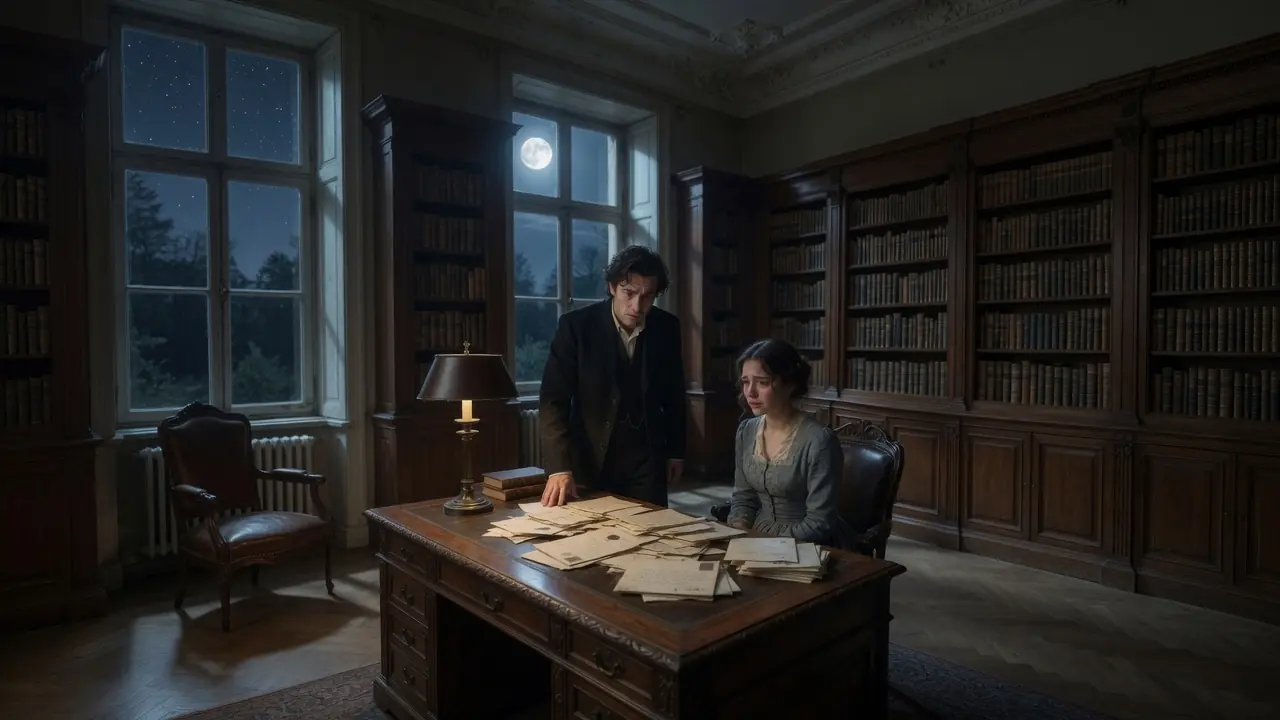
The library of Thorne House was a tomb of shadows, lit only by the dying embers in the hearth and the cold silver light of a full moon spilling through the floor-to-ceiling windows. Juliet sat at her desk, her fingers tracing the jagged edges of Arthur’s last letter. She felt like a woman standing on the edge of a precipice, waiting for the wind to either lift her or dash her against the rocks. A heavy knock at the door startled her. Before she could call out, the door groaned open.
Arthur Blackwood stood in the doorway. He had discarded his evening coat, his white linen shirt unbuttoned at the throat, his hair disheveled, as if he had been running his hands through it in a fit of madness. He looked haunted, more like the man in the letters than the Marquis of the ballroom. “My lord,” Juliet rose, her heart hammering a frantic rhythm against her ribs. “It is late. My father—”
“Your father is asleep, and I am a man possessed, Juliet.” He crossed the room in three long strides, stopping only when the mahogany desk stood between them. His gray eyes were turbulent, swirling with a storm of conflict. “I have spent the last four hours walking the streets of London trying to find a way to say this that doesn’t make me a villain or a fool.” Juliet gripped the edge of the desk. “Say what, Arthur?”
He let out a harsh, jagged laugh. “I have come to ask for your hand. I have come to tell you that I want you to be my wife, that I find your wit to be the only thing that makes the air in this city breathable. I admire you. I believe I could worship you.” Juliet’s breath caught. But before she could speak, he held up a hand, his expression pained. “But I must be honest. If we are to wed, I cannot give you all of me. There is another, a woman I have never met, a woman who exists only in ink and shadow. She has seen the parts of my soul I didn’t know existed. I cannot give her up. I will propose to you. I will cherish you, but I will keep her as my sanctuary. I am a divided man, Juliet. Can you live with a husband who is only half present?”
The silence that followed was so profound Juliet could hear the ticking of the clock in the hall. The irony was a physical weight, a beautiful, agonizing pressure in her chest. He loved her. He loved both of her. And he was so honorable in his brokenness that he would confess his infidelity to a ghost before he even placed a ring on her finger. “You love her,” Juliet whispered, her voice thick with emotion.
“I love the way she sees the world,” Arthur said, his voice breaking. “I love that she challenged me to be more than a title. I love her, yes, but I want you.” Juliet reached into the shallow drawer of her desk. Her hands trembled so violently she nearly dropped the silk ribbon. She pulled out the stack of letters, the moonlit mail, and laid them on the desk between them. On top sat the letter he had sent only days ago, the one about his brother, the one where his tears had blurred the ink.
Arthur froze. His gaze fell upon the bundle. He recognized the paper. He recognized his own seal. Most of all, he recognized the jagged, desperate slant of his own handwriting. Slowly, his eyes lifted to hers. The confusion in them shifted to shock, then to a dawning, terrifying realization. “The river,” he breathed, his voice barely a ghost of a sound. “Beneath the ice, there is a river.”
“It runs deep and fast, Arthur,” Juliet said, a single tear escaping and tracing a path down her cheek. “And it was always running toward you.” Arthur reached out, his fingers brushing the letters as if they might turn to ash. “The Mediator. You. All this time, the fire I was chasing—it was burning right in front of me.” “I was afraid,” she confessed, her voice a broken plea. “I thought you wanted a portrait. I thought if I showed you the woman with the ink-stained fingers and the angry heart, you would turn away.”
“Turn away?” With a low, visceral groan, Arthur vaulted around the desk. He didn’t wait for permission. He caught her face in his hands, his thumbs sweeping away her tears with a tenderness that shattered her. “Juliet,” he rasped, his forehead dropping against hers. “I have been searching for a way to bridge the gap between my duty and my soul. I didn’t know they were the same path. I didn’t know the woman who provoked me at the ball was the same woman who saved me in the dark.”
He kissed her then—not a polite, courtly kiss, but a desperate, starving claim. It tasted of salt and ink and the promise of a thousand tomorrows. In his arms, Juliet felt the constraints of her world finally snap. The Mediator and the lady, fused into a single whole being, held fast by a man who finally saw all of her. He pulled back just an inch, his eyes blazing with a fierce, reverent awe.
“No more ghosts, Juliet. No more masks. Only the truth,” she whispered, her hands tangling in his hair. In the quiet sanctuary of the library, as the moon set and the first gray light of dawn touched the horizon, they realized that some secrets are not meant to be kept, but to be shared, and that the most profound love stories are not written in the stars, but in the brave, honest strokes of a pen across a trembling page.