The paper came wrapped round a parcel of sheepskin. Verity Thornburn read it standing up at 5 in the morning in the harness room at Old Tarn. She had not meant to read it at all. She had meant to get the skins out of the wet and set them flat before the frost took them, but the string had gone and the wrapping had fallen open on the bench. Under her hand lay the smallest column of the morning post for the 4th of February, printed 6 days before.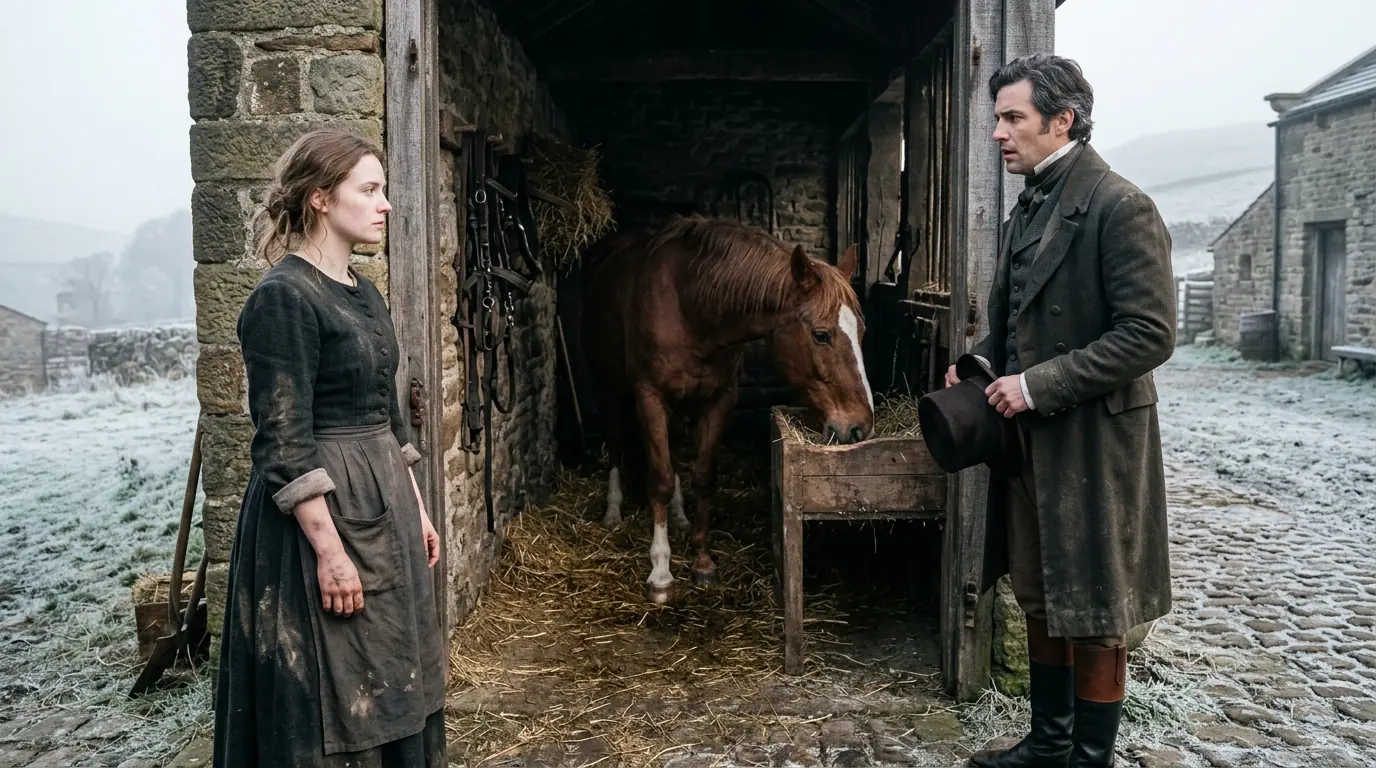
A Winderby tradesman had used it to keep the rain off a hide:
"A marriage has been arranged and will shortly take place between his grace the Duke of Glenn Moore of Old Tarn in this county and of Hill Street London and Sedonia, only daughter of Ephraim Brindle Esquire of Warrington Iron Master."
That was all. Two lines of print for a house and a name and the rest of a man's life.
Verity stood with her hand flat on the paper. The lantern hung on its nail behind her, and the light came over her shoulder onto the print so that her own shadow lay across the second half of the line. Outside in the dark, a horse shifted his weight and knocked the boards. She read it twice, folded the paper along the crease it had already learned, put it in her apron pocket, and carried the skins into the dry.
It was February. The yard was black ice from the pump to the muck heap. The beck was loud under the arch, and there were seven horses at Old Town, where there had once been 31. Verity was three and 20. She had been at Oldtown 9 weeks. She was there to mend books.
The corn was kept in the loft over the coach house in a bin with a lid that had to be lifted with both hands because the hinge had gone in the year the old Duke died. Verity went up the ladder with the lantern hooked on her arm, the way Ned Buick had shown her, and filled the scoop and came down. She was not a groom. There was no groom at Oldtown now, but Ned himself, who was 71, and a boy from the village 3 days a week when the boy could be spared.
Ned's hands had gone. That was the whole of it. Some winters back the joints had begun to swell, and now in frost he could not close his fingers on a scoop before 8:00 when the kitchen fire had done its work on them. He could still handle a horse. He could not lift a bin lid at 5. So Verity fed them.
It had begun on her fourth morning when she came out to the pump and found the old man standing at the loft ladder with his hands under his arms, looking up at it, saying nothing at all. She had said, "Tell me how much and to which," and he had told her. He told her again the next morning, and by the end of the week, he only stood at the door of each box and watched. And by the end of the second week, he did not always come out.
There were seven. Wyn and Dart, the plow pair, who were not the estates horses at all, but the home farms, and who ate like churches. The two carriage horses that had not been out of the county since Christmas. A grey mare who was in foal. The Duke's own horse, Duro, a big brown bay with a white foot brought home from Spain and hard-mouthed on one side. And in the last box on the north side, where the wind came under the door, the other one.
His name was Almeida. He was 22 years old. He had been the Duke's second charger through four campaigns, and he had come home in a transport out of Bordeaux in the summer of the peace, and he had not been ridden since. His teeth were worn to nothing on the near side. He could not eat hay, or not enough of it. His mouth turned it into wads and dropped them in the manger, half chewed, so that a stranger looking in would have said he had been fed and left it.
Verity had learned that in her first week. It had taken her another to find the remedy. Bran crushed oats, beat, scalded with hot water, and left to swell. Given warm in a wide, shallow tub, so that he could work at it with the sound side of his mouth. It took 20 minutes to make, it took him 40 to eat. That was why she came out at 5.
"He'll not thank you," Ned had said the first time.
"I don't need thanking," Verity said. "I need him not to be dead by March."
The library at Oldtown ran the whole length of the east front, and for 2 years it had been a slow disaster. Nobody looked at a gutter had split in the storm of the year before last. The water went down inside the wall for 5 weeks before anyone traced it. It came out along the third bay of shelving. It had ruined, by Verity's count on the day she arrived, 411 volumes. Not burned, not lost. Ruined in the particular way that water ruins books, which is patient and quiet and stinks.
The boards had swollen and split their leather. The glue had gone. Old text blocks had lifted out of their bindings like a shoe coming away from its soul. Where the shelves had held them tight, the leaves had dried in a mass and become one solid thing, a brick with gilding on its edge.
Mr. Sket, who was the agent, had written to London in the autumn to ask what should be done. The answer had come back through a secretary: The library was to be put in order at a cost not exceeding £60. £60 was 2 years wages for a housemaid. It was also, for a binder, about a tenth of what 400 books needed. Verity had known that when she took the work. She had taken it anyway.
£30 and her keep from the 1st of December to the 1st of June, paid out of the household and not out of the 60. The 60 was for materials, every penny of it. She had wanted the six months. The alternative had been the counter at the linen drapers in Winderby.
Her father had been Isaac Thornburn, bookbinder and stationer of Bridge Street, Winderby. He had bound for the old Tarn Library in the old Duke's time, for the Assizes, for two Winderby attorneys. He had taught his daughter to sew a section before she was seven. She had asked, and he could not think of a reason to say no.
He died in the November of the typhus year. The lease of the shop went back to the landlord. The press went to a man in Warrington for £7. Verity had been left with a box of tools, a brother of 16, and a rule she had made for herself and had not broken since. She did not tell people what she could do. She showed them and then let them decide what to call it.
The tools were in the box on the library table now. Bodkins, a needle case, the sewing frame her father had made himself out of beech, three bone folders worn to the shape of three different hands. The one she used was his. It had a crack in it, stopped with a whipping of waxed silk.
She worked at the long table in the fourth window. She had asked Mrs. Mossup for the fourth window because it faced northeast and got the morning without getting the sun. The method was her father's and it was not complicated and it could not be hurried.
Take the book, determine what it is. Determine what is left of it. Take it apart if it must come apart. Wash the leaves in the flat tin bath one at a time in water off the boil and left to cool. Dry them under weights between blotting sheets and old felts. Turn them. Turn them again. Mend the tears with paper and paste on the flesh side so the mend is on the back of the reading. Resew, reback. Where the leather is gone, the leather is gone. You do not paint a new hide to look like an old one.
By the 10th of February, she had done 62 of the 411. She kept the account of them in a ruled book, the title, the date of the addition, what had been wrong, what she had done, and what it had cost in materials, down to the halfpenny. Nobody had asked her for the account. She kept it because a thing you cannot account for is a thing somebody can call anything they like.
Mrs. Mossup came in at 10 with the tray and stood a moment looking down the room at the tin bath and the sheets of felt and the 16 books lying open under weights like patients.
"He's coming home," she said.