“You can tell everything about a man by how he speaks to those who can do nothing for him.”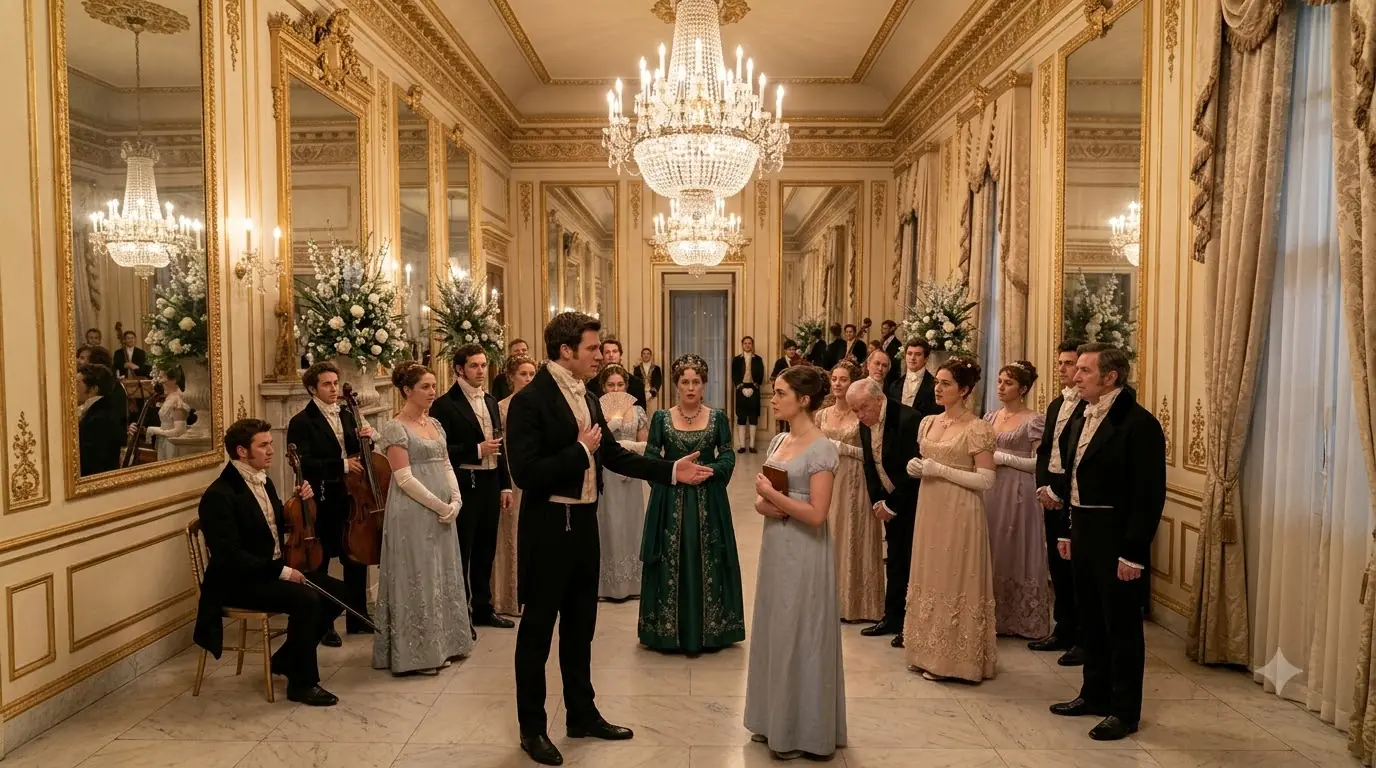
It was a saying Cesaly Marchmont had heard first from her father, a country clergyman of very modest income and very great conviction, who had pressed it into her keeping the way other fathers pressed coins or cameos into daughters' palms before their deaths. He had died when she was 19, leaving her with that aphorism, an unfinished sampler of pale blue thread, and debts that swallowed the rectory before the grass had grown over his grave. The saying was all she had carried into service. She had carried it for 11 years, and in 11 years she had found it to be true without exception.
It was the most reliable instrument she possessed, and she trusted it the way a navigator trusts a compass. Not because it was infallible, but because it was consistent, and consistency in an uncertain world was worth more than most things the world cared to offer. She was 30 years old in the autumn the Duke of Ashvair came to Thornfield Park—30 and a companion. The two facts together formed a kind of sentence.
It was the sort of sentence passed quietly by the world over women who had neither beauty enough to make a brilliant match nor connections enough to make a modest one. She was not precisely plain. Her eyes were gray and steady, her figure slight, her manner composed in the way that women in her position must be composed or break entirely. Her hair was an ordinary brown that did well enough in candlelight, but made no particular impression by day.
She had small, capable hands, and a good memory for names and obligations, and the subtle hierarchy of any household she entered, and a temper she had learned to keep at such a low and even heat that most people never detected it existed at all. She had been overlooked so many times by so many people in so many rooms that she had come to wear invisibility as a second skin. It was not unhappy. It was simply the shape of her days.
And she had fitted herself to that shape with the patient pragmatism of someone who understands that a well-made garment can outlast a beautiful one by decades. 11 years was long enough to have formed opinions about the houses she had moved through, and she had moved through four before Lady Ashdown. The first had been a widow in Derbyshire, whose daughter required a companion more for propriety than for company—a girl of 16 who would rather have read novels than managed her mother's correspondence, and who eventually eloped with the undergardener, at which point the widow dismissed everyone associated with the catastrophe as though proximity to scandal were catching. The second had been a family in Bath, three sisters in their middle years, and a mother who was dying in increments, and had a great deal to say about it, and Cesaly had spent two winters in that house, learning that grief expressed as complaint was still grief, and deserved patience, even when the patience was expensive.
The third had been a brief and uncomfortable arrangement with an Earl's daughter, who discovered upon Cesaly's arrival that she had expected someone more fashionable, a misunderstanding that resolved itself in 4 months with no particular ill will. Then Lady Ashdown and 6 years of service to a woman who was difficult in the specific and predictable ways that made her manageable, and who ran a household with sufficient competence that Cesaly's work was actually the work it appeared to be, rather than the quiet management of chaos that three of her previous positions had required. Her employer was Lady Winifred Ashdown. She was the baroness of Thornfield, 44 years old, widowed, and magnificent in the manner of a woman who had decided at some point that magnificence was the only posture worth the sustained effort.
Lady Ashdown had been beautiful at 20 and was still beautiful at 44, having treated her appearance as a professional matter rather than a gift, attending to it with the same practicality she brought to estate management. She was not unkind, precisely, she was preoccupied. She swept through rooms the way weather moves through valleys, loud and purposeful, and leaving things altered behind her. And if Cesaly was occasionally flattened in the passing, it was not malice, but simple force of motion.
The baroness had opinions about everything, and the energy to enforce them. She had a genuinely good ear for music, a taste in furniture that was costly but never vulgar, a nose for gossip that could detect the early stages of a scandal before its principals were aware of its existence, and a memory for social debts and obligations that would have served a barrister admirably. She required from Cesaly the complete management of her correspondence, the tactful reordering of social commitments when they collided, the composition of letters she found too taxing to write herself when the cold made her fingers ache, and the maintenance of a running awareness of every person of consequence in the county, and how they stood in relation to Lady Ashdown. Cesaly fetched and arranged and accompanied and listened and said very little that was not required of her.
She had grown skilled at reading the room before she entered it, and at finding the edge of things, the quiet margin where a companion stood without quite disappearing. The household at Thornfield was ordered and comfortable by the standards of houses in which Cesaly had worked, which was to say that the cook was reliable, and the housekeeper capable, and the footmen young but willing to learn, and the whole machinery of the place operated with only the ordinary friction of human beings, compelled to share space and purpose. Cesaly liked the library, which was extensive for a house of Thornfield size, and suggested that some previous Ashdown had valued books, as the current baroness valued furniture. She liked the walk along the ha-ha wall in the late afternoons of autumn, when the light went horizontal through the old oaks, and turned everything briefly to gold before the cold came in from the north.
She liked the small winter garden off the east corridor, which she had found by accident in her third month, and claimed for herself in the way of people who find rooms that no one else is using. These small likings had accumulated into something she recognized, without making much of, as a life she could continue indefinitely. It did not soar. It did not require soaring.
It was sufficient, and she had learned enough of the world to know that sufficient was not nothing. It was from this margin of settled sufficiency that she first saw the Duke. He arrived on a Tuesday in October when the park was all bronze and the rain smelled of mud, the old oaks along the drive half bare, their leaves matting the gravel in wet drifts. The light was the color of old pewter, and the rooks had gathered in the field beyond the ha-ha wall and were making their collective autumn complaint, which sounded like a committee that had sat for three hours and reached no conclusion.
Cesaly was at the library window with Lady Ashdown's morning correspondence sorted in her lap, the letters ranked by urgency in the system she had devised in her second year of service and never abandoned when the traveling carriage turned in from the road. It was a fine carriage, very dark, with no crest on the door that she could make out through the rain. The groom who ran ahead to the portico was unfamiliar. She thought nothing of it at first.
Lady Ashdown received a great many visitors of varying importance, and Cesaly had learned not to rank them before she knew who they were. What she noticed was the man who stepped down from the carriage without waiting for the step to be let. He was tall and wore his coat the way men wear coats when they have stopped thinking about clothes entirely, and the clothes have simply become an extension of the body, neither conscious nor careless, but simply present. He did not look up at the house in the way that visitors usually did, that involuntary assessment of a new place, its windows and proportions, and the statement it makes about the people within.
He stood for a moment in the rain, his hat still in his hand, regarding the gravel at his feet with an expression she could not fully read from the window—something between reluctance and decision, like a man who had come a long way to do a thing he did not particularly wish to do and had arrived at the place where the doing was unavoidable. Then the footman opened the door, and he went in, and the carriage moved around to the stables, and the rook settled again in the frost-brown grass, and that was all. She learned his name from the letter she was sorting not 4 minutes later. She had not recognized the seal when she placed it at the bottom of the stack that morning, having received it while Lady Ashdown was still abed.
“My dear,” the baroness had said over breakfast one morning in September, in the tone she used when arranging the world to her satisfaction and wishing Cesaly to record the arrangement, “the Duke of Ashvair will be with us in October. He has newly returned from the Continent and has some estate business to settle with the Thornfield solicitors—nothing that concerns you particularly.”
And she had moved on to the question of whether the drawing room should be repainted before winter, which apparently concerned Cesaly considerably, since she was dispatched to interview painters, compare their estimates, inspect their previous commissions in three neighboring houses, and compile a report comprehensive enough to justify the baroness's eventual decision to wait until spring, when the light would be better, and the disruption to the winter season avoided. The Duke of Ashvair, Cesaly gathered through the ambient intelligence of a well-run household, was 38 years old. He had inherited at 26 following the death of his father and elder brother in the same fever within a fortnight of each other. It was a loss so swift and double that it had apparently remade him overnight from a second son with modest expectations into a man carrying an estate of considerable size and the full weight of a line that needed continuing.
He had served two years with the cavalry in his late 20s for reasons the household debated variously, some holding that he had gone for love of soldiering, others that he had gone to put distance between himself and a grief no amount of estate management could fill. He had not married, which the household staff found most interesting, and which Cesaly found least surprising. Men like that did not marry until they were ready, and sometimes not even then. They lived in the long interior siege of their own requirements, and waited for something to move them.
And in the meantime the estates waited and the heirs did not come and the solicitors aged attempting to arrange proximity with suitable women and nothing came of the arrangements. She filed this in the same place she filed most things she thought about and could not use. He did not see her that first day. She was near the bookcase at the edge of the entrance hall when he crossed it the following morning, and he passed within 6 ft of her without a glance.
She was quite accustomed to this. She noted his height and the deliberate, unhurried quality of his movement, upright without military stiffness, precise without effort, and went on with her morning. The week that followed established a pattern. Lady Ashdown glittered at dinner, at which Cesaly did not sit, having her meals in the smaller room adjacent to the kitchen that was technically called the housekeeper's parlor, though no housekeeper had used it in years.
It had become, over the course of Cesaly's tenure, simply the room where she spent the hours she was not needed. The baroness entertained the Duke in the drawing room after dinner, with the candlelight very well managed for the purpose, took him riding along the estate margins on the dry afternoon, and showed him the gallery with its portraits of Ashdown ancestors and the folly by the lake, which had been fashionable once and now merely sat in the November reeds looking like an error in stone that no one had got around to correcting. Cesaly heard all of this secondhand from the maid who laid the fires, supplemented by what she could observe in the brief passages through corridors and doorways that her duties required. She observed that the Duke answered Lady Ashdown's considerable conversational energy with a composure that was not quite warmth and not quite its absence, something more like genuine attention.
He was listening. He was not being carried away. She observed that he was courteous to every member of the staff she saw him address, quick and direct, without the performance of condescension that some men of his rank still maintained as though they had been instructed in it, and had not since been given reason to revise the lesson. He held the door for the young footman carrying a laden breakfast tray.
He thanked the kitchen girl who brought his horse water without requiring her to wait to be dismissed. He gave his instructions once and did not repeat them with additions. She filed these observations without knowing precisely why. Perhaps because her father's saying was on her mind.
Perhaps because 30 years of watching rooms had given her no other instrument for taking the measure of people, and this particular man kept measuring well, and that was the kind of thing she noticed. On the ninth day he spoke to her. She was in the small winter garden off the east corridor. The room had been built for a previous Lady Ashdown, who had kept exotic plants, and whose death had left it cold and glass-walled, unpleasant in the way of spaces emptied of their original purpose but not yet reassigned to another.
The bay trees in their pots remained, thick stemmed and dark leaved, indifferent to the cold. The heating from the adjacent corridor leaked through the inner wall sufficiently to prevent the room from freezing without making it warm. Lady Ashdown avoided it because the northeast morning light was not flattering to her complexion, and the household staff came here only once a fortnight to water the bay trees. Cesaly had discovered the room in her third month at Thornfield, and had returned to it once a week ever since, because the combination of cold glass and pale light, and the smell of old soil from the neglected window boxes made it feel like the outside without being the outside, which suited a certain mode of thought she could not achieve in properly heated rooms.
She had been sitting for perhaps 20 minutes with her notebook open, drafting Lady Ashdown’s response to her cousin in Bath, which required careful calibration of warmth to avoid encouraging a visit the baroness had privately described as “a prospect of limited appeal,” when she heard the garden door open and close. She looked up. He was standing at the far end of the room between the two bay trees, looking at her with mild surprise that was not displeasure.
“I beg your pardon.” He inclined his head slightly. “I was told this room was generally unoccupied.”
“It usually is.” Cesaly began gathering her papers. “I will move to another room.”
He raised one hand, less a gesture than a gentle staying of motion. “There is no need. I came only for the quiet. I imagine you came for the same reason.”
She was not accustomed to having her reasons identified, much less accurately, by anyone above the station of a housemaid. The people in whose houses she had served tended to assume that companions were where they were because their employers required it. He had identified her purpose without effort or ceremony, as though it were obvious, and was proposing that they share the room because they shared the motive.
“I have some letters,” she said, returning to her notebook.
“Then I will sit here and disturb neither your letters nor your quiet.”
He crossed to the bench along the south window, the one with the faded cushion embroidered badly with a hunting scene, the colors worn to brown and gray, and sat with his back to the glass and a book he had been carrying that she had not previously noticed. She returned to her drafts. He read. The light moved slowly across the glass floor tiles. A pigeon settled on the roof above and walked along the ridge and went away.
They sat like that for perhaps half an hour, and it was the most companionable silence Cesaly had passed in 11 years of service. He stood when she gathered her things to leave. She noticed the exact quality of it. It was not a performance, nor a correction for an audience that did not exist, but simply a habit so deeply formed that it operated below thought. She said good morning to the general direction of the room and left before she could think about it further.
The trouble with Lady Ashdown's arrangement, which Cesaly had understood from the sealed letter and confirmed through careful observation, was that the baroness intended to marry the Duke of Ashvair. She intended it with the focused, practical energy she brought to all projects that mattered to her. The Duke was young enough to be interesting and old enough to be predictable. He was wealthy, ancient in title, possessed of an estate well-managed, and therefore likely to remain solvent, and he had returned from the continent without an evident entanglement.
Lady Ashdown was beautiful in the way of women who have made beauty a profession, well-connected, and in complete command of her household and her presentation. It seemed on paper an entirely possible thing. Whether the Duke understood what he had been brought to seemed to Cesaly less certain. He had the manner of a man who had weighed the situation, found it manageable, and had not yet decided whether manageable was sufficient.
This was different from a man who had decided he wanted something. The difference was not one that most people would notice. Cesaly noticed it and filed it and said nothing. Over the following fortnight, he continued to find the winter garden quiet, and so did she.
And after the third coincidence, the coincidences became an understood arrangement that neither of them named. They did not always speak. Sometimes they read in parallel for a full hour, the only sounds the turning of pages, the inadequate heating system's occasional protest, and the distant commentary of rooks from the park. He asked her opinion of a passage sometimes and she gave it without the diplomatic softening she kept for public rooms and he listened with the particular stillness of someone genuinely weighing what has been said before responding.
He disagreed with her twice in the first fortnight, clearly and without apology, and she disagreed with his disagreement, and they arrived at neither resolution nor irritation, which she found interesting. He had a small scar below his left ear, old and well-healed, that she found herself noticing when he turned his head at a particular angle. She stopped noticing it after the fifth visit, because noticing things repeatedly served no purpose. He asked her name on a gray Wednesday in the third week, as though they had been interrupted mid-conversation at some earlier point and he was now returning to it.
“Cesaly Marchmont,” she said, keeping her eyes on her notebook. “I am Lady Ashdown’s companion.”
“I know what you are.” He turned a page. “I did not know what you were called.”
There was a difference in those two statements, and she felt it precisely—the way one feels a step slightly higher than expected. It was a small recalibration of where the ground lay. She returned to her letters and filed the difference in the same careful place she had been filing similar things for 3 weeks under the heading of professionally inconvenient and left it there. The afternoons provided their own opportunity.
The park at Thornfield was extensive enough to walk without repetition, and she had her usual route along the ha-ha wall and back through the East Field, which she had walked since her first autumn at Thornfield. On one of these afternoons, in the third week of his visit, she came down from the ha-ha and found him returning along the same path from the estate margins, where he had apparently been in conversation with the farm manager about the drainage situation in the lower meadow. It was a problem he described with the focused attention of a man who was genuinely interested in drainage and not simply performing interest in order to look capable. They fell into step without discussing it.
The conversation that followed was nothing in particular and everything the way conversations are when the people having them have stopped performing for each other and are simply present in the same cold afternoon. They walked together four more times before December, once in a light rain that neither of them mentioned. Once in a cold so clear and sharp that the park looked like something printed rather than grown. He talked about the estate at Ashvair in the matter-of-fact way men talk about places they are responsible for and have stopped sentimentalizing: the drainage problem in the east field, the question of the home farm’s crop rotation, and a quarrel between the steward and the head groom that had been running for two years without resolution.
She told him about the Norfolk rectory and her father's extraordinary private library, built on a clergyman's annual income by a systematic and unembarrassed preference for books over everything else a clergyman might reasonably have purchased instead. She described the smell of it, damp and tallow, and the particular dust that collects on the tops of densely shelved volumes. She described coming home from the dame school at the age of seven, and finding her father in the study in his coat and hat and outdoor boots, having apparently sat down on entering to read one more page of something, and been there 3 hours without noticing the cold or removing the hat. The Duke walked with his head slightly bent, watching the path, and said he would have liked to meet a man who chose books over horses.
"He would have found you extremely disappointing," she said, "given your stables." He looked at her sidelong. The almost smile appeared unguarded and not managed, and it stayed with her for the rest of the afternoon, in a way she found professionally inconvenient, and did not particularly try to address, because addressing it would have accomplished nothing useful, and she was a practical woman. She did not tell Lady Ashdown about the winter garden or the walks. The garden was within her liberty.
The walks were within her liberty. Nothing had occurred that required reporting, but she knew with the quiet certainty of 11 years reading households that Lady Ashdown would find the repeated coincidence of location and company unsatisfactory, and she had no wish to displace the Duke from the one room in the house he had found for his own peace. And the reason she had for not wishing this were something she examined carefully once, and then did not examine again. Mrs.
Rowena Fel arrived at the end of November. She was Lady Ashdown's cousin, which meant she had rights of stay and conversation that a visitor of any other connection would not have possessed, and she exercised them without restraint. Mrs. Fel was not malicious, probably.
She was the kind of woman who entered rooms to find the most interesting thing in them, and who could not pass two people without wanting to know the exact arrangement of their feelings for each other, and then share that knowledge with whoever would react to it most visibly. She had the instincts of a retriever that has found something in the long grass, and brings it to the nearest person of consequence, without considering whether it is the kind of thing they wish to have retrieved. She came into the winter garden on a Thursday morning looking for the scissors kept in the basket near the east door. She noticed Cesaly at the bench with her notebook.
She noticed the Duke 5 minutes later when he came through the corridor door. She stood in the opening between the two rooms for a moment, scissors in hand, wearing an expression of composed and pleasurable interest—the expression of a woman who had just confirmed something she suspected and was deciding exactly what to do with the confirmation.
“How charming,” Mrs. Fell said to no one in particular, and went away.
Nothing happened immediately. It was the nature of such things to gather for a time before they broke. Lady Ashdown said nothing to Cesaly that evening, nor the next morning, nor the morning after that. Cesaly continued her work.
She drafted letters and selected fabrics and accompanied the baroness to the village on Tuesday for the charitable committee at which Lady Ashdown was magnificent about the proposed new well and Cesaly took notes and said nothing. The Duke said nothing when they passed in the entrance hall on Wednesday, two housemaids behind him and no space for privacy. The winter garden continued as it had always been. She noted, though she kept the noting brief, that on the Thursday following Mrs.
Fel's arrival, he stayed in the garden somewhat longer than usual, as though the quiet had become more necessary, and he was reluctant to leave it for what waited outside. Lady Ashdown's campaign continued through November. There were intimate dinners, rides that required the baroness's guidance through the eastern wood, a musical evening at which Lady Ashdown played with genuine and considerable skill, and fixed the Duke with a look across the room that had brought stronger men to the question of matrimony before the program concluded. The Duke was not brought to the question of matrimony.
He was courteous, attentive, and entirely pleasant, and gave nothing away. Cesaly watched from the edge of the music room, thought about her father's saying, and wondered whether the Duke had a version of his own. The conversation she had been waiting for came on a Thursday in December. Lady Ashdown sat in the morning room with her coffee, and her hands folded and her posture absolutely correct, and said, in a voice entirely devoid of warmth, but not of fairness, that she had become aware that Cesaly had been spending some of her private hours in the East Wing Winter Garden, and that she had simply wanted to mention it, because she understood that his grace found the East Wing inconvenient for his purposes, and was unlikely to return to it, and she had mentioned as much to him this morning. She hoped Cesaly found the library comfortable, as it was a considerably warmer room.
Cesaly said thank you. She said she was very comfortable in the library. She gathered the morning's correspondence and withdrew with perfect composure and stood for a moment in the corridor with her back against the wall and the letters against her chest until the feeling that the floor had moved slightly had settled back into stillness. Then she went to the library, which was colder than the winter garden, looked onto the north drive, and had no bay trees and no bench with a badly embroidered hunting scene. She sat down, wrote four letters in her best hand, and did not think about anything at all.
He did not come to the winter garden the following day, nor the day after. She had not expected him to. Lady Ashdown had been clear and had spoken to him directly, which was her prerogative, and there was no world in which a duke continued frequenting a room with a companion against the explicit management of his hostess. This was how things worked.
She had always understood how things worked. Understanding how things worked had been her primary professional qualification for 11 years, and she was very good at it. He came to the library on the fourth day. He arrived at 11:00 when she was usually alone and sat across the table where she was drafting Lady Ashdown's response to the county society invitation and looked at her for a moment without speaking.
“Lady Ashdown tells me you have requested a change of rooms for your private hours.” He set one hand flat on the table beside him, not reaching toward her, simply placing it.
Cesaly set her pen down carefully. “That is one way to describe it.”
“What would be another?”
She looked at him directly. Outside, rooks called once from the oak at the park’s corner and fell silent. “I think that I was moved as one moves a piece of furniture placed inconveniently. That is entirely within Lady Ashdown’s rights. I have no complaint.”
“You may not,” he said, holding her gaze without moving, “but I find that I do.”
She said nothing. It was the most dangerous kind of silence, the kind that could mean anything and therefore required her to mean nothing at all, because she was the one who could least afford for it to mean something.
“Miss Marchmont.” Her name in his voice was weighted exactly right. “I should tell you something, and I ask you to take it in the spirit intended, which is entirely plain and without any intention of putting you in a difficult position.”
He paused. “I came to Thornfield at my solicitor’s suggestion. He and Lady Ashdown share a solicitor, which I mention not to diminish her, but to be clear that I came knowing something of what I was coming to. I was aware of the project. I am not as unobservant as I perhaps appear.”
Cesaly folded her hands on the table. They required occupying.
“I have spent six weeks in this house,” he continued without looking away. “The only hour of my day I have found myself looking forward to is the one in the winter garden, and the reason has nothing to do with the bay trees. I think you understand what I am saying.”
“I think,” she said carefully, “that you are tired of the house and find quieter company a relief from the demands of society.”
“That is one way to describe it.”
Her own words returned to her. She felt them settle somewhere behind her sternum and stay. “Your Grace, I think you should consider carefully before you say anything further. I am Lady Ashdown’s companion. I have no means, no connections of any standing, and no family name that opens doors. If you are suggesting something other than what I understand you to be suggesting, I hope you will tell me plainly, because I cannot afford to misread the situation and survive the misreading with any ease.”
“I am suggesting,” he said, neither rushing nor softening it, “that I would like to continue to sit in the same room as you and not be required to be anyone in particular. In time, I would like to suggest further things, if you are willing to hear them. I have no intention of doing anything to damage your position here or elsewhere.”
The fire settled with a small sound. A door closed somewhere in the upper house.
“I will be in the library each morning at eleven o’clock,” she said, picking up her pen, “as is my custom.”
He nodded once, the deliberate nod she had come to recognize as his way of marking something settled, and left.
She sat for a moment with the pen in her hand, the letter half finished on the table, the fire burning steadily in the grate, and the afternoon going gray at the north window. And then she finished the letter, which was about the county society, and not about any of the things she was thinking about, and the afternoon continued as afternoons did. What followed was not a courtship in any form Cesaly had a name for. There were no flowers or letters or the conventional instruments of the purpose.
There were mornings in the library on opposite sides of the long table. Occasional exchanges of opinion and quiet amusement and genuine disagreement that carried everything the conventional gestures could not. He told her about the cavalry with the matter of factness of someone who has put difficult things far enough away to handle. He described the field hospital with the same tone he used for the drainage in the east meadow at Ashvair. She thought it was not indifference, but rather the voice of a man who had decided, during or after the illness, that the things which had not killed him deserved to be described plainly and moved past cleanly.
She found this quality in him the way she found most qualities in people she paid attention to gradually and without announcement and she added it to the list of things she was filing as professionally inconvenient and did not look at the list directly. She told him about the Norfolk rectory and her father's library, the Latin grammars beside the novels, the books of sermons beside the natural histories, all of it smelling of damp and tallow and entirely absorbing to a child who had nowhere else particular to be. She described coming home from the dame school at the age of seven and finding her father in the study in his coat and hat and outdoor boots, having apparently sat down on entering to read one more page of something and been there 3 hours without noticing the cold. The Duke walked with his head slightly bent and said he would have liked to meet a man who chose books over horses.
“He would have found you extremely disappointing,” she said, “given your stables.” The almost smile appeared again.
She filed it as professionally inconvenient, and it kept returning, and she kept filing it, and this continued until filing it became a habit she had stopped noticing. The way breathing is a habit you have stopped noticing. She thought about what it meant that she had noticed. In four houses before Lady Ashdown, she had been invisible in the way of very good servants, present and capable and simply not considered by the people she served, and she had not thought this remarkable, because it was the condition of her work, and she had arranged herself accordingly.
In this house she had been invisible in the same way until approximately the 9th day of October. She understood that this was not a change in her. She had not become more visible. She had been noticed by a man who paid attention to things that most people did not pay attention to, which was a different event entirely.
And she kept the distinction clear because it mattered to her that she was clear about such things. What she was less clear about and had been less clear about with increasing intensity since the third week of October was what she wanted. This was a question she did not customarily ask herself. What she wanted had been irrelevant to the shape of her life for so long that she had ceased consulting the question and had learned instead to want what was available and to find in the available things their actual merits which were real and sufficient and genuinely valued.
She wanted the winter garden and the walk along the ha-ha wall and the library and the particular quality of the afternoon light in the park in late October. These were true wants and she had them. The other thing she was beginning to notice she wanted she kept at the very back of the room and did not look at directly the way you do not look directly at a very bright light. Not because it would destroy you, but because it would take some time afterward to see anything else clearly.
On the afternoon of the 3rd week of December, the day before Mrs. Fel was expected to depart. Cesaly passed the east corridor at a time when she was carrying several of Lady Ashdown's winter garments to the cedar press and heard Mrs. Fel's voice in the drawing room addressing Lady Ashdown about the companion's extraordinary influence over the Duke of Ashvair.
Cesaly did not stop walking. She did not slow her pace. She kept her steps even and her arms level, and carried the garments to the cedar press, and folded them in the proper way, the sleeves inward and the seams aligned, and closed the door. Then she stood in the corridor for a moment, and breathed and calculated.
The dinner party was in 2 days. Mrs. Fel would still be in residence. 2 days was not enough time for anything to resolve itself, and resolution was not, in any case, something she had any particular power over. She went back to her work.
The evening of the dinner party came on the second Thursday of December. Eight persons sat at Lady Ashdown's table. The solicitor and his wife were among them, along with a local baronet and his shy daughter, who said almost nothing for three courses, Mrs. Fell in her best green silk, the Duke, and two others Cesaly knew only as names on the guest list. Cesaly was not at the table.
She was in the adjacent parlor with her neglected needlework, a piece of linen with a vine pattern she had begun the previous spring, and had not much advanced. She was not precisely listening through the door, which was slightly ajar in the way of old houses that never quite close. Rather, she was maintaining the background awareness that long practice had made reflexive. The low hum of social information that she processed the way a ship's navigator processes the sound of water, not because each sound requires a response, but because the pattern matters. She heard Mrs.
Fel's voice during the fish course. She heard her own name in it, Marchmont, in the particular register Mrs. Fel used for intelligence of a delicate nature delivered to an audience selected for its receptivity. She heard Lady Ashdown's voice answer, very composed, the voice of a woman rearranging her posture at her own table.
She set down the needlework and folded it and sat with her hands in her lap and looked at the fire and arranged herself. She had known this was possible. She had known it from the moment Mrs. Fel had stood in the winter garden doorway with the scissors and said how charming.
She had known it from before that, from the first afternoon in the library. Because she had learned to know things early so that she had time to prepare before the impact. She prepared now. She found the ground under her feet and stood on it and checked that it was solid.
She had risen and taken three steps toward the corridor door when the dining room door opened. He was standing in the opening in his evening coat, looking at her with the full weight of the last two months in his expression and apparently no particular plan.
“You heard?” he asked.
“Enough of it.”
“Then you understand that Mrs. Fell has described, with whatever accuracy or embellishment she chose, the nature of our acquaintance, and that Lady Ashdown has heard it at her own table with eight persons around it, which is the worst possible arrangement for such a thing.”
“Yes.” He stood where he was.
“You should go back.”
“I should.” He did not move. “Miss Marchmont, I have been at that table for three hours deciding whether to tell you something, and I have now run out of time in which to decide, so I will simply tell you.”
The fire was low. A clock gathered itself to strike the quarter hour.
“I came to Thornfield because my solicitor believed Lady Ashdown and I were a practical match. He was not wrong that, on paper, we are precisely that. I intended to assess the situation and, in all likelihood, to allow it to proceed because I am 38 years old, I have delayed long enough, the estate requires an heir, and those facts have not changed.”
He stopped. The fire settled with a small, soft sound.
“And then I spent six weeks sitting across a table from you and walking in a park that is not my park. On honest examination, I find that I cannot allow the situation to proceed—not because the arrangement is wrong, or because Lady Ashdown lacks any quality one could reasonably require, but because I have come to the conclusion that I am in love with you. Marrying in full knowledge of that fact would be a dishonesty to everyone involved, including her, which she does not deserve.”
The clock struck the quarter. Cesaly stood in the parlor with the needlework basket at her feet and her hands empty, while 30 years of practical sense presented a comprehensive case against precisely what she had spent 11 years pressing flat and keeping there.
“You are telling me this,” she said, “while eight people are waiting for you at the table.”
“I am.”
“And you expect me to do what with that information?”
He looked at her. For the first time in two months, she had the clear sense that he did not know precisely what he was doing. His composure had given way to something more fundamental and less managed, and he was simply standing in a room, being honest with spectacular timing and apparently no regret about it.
“I expect nothing,” he said steadily. “I wanted you to know because I could not sit at that table and listen to Mrs. Fell describe you as a problem to be managed and say nothing. I am not asking you to say anything. I am aware that a declaration from a man of my position is not simply a welcome thing when the person being declared to has no position from which to receive it without complicated consequences.”
Cesaly looked at the dying fire, then at him. “Go back to the table. We will speak tomorrow.”
He went. The door closed. She stood in the room for a long time after, feeling the ground carefully under her feet, checking where it was solid and where it had shifted. The ground had shifted substantially.
She had not prepared for the ground to shift substantially, which was unusual because she prepared for most things. She found, holding herself very still, and checking her own condition with the same practical care she brought to everything, that she was not entirely against the shifting. She went to bed with this, and held it at arm's length for the better part of the night, and arrived at morning, having slept approximately 4 hours, and felt, in spite of this, unusually clear. Lady Ashdown sent for her at 9.
Cesaly came with the account books because she had thought if she came prepared for ordinary work, it would be easier to conduct what followed as ordinary work. The baroness was at the window with her morning coffee, looking out at the park where the frost had come in the night and turned everything white and silver and completely still. She did not turn when Cesaly entered.
“Mrs. Fell spoke to me last night,” the baroness said. Her voice was quiet and entirely composed, which cost something.
“I know.”
“Did you know she would?”
“I thought it possible. From the day she came into the winter garden.”
A long pause followed. The frost lay even and unmarked across the park.
“He came back to the table,” Lady Ashdown said, keeping her eyes on the park. “He was entirely civil for the remainder of the evening. He said nothing to me, and I said nothing to him.”
There was something in her voice that was not quite hurt and not quite anger, something more like the long exhale of a woman who had been presented with information she already possessed and had been waiting to receive officially.
“I do not blame you. I find I wish I could, because it would be simpler, but I cannot honestly place the fault on a woman who spent two months being entirely discreet and obviously uncomfortable about it.”
Cesaly stood with the account books, the frost outside, and the baroness’s profile against the winter light. She thought about what it was to be this woman—to have built all this and to have it remain insufficient against something as arbitrary as the direction of a man’s attention—and felt for her a sympathy that was genuine and not pity.
“I am not going to dismiss you,” Lady Ashdown said. “I want you to know that clearly and first.”
The tension in Cesaly’s shoulders released so suddenly that she gripped the account books harder to have something to hold. “Thank you.”
“I think you should speak to him.” The baroness turned from the window at last and looked at Cesaly with a measuring expression that was not without warmth, that cost her something, and that Cesaly thought she would remember for a very long time. “I think you know as well as I do that the situation will not resolve in my direction, regardless of what you do or do not do. I would prefer the whole business settled before Christmas because I have guests coming at the new year and I require this house to function properly. He takes his horse out at eight and returns by ten. You have approximately 20 minutes if you go now.”
She met him where the east park opened onto the ha-ha wall, where the frost lay thick on the grass, and her breath came in clouds as she climbed the rise. He had seen her coming from some distance and had dismounted. He stood at the top of the rise with the reins in one hand, waiting without making a production of the waiting. The horse stood quiet beside him. The bare hornbeam at the field's edge was very black against a sky of pale and colorless winter light.
She came up the rise and stood in front of him with the cold between them.
“You told me last night that you are in love with me.”
“I did.”
“I want you to know that I have considered the situation very carefully, as I am incapable of not considering things very carefully, and I have arrived at the following.”
He waited perfectly still.
“I have spent 11 years becoming excellent at disappearing,” she said, keeping her eyes on his, “and I find I have no interest in disappearing any further. I have spent 11 years telling myself that the shape of my life is fixed, which it appeared to be. I have been wrong about very few things in my life, but I think I have been wrong about that.”
She looked at him directly in the cold, clear light, with frost on the grass around them, her breath visible, and her hands cold inside her gloves. “I am telling you this because you were honest with me and I am trying to return the honesty, not because I have any clear picture of what comes next.”
“Neither do I.” Something shifted in his expression, something carefully held finally releasing. “I find it matters less than I expected.”
“Good,” she said, which was not what she had planned, but seemed to serve.
He was looking at her with the almost smile, and it was no longer professionally inconvenient. It was simply what it was—warm, specific, and entirely directed at her.
“I should like,” he said, “to return to Ashvair at the end of December, when estate obligations bring me home, and to write to you from there with your permission. I should like to come back in spring and have a conversation that is not conducted in frost in someone else’s field.” He stopped. “I am 38 years old, and I appear to have entirely forgotten how any of this is managed.”
“I have never known,” she said. “I expect we will manage.”
The horse blew a great warm cloud against her shoulder, which made them both look at it, and the gravity of the last two months lifted into something lighter. They stood in the field with the frost and the bare hornbeam, and the horse's warm breath between them, and neither of them spoke. And it was the best silence Cesaly had stood in in 11 years of service, better even than the winter garden, and she was quite certain she would not forget the color of the sky above the hornbeam's bare branches as long as she lived. He left 2 days after Christmas, the roads having dried enough to allow it.
He bid Lady Ashdown farewell in the entrance hall with perfect courtesy, and she received it with perfect grace, and Cesaly stood at the edge of the hall in her accustomed place, where she had stood at the edges of things for 11 years. He turned before he went through the door, and looked at her directly, in front of the footman, and the baroness's maid, and the housekeeper, who had come for the last of the luggage. He bowed to her, a deliberate, proper bow, not the slight inclination of a social reflex, but the considered bow of a man making a statement to a room, the kind that is not decorative, but intentional. The room received it in silence.
The footman looked at the floor. Lady Ashdown's expression did not change. Cesaly held the bow and let it mean what it meant, and said nothing at all, and that was sufficient. He wrote on the third of January, four pages in a clear, unornamented hand covering the lanes at Ashvair in winter, the condition of the home farm, the resolution of the two-year quarrel between the steward and the head groom—which had been settled in the groom's favor on grounds the steward continued to dispute, though no longer loudly—and the state of the old northern wall along the kitchen garden, which required repointing and would continue to require it if the delays continued at their current pace.
At the end, in one paragraph, he wrote that he had found himself that morning at his study window without any memory of how long he had been standing there, which he thought she should know; that he attributed the condition to her entirely; and that he remained hers. She read it four times. Her reply ran to three drafts and covered her views on the management of household quarrels. Her reply ran to three drafts and covered her views on the management of household quarrels, the Thornfield accounts she was reviewing, which had some interesting discrepancies in the kitchen expenditures she intended to raise with Lady Ashdown in the new year, and the observation that she had passed the winter garden three times in the past week and found it entirely ordinary, which she meant him to interpret as he wished.
The letters continued through January and February, one from each of them approximately once a fortnight, sometimes less, sometimes more. She kept his in the drawer under her writing materials, not hidden, simply there. In the place she kept things that mattered, and did not need to be announced. She did not read them again after the first reading, except occasionally on evenings when the housekeeper's parlor was particularly cold and the fire had burned low, and she found herself doing it without having decided to.
Spring came late. The snow lasted through March, and the first green appeared only in the second week of April. The snow lasted through March, and the first green appeared only in the second week of April, hesitant and thin, as though uncertain of its welcome after such a long cold. He came in the third week, riding rather than traveling by carriage, arriving in the late afternoon when the light had gone gold across the newly leafed park and the rooks were back in the oaks, making a spring noise more settled and satisfied than their autumn complaint, as though they had reached a conclusion they had been uncertain of in October and found it sound. Lady Ashdown received him for dinner with the composure of a woman who has decided what her dignity is and found it solid, which Cesaly thought was genuinely admirable, and said so in her private mind with real conviction.
Cesaly sat at the dinner table for the first time in the chair that had been Mrs. Fels, who had not been invited back to Thornfield after December, and had not been expected to be. The baronet's wife was there, along with the solicitor and two neighbors whose company Lady Ashdown enjoyed, who asked Cesaly sensible questions and listened to her answers. The evening was entirely pleasant, and Cesaly kept marveling quietly throughout the soup, the fish, and the roast—not at the pleasantness itself, but at the fact that she was sitting at the table where, for six years, she had not sat. It felt not strange, but simply correct, as though the table had always been expecting her. After dinner, when Lady Ashdown had retired to the drawing room with her coffee, he held the dining-room door open. They stood together in the corridor, the evening light coming gold through the window at the end of the hall and the sound of Lady Ashdown's piano beginning in the next room—something slow and Italian, the kind of piece she played when she was in a reflective and private mood and required music to think by.
He asked her to marry him very plainly as he did everything in the manner of a man who has been thinking about something for 4 months and has finished with all the surrounding language and arrived at the simple fact of it. She said yes as plainly and meant it fully without qualification or hesitation or the careful measuring of consequences that had governed her for 30 years because she had done the measuring already in November and December and January and through the long cold months of waiting and she had arrived at yes and there was nothing left to add to it. He took her hand. They stood in the corridor with the evening light around them and Lady Ashdown's music coming soft through the wall and 11 years of practice at invisibility behind her.
And in front of her everything that had no name yet, but was entirely, solidly, undeniably there. Outside, the park lay in its spring green, the grass long and new, and the first birds were busy in the hedgerow along the eastern boundary. The old hornbeam at the east field's edge had come fully into leaf at last, every branch carrying the fresh weight of new growth. The tree that had stood bare and black against the colorless winter sky was now dense and unhurried, entirely itself, patient in the way of old things that have weathered many winters and know with certainty that the green always returns.
In the yard, his horse had finished at the water trough and raised its head. It stood with its ears soft and its breathing slow and even, the way horses stand when they have decided they are somewhere they intend to remain.