By the time the clock struck nine, Claribel had lost the only beautiful thing she owned. Forty people watched it happen; not one of them said a word.
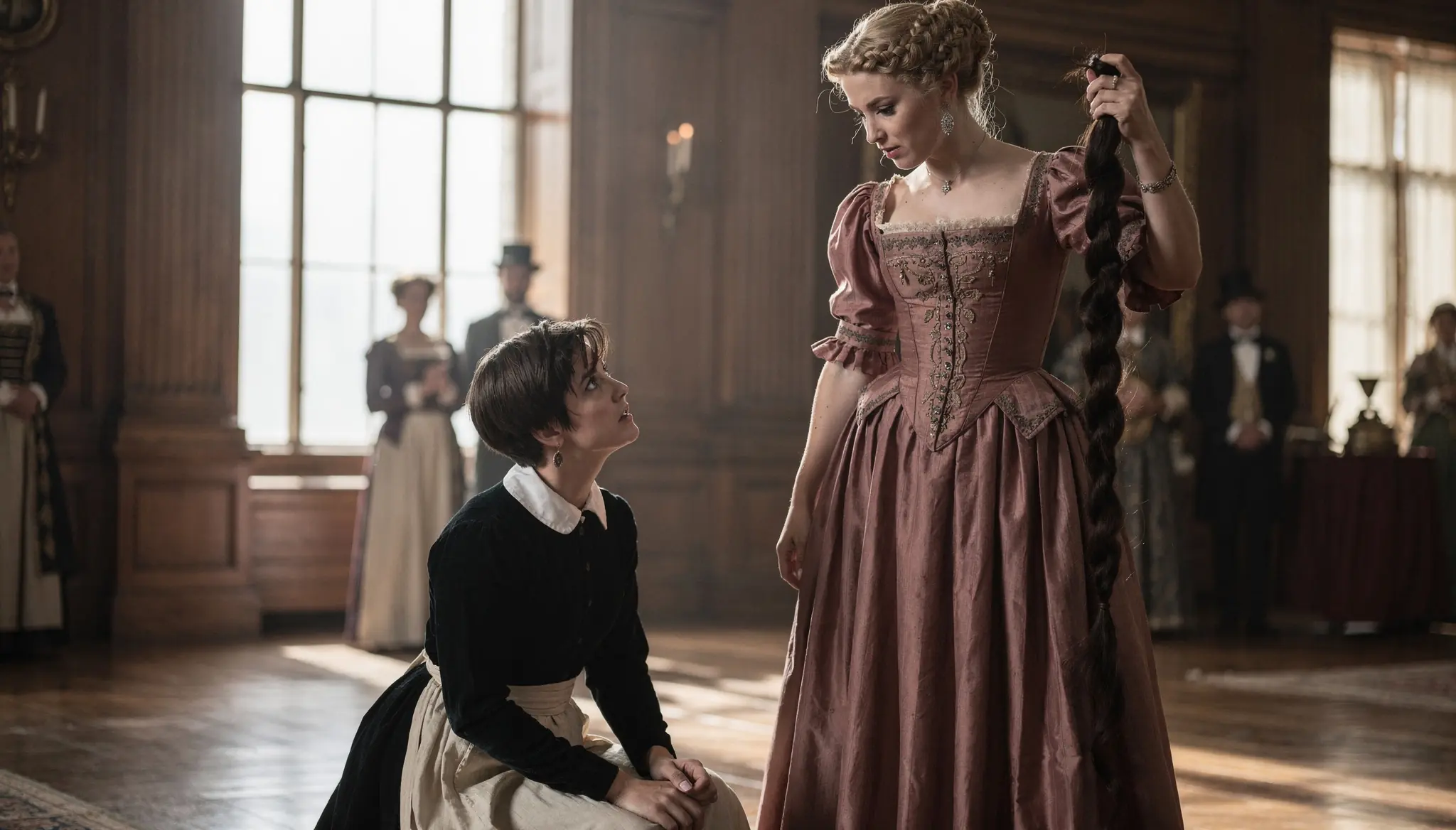
Lady Cecilia Marlowe, the future Duchess of Ravenshire, cut off a young maid's hair in front of the entire household, then threw it into the fire like rubbish. She expected tears; she expected begging. She got neither. The maid touched what was left of her hair, looked her lady straight in the eye, and said six quiet words. Those six words would one day bring a powerful earl to his knees.
High above them, in the shadows of the gallery, the Duke of Ravenshire saw everything—and he did nothing.
It all began with a book.
That morning, Clara had been dusting the library at Ravenshire Hall when she found it lying on the floor. It was an old book of poems, very worn, with a torn page hanging loose from the spine. Clara knew whose book it was: it had belonged to the old Duke who had died three years before. His son, the new Duke, kept it on his desk and never let anyone move it. Someone had knocked it to the floor—perhaps a careless footman, perhaps the wind from the open window.
Clara could have left it there. Instead, she sat down quietly in the corner, took a needle and thread from her apron pocket, and carefully stitched the loose page back into place. She had learned to mend books as a little girl; her father had taught her. He used to say that a torn page was like a broken promise: you could not always undo the damage, but you could try to hold things together.
She was just placing the book back on the desk when the door opened.
The Duke of Ravenshire stood in the doorway. Henry Ashcombe was thirty-two years old, tall and dark-haired, with a serious face that rarely smiled. The servants said he was cold; they said he had not laughed once since his father died. Clara had worked in his house for two years, and in all that time, he had spoken to her perhaps four times.
He looked at the book in her hands, then he looked at her. Clara's heart began to pound. Servants were not supposed to touch the Duke's private things.
"Forgive me, Your Grace," she said quickly. "It was on the floor. The page was torn. I only meant to—"
He walked over and took the book from her. He opened it to the mended page and studied it for a long moment. The stitches were small and neat, almost invisible.
"You did this?" he asked.
"Yes, Your Grace."
He was silent. Clara waited for him to scold her. Instead, he said something she never expected.
"Thank you. This book meant a great deal to my father." He paused. "And to me."
Then, for just a moment, the corner of his mouth lifted. It was not quite a smile, but it was close.