The Duke’s Son Hadn’t Laughed in Years — Until His New Governess Arrived

Chapter 1

Reader Theme:
Font Size:
24px
The Duke’s Son Hadn’t Laughed in Years — Until His New Governess Arrived

One year ago, Duchess Eleanor Sinclair died when her carriage overturned on the North Road. Blackthorne Manor had been silent ever since. Duke Edward Sinclair buried himself in ledgers and estate business, rarely stepping foot in the nursery. His six-year-old son, Charles, had spoken only a few words and had not laughed once since he watched his mother's carriage go over that ridge.
Six governesses had come and gone in a year. Charles refused to look at any of them, and the staff had stopped expecting a seventh to last. Then Rose Winthrop arrived, younger than the others, plainly dressed, and carrying a single worn trunk. The housekeeper warned her before she even reached the nursery door. "The boy doesn't talk. Don't expect him to."

Rose only nodded and walked in anyway. She did not kneel down and coo at him the way the others had. She did not ask him questions he would not answer. She simply sat on the floor across from him, pulled a wooden toy sword from her trunk, and said, "I hear this nursery used to have pirates in it. Shame. I was hoping for a proper sword fight."

Charles stared at her and said nothing, but he did not look away either.

That evening, Duke Sinclair returned from London earlier than expected. He walked through the front doors braced for the usual silence, the empty halls, the closed nursery door, and the quiet that had followed him for a year. Instead, he heard something that stopped him cold in the entryway, a sound he had not heard in twelve months.

Charles was laughing.

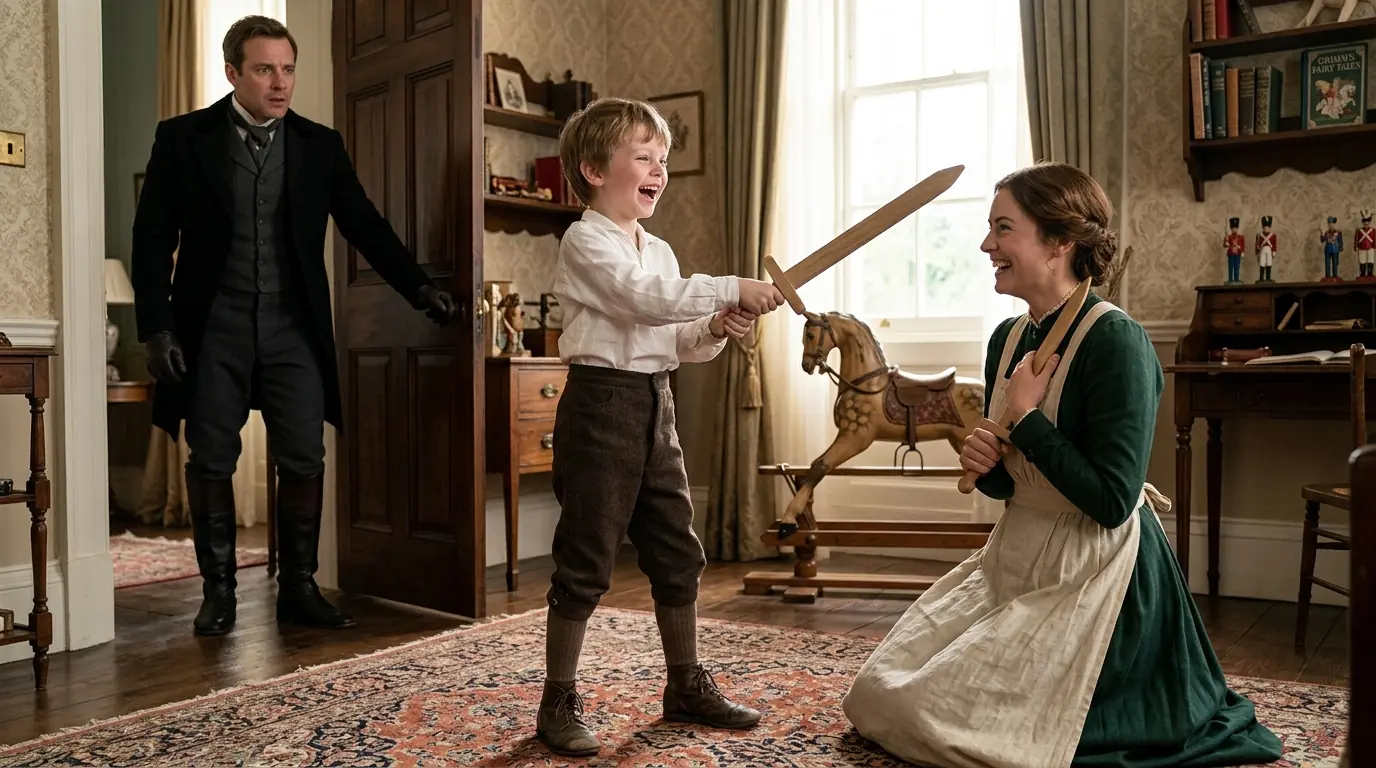
The Duke moved toward the nursery like a man in a dream, afraid that if he walked too fast the sound would vanish. He reached the doorway and froze. Inside, Rose was staggering dramatically across the rug, clutching her chest, defeated in an epic sword battle against a boy wielding a wooden blade twice his size. Charles was laughing so hard he could barely stand, tears of joy on his face.

The Duke did not announce himself. He simply stood in the doorway, watching his son laugh for the first time since he buried his wife. Rose finally noticed him and froze, embarrassed and expecting a reprimand. But the Duke said nothing. He only looked at his son, full of life for the first time in a year, and then at the young woman kneeling on his nursery floor, still holding a child's wooden sword.

For the first time since Eleanor died, Blackthorne Manor was alive.

Duke Sinclair could not stop staring at the governess who had accomplished in a single afternoon what no physician, tutor, or grieving father had managed in an entire year. Charles began speaking again, but only to Rose. At breakfast, he whispered his answers to her instead of the maid. During lessons, he would recite his letters only if Rose was the one holding the book.

The staff noticed. The Duke noticed more.

Rose started taking Charles into the gardens, the ones Eleanor had once tended herself, now overgrown and forgotten. She did not ask permission. She simply began pulling weeds beside him, teaching him the names of flowers his mother used to grow. Slowly and quietly, she restored small routines nobody else remembered: a Sunday walk to the pond, a bedtime song hummed just off-key, and leaving the nursery window cracked open for the morning birds.

Duke Sinclair watched all of this from a distance, unsure what to make of it. He told himself he was merely observing his son's progress, but he found himself lingering in hallways longer than necessary, listening for Charles's laugh and for the voice that seemed to summon it so easily. One afternoon, he caught Rose teaching Charles to skip stones at the pond, the exact spot, though he said nothing of it, where Eleanor used to take him as a baby. Charles smiled every time Rose clapped for him.

It unsettled the Duke how effortless it looked.

The household began to whisper. The cook remarked that the manor breathed differently since the new governess came. Even old Mrs. Pratt, the housekeeper who had watched the hopes of three governesses die in the past year, admitted she had never seen the boy attach himself to anyone so quickly.

But Rose carried something she showed no one.

Each night, once Charles was asleep, she slipped out a side door and crossed the frozen grounds to the manor's abandoned chapel, the one nobody had opened since the funeral. She lit a single candle at the Duchess's grave and laid fresh flowers, always the same kind: white lilies, Eleanor's favorite. She never stayed long. She never explained it to anyone, and she made certain no one saw her go, or so she believed.

One night, the Duke could not sleep. He noticed a light moving across the dark lawn and followed it out of curiosity, staying well behind the trees so as not to be seen. He watched Rose kneel at his late wife's grave, arranging the lilies with careful hands, her head bowed. He almost stepped forward and asked why a governess he had hired only weeks ago would grieve his wife as if she had known her.

Then he heard Rose speak so quietly he almost missed it. The words carried faintly on the winter air.

"I promised I would protect him."

The Duke went still. Protect him, not care for him, not watch over him the way any hired governess might speak of a charge. Protect. As though it were a vow made long before she ever set foot in Blackthorne Manor.

He wanted to step out from the trees and demand an answer, but something stopped him. Perhaps it was the same instinct that told him not to trust too quickly. Instead, he watched her rise, brush the frost from her skirts, and walk back toward the house without ever knowing she had been seen. The Duke stood alone by the chapel for a long while afterward, staring at his wife's grave.

For the first time in a year, a new kind of question kept him from sleep. Who exactly was Rose Winthrop?

Rose was given permission to organize the late Duchess's private library, a task no one else had wanted to touch since Eleanor died. Books had sat untouched for a year, dust thick on the shelves, Eleanor's handwriting still visible in the margins of old novels. While clearing a locked writing desk in the corner, Rose found a false bottom in one of the drawers. Inside was a small wooden box, and inside that, a sealed letter.

The handwriting on the front stopped her cold: To the woman who will one day care for my son.

It was unmistakably Eleanor's hand, the same elegant slant Rose remembered from years of letters passed between them. Rose's fingers trembled as she broke the seal. The letter was short, written in the unhurried voice of a woman who suspected, perhaps, that she would not have much time. Eleanor wrote of her fears for Charles, that grief might harden him and that a father lost in mourning might forget how to hold his own son.

She begged whoever read the letter to love Charles freely and fiercely, as if he were her own. "Whoever you are, I trust you were sent to us for a reason. Please don't let my son grow up in silence."

News in the same category

News Post

The Duke’s Son Hadn’t Laughed in Years — Until His New Governess Arrived

4 Part