The rotting duke said, "Whoever marries you will be lucky."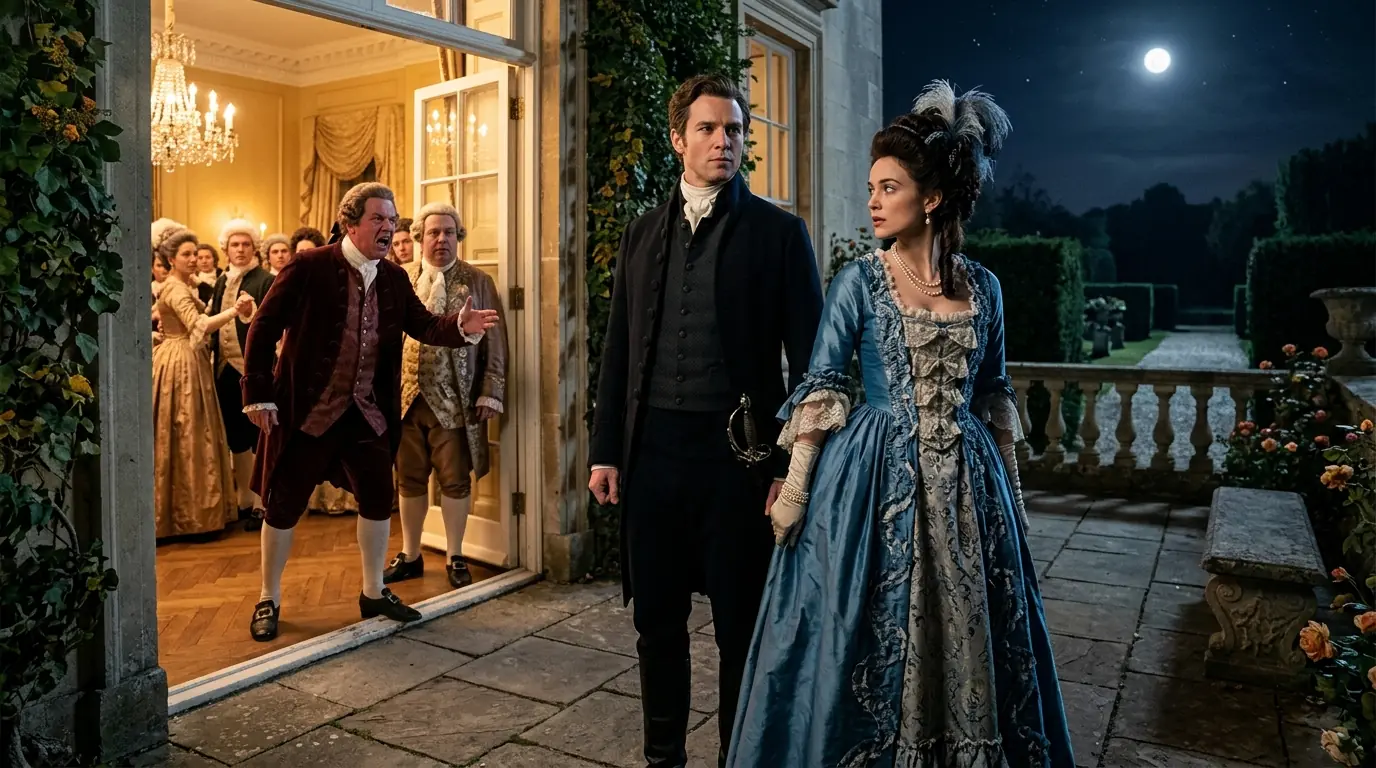
And she replied, "I accept your proposal."
Most romances begin with a glance. Daphne's began with a bargain no one expected her to survive. In a glittering ballroom full of chandeliers, whispered judgments, and the cold mathematics of marriage, she was being handed to a cruel old lord like property.
Then she stepped onto a moonlit terrace, spoke one reckless sentence, and accepted a proposal from the one-man society called "the rotting duke."
But Arthur Pemberton was not the monster people muttered about behind fans and velvet gloves. He was quiet, wounded, and far more dangerous to Daphne's future than any scandalous rumor could explain, because he saw her when no one else did. And Daphne, sharp as a needle and unwilling to be broken, was never meant to fall for the man she had just agreed to marry. She only meant to save herself.
Except some marriages are not built from duty. They are built from defiance, secrets, and the dangerous hope that love might bloom in the last place anyone would ever think to look.
One
The music inside the assembly rooms of Bath was the kind that made people forget their troubles. It curled between the silk gowns and powdered wigs, wound through the golden blaze of the chandeliers, and pressed against the tall windows where October frost had begun to form on the glass. In 1772, there was no finer stage in England for the business of marriages, alliances, and the slow, polished cruelty of polite society.
Lady Daphne Ashworth did not hear the music. Not truly. She stood near the far wall with a glass of ratafia she had not touched, watching the dancers spin in perfect formation, and all she could hear was the sound of her future closing like a heavy iron door.
Thirty minutes ago, her father, Lord Ashworth, had gripped her elbow and steered her behind the curtained alcove near the east corridor. He had not asked; he had announced. She was to be betrothed to Earl Cranbrook, a man of fifty-three with a red face, small wet eyes, and a reputation for temper that even his own servants whispered about. The alliance would secure the Ashworth family's crumbling debts and strengthen her father's seat in Parliament.
"You will smile," her father had said in the tone that left no room for argument. "You will be gracious, and you will not embarrass me."
She had smiled. She had been gracious. She had nodded while the earl lifted her gloved hand to his lips and looked at her the way a man looked at furniture he intended to purchase.
Now, standing in the crowded, glittering room, Daphne could no longer breathe properly. She set her untouched glass on a passing tray, smoothed her blue silk skirts, and walked with controlled steps toward the tall French doors at the back of the room. Nobody stopped her. Nobody noticed. She was already becoming invisible, which she supposed was the entire point.
The terrace garden met her like cold water thrown in the face. The night air was sharp with autumn, carrying the smell of damp stone and the last of the season's roses. Daphne exhaled for the first time in an hour. She pressed her palms against the stone balustrade and looked out at the moonlit garden below: dark hedges, pale gravel paths, the quiet geometry of a world that did not care who she was marrying.
She thought she was alone. She was wrong.
"You might want to lower your voice," said someone quietly from the shadows. "The doors are not entirely thick."
Daphne spun.
A man was sitting on a stone bench at the far end of the terrace, half-hidden in the shadow cast by climbing ivy on the wall behind him. He was angled slightly sideways, his left side tucked into the darkness, as though he had chosen that particular bench with deliberateness. In the pale moonlight, what she could see of him was remarkably handsome: strong jaw, dark hair, a stillness about him that was not unfriendly, but was not warm either. His coat was well-cut. His posture held a tension that had nothing to do with rudeness.
"You let me stand here thinking I was alone," she said.
"You were clearly in need of a moment," he said. "I did not want to interrupt a very dramatic internal crisis."
Under different circumstances, she might have turned around and gone back inside, but the image of Earl Cranbrook's wet eyes rose up behind her, and she found she had no interest in returning to any of it.
"I have just been handed to an old cow," she said, to nobody in particular. "A controlling, ancient gargoyle of a man who has buried two wives already, and my father is in there smiling as though he has done me a great favor." She laughed, but it came out brittle and strange. "I would have been better off marrying the rotting duke himself than that wretched earl. At least the rotting duke has the decency to stay isolated and bother nobody."
There was a pause.
Then the man on the bench let out a laugh—low, warm, and entirely unexpected.
Daphne turned with narrowed eyes. "I fail to see what is funny."
"Forgive me," he said, though he was still smiling. "I am not laughing at your pain. I am laughing at the particular cruelty of the universe."
He rose from the bench. It was a slow movement, careful, and she noticed the way his weight shifted as he straightened—a stiffness on his left side he had clearly long since learned to manage. He was taller than she had expected, and he looked at her with a directness that was almost startling.
"My name is Arthur Pemberton. I am the Duke of Blackwood." A brief pause. "Though I believe you may know me by another name."
The night air felt colder. Daphne stared at him. She looked at his face—strong, dark, and very much not rotting. She thought about the rumors: Blackwood never comes to London. Blackwood is diseased, decaying. They say you can smell him from the hall.
She had just called him an old cow's preferable alternative. To his face. In a garden.
"Oh," she said.
"Yes," he said.
The French doors at the back of the terrace flew open. Her father stood in the doorway with a face dark with fury, and Earl Cranbrook was a wide, red shape just behind his shoulder.
"Daphne, come inside now."