The commission arrived on a Tuesday in the kind of envelope that meant business. Thick cream paper, a wax seal pressed with an unfamiliar crest, the address written in a hand too careful to be casual.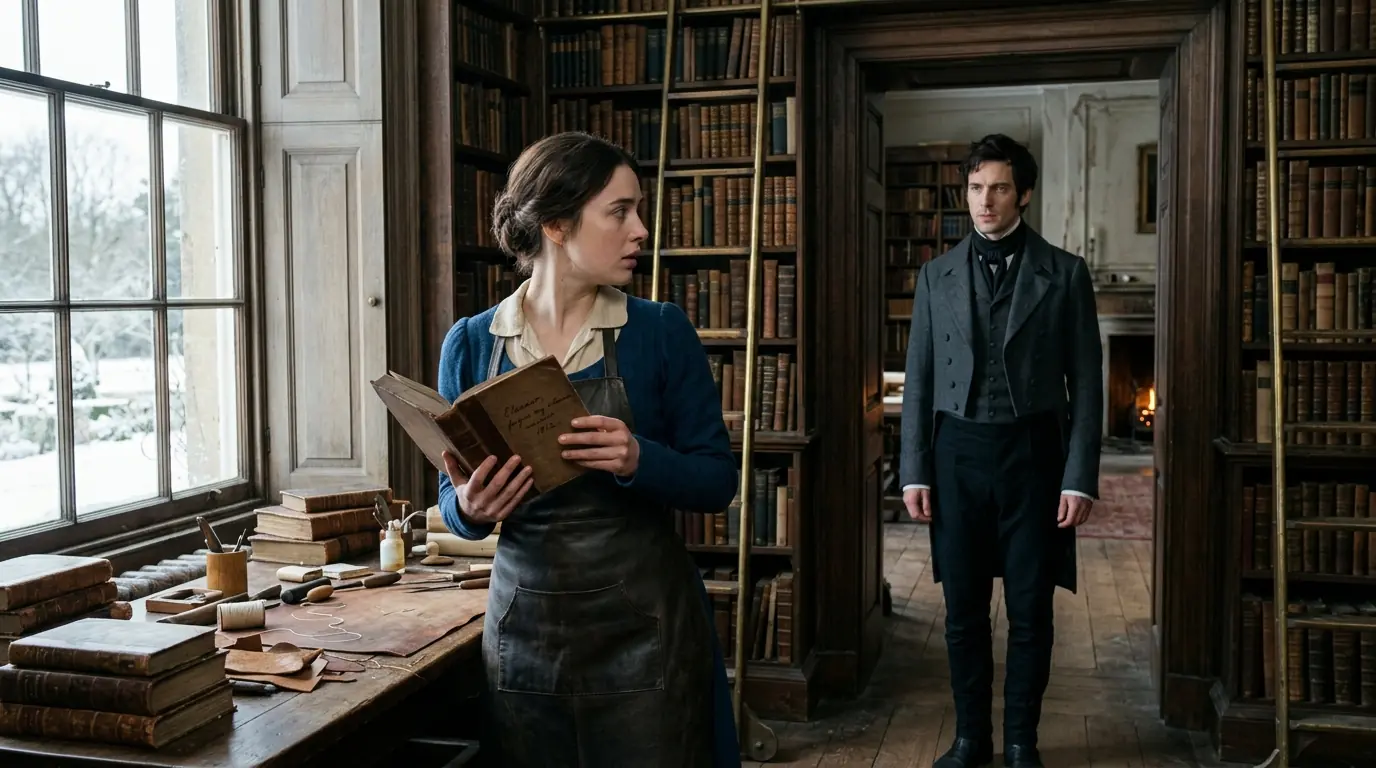
Ivy Caldwell read it twice at the kitchen table of her grandmother's small house, which was now her small house, which still smelled like the beeswax her grandmother had used to condition leather bindings for 60 years. The letter was from a solicitor named Sewell, acting on behalf of Gareth Oldwin, Earl of Blackwell. The library at Blackwell Manor required the services of a skilled bookbinder. The commission would last no fewer than 3 weeks. The rate offered was generous to the point of being suspicious.
Ivy set the letter down and looked at the bookshelf against the far wall, the one her grandmother had built herself from wood she'd traded for three rebound hymnals. Every book on it had been placed there by a woman who had known exactly which pages mattered.
She began to pack the following morning.
The road to Blackwell Manor wound through 4 miles of bare winter fields before the house emerged from the tree line. Stone, pale gray, four stories with tall windows that caught the late December light and turned it to copper.
The carriage Sewell had sent was warm enough, but Ivy had not slept. She had spent the journey reading the one thing she'd brought from her grandmother's wooden chest, a journal, slim and cloth-covered, filled with Constance's handwriting in the faded ink of someone who wrote every night for 40 years. She hadn't read it before. She'd thought she understood its contents. She had been wrong.
Mrs. Crane met her at the door before the coachman had finished with the trunk. The housekeeper was a small woman with a quick face and hands that moved constantly, touching keys, touching her collar, touching the door frame as she held it open.
"Miss Caldwell." Her voice was warmer than her expression. "We've been expecting you. I've aired the workroom. The fire is ready."
Ivy thanked her and stepped inside. The entrance hall smelled of old wood and candle wax and something else, something beneath both that she couldn't place yet. She noticed the floors had been freshly swept. She noticed the flowers on the hall table were real, not dried, which meant someone had gone to the effort of finding them in December. She noticed that the portrait above the staircase, a man in his 50s with kind eyes and ink-stained fingers, had recently been dusted, but not recently enough to remove the grief that had settled into the frame.
She asked Mrs. Crane quietly whether the Earl knew she was arriving today.
The housekeeper's hands went still for just a moment. "He knows a bookbinder has been engaged." She began moving toward the stairs. "He did not specify that he wished to know more than that."
Ivy followed her. She stored the distinction carefully.
The library was on the second floor, two rooms connected by a doorway whose door had been propped open with a brick recently because the hinges were stiff from two years of being closed. The smell hit her first, old paper, old leather, the particular sweetness of books that have been loved and then left. 2,000 volumes, she estimated, maybe more, floor to ceiling on three walls with rolling ladders on brass tracks. The windows were tall and north-facing, which meant the light would be steady all day.
In her grandmother's journal, on the third page, Constance had described this room in exactly those words, "Steady all day."
Ivy set her case on the long work table by the north window and did not yet open it. She walked the library the way her grandmother had taught her to walk any new space, slowly, without touching, with all her attention. She read the spines. She noted the condition of each shelf. She identified the worst of the damage without laying a hand on it.
And in the bottom left corner of the third wall, she found what she had half expected and wholly dreaded finding. Her grandmother's bookplate. A small rectangle of cream paper pasted to the inside cover of a volume of botanical illustrations, ex libris C. Caldwell, Conservator. The same plate appeared in seven more volumes on the same shelf, and in a ninth at the very end of the row, a book with no title on its spine, its cover plain brown board, its bookplate missing. But inside the front cover, in her grandmother's hand, four words in pencil, "For the one who asks."
Ivy closed the book and stood with it in both hands for a long time.
She did not hear the Earl until he spoke.
"You've found the corner she kept."
She turned. He was standing in the doorway, tall, dark-haired, wearing a plain gray coat that had seen better winters. He was younger than she'd expected, perhaps 33. His face was composed in the way of a man who had learned composure as a survival skill rather than a social grace. And his eyes, when they moved from the book in her hands to her face, were the shade of gray that looks almost blue in certain light.
She told him her name. She told him why she'd come.
"I know why you've come," he said. "Mr. Sewell arranged it." He looked at the book she was holding. "What I don't know is why you're holding that one."
"Because it has my grandmother's writing inside it."
Silence.
He came into the room then, not quickly, the way a person enters a space they've been avoiding. One foot, then a pause, then the other. He stopped three shelves from her and looked at the book without taking it.
"Your grandmother was Constance Coldwell."
"Yes."
"She was here for 31 years." He said it without looking at her. "She left 6 months before my father died. He didn't explain why. I assumed they'd had a disagreement."
"She left because she was ill," Ivy said. "She died 8 months after she came home to me."
He was quiet for a moment, then, "I'm sorry."
"So am I."
The silence between them was not uncomfortable. It was the kind of silence two people share when they have both lost something, and neither wants to perform grief for the other.