Chapter 1: The House Party of Intentions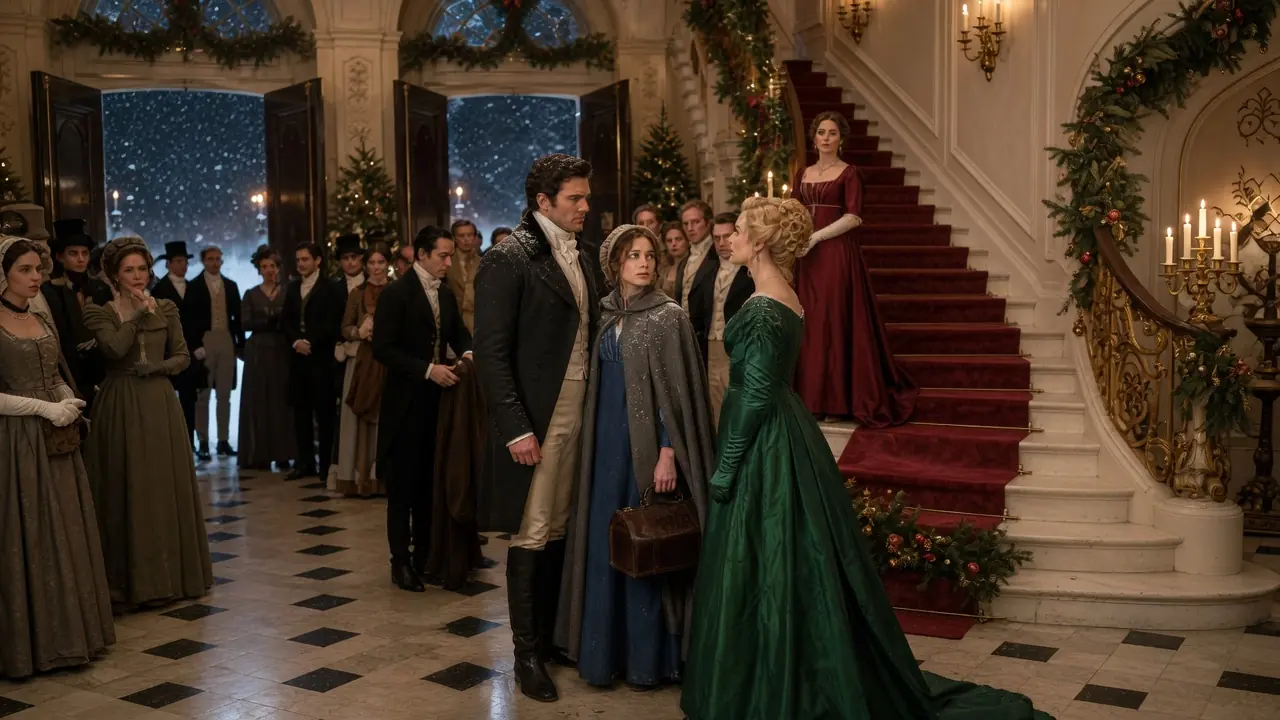
Winterly Hall did not merely sit upon its hill; it ruled it. Even in snow, even beneath a sky the color of pearl, the house looked like something built to outlast winters, wars, and the smaller storms of human opinion. Its long front stretched in dignified symmetry, its high windows held the winter light like pale glass lanterns, and its chimneys sent steady smoke into the air as if the building itself breathed with quiet authority.
By the third week of December, Winterly was dressed for Christmas. Evergreen garlands were looped along the staircase rails, heavy with holly berries that shone like small rubies. Wreaths hung in every public doorway. Bowls of polished oranges and winter apples sat on sideboards beside little piles of walnuts and ribbon sweets. The servants moved briskly in a coordinated urgency that felt almost like celebration, because it was.
For the first time in years, there was a house party.
And the village, of course, had noticed. They always noticed anything to do with Adrian Ashcombe, Earl of Winterly, if only because he gave them so little else to notice. For years, he had been a figure glimpsed rather than known: a gentleman on horseback in the early morning, a tall silhouette at a distant window, a quiet presence at church who left promptly after the final hymn. Courteous, dutiful, unshowy, and always alone.
He was seven-and-thirty now, a man in the full strength of adulthood with a title ancient enough to command respect and an estate large enough to employ half the county. Yet he lived like someone under a sentence. In London, they called him proud. In the countryside, they called him haunted. In truth, he was neither—at least not in the simple way those words suggested.
Adrian stood in the arched window of his study and watched the first carriages begin to arrive, their wheels crunching the frost-hardened gravel. His hands were clasped behind his back. His expression was calm, but his jaw was set as though he were bracing against an impact he had seen coming from miles away.
Behind him, his sister's voice carried the soft authority of affection. "You look as though you were about to ride into battle."
Lady Clara Ashcombe, née Clara Ashcombe of Winterly, stood with her hands folded over her stomach, her face bright from the cold and from satisfaction. She had been married three years, and motherhood had made her more determined, not less. If anything, she had developed the firmness of a woman who had discovered she possessed good sense and intended to use it.
Adrian did not turn. "This is not battle," he said evenly. "It is theater."
"It is Christmas," Clara corrected, stepping closer. "And it is life. You are going to take part in it whether you glare at the driveway or not."
He exhaled—a controlled breath, measured as though it cost him. "You invited half the county," he said.
"I invited the right half," Clara replied. "And I did not do it to torment you."
Adrian's gaze remained fixed on the carriages.
Clara's voice softened. "I did it because you cannot keep living as though everyone is an enemy, Adrian."
His shoulders tightened slightly, as if a hand had pressed a bruise. "I do not think everyone is an enemy," he said after a moment. "I think everyone wants something."
Clara said nothing at first. Then, very gently, she asked, "And do you believe no one can want you?"
Adrian's silence was answer enough.
Outside, footmen opened carriage doors, luggage was lifted down, and laughter rose. The first stream of guests entered the great hall, shaking snow from cloaks, exclaiming at the greenery, and admiring the glow of the fires as if Winterly had never been anything but warm.
Clara smiled. "Come," she said. "Your first wave is here. Try not to look like a man awaiting execution."
***
The house party had been designed with intention. Not the kind of intention spoken aloud in polite company, of course. No hostess ever admitted she was arranging a marital parade; it was always described as a pleasant gathering, a festive stay, or a few friends for Christmas.
But Lady Clara's invitations had been carefully chosen, and nearly every guest understood why. Winterly needed a countess. The Earl needed—well, the Earl needed something he had forgotten he was allowed to want.
And so, the eligible young ladies began to arrive. They did not arrive as a faceless flock; they arrived like distinct notes in a practiced arrangement, each carrying her own flavor of charm and strategy, supported by an aunt or mother skilled in the art of presenting a daughter as destiny.
Miss Lavinia Crowhurst came first: tall, striking, and draped in emerald silk that seemed almost aggressive in its elegance. Lavinia stepped into Winterly Hall as though she already owned it. Her mother, Lady Crowhurst, followed with a smile fixed like a brooch.
Lavinia's eyes moved quickly, measuring the width of the staircase, the sheen of the floors, the height of the ceilings, the number of footmen. "This house," she murmured, as though tasting the word, "is so very appropriate." Her glance slid to Adrian with a look that was not admiration so much as selection.
Miss Honoria Bellwether arrived in a burst of laughter. She was golden-haired and pretty in a bright, easy way, her cheeks kissed pink from the cold. She spoke warmly to the servants as if she were already adored by them, and when she met Adrian, she smiled as though they were co-stars in a romance she had long decided would end in applause. "How fortunate you are to have such a Christmas," she said brightly. "One cannot bear winter without company. It becomes positively melancholy." Adrian replied with civility; Honoria took that civility as encouragement.
Miss Arabella Fenton came with a sharper kind of energy. Her eyes were clever, her conversation brisk. Her father was an ambitious man who wanted a peerage for his family line, and Arabella had been raised to understand that marriage could be both affection and advancement. When Adrian greeted her, Arabella studied him like a page she meant to read properly. "It must be extraordinary," she said, "to shoulder a name with such history."
"It is ordinary," Adrian replied, "if one has done it long enough." Arabella's smile suggested she liked the challenge of what was difficult.
Miss Charlotte Denham arrived last among the principal candidates. She was not flashy; she was controlled, beautiful in a composed, polished way, with the grace of someone born to high society. She was connected to a duke through her mother's line, and even those who disliked her could not deny she would make a faultless countess. Charlotte greeted Adrian with perfect manners, neither too warm nor too cool. "My lord," she said with quiet confidence, "Winterly is exactly as I imagined." Adrian inclined his head. Charlotte's gaze did not flutter; it assessed.
And that, Adrian thought bleakly, was the point.
***
By the time the drawing rooms filled that evening, Winterly Hall shone with the concentrated splendor of a country house Christmas. Candles gleamed in tall chandeliers. Evergreen swags framed mirrors and doorways. A string quartet played near the far end of the main salon, their music soft enough to allow conversation, rich enough to lend every word a sense of occasion. Guests drifted between rooms in a gentle tide of silk and velvet, carrying glasses of warmed wine or spiced punch. The air held the scent of pine, beeswax, and roasting chestnuts.
Adrian moved among them with practiced ease. He was a good host; he knew how to make a guest feel seen without giving away too much. He listened, he asked polite questions, he smiled at appropriate moments. It was, however, the smile of a man performing an obligation.
And then, a different carriage arrived.
Not a barouche with a crest and a coachman in livery, but a smaller, practical vehicle, its lines plain, its wheels splattered with slush. Doctor Jonathan Hart, the local physician, stepped down first, rubbing his hands together against the cold. He looked a little out of place already, as though he had wandered into a world meant for other men.
Then his daughter descended. Miss Eleanor Hart moved with quiet care, smoothing her wool cloak as she stepped onto the gravel. Her bonnet framed a face that was neither striking nor forgettable. She was slender, composed, and very plainly dressed compared to the other ladies. Yet her eyes—clear, steady, thoughtful—held something rare. Not ambition, not hunger, not fear, just calm attention, as though she observed the world not for what she could take from it, but for what she could understand.
Clara hurried down to meet them, her warmth immediate. "Doctor Hart, thank you for coming. And Miss Hart, how glad I am you accepted."
Eleanor's curtsy was simple, her smile genuine. "You were too kind to insist," Eleanor said.
"I was not kind," Clara replied. "I was determined. Christmas is not meant to be spent alone."
As Clara guided them inside, Adrian, standing at the far end of the hall midway through greeting another guest, looked up. His gaze landed on Eleanor. And for the briefest moment, his expression shifted. Not interest, exactly. Not desire. Recognition.
As though he had seen something honest in a room full of performance.
Chapter 2: The Doctor's Daughter and the Earl's Distance
The first test came swiftly. It arrived in the shape of a glittering conversation circle around Adrian, arranged like a net.
Miss Honoria Bellwether positioned herself with graceful confidence near his shoulder, laughing lightly at every remark he made. Miss Arabella Fenton drifted close enough to listen, her gaze sharp and curious. Miss Lavinia Crowhurst stood opposite, perfectly placed so that Adrian could not look anywhere without encountering her.
They spoke of London, of fashion, of Christmas balls and winter hunting parties. And always, subtly, the conversation returned to Winterly—to the estate, to what it would mean to be mistress of it.
Lavinia's tone was smooth as satin. "One can tell at once that your household is exceptionally well managed. The staff are highly trained, the standards admirable. A great estate must require—how shall I say it—strong leadership."
"Good stewards," Adrian said politely.
"And a countess," Lavinia added, her smile bright, "to ensure the right tone in every room."
Adrian's expression did not change.
Honoria leaned in, her eyes sparkling. "Surely you must miss the bustle of London. It is so dull here in winter. One needs company, dancing, flirtation."
"Do you?" Adrian asked mildly.
Honoria laughed as though he were teasing her.
Arabella watched him. "You dislike being pursued," she observed.
Adrian's gaze flicked to her. "I dislike being assumed upon," he said.
The smallest pause followed—too small for a true breach of manners, but enough to send a ripple of interest through those listening. Arabella's smile sharpened as though she found that edge intriguing rather than alarming.
Clara, watching from across the room, felt a flicker of irritation—not at Adrian, but at the spectacle. That was when she noticed Eleanor.
Eleanor was not part of the net. She stood beside an elderly aunt who had grown tired and needed a chair. Eleanor had guided her gently to a settee near the fire and was now speaking with her in a low voice, her posture attentive. The older woman's shoulders relaxed. Eleanor's presence seemed to calm rooms. Clara felt a shift of hope she had not planned.
Later, in a corridor near the servants' stairs, Eleanor found herself kneeling beside a young housemaid whose hand was bleeding through a cloth.
"Oh, miss," the girl whispered, mortified. "I did not mean to. I dropped the tray. I'm so sorry."
"Hush," Eleanor said gently. "This is not a moral failing. It is a cut."
The girl's breath caught on a sob. Eleanor's hands were steady as she examined the wound. "You will need it cleaned, but it will heal cleanly if treated promptly."
The girl nodded, trembling. Eleanor's voice softened further. "Look at me. Breathe."
The girl obeyed, her tears subsiding. Then Eleanor looked up and met Adrian's gaze.
He stood at the corridor's end, having stepped away from the drawing room for air or refuge or both. He had not meant to intrude, yet he had stopped, arrested by the sight of someone attending a wound without drama.
Eleanor rose smoothly and curtsied. "My lord."
"You need not have troubled yourself," Adrian said.
Eleanor's expression held mild surprise. "It did not trouble me."
"It is not your responsibility," he said, as though testing the idea.
Eleanor's eyes were calm. "Someone's responsibility does not depend upon rank," she replied, "only upon ability and willingness."
Adrian's mouth tightened slightly—not in anger, but in thought. The maid looked between them, wide-eyed.
Eleanor said, "If you will permit, my lord, I shall take her to the housekeeper to have it properly dressed."
Adrian inclined his head. "Of course."
As Eleanor guided the girl away, Adrian remained still in the corridor, as though something in his chest had shifted and he did not quite know what to do with it.
He returned to the drawing room shortly after, but the air felt changed. The net tightened again. Lavinia approached. "My lord," she said, "how admirable of you to keep such a kind household, so attentive to your servants."
Adrian's gaze remained fixed past her for a moment, where Eleanor's figure had disappeared around a corner. "Yes," he said softly, "attentive." But his tone did not invite Lavinia's satisfaction.
***
The next morning, snow lay thicker upon the ground, bright as sugar beneath the pale sun. After breakfast, guests divided into amusements: some went for a drive, some for a walk, some for skating on the frozen pond, which had been cleared carefully by the steward and deemed safe.
Adrian, when pressed, agreed to join the skating party. He did not enjoy skating—it required a kind of ease he no longer felt comfortable displaying—but Clara insisted. "You will not die of harmless cheer," she said.
Outside, laughter echoed across the winter landscape. Honoria skated with theatrical delight, her cheeks flushed, her shrieks carrying across the ice. Arabella moved with surprising skill, her posture controlled as though determined to be impressive without appearing eager. Charlotte glided smoothly, elegant as a swan, scarcely seeming to exert herself at all.
Lavinia, for her part, did not skate much. She preferred to stand near Adrian, complaining lightly of the cold while letting her sleeve brush his arm. "How charming," she said. "How rural. How wholesome."
Adrian responded with absent politeness. Then he noticed Eleanor.
Eleanor was not skating. She stood at the pond's edge with Dr. Hart, watching with a small, appreciative smile. She looked comfortable in the cold, her cloak plain but well-made, her cheeks pink. She seemed content simply to observe.
Adrian found his feet moving before his mind had decided. He approached, his skates crunching softly on the snow by the pond's edge. "Miss Hart," he said.
Eleanor curtsied. "My lord."
Dr. Hart inclined his head. "Lord Winterly."
Adrian felt awkward—an unusual sensation for him, and therefore almost irritating. "I..." he began, then paused. "I saw you yesterday in the corridor."
"Yes," Eleanor said calmly. "Your maid was injured."
"You were competent," he said, as though the word were insufficient, but the best he could manage.
Eleanor's smile was faint. "I have had practice."
Dr. Hart said nothing, but his eyes sharpened with interest. He had watched too many people in pain to miss the way the Earl's tone held something like hunger—for calm, for steadiness, for an absence of performance.
Adrian looked back toward the ice. Honoria's laughter rang out again, bright and insistent. "I suspect," he said quietly, "that you find this all rather strange."
Eleanor's gaze followed his. "I find it impressive," she said gently, "but yes, strange, perhaps. It is a world arranged around different needs."
Adrian's eyes flicked back to her. "And what is your world arranged around?"
Eleanor's answer was simple: "Health, duty, and the small ways we keep one another from falling apart."
The words landed with unexpected force. Adrian looked away, swallowing something. "You speak plainly," he said.
"I speak honestly," Eleanor replied. "It is not always the same thing, but I try."
Adrian's breath formed a pale cloud in the air. "So do I," he said, almost too quietly.
Eleanor's gaze held his, steady. For the first time in a long time, Adrian felt not pursued, not evaluated, not trapped, but simply met.
***
That afternoon, Winterly Hall glittered with activity. A tree stood in the great parlor—modest by London standards, but richly decorated for the countryside. Apples, ribbons, strings of cranberries, and small candles were carefully placed, lit only under supervision. Beneath it, small parcels for the servants and the tenants' children had been arranged. Guests wrote place cards for the Christmas dinner. Some helped arrange evergreens. Some practiced carols for the village sing.
Clara had planned everything, and beneath it all, the house breathed with a new kind of life. Yet Adrian's inner world remained tense, because the siege he feared was not only social; it was personal.
In his study that evening, after guests had retired to dress for dinner, Adrian opened a drawer and withdrew a packet of letters tied with ribbon. They were not love letters; they were legal correspondence—threats, claims, demands. A distant cousin had revived an inheritance dispute, pressing the argument that Adrian's father had made provisions improperly and that certain lands should revert.
It was not likely to succeed; Adrian had good counsel. But the threat had become public enough to stir gossip. A weak man would rush to marriage to protect his position. A strong man might still rush if he could not bear being alone while attacked.
Adrian stared at the letters until his vision blurred slightly. He did not want to be chosen for safety. He did not want to choose someone merely as armor. And yet the house party downstairs felt like exactly that: a parade of armor offerings.
His chest tightened. He set the letters back in the drawer and locked it with a decisive click, as if he could lock away the fear.
Chapter 3: Christmas Eve and the Snowbound Truth
Christmas Eve arrived like a crescendo. The day was full of bustle: decorating, rehearsing, walking parties, laughter, and parcels delivered. The kitchen sent out scents that wrapped the house in warmth—roast goose, spiced biscuits, citrus peels simmering in sugar.
By evening, Winterly shone.
Dinner was magnificent. The table was set with silver that gleamed like moonlight. Candles stood in tall branches, their flames reflected in crystal. Bowls of winter flowers and evergreens ran the length of the table. Guests were in their finest: silk, velvet, pearls, gloves.
Eleanor, in contrast, wore a gown of simple blue muslin with a narrow ribbon at the waist. It was modest, well-fitted, and clean. She wore no jewels beyond a small locket at her throat. And yet, in the candlelight, her simplicity looked like quiet confidence rather than lack.
Adrian sat halfway down the table, placed carefully by Clara between Miss Charlotte Denham and Miss Arabella Fenton—two women who could carry conversation without appearing desperate. Charlotte spoke smoothly about a London ball, her words precise. Arabella spoke sharply about politics, her eyes bright. Adrian answered, listened, smiled. But his gaze drifted, again and again, toward Eleanor at the far side, seated beside her father among the useful guests Clara had arranged: the vicar, the steward, a local magistrate, and Dr. Hart.
Eleanor laughed once at something the vicar's wife said. It was not loud, it was not practiced; it was simply genuine. Adrian felt a peculiar ache.
Across the table, Honoria caught Adrian's glance away from her and frowned slightly. Lavinia noticed, too, her eyes narrowing. Charlotte noticed everything. Arabella noticed the shift and filed it away.
***
After dinner, the house gathered in the music room. A young cousin played a lively piece. Charlotte sang something polished. Honoria insisted on a duet that drew laughter and applause. Arabella recited a witty poem. Then Clara, with a conspiratorial sparkle, announced, "We shall go to the village for carols."
A ripple of approval rose. Cloaks were fetched, gloves pulled on, lanterns lit. They streamed out into the cold like a small procession.
In the village below, the churchyard was bright with lanterns and low laughter. Evergreen wreaths hung on the gate. The villagers stood together in family clusters, neighbors leaning close. And there, among them, Eleanor took her place naturally, as though she belonged. She held a small book of carols. When the singing began, her voice rose clear and steady, untrained but true.
Adrian stood at the edge at first, half-shadowed, observing. He watched Honoria's bright performance smile, Lavinia's careful poise, Arabella's calculated warmth, Charlotte's dignified attention. And then he watched Eleanor, singing as if nothing mattered except the words and the shared breath of human voices in cold air.
*"God rest ye merry, gentlemen..."*
The phrase struck Adrian with a strange irony. He had not been merry in years. Yet hearing Eleanor sing, he felt something soften at the edges of his defense.
When the carols ended, the vicar offered a short blessing. People murmured, "Amen." Children laughed. Snow began to fall again, light as sifted flour.
As guests turned back toward the house, Eleanor lingered slightly, speaking to an elderly woman who had been coughing. Doctor Hart was across the path, speaking with another man.
Adrian found himself beside Eleanor before he could reconsider. "You sing," he said.
Eleanor looked up, her cheeks pink from the cold. "Yes," she said, as though it were not remarkable.
"Not as performance," he added, surprised by his own insistence.
Eleanor's smile was small. "It is not meant for performance. It is meant for belonging."
Adrian's breath caught slightly. "Do you feel you belong here?" he asked quietly.
Eleanor's eyes held his. "In the village?"
"Yes."
"And at Winterly?" he asked, softer still.
Eleanor hesitated—a rare pause. "Tonight," she said honestly, "I feel welcome. That is different from belonging, but it is not nothing."
Adrian's throat tightened as though the air had grown colder. They began walking toward the hall, the lantern swinging gently.
"People often assume," Adrian said, "that I am fortunate."
Eleanor glanced at him, attentive. "And are you?" she asked.
He almost laughed—almost. But the sound would not come. "I have a title," he said. "Land, wealth, a house large enough to lose oneself in. It is not the same as fortune."
Eleanor's voice was soft. "It is not the same as peace."
Adrian looked at her sharply. Eleanor did not flinch.
"I have heard," she continued gently, "that you have had difficulties in London."
Adrian's jaw tightened. "Gossip," he said.
"Sometimes gossip is cruelty," Eleanor replied. "Sometimes it is a warning. Sometimes it is merely noise, but it has weight all the same."
Adrian's breath came steady, controlled. "I am tired," he admitted.
Eleanor's gaze softened. "Then rest," she said.
"It is not that simple."
"It rarely is," she replied. "But it is still necessary."
They reached the hall steps. Lantern light painted their faces warm against the snow. Inside, the great hall glowed with fires and candlelight. Guests drifted to the parlors again, laughing, sipping punch, playing cards.
Eleanor turned slightly as if to rejoin her father. Adrian's voice stopped her. "Miss Hart."
She looked back. He hesitated, then spoke as if forcing words past a wall. "If you were to judge me," he said quietly, "what would you see?"
Eleanor's expression was thoughtful. "I see a man," she said carefully, "who has been struck more than once and has learned to stand very still so he will not be struck again."
Adrian's chest tightened. "That is..." He swallowed. "...accurate."
Eleanor's gaze held his without pity. "And I see," she added, "that you are not cruel. Not proud, not indifferent. Only... defended."
Adrian stared at her as though she had named a thing he had hidden even from himself. Then, very softly, he said, "I do not know how to stop."
Eleanor's voice was almost a whisper. "Perhaps," she said, "you stop in small ways. Not all at once, not for everyone, but for one person who will not use it against you."
The words landed like warmth. Before he could answer, a burst of laughter rose from the parlor. Honoria's voice floated out, bright.
Eleanor's gaze flicked toward it, then back to Adrian. "I should return," she said quietly.
"Yes," Adrian said. "Of course."
But as she walked away, he felt the space she left like an opened window in a room that had long been airless.
***
Later that night, the house settled. Guests retired, fires were banked, the corridors quieted. Adrian remained awake. In his study, he opened the locked drawer again and withdrew the letters. He read them more carefully this time, as if searching for something he had missed.
Then he heard a soft knock at the door. He stilled. "Come."
Dr. Hart entered, his face grave but not hostile. "My lord," he said, "forgive the intrusion. A footman mentioned you were awake. I wish to speak with you."
Adrian's posture tightened automatically. "About what?" he asked.
Dr. Hart's eyes were direct. "About my daughter."
Adrian's breath stopped.
Dr. Hart continued calmly. "I have served this village for years. I have seen men of every rank. I have seen kindness and cruelty, and I have seen the way certain guests have watched Eleanor tonight."
Adrian's jaw tightened. "She is under no threat."
"Not physical," Dr. Hart said, "but social games have teeth. Eleanor is not trained for them. She is too honest."
Adrian felt an unexpected surge of protectiveness. "I have no wish to harm her," he said.
Dr. Hart studied him. "I believe that," he said, "which is why I am here. You are an earl. My daughter is a doctor's daughter. If you seek amusement, she is not for it. If you seek a symbol, she is not for it. If you seek a way to silence gossip, she is not for it."
Adrian's throat tightened.
"And if," Dr. Hart added, "you seek companionship with sincerity, then I will not stand in your way. But you must understand what you are asking of her."
Adrian's hands curled slightly at his sides. "I do not know what I am asking," he admitted. "Not yet."
Dr. Hart's gaze softened marginally. "Then do not ask," he said simply. "Not until you do. Eleanor deserves clarity, my lord, not uncertainty dressed as romance."
Adrian swallowed. "You speak cheaply... no, you speak boldly."
Dr. Hart's mouth twitched—almost a smile. "I speak as a father, and as a man who has watched too many hearts broken by those who did not mean to do harm."
Adrian nodded once. Dr. Hart inclined his head. "Good night, my lord."
When he left, Adrian sat in his chair, staring at the letters. The fire crackled softly. For the first time, the siege felt less like society's pressure and more like his own fear of wanting.
Chapter 4: Christmas Day and the Courage to Be Chosen
Christmas morning arrived clear and cold. The sky was washed pale blue, as if scrubbed clean. The house woke early. Bells rang faintly from the village. Servants moved quietly. Fires were coaxed brighter. Guests appeared in morning attire, soft with sleep and anticipation.
Adrian dressed without ceremony and joined the party for church. He walked with Clara and her husband, surrounded by guests whose breath steamed in the cold. Honoria chatted merrily. Lavinia held her muff with deliberate elegance. Arabella spoke in low tones to a gentleman about Parliament. Charlotte walked with calm poise, her gaze forward as if she had already pictured herself entering church on an earl's arm.
Eleanor walked slightly behind, beside her father, her posture relaxed.
In the church, winter light filtered through clear panes. Evergreen boughs framed the altar. The scent of pine and old stone filled the air. The hymns began. Adrian's voice joined automatically from habit. Yet this morning, he heard the words as if for the first time in years: *Peace, mercy, joy.*
He glanced sideways, almost without meaning to. Eleanor sang quietly, her eyes lowered, her expression serene. Something in Adrian's chest loosened. Not all at once, but enough.
After the service, villagers gathered in the churchyard, exchanging greetings, wishing blessings, and admiring one another's children and scarves. Clara spoke to everyone, radiant. Guests smiled, their polished manners softened by rural charm.
Adrian found himself standing near Eleanor by the old yew tree. Snow glittered on the branches. The sun was cold but bright.
Eleanor looked up at the tree, then at him. "It is beautiful," she said softly.
"Yes," Adrian replied, then hesitated. "Do you enjoy Christmas, Miss Hart?"
Eleanor's smile held quiet warmth. "I do," she said. "Not because it is easy, but because it insists that light exists, even in winter."
Adrian's gaze sharpened. "That is a very... hopeful way to see it."
Eleanor's eyes met his. "Hope is not always a feeling," she said gently. "Sometimes it is a decision."
Adrian's breath hitched, as if the words had struck something precise. Before he could answer, Lavinia approached like a ship cutting through water.
"My lord," she said smoothly, "I hope you will honor me with the first turn in the Christmas dance this evening."
Adrian's mouth tightened fractionally. Clara, across the yard, watched with narrowed eyes.
Adrian said, "I..." then paused. "If you will excuse me, Miss Crowhurst, I have promised my sister I would speak with the steward."
Lavinia's smile stiffened. "Of course," she said, and withdrew with impeccable politeness, though her eyes flashed.
Eleanor watched, silent. Adrian felt something like shame. "I am not skilled at evasion," he said quietly.
Eleanor's expression remained kind. "You are skilled," she said, "at avoiding your own wishes."
Adrian looked at her sharply. Eleanor did not retreat; she merely said, "Forgive me. That was not my place."
Adrian's voice was low. "Perhaps it should be."
Eleanor's breath caught slightly at the tone—gentle, sincere, unfamiliar.
Then Dr. Hart approached, his face serious. "Eleanor," he said, "we must return to the hall. A boy in the village has taken ill. The fever is worsening."
Eleanor's expression changed instantly, focus replacing softness. "I'm coming," she said. She turned to Adrian and curtsied quickly. "My lord."
Adrian watched her go, feeling the strange tug of admiration deepening into something more dangerous. Not desire born of beauty and novelty—something quieter. Need.
***
Back at Winterly, preparations for Christmas dinner continued, yet the mood shifted as news of the illness traveled. A tenant's child, little Samuel Reed, had been feverish for days. Dr. Hart had visited, and Eleanor had assisted. But the night before, the fever had spiked. This morning, the child's breathing had grown labored. Dr. Hart and Eleanor left at once, taking a covered cart with supplies.
Clara wrung her hands. "Oh, the poor boy," she murmured. "It's dreadful in winter. Everything becomes worse."
Honoria sighed dramatically. "How very sad."
Arabella asked practical questions about access to medicine. Charlotte offered a composed expression of concern.
Lavinia said, "It is inconvenient. We are meant to dine early."
Clara's eyes snapped toward her. Adrian heard Lavinia's comment and felt something harden. He did not speak, but later, when he found the steward in the corridor, he asked quietly, "Where do the Reeds live?"
The steward hesitated. "A mile past the old mill, my lord."
Adrian nodded once. "I will go," he said.
The steward blinked. "My lord?"
"I said I will go," Adrian repeated, calm but final.
He returned to his room, put on boots and a heavy coat, and left without announcement. Snow crunched under his feet. The air burned cold in his lungs. And for the first time in years, Adrian moved not from duty alone, but from impulse.
***
The Reed cottage was small, low-ceilinged, smelling of damp wool and fear. Inside, Dr. Hart stood over the bed, his sleeves rolled up. Eleanor sat beside the boy, her hand on his wrist, her face composed but intent. Samuel's mother hovered near the hearth, eyes wide with exhaustion.
When Adrian entered, the room went still. Eleanor looked up, startled. "My lord..." she began.
Adrian's voice was low. "Do not stop," he said.
Dr. Hart glanced at him, then back to the child. Adrian moved quietly, removing his gloves. "What do you need?" he asked.
Eleanor hesitated, then said, "Boiled water, clean cloths, another candle."
Adrian nodded, as if this were the most natural request in the world, and began helping, moving efficiently without fuss.
The boy's mother stared. "My lord..." she whispered. "You needn't..."
Adrian looked at her. His expression was not stern, but steady. "He is your son," he said. "Of course I need to."
Something in the woman's face crumpled with relief.
Eleanor watched Adrian as he worked. There was no performance in him here—no guarded smile, no polished courtesy, only a man present in a small room, choosing to be useful.
Hours passed. The fever began slowly to break. Samuel's breathing eased. His skin cooled slightly. His mother wept quietly into her apron. Dr. Hart exhaled, the tension easing from his shoulders. Eleanor's eyes closed briefly as if in silent gratitude.
Adrian felt a strange, tight warmth in his chest. When Dr. Hart stepped aside, he looked at Adrian with frank respect. "You did not need to come," he said.
Adrian's voice was quiet. "Yes," he replied. "I did."
Eleanor rose slowly, her hands stiff from cold and effort. "My lord," she said softly, "thank you."
Adrian looked at her. In the dim candlelight, her face was pale with fatigue, her hair slightly loosened, her composure frayed at the edges by honest work. He had never found any woman more beautiful.
"I did nothing," he said.
Eleanor's gaze held his. "You came," she said, "when you could have remained warm and untouched. That is not nothing."
The words landed like a hand on his chest. Outside, snow continued to fall.
They left the cottage together, Dr. Hart following. The night air was sharp. As they walked back toward the cart, Eleanor spoke quietly. "You are different here," she said.
Adrian's mouth tightened. "Here, no one asks anything of me except what I can do."
Eleanor's gaze softened. "And perhaps," she said, "that is the only question worth answering."
***
They returned to Winterly late. The house was glowing with Christmas light, the windows bright against the snow. Inside, the dinner party had been delayed; Clara had insisted. Guests had murmured, complained, and performed concern.
When Adrian entered with Eleanor and Dr. Hart, heads turned. Honoria's mouth fell slightly open. Arabella's eyes narrowed with interest. Charlotte's expression remained composed, but her gaze sharpened. Lavinia's eyes flashed with irritation.
Clara, however, looked at her brother with sudden, fierce tenderness. "You went," she said softly, as if she could hardly believe it.
Adrian nodded once. Clara took Eleanor's hands impulsively. "Thank you," she said. "Thank you for helping him."
Eleanor looked embarrassed. "It is what we do," she murmured.
Lavinia's voice floated from behind her, smooth as ice. "How very charming," she said. "A rustic little adventure. But surely, my lord, you are exhausted. You must take wine and rest. We cannot have you falling ill as well."
Adrian turned his head. For once, his expression did not soften into politeness. "No," he said calmly.
Lavinia blinked. "Pardon?"
"I will not be managed," Adrian said, still calm. "Not by you, not by anyone."
The room went very quiet. Lavinia's cheeks flushed. Charlotte looked down as if withdrawing with dignity from something unpleasant. Arabella's eyes gleamed. Honoria looked as though she might cry. Clara's breath caught. Eleanor stood very still.
Adrian looked at Eleanor then, not at Lavinia. His voice lowered, but everyone could still feel the weight of it. "Miss Hart," he said, "will you walk with me?"
Eleanor's eyes widened slightly. She glanced toward her father. Dr. Hart's gaze was steady; he gave a small nod.
Eleanor turned back to Adrian. "Yes," she said quietly. "I will."
***
They walked through the corridor lined with Christmas greenery, the candles flickering softly. Adrian did not speak at first; he seemed to be gathering courage. At last, in the quiet of the small library, he stopped.
The room was dim. The window showed snow drifting down. The fire was low, but warm. Eleanor stood near the hearth, her hands clasped.
Adrian faced her. "I have been under siege," he said.
Eleanor's gaze remained steady.
"By society," he continued, "by expectation, by gossip, by people who want my name and my estate and my compliance. I have grown so tired of being watched."
Eleanor's voice was soft. "Then stop living for their eyes," she said.
Adrian let out a breath. "I tried," he said. "I withdrew. I became cold. I became... defended."
Eleanor did not contradict him. She only listened.
Adrian's voice tightened slightly. "And then you arrived."
Eleanor's breath caught. Adrian took a step closer, not touching, but near enough that the space between them felt charged.
"You do not look at me as though I am a prize," he said. "You do not speak as though you are auditioning. You do not flatter. You do not angle. You simply exist, honestly."
Eleanor swallowed. "Honesty is not always comfortable," she said quietly.
"It is," Adrian replied, "a relief."
Eleanor's eyes softened. Adrian hesitated, then said, "I have not been happy—not for years."
Eleanor's voice was almost a whisper. "I am sorry."
Adrian shook his head once as if refusing pity. "I do not want pity," he said. "I want something I have forgotten how to ask for."
Eleanor's gaze held his. "What is it?" she asked, steady.
Adrian's throat tightened. "A companion," he said. "Not a mask, not armor, not a person chosen to silence gossip. A companion who will sit in the truth with me even when it is ugly, and not use it as a weapon."
Eleanor's eyes brightened slightly, but her voice remained calm. "And why," she asked gently, "do you think I would not be afraid of that?"
Adrian's breath caught. He did not answer quickly. He did not reach for easy romance. "I do not know," he admitted. "I only know that when I am near you, I feel less..." He stopped, searching for a word.
Eleanor supplied it quietly: "Less alone."
Adrian's gaze snapped to hers.
Eleanor's voice was soft, honest. "Yes," she said. "Less alone."
Silence held them for a moment, warm and charged. Then Eleanor spoke carefully. "My lord, I am not trained to be a countess."
Adrian's mouth twitched slightly—almost a smile. "I am not trained to be a man who trusts," he said. "Yet here we are."
Eleanor's smile was small, but real. "I have a quiet life," she said. "I am useful. I am not glamorous."
Adrian's gaze softened. "You are," he said, "the first person in this house who has felt real to me in a long time."
Eleanor's breath trembled slightly. "And your world is difficult," she said. "It will push at me. It will test me. It will not be kind."
Adrian's voice lowered. "Then I will stand between you and it," he said. "Not as a savior—as a partner."
Eleanor's eyes shone. She looked down for a moment, gathering herself. When she looked up again, her voice was steady. "I will not be a symbol," she said.
Adrian nodded once. "Good."
"I will not be taken," she continued, "because you are lonely. Loneliness is not love."
Adrian's jaw tightened. "You are right," he said.
Eleanor's voice softened. "But I will," she said quietly, "be considered, if you are willing to learn how to be known again."
Adrian's breath came out slow. "I am terrified," he admitted.
Eleanor's expression held compassion without indulgence. "So am I," she said. "But fear is not always a warning. Sometimes it is simply the price of something worth having."
Adrian stared at her as though the words had opened a door. Then, very gently, he reached for her hand. He did not seize it; he did not assume. His fingers hovered, asking.
Eleanor lifted her hand and placed it into his. The contact was light, but the meaning was profound.
Adrian's voice was hoarse. "Eleanor," he said softly, tasting her name like a promise.
Eleanor's eyes held his. "Yes," she whispered. "Adrian."
He closed his eyes briefly as if something inside him had finally unclenched. When he opened them, his gaze was steady. "I will speak to your father," he said, "properly."
Eleanor nodded.
"And I will speak to my sister," he added, the corner of his mouth lifting, "before she arranges our wedding breakfast without my knowledge."
Eleanor let out a soft laugh—quiet, surprised, warm. Adrian's chest tightened with something like joy.
***
Christmas dinner that night was different. It was still grand, still glittering, still full of candles and wine and laughter. But the tone had shifted, because the Earl, so long distant, was present. He spoke more freely. He smiled more easily. He sat nearer to Eleanor, no longer pretending she was invisible.
The eligible ladies noticed. Honoria looked wounded, then forced brightness. Arabella watched with sharp curiosity, then turned her attention elsewhere with admirable practicality. Charlotte withdrew with dignified resignation.
Lavinia... Lavinia grew cold.
Later, Lavinia cornered Clara in the corridor. "This is absurd," Lavinia hissed softly. "You invited us here for a purpose."
Clara's eyes flashed. "I invited you here to celebrate Christmas," Clara said. "If you mistook that for entitlement, that is your own mistake."
Lavinia's expression tightened. "She is nobody," she said. "A doctor's daughter."
Clara stepped closer, her voice low but deadly. "She is somebody my brother looks at as though he can breathe again," Clara said. "And that is more than I have seen any of you offer him."
Lavinia's eyes widened. Clara smiled sweetly. "Enjoy your pudding," she said. "And mind your manners."
***
The next day, snow kept falling, soft and endless. Guests remained at Winterly longer than planned; roads were blocked. The house party became snowbound, trapped in its own festive world.
It might have been an inconvenience. Instead, it became a gift.
Adrian and Eleanor found pockets of quiet in the busy house: the library, the corridor by the long gallery, the conservatory where frost traced the glass. They spoke of small things and large ones. He told her, slowly, about his parents' deaths, about the cousin's threats, about the gossip that had made him feel hunted. Eleanor listened without flinching. She did not excuse him, but she did not punish him, either.
And in that steady space, Adrian began, inch by inch, to loosen his grip on solitude.
On the final evening, Clara arranged one last small gathering in the great hall. The servants sang, the guests played cards, the tree candles glowed, and Adrian, standing beside Eleanor, felt something he had not felt in years. Not triumph, not relief—peace.
Dr. Hart approached later, his gaze steady. "My lord," he said.
Adrian turned fully, respectful. "I wish to speak plainly," Dr. Hart said.
Adrian nodded. "Please."
Dr. Hart looked briefly toward Eleanor, then back. "My daughter has always been unassuming," he said. "Not because she lacks worth, but because she does not seek to impose it."
Adrian's voice was quiet. "I see her worth."
Dr. Hart's eyes sharpened. "Then speak it," he said. "Not only to me—to her, and to the world that will try to reduce her."
Adrian's jaw tightened with resolve. "I will," he said.
Dr. Hart studied him a moment longer, then gave a small nod. "Very well," he said. "Then I will tell you something in return."
Adrian waited.
Dr. Hart's voice softened. "Eleanor's mother died young," he said. "And Eleanor learned early that love can vanish. She does not give her heart easily. If she has given you even a portion of it, do not waste it."
Adrian's throat tightened. "I will not," he said.
Dr. Hart nodded once, satisfied.
***
On Twelfth Night, when the snow finally eased and the roads began to clear, guests departed. Carriages rolled away, the glittering crowd dissolved, and the eligible ladies left with varying degrees of grace. Winterly Hall grew quieter, but it did not return to silence, because Eleanor remained—not as a guest under obligation, but as someone invited to stay.
Adrian walked with her through the great hall one morning after the last carriage had gone. The greenery still hung on the banisters. The tree still stood, its ribbons slightly drooping now. The air smelled faintly of pine and extinguished candles.
"It feels different," Eleanor said softly.
Adrian looked at her. "It is different," he replied.
Eleanor's gaze lifted to his. "And you?" she asked.
Adrian exhaled. "I feel," he said slowly, as though the words were new, "as if the siege has ended."
Eleanor's smile was gentle. "And what replaces it?" she asked.
Adrian's eyes held hers. "Work," he said. "Life. Trust, built slowly." He paused, then added quietly, "Joy, chosen."
Eleanor's eyes brightened. She took his hand.
They stood together in the quiet splendor of Winterly, the winter light spilling through tall windows, snow glittering outside. And for the first time in years, the Earl of Winterly did not feel like a man waiting for judgment.
He felt like a man stepping into his own life.