Year 2000, Broken Bow, Nebraska.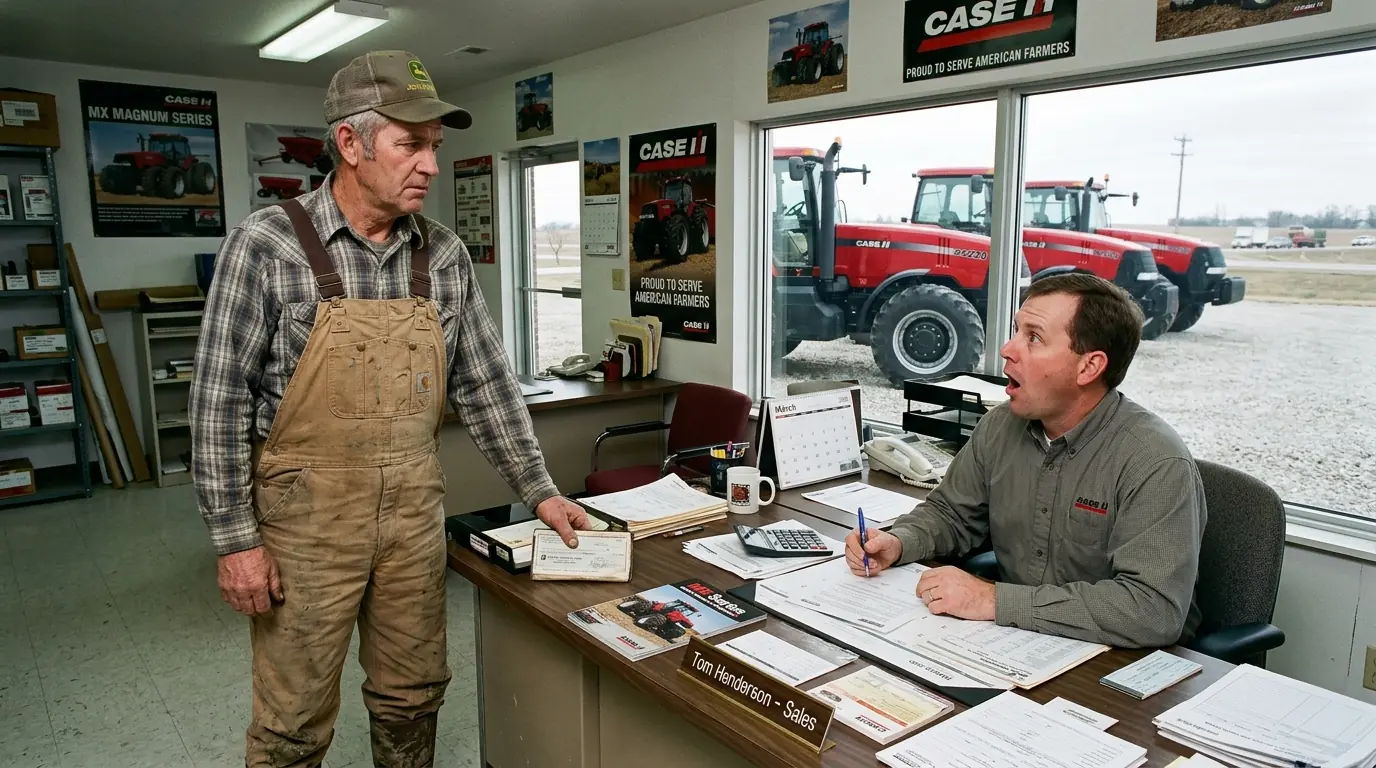
Tom Henderson had been selling Case IH tractors in Broken Bow, Nebraska for 17 years. He'd seen farmers trade in worn-out machinery they'd nurse through one more season. He'd arrange financing packages that stretched families so thin you could see daylight through their budgets. He'd watch good people lose their farms and watched lucky ones hit it right. But he'd never seen anything like the man who walked through his door on a Tuesday morning in March 2000.
Harold Bergstrom was 58 years old, wearing Carhartt bibs that had seen better days, a John Deere cap that was probably older than Tom's youngest kid, and boots that clearly spent most of their time in the field. He walked with a slight forward lean of a man who'd spent decades on tractor seats, and his handshake had that particular firmness that comes from a lifetime of manual work.
"I need to talk about tractors," Harold said.
Tom gestured to his desk. Standard opening. Every farmer who walked through that door needed to talk about tractors. "What are you looking at? Trade-in? Upgrade?"
Harold settled into the chair across from Tom's desk. "Neither. I want to buy five MX Magnums. Cash."
Tom's pen stopped moving. He looked up. Harold's face was completely serious.
"I'm sorry," Tom said carefully. "Did you say five?"
"Five. Cash."
Tom set his pen down. In 17 years of selling farm equipment, he'd financed million-dollar deals. He'd arranged lease packages that covered entire fleets. But he'd never heard anyone casually announce they wanted to walk out with over half a million dollars in equipment, paid in full.
"Mr. Bergstrom..." Tom started. "I don't mean any disrespect, but that's $650,000, give or take—"
"Depending on configuration, I know what they cost," Harold interrupted.
There was a pause. Outside, a semi loaded with fertilizer rumbled past on Highway 2. The fluorescent lights hummed. Tom tried to figure out if this was a joke, some kind of farming community prank, or if the man sitting across from him was actually serious.
Before we go any further, Tom said, leaning forward, I need to explain something to you about what you're about to hear. What I'm going to tell you isn't just one man's story. Everything I'm about to describe—the equipment specifications, the economic conditions, the decisions Harold made—all of it is drawn from documented agricultural history, USDA reports, Case IH production records, and interviews with farmers and dealers who lived through this exact period in rural Nebraska. While I constructed this narrative for clarity, every fact about the 2000 farm economy, every detail about these MX Magnum tractors, every aspect of the financial landscape is real. This isn't fiction. This is how it actually worked.
Now, to understand what happened next in that dealership, you need to understand where Harold Bergstrom came from.
Harold was born in 1942, right in the middle of World War II, on the same Custer County farm where he still lived in 2000. His father, Leonard Bergstrom, had bought that quarter section in 1938: 160 acres for $3,200, borrowed from an uncle because no bank would touch farm loans in Nebraska that year.
Leonard had seen the Dust Bowl. He'd seen his neighbors auction off their land. He'd watched men with college degrees work for 30 cents an hour because there was nothing else. So, Leonard Bergstrom taught his son one lesson above all others: Never, ever, ever owe money you can't pay back tomorrow.
Harold grew up watching his father do things that seemed crazy to neighbors. While other farmers leveraged up in the 1950s boom to buy new machinery and more land, Leonard kept running equipment that was old when Truman was president. While everyone else expanded, Leonard saved. Put money in coffee cans, then in bank accounts, then in treasury bonds. Lived like he was still in the Depression, even when times got better.
"That's what got people in trouble," Leonard would say, standing in a machine shed looking at his ancient John Deere Model A. "They thought good times last forever. They don't. Bad times come back. They always come back. And when they do, I'll still have my farm."
Harold absorbed those lessons at a molecular level. He took over the farm in 1967 when he was 25 years old. His father gifted him the original 160 acres and sold him another 160 he'd accumulated over the years. Harold paid cash—money he'd saved from 5 years working construction in Lincoln before coming back to farm.
From day one, he operated by his father's rules. If you can't pay cash, you don't buy it. If you can't afford to lose it, you don't risk it. If you don't absolutely need it, you don't buy it at all.
The 1970s were hard. Everybody remembers the boom at the end of the decade, but the early years were brutal. Corn prices bounced between $1.18 and $1.57 per bushel. Harold ran old equipment, rented a little land when he could afford it, and saved every penny that didn't go to seed, fuel, or feeding his young family. His wife, Martha, kept the books and kept the household budget tighter than a bowstring.
Then came the boom: 1977, 1978, 1979. Land prices shooting up. Corn hitting $2.50, then $3. Every farmer Harold knew was buying more land, bigger equipment, expanding like crazy. The Agriculture Secretary had told farmers to "get big or get out," and everyone took that advice seriously.
Harold didn't. He kept farming his 320 acres. He rented another quarter section when the price was right. He ran tractors that were older than his marriage. He saved. While his neighbors were signing notes for $500,000 land purchases, Harold was putting money in CDs at 14% interest.
"You're missing out," his neighbors told him. "Land's never going to be cheaper than it is right now. You got to leverage this opportunity."
Harold just smiled and said he was fine where he was.