Before sunrise, three trucks rolled into an abandoned fish farm. Inside them were forty thousand channel catfish. Fish so unwanted the hatchery was paying to destroy them. The ponds had been empty for nearly ten years. Neighbors stopped along the road and laughed.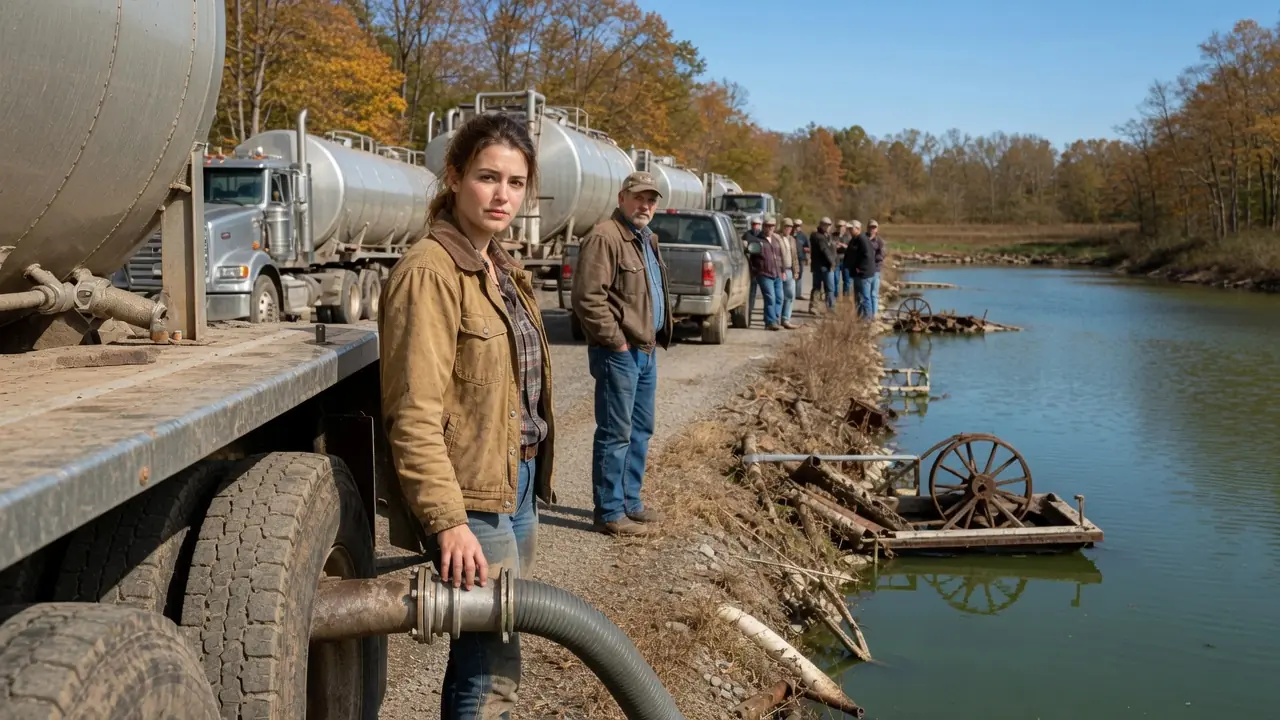
They said the young woman had just bought herself a graveyard full of fish. But she didn't panic. She only looked at the driver and asked, "Is that all of them? Or do you have more?" A cool spring breeze drifted across the forgotten ponds outside Pine Bluff, Arkansas. Gray clouds hung low over the quiet countryside and the abandoned farm seemed as though time itself had stopped breathing.
Abigail Turner was 27 years old, but the last two years had added a quiet weight to her heart that made her seem older whenever she looked into a mirror. She stood about five feet seven with a lean frame shaped more by hard work than exercise. Her chestnut brown hair was usually tied into a loose ponytail, though strands often escaped and framed her oval face. She had clear hazel eyes that rarely showed excitement anymore, only careful determination. Her lightly freckled skin carried the warmth of someone who preferred working outdoors.
And although she smiled politely to strangers, losing her grandfather only months earlier had left her naturally reserved. He had been the one person who always believed she could accomplish difficult things, even when she doubted herself.
Since graduating from college, Abigail had worked long hours as a bookkeeping assistant in Pine Bluff. The job paid just enough to cover rent, groceries, and the old pickup truck that seemed to need repairs every season. Her life had become painfully predictable. Wake before sunrise, drive to work, return home exhausted, repeat. She often wondered if this endless routine was all life had planned for her.
Everything changed after her grandfather's will was read. Instead of money, she inherited twelve acres of neglected land nearly an hour outside town. The property contained five old channel catfish ponds that had been abandoned for almost ten years. The banks had collapsed in several places. Thick weeds covered broken pipes.
Rust coated every remaining piece of equipment, and the old paddle wheel aerators looked more like forgotten sculptures than working machines. Murky green water filled only part of the ponds while insects buzzed above the stagnant surface. The locals considered the property cursed with bad luck rather than valuable land.
One afternoon, while Abigail inspected the ponds for the first time, Harold Benson stopped his dusty pickup beside the gravel road. Harold was a broad-shouldered man in his early 60s with weathered skin, a square jaw hidden beneath a neatly trimmed gray beard, and kind blue eyes that had spent decades watching crops succeed and fail. Years of droughts and failed harvests had made him practical rather than optimistic. Folding his arms against the truck door, he spoke gently. "You ought to sell this place while somebody still wants it." He explained that several owners had tried raising catfish there before losing everything.
One family had walked away after repeated disease outbreaks. Another had gone bankrupt repairing equipment that never seemed to stay functional. Harold wasn't mocking her. He genuinely believed he was protecting a young woman from repeating the same mistakes. Abigail thanked him politely, but as she looked across the quiet ponds, something deep inside refused to let go.
She couldn't explain why. Perhaps it was grief. Perhaps it was stubbornness. Or perhaps she simply wasn't ready to throw away the final piece of her grandfather's legacy.
Over the following weeks, Abigail spent every evening reading articles about aquaculture, watching educational videos, and calling anyone willing to answer beginner questions. Most conversations ended with polite warnings that fish farming required years of experience and enormous investment. Yet every warning somehow strengthened her resolve instead of weakening it.
Eventually, one fisheries consultant mentioned a large hatchery nearly sixty miles away that occasionally dealt with surplus fish. That conversation introduced her to Carol Reyes.
When Abigail called, Carol explained the situation without softening the truth. A major commercial contract had collapsed only weeks before delivery. More than forty thousand channel catfish had already grown beyond the size required by the buyer. Keeping them alive meant spending thousands of dollars every day on feed, electricity, labor, and water management. Because of biosecurity regulations, the hatchery couldn't simply release them elsewhere.
The company had already arranged to pay contractors to destroy the entire stock. "You don't want these fish," Carol warned. "They're becoming expensive every single day." Abigail listened quietly. Every sensible thought told her to thank Carol and hang up. She had no experience, limited savings, broken ponds, and no guarantee anything would survive.
Fear whispered that everyone else was probably right.
Then she remembered her grandfather's hands, rough from decades of honest work, and the way he always said that people often abandoned something one day before it finally became worthwhile. She took a slow breath. "When does the first truck arrive?" she asked. Silence filled the line. Carol blinked in disbelief before giving her the date.
Three mornings later, the entire town seemed to gather along the gravel road as three tanker trucks slowly rolled toward the abandoned ponds carrying more than forty thousand unwanted channel catfish. Drivers climbed down preparing their hoses while curious neighbors laughed openly, shaking their heads.
To everyone watching, Abigail Turner hadn't inherited an opportunity. She had just turned 12 worthless acres into the largest fish graveyard Pine Bluff had ever seen.
The excitement that had surrounded the arrival of the three tanker trucks disappeared almost as quickly as the water settled.
By sunset, the curious neighbors had driven home leaving Abigail Turner alone beside five silent ponds that now held more than forty thousand living channel catfish. The laughter still echoed in her mind, but it wasn't the laughter that frightened her. It was the realization that every fish swimming beneath the surface now depended entirely on someone who had never managed a pond before.
For the first three days, everything appeared almost peaceful. Abigail walked the pond banks before work, returned again before sunset, and spent every evening recording water color, fish activity, and weather conditions in a small notebook her grandfather had once used for keeping orchard records. She barely slept. Every unusual ripple made her wonder whether disaster had already begun.
It arrived before dawn on the fourth morning. The air felt strangely still as Abigail stepped from her pickup carrying a flashlight. Before she even reached the water, a sharp, earthy odor stopped her. Then the flashlight beam revealed hundreds of pale bellies floating near the shoreline. Her heartbeat froze.
As she hurried along the bank, the number grew into thousands. Fish gasped weakly at the surface, while others drifted motionless through the shallow water. She dropped to her knees without realizing tears were already running down her face. "I did something wrong," she whispered to herself.
The old aerators continued turning lazily across the ponds, their rusted paddles barely disturbing the surface. They looked busy enough from a distance, yet they lacked the power to replenish enough oxygen during the long, humid night. Abigail had trusted old machinery simply because it was still moving.
By noon she had spent nearly every dollar remaining in her savings hiring local workers to remove dead fish before the water quality deteriorated further. Watching truckloads of lifeless fish hauled away felt almost unbearable. Every fish represented another mistake she could not afford.
That afternoon she drove to the aquaculture extension office at the University of Arkansas carrying photographs, water samples, and more questions than confidence.
There she met Dr. Benjamin Collins.
Dr. Collins was sixty-one, tall and slightly stooped from decades of leaning over laboratory tables and pond banks. Thick silver hair framed a narrow face marked by countless hours beneath the Arkansas sun. A neatly trimmed white mustache softened his otherwise serious expression, while gentle green eyes revealed remarkable patience. Earlier in his career, he had lost nearly an entire university research pond because of an equipment failure during an unexpected heat wave. The experience had shaped his philosophy forever.
He never mocked beginners because he understood that knowledge usually arrived only after painful mistakes. He examined Abigail's notes carefully instead of rushing toward conclusions. "You've already done something many new producers never do," he said calmly. "You kept records." Abigail looked at him with exhausted disbelief. "I've already lost thousands." "And because of that," he replied quietly, "you'll never ignore dissolved oxygen again." Over the next several hours, Dr. Collins explained that fish consumed oxygen continuously throughout the night while aquatic plants stopped producing fresh oxygen after sunset.
On humid nights with little wind, oxygen levels could collapse just before sunrise. Old paddle wheels that appeared functional often produced only a fraction of their original performance. Rather than recommending expensive commercial equipment Abigail couldn't afford, he sketched a simple design for a homemade paddle wheel aerator powered by an affordable gasoline engine. He also taught her to measure water conditions before sunrise each morning instead of waiting until daylight revealed the damage.
For nearly two weeks, Abigail worked until her hands blistered. She replaced broken bearings, rebuilt supports, tightened belts, and installed the homemade aerator exactly as Dr. Collins had demonstrated. Every dawn she checked the ponds before the first birds began singing.
Just as confidence slowly returned, dark clouds gathered across Jefferson County. A violent overnight storm pounded the property with relentless rain.
Before sunrise, one weakened pond bank gave way beneath the pressure, sending muddy water rushing into a drainage ditch. Abigail fought through knee-deep mud with sandbags until her shoulders trembled from exhaustion. She managed to stop the breach before losing the entire pond, but the repair consumed nearly all the money she had managed to save after the oxygen disaster.
The following week brought another challenge. Great blue herons discovered the recovering ponds. Elegant, yet relentless, the tall birds stood motionless in the shallow edges before striking with astonishing speed. Several mornings in a row, Abigail counted fewer young fish despite improving water quality. She stretched protective netting across the most vulnerable pond edges, sacrificing appearance for survival.
Then feed prices suddenly climbed as grain markets shifted across the region. Each invoice felt heavier than the last. Abigail sat alone one evening inside her aging pickup, calculator resting on the steering wheel, wondering whether selling every remaining fish before losing even more money might be the only sensible decision left.
As she searched the glove compartment for another receipt, a folded copy of her grandfather's property deed slipped onto the seat. On the back, written in his familiar handwriting, were the words she had nearly forgotten. "What other people throw away is often just waiting for the right person to recognize its value." Abigail closed her eyes. When she looked back toward the quiet ponds, she no longer saw failure. She saw one more reason to stay.
Nearly a year had passed since the three tanker trucks first rolled onto the forgotten property outside Pine Bluff.
The ponds no longer looked abandoned. Freshly repaired banks framed clearer water. The homemade paddle wheel aerators turned steadily before every sunrise, and the weeds that once swallowed the shoreline had been replaced by narrow paths.
Abigail Turner walked every morning. She still carried the same weathered notebook, but its pages were now filled with feeding schedules, water temperatures, oxygen readings, and observations written in careful handwriting. Every entry represented a lesson that had once cost her sleep, money, or heartbreak.
The fish had changed, too. Thousands of channel catfish that had once been dismissed as worthless now moved confidently beneath the surface. Watching them feed had become Abigail's favorite part of each day. The sound of water erupting around floating feed reminded her that persistence sometimes made more noise than luck ever could.
One Saturday afternoon, a familiar pickup truck rolled onto the property.
Harold Benson climbed out slowly, removing his faded cap as he looked across the ponds. The broad-shouldered farmer, who had once encouraged Abigail to sell the land, seemed almost embarrassed to stand there now.
His gray beard had grown slightly longer over the past year, and the wrinkles around his blue eyes softened as he watched healthy fish breaking the surface. "I heard they're finally growing," he said, trying to sound casual. Abigail smiled politely. "They are." Harold hesitated before scratching his beard. "Think you've got four good ones you could sell me?" She harvested the fish herself, cleaned them carefully, packed them in ice, and accepted cash that felt strangely meaningful.
It was not the amount that mattered. It was the fact that someone who had expected her to fail was now becoming her first customer.
Two evenings later, Harold knocked on her door again. "You were right," he admitted with an honest laugh. "Best catfish my wife and I have had in years." Within another week, two of Harold's neighbors arrived asking whether they could buy fish as well. Abigail suddenly found herself answering phone calls instead of searching for advice.
The local farmers market welcomed her the following month.
Every Saturday, she loaded coolers into the back of her old pickup before sunrise. Some customers bought only two fish. Others asked endless questions about how they had been raised. Abigail answered every one with quiet patience because she remembered what it felt like not to know anything herself.
Word spread farther than she expected.
One afternoon, she received a phone call from Little Rock.
The caller introduced himself as Marcus Whitfield, owner of Riverstone Kitchen, a respected family-owned seafood restaurant known for purchasing directly from regional producers.
Marcus was forty-six, tall with neatly combed dark hair touched by silver above his ears. A short, well-kept beard framed a confident face while thoughtful brown eyes revealed a man who judged quality more carefully than appearances.
Years earlier, a supplier had repeatedly delivered inconsistent seafood that nearly ruined his restaurant's reputation. Since then, Marcus trusted only producers who could prove reliability over promises.
He drove to Abigail's farm himself. Rather than discussing price immediately, he inspected the ponds, examined the fish, and watched Abigail explain her feeding records and water management system.
Finally, he nodded. ""I don't need the cheapest fish," he said. "I need the same quality every single delivery." Abigail accepted the order with excitement she struggled to hide.
That excitement disappeared the following week.
The original batch of rejected fish had never been uniform. Some catfish had grown rapidly while others remained noticeably smaller. When Marcus received his first shipment, several fish fell outside the weight range his kitchen required. He called politely but firmly, ""I can't build a menu around fish that arrive in three different sizes." Abigail apologized and promised to do better. The second delivery improved, but not enough.
Driving home that evening, disappointment settled heavily over her shoulders. She had finally reached the opportunity she had dreamed about, only to realize she still lacked one of the industry's most important skills.
The following morning, she returned to Dr. Benjamin Collins.
Together they walked beside the ponds while he explained that successful producers did not simply raise fish. They managed growth. Fish of different sizes competed differently for feed, reached market weight at different times, and needed separate management if consistency was the goal.
Following his advice, Abigail spent the next several weeks grading every pond. Larger fish were moved into one section, medium fish into another, and slower growers into separate ponds where feeding schedules could be adjusted specifically for them. The work was exhausting, but for the first time every pond had a clear purpose instead of simply holding fish.
Marcus agreed to give her one final opportunity.
This time every fish in the delivery met the exact specifications. He smiled as he inspected the shipment. "I think we've finally found our rhythm." Not long afterward, Abigail's phone rang once more. The caller was Carol Reyes.
The hatchery manager explained that another large batch of commercial stock had failed to meet grading standards after a canceled contract. Before finishing her explanation, she paused with a quiet laugh. "I suppose I already know your answer." Abigail looked across the ponds that everyone had once called worthless. "When do the trucks arrive?" she asked.
Two years after the first rejected fish arrived, Abigail Turner's property no longer resembled the forgotten farm that had once drawn laughter from passing drivers. The five ponds shimmered beneath the Arkansas sun, each serving a specific purpose in her carefully planned production cycle. Fresh gravel roads connected every section of the farm. Insulated water lines replaced cracked pipes and a modest processing building stood where weeds had once reached above her shoulders. Every improvement represented countless mornings that began before sunrise and evenings that ended long after dark.
Success did not change Abigail's appearance as much as it changed her confidence. Her chestnut hair was still tied into a practical ponytail. Her work boots were still stained with mud and the freckles across her cheeks still darkened beneath the summer sun. Yet there was a steadiness in her hazel eyes that had not existed when she first inherited the ponds. She no longer questioned whether she belonged in aquaculture.
She questioned only how much better she could become.
Instead of selling only whole fresh fish, Abigail invested in a small refrigerated storage room and a state-certified processing area. She learned how to prepare clean fillets, package fresh portions, and produce smoked channel catfish using traditional hardwood smoking techniques. Every new product allowed her to reach customers who wanted convenience as much as quality. The profit from one processed fish often exceeded what she once earned selling two whole fish, giving her business a stability that raw sales alone could never provide.
The growing operation soon attracted attention beyond local restaurants.
One afternoon, a white pickup carrying the logo of Delta Fresh Distribution pulled into the farmyard. The driver introduced himself as Richard Lawson.
Richard was fifty years old, tall and powerfully built, with broad shoulders that still reflected years of loading freight before he became a regional distributor. His closely cropped salt and pepper hair matched the neatly trimmed beard outlining his square jaw. Deep lines around his dark eyes came from decades of solving supply problems rather than avoiding them. Earlier in his career, an unreliable producer had failed to deliver during a holiday season, costing his company several important clients. Since then, Richard trusted consistency above charm.
After touring the ponds and processing facility, he spoke plainly. ""I can offer you a long-term contract," he said, "but the volume is far beyond what you're producing today." Abigail understood immediately. Accepting meant expanding, declining meant remaining comfortable.
That evening, she walked slowly around the oldest pond on the property, the only one still waiting to be fully restored.
Years earlier, she would have seen another impossible expense. Now she saw unused opportunity.
Within weeks, construction crews repaired the remaining pond completely. New liners reinforced weak sections of the banks. Additional aerators were installed and water quality monitoring expanded across the entire farm.
Expansion required more than equipment. It required experienced people. Abigail hired several former hatchery employees who had recently lost their jobs after a nearby operation reduced its workforce.
Among them was Daniel Pierce, a quiet thirty-eight-year-old technician with short black hair, weathered skin, and calm gray eyes that missed very little. A neatly trimmed beard framed his narrow face, while years spent diagnosing fish health had taught him to notice problems long before they became visible to everyone else. Losing his previous position had humbled him, but it had also strengthened his belief that careful observation prevented expensive disasters.
Daniel quickly became responsible for daily health inspections.
Late one autumn morning, while walking the banks together, he noticed several fish swimming slightly apart from the main schools.
Their movements were slower than normal, almost subtle enough to ignore.
Many producers would have overlooked the warning. Abigail did not. Years of recording behavior every single morning had trained her eyes to recognize when something felt different before it looked dramatic.
Water samples were collected immediately, feeding was adjusted, and the affected pond was isolated while veterinary testing confirmed the beginning of a bacterial outbreak.
The response came early enough to stop the disease from spreading into the remaining ponds. Losses were limited to only a small portion of one production pond, while thousands of healthy fish continued growing uninterrupted.
Richard Lawson watched the farm's response with quiet admiration. More than the harvest itself, the disciplined management convinced him that Abigail could be trusted with larger contracts.
As months passed, restaurants praised the consistency of her fillets, grocery stores welcomed her smoked products, and distributors appreciated deliveries that arrived exactly as promised.
Hatcheries continued calling whenever another batch of fish failed to meet commercial grading standards because everyone knew there was one farm that never dismissed overlooked stock simply because others had.
The same rejected fish that once carried disposal costs had become the foundation of a business respected throughout the region. And Abigail's reputation spread just as steadily as the waters that now flowed through every restored pond.
Three years after the first trucks arrived carrying fish nobody wanted, Abigail Turner's farm had become a place people slowed down to admire instead of mock. The gravel road was smoother now, the pond banks were clean, and the processing building hummed quietly in the early mornings while cold storage units held neatly labeled boxes of fresh fillets and smoked channel catfish.
Revenue had grown far beyond anything Abigail had imagined when she first stood beside those broken ponds with mud on her boots and fear in her chest.
What surprised her most was not the money, it was the silence.
Nobody laughed anymore when tanker trucks backed through the gate. The truck still came every month from Carol Reyes's hatchery, sometimes carrying batches too uneven for commercial buyers, sometimes carrying fish from canceled contracts, sometimes carrying stock other producers considered too troublesome to manage.
To Abigail, those trucks no longer looked like a warning. They looked like the beginning of another season.
She had learned that value did not always arrive polished and prepared. Sometimes it arrived splashing inside steel tanks, unwanted by everyone else, waiting for someone patient enough to understand it.
Farmers began visiting from neighboring counties. Some came with notebooks. Others came with embarrassed smiles. A few were the same men who had once parked along the road to watch her fail.
Harold Benson was among them one bright morning, standing beside two younger farmers while Abigail explained how she separated fish by size, monitored oxygen before sunrise, and never trusted a pond simply because the surface looked calm. Harold, now slower in his movements but warmer in his pride, listened like a student.
His gray beard moved with a small grin when one of the younger men asked whether abandoned ponds were worth restoring. ""Ask her," Harold said. "She's the one who proved me wrong." Abigail laughed softly, not with bitterness but with a kind of peace she had spent years earning. She did not need apologies from the town. The ponds themselves had become the apology.
One morning before sunrise, long before the workers arrived, Abigail walked alone along the bank of the oldest pond. Mist hovered above the water like a silver veil, and the soft turning of the aerator sounded almost like breathing. Her grandfather's old notebook rested under her arm, its pages now filled with numbers, sketches, mistakes, and small victories. She stopped near the place where she had once found thousands of dead fish floating after her first terrible mistake. For a moment, the memory returned so clearly that she could almost smell that bitter dawn again.
But the pond before her was alive. The water rippled as healthy catfish moved below the surface.
Abigail placed one hand against the notebook and thought of her grandfather's words. What other people throw away is often just waiting for the right person to recognize its value.
For years she had believed he meant the land.
Then she had believed he meant the fish. But standing there in the quiet, she understood at last that he had meant something deeper.
He had left her those ponds because he had seen a part of her she had not yet recognized in herself. The patience to learn, the courage to endure embarrassment, and the stubborn tenderness to stay with something broken until it revealed what it could become.
The inheritance had never truly been twelve acres. It had been a way of seeing.
Later that morning, another tanker truck rolled through the gate.
Daniel Pierce guided it toward the receiving area while workers prepared the transfer lines. Carol had called the day before with another batch most buyers had rejected.
Years earlier, such a delivery would have drawn laughter from the roadside. Now a few farmers stood nearby watching carefully, not to mock, but to learn.
Abigail looked at the fish flashing inside the tank and smiled. To someone else, they were a disposal problem. To her, they were proof that nothing living should be judged only by the condition in which it was found.
As the first rush of water carried the new channel catfish into the restored pond, Abigail felt her grandfather's legacy move through the farm like sunlight touching water.
What had once been called worthless had built a business, healed a piece of land, and taught an entire town to look twice before giving up on something.
And as the truck emptied beneath the Arkansas sky, Abigail Turner already knew this was not the end of the story. It was simply another beginning.
Maybe the greatest miracle in this story wasn't that abandoned ponds became a thriving fish farm. Maybe the miracle was that God changed one person's way of seeing the world.
While everyone else saw something worthless, Abigail chose to see possibility. While others saw failure, she chose faith, patience, and hard work.
Sometimes God doesn't place a miracle directly into our hands. Sometimes he places an opportunity there instead. Wrapped in disappointment, hidden behind rejection, waiting to see whether we'll walk away or keep believing.
Perhaps there's something in your own life today that feels forgotten, broken, or overlooked. A dream, a relationship, a small opportunity everyone else says isn't worth your time.
Don't be too quick to give up on it.
With faith, perseverance, and God's guidance, today's disappointment may become tomorrow's greatest blessing.