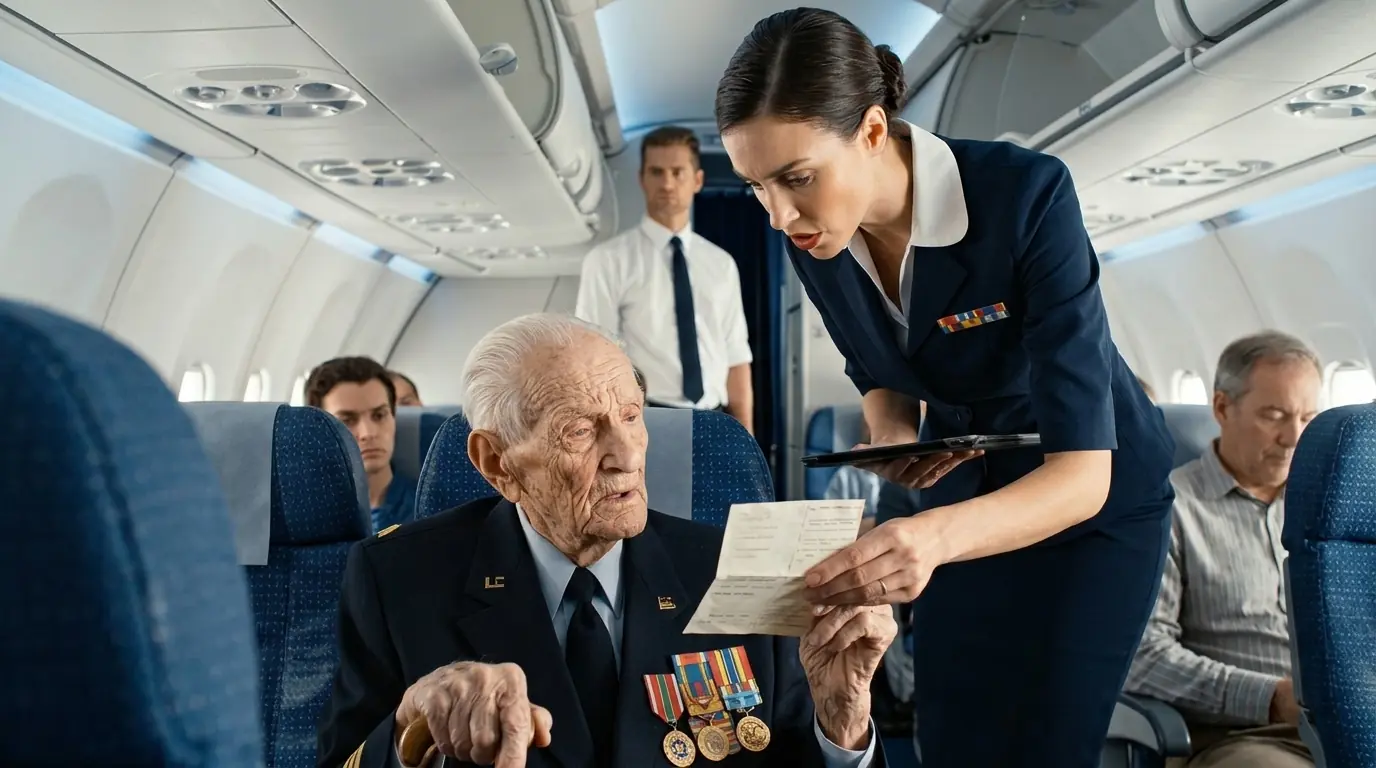
“Sir, I need you to gather your things and move to seat 34E.”
The flight attendant stood in the aisle with her tablet pressed against her chest, her smile already gone. Behind her, passengers were still forcing carry-ons into overhead bins, pretending not to listen while listening to every word. The plane smelled of raincoats, coffee, jet fuel, and the impatient breath of people who believed their own connection mattered more than anyone else’s discomfort.
Arthur Bennett looked up from seat 6D.
He was eighty-six years old, thin but straight-backed, with white hair combed carefully beneath a dark wool cap. His suit was charcoal, a little shiny at the elbows, and his tie had been knotted by hands that still remembered military neatness even when the fingers ached. A polished black cane rested against his knee, and his left foot was positioned carefully where he could stretch it into the aisle once the cabin settled.
“I cannot sit in a middle seat,” Arthur said.
The flight attendant’s name tag read Lauren Mills.
She checked the screen again, though she had checked it twice already. Her voice took on the careful firmness of someone who had decided kindness was taking too long. “We have a family that needs to sit together. You are traveling alone, and 34E is the only open seat.”
Arthur turned his head slightly.
Across the aisle stood a woman, her husband, and a boy of about ten. The child wore noise-canceling headphones around his neck and gripped a small stuffed astronaut against his chest. His eyes darted between the adults, the seats, and the crowded aisle with the panic of a child who had already endured too much noise for one morning.
Arthur understood why the parents wanted to sit together.
He did not resent them.
“What are their assigned seats?” he asked.
Lauren’s jaw tightened. “Six A, six B, and thirty-four E.”
Arthur nodded toward the father. “Then the boy and his mother can remain in six A and six B. His father can take the open seat.”
The father looked down, embarrassed.
“I can do that,” he said quietly.
Lauren shook her head before he finished speaking. “The family requested to remain together. We are trying to resolve this quickly.”
Arthur rested one hand on the cane.
“I booked this aisle seat six months ago.”
“I understand.”
“No,” he said, calm but firmer now. “You do not.”
A few heads turned.
Arthur disliked that most of all. He had spent half his adult life avoiding attention, and the other half learning that attention rarely arrived gently. He had not boarded FalconAir Flight 619 expecting to explain his body to strangers between the first-class curtain and a crying child.
Lauren lowered her voice, but not enough to make the conversation private.
“Sir, many passengers prefer aisle seats.”
“This is not a preference.”
“Then the accommodation should be noted in your reservation.”
“It was.”
Lauren glanced at the tablet. “I don’t see it here.”
Arthur reached slowly toward the inside pocket of his jacket.
Lauren’s hand rose at once.
“Please keep your hands where I can see them.”
The aisle changed.
Not loudly.
Not visibly to everyone.
But Arthur felt it.
He froze with two fingers just inside the jacket, then withdrew his hand empty and laid it flat on the armrest. The old discipline came back instantly. Slow movements. Clear voice. No sudden motion near someone who has already decided you are difficult.
“I was reaching for my medical card,” he said.
“You can show it to the gate agent after we get you reseated.”
“I am not standing again unless I must.”
“Then I am giving you a crew instruction,” Lauren said. “Move to 34E, or we will have you removed from the aircraft.”
The words traveled down the front cabin like a cold draft.
A man in 5C lowered his phone slightly, pretending he had not started recording. A woman in 4A looked up from her paperback. The boy with the stuffed astronaut pressed the toy harder against his chest while his mother whispered something meant to calm him and failing.
Arthur looked out the window.
Rain streaked the glass at Baltimore-Washington International. Ground crews moved beneath the gray morning, yellow vests bright against the wet tarmac. The aircraft was bound for San Antonio, and the weather had already delayed boarding by twenty minutes.
Arthur had not been to Texas in fifty-one years.
Inside his jacket was a folded letter.
He had carried it for two weeks.
He had opened it only three times, because each reading made his chest feel too small for breath.
The man who wrote it was dead now.
The funeral was that afternoon.
Arthur looked back at Lauren.
“I do not want to delay your flight.”
“Then stand up.”
He closed his eyes for half a second.
Pain did not frighten him.
Pain had been with him so long it had become a tenant in his body, stubborn and unpaid. There was metal in his hip, old nerve damage in his lower spine, and a left knee that sometimes locked without warning when forced into tight spaces. The aisle seat was not comfort. It was the difference between surviving four hours and spending the landing unable to stand.
Still, he pressed both hands against the armrests and pushed himself up.
The pain arrived before he was fully upright.
It moved from his hip into his back, then down his leg like a live wire. He gripped the seat in front of him. The cabin tilted for a moment. The boy stopped fidgeting and stared.
Arthur reached toward the overhead bin for his leather shoulder bag.
His left leg failed.
His knee struck the side of the seat, the cane slipped sideways, and Arthur fell hard against the armrest. A woman gasped. The father from row six caught him by the shoulder before he hit the aisle floor.
Something small fell from Arthur’s jacket pocket.
It landed on the carpet with a dull metallic sound.
The boy with the astronaut bent before anyone could stop him and picked it up.
It was a pair of old military pilot wings.
Silver once.
Darkened now.
One side bent inward, one edge scarred by heat, with a tiny reddish-brown stain set deep into a scratch that age had never erased.
The boy held it out carefully.
“You dropped this, sir.”
Arthur’s face changed.
He took the wings with both hands.
“Thank you.”
The boy studied him. “Were you a pilot?”
Arthur closed his fingers around the metal.
“A long time ago.”
Lauren picked up the cane and held it out stiffly.
“If you are unable to walk safely, we may need airport medical to assist you off the plane.”
The young man filming spoke for the first time.
“He told you he couldn’t move because of an injury.”
Lauren turned sharply.
“Sir, please stay out of this.”
“It became everyone’s business when you made him stand in front of everyone.”
A murmur traveled through the first few rows.
Another flight attendant stepped through the curtain from the forward galley. She was older than Lauren, with calm eyes and the posture of someone who had spent decades learning the difference between a problem and a person. Her name tag read Denise Calder.
“What is happening here?” Denise asked.
Lauren explained quickly.
“Passenger in 6D is refusing to move. Family separation issue. He claims a medical condition, but there is no note on the manifest.”
Arthur breathed slowly through the pain.
“I asked to remain in an aisle seat.”
Denise looked at him, then at the cane, then at the pilot wings in his hand.
“What is your name, sir?”
“Arthur Bennett.”
Something flickered across Denise’s face.
Not recognition exactly.
Memory searching for a shelf.
She crouched slightly so he would not have to look up too far.
“Mr. Bennett, can you sit back down?”
“Yes.”
“Then please do.”
Lauren opened her mouth.
Denise raised one hand.
“Let him sit.”
The father helped Arthur lower himself back into 6D. He did it gently, the way people move when they realize they have been standing too close to another person’s humiliation. Arthur sank into the seat and placed the old wings on his palm, thumb resting over the bent edge.
Denise turned to Lauren.
“Come with me.”
They stepped into the forward galley.
Lauren kept her voice low. “We’re already late. Operations is asking for door closure.”
Denise looked back through the curtain.
“You made him stand after he told you he had a service injury.”
“He says he has one.”
“Did you verify with the gate?”
“There wasn’t time.”
“There was time to threaten removal.”
Lauren looked away.
Denise picked up the interphone and called the cockpit.
Captain Miles Grayson answered after one ring.
“Grayson.”
“Captain, we have a seating conflict in row six. Elderly passenger named Arthur Bennett. Booked an aisle, says he has a service injury, and the accommodation note is missing from the tablet. Lauren attempted to move him to 34E.”
The cockpit went quiet.
Denise waited.
“Captain?”
Miles Grayson’s voice returned slowly.
“What name did you say?”
“Arthur Bennett.”
“Age?”
“Mid-eighties.”
“Description?”
Denise glanced out again.
“White hair, charcoal suit, cane, old pilot wings.”
The silence deepened.
In the cockpit, First Officer Brandon Lee turned from the checklist.
Captain Grayson had gone completely still.
On the small shelf beside his flight bag was a folded photograph he carried on long routes. It showed four men beside a damaged rescue helicopter half-sunk in mud. One of them was Captain Grayson’s father, young, thin, bandaged across the ribs, one arm around a pilot who looked too exhausted to stand but too stubborn to sit.
On the back, written in his father’s shaky handwriting, were the words:
MAJOR ARTHUR BENNETT. HE BROUGHT ME HOME.
Miles reached for the interphone.
“Denise, is Mr. Bennett still seated?”
“Yes.”
“Keep him there.”
“We still need to finish boarding.”
“Stop boarding procedures.”
“Captain, operations is pressuring us.”
“Tell operations I am handling a safety matter.”
Denise looked through the curtain at Arthur.
His eyes were down, fixed on the wings in his palm.
“Understood.”
Miles removed his headset.
Brandon watched him.
“You know the passenger?”
Miles stared at the cockpit door.
“I think he saved my father’s life.”
Arthur unfolded the letter in his lap.
It had arrived in a thick cream envelope from a law office in San Antonio, forwarded through an old veterans’ organization and then through a neighbor who still collected his mail when Arthur forgot. The handwriting on the copy inside was familiar enough to hurt before he read the signature.
Arthur,
If you are reading this, then I finally found an address that still knows you.
I am writing this before the cancer gets clever enough to steal my hands.
Do not be angry that I waited. You and I were both good at silence, but you were always better at disappearing.
My funeral will be in San Antonio on April 18. I know you hate ceremonies. I know you hate people thanking you. Come anyway.
I had fifty-one years after that valley. A wife. Two sons. Four grandchildren. A house full of noise. Morning coffee. Christmas arguments. Bad knees. Good dogs. More life than any man should have been allowed after what happened to us.
You gave me all of it.
My youngest son, Miles, flies for FalconAir now. You met him once when he was a baby. He has your stubbornness, which I consider a design flaw.
If you come, sit with my family.
You have been part of it since the day you came back.
Your brother,
Thomas Grayson
Arthur folded the letter halfway, then unfolded it again.
He remembered Thomas Grayson at twenty-seven. Mud on his face, blood through his sleeve, one boot missing, still trying to help lift another wounded man into the helicopter while barely able to breathe. He remembered shouting at him to stay conscious. He remembered the sound of rounds tearing leaves above the rotor.
He did not remember the baby.
Or maybe he did.
A small child in a hospital waiting room.
Thomas’s wife holding him.
Arthur had been in a wheelchair then, angry enough to frighten nurses and ashamed enough to avoid mirrors.
The cabin lights flickered as power shifted.
A passenger sighed loudly.
Lauren stood in the galley with her arms folded too tightly.
Then the cockpit door opened.
Every conversation near the front rows faded.
Captain Miles Grayson stepped into the cabin wearing a dark pilot uniform with four gold stripes on his shoulders. He was in his early fifties, tall, steady, with gray at his temples and the kind of face that seemed built from both discipline and grief. Passengers watched him walk down the aisle.
He stopped at row six.
For a moment, he said nothing.
Arthur looked up.
He saw Thomas immediately.
Not the whole face.
Not exactly.
But the eyes.
Thomas had looked at the edge of death with those same gray eyes and argued with it as if death were a mechanic who had done poor work.
“Miles?” Arthur asked.
The captain’s throat moved.
“Yes, sir.”
Arthur tried to stand.
Miles raised one hand.
“Please don’t.”
Then Captain Miles Grayson drew himself to attention in the aisle of a commercial aircraft full of delayed passengers, tired parents, business travelers, and strangers who had been impatient only moments before.
His heels came together.
His shoulders squared.
He raised his right hand in a precise salute.
“Major Bennett,” he said, voice steady but thick with feeling, “my father told me that if I ever stood before you, I was to salute before I spoke.”
The cabin went silent.
Not airplane quiet.
Something deeper.
Miles held the salute.
“I had a father because of you, sir.”
Arthur’s lips parted, but no words came.
He looked at the raised hand, the gold stripes, the face of a boy he had barely remembered holding the years of a family that had existed because one pilot refused an order.
Slowly, painfully, Arthur lifted his hand.
His salute trembled.
His fingers did not align perfectly.
It did not matter.
Miles lowered his hand only after Arthur did.
Lauren stood frozen near the galley curtain.
Miles turned slightly toward the cabin.
“In September 1972, my father was an Air Force lieutenant attached to a reconnaissance operation over terrain no rescue aircraft was supposed to enter.”
Arthur looked down.
Miles continued.
“His aircraft went down during a storm. The survivors were trapped for more than a day, surrounded, wounded, and out of reliable radio contact. Two rescue crews were ordered to stand down because the weather and ground fire made extraction nearly impossible.”
A few passengers leaned closer.
“The pilot who refused to stop asking for permission was Major Arthur Bennett.”
Arthur murmured, “I asked once.”
Miles almost smiled.
“My father said you asked once, were denied, and then went anyway.”
Arthur said nothing.
“Major Bennett flew a rescue helicopter into that valley with one crew chief, one medic, and no escort. He landed under fire and lifted seven wounded men out through weather that had grounded everyone else.”
Miles paused.
“Before crossing friendly lines, the helicopter was hit again. Major Bennett crash-landed in a flooded field and carried my father clear of the wreck before the fuel tank ignited.”
Arthur’s hand moved to his hip.
He did not notice.
Miles did.
“The injuries he sustained ended his flying career.”
The passengers looked at Arthur again.
The suit was still old.
The cane was still necessary.
The man had not changed.
Only the room’s understanding had.
Miles looked back at him.
“My father lived fifty-one more years. He taught me to ride a bike. He taught me to fly. He stood at my wedding. He held my daughters. He grew old beside my mother.”
His voice wavered.
“All because this man went back.”
Arthur stared at the letter.
“I did what any pilot should have done.”
“No, sir,” Miles said. “You did what everyone hopes a pilot would do and what very few were ordered to risk.”
The mother of the anxious boy stood halfway.
“Mr. Bennett, we are so sorry. We never wanted anyone forced out of a seat.”
Her husband nodded quickly.
“I’ll take the back seat. Please, stay where you are.”
Arthur looked at the boy.
“What’s your name?”
“Oliver,” the boy whispered.
Arthur opened his palm and showed him the bent wings.
Oliver’s eyes widened.
“Were those on your helicopter?”
“No. Thomas gave them to me later. Mine burned in the crash.”
“Why are they bent?”
Arthur looked at Miles.
“So we wouldn’t forget what got broken.”
A man in 3A, dressed in a navy suit and carrying the tired expression of a consultant who lived in airports, stood.
“I’m traveling alone,” he said. “I have 2D. The boy’s father can have my seat. I’ll take 34E.”
The father blinked.
“That’s very kind, but you don’t have to.”
“I know,” the man said. He looked toward Arthur. “That seems to be the lesson.”
Denise reorganized the cabin within minutes.
Oliver and his mother stayed in 6A and 6B.
Arthur remained in 6D.
Oliver’s father moved up front.
The businessman walked to 34E with his bag and no complaint.
The entire conflict dissolved once people stopped treating Arthur as the easiest person to inconvenience.
Miles crouched beside Arthur’s seat.
“My mother will be waiting in San Antonio.”
Arthur stiffened slightly.
“She doesn’t know I’m coming.”
“She will soon.”
“I don’t want a scene.”
Miles looked at him with Thomas’s eyes.
“My mother has been waiting to thank you for longer than I’ve been alive. You are getting a scene.”
Arthur’s mouth twitched.
“Your father warned me you were stubborn.”
“He called it inherited.”
Arthur looked down at the letter.
“He talked too much.”
“All the time.”
For the first time that day, Arthur smiled.
Miles stood and turned toward Lauren.
“Ms. Mills, please come to the galley.”
Lauren followed him forward with her face pale and her hands clenched.
Inside the galley, Miles lowered his voice.
“Did Mr. Bennett tell you he could not sit in a middle seat because of a service injury?”
“Yes.”
“Did he explain why?”
“Yes.”
“Did you verify the reservation or call the gate?”
“No.”
“Why not?”
She swallowed.
“We were late. The gate agent said to find the easiest solo passenger to move. I thought he would be easiest.”
Miles let the words hang.
Lauren heard them differently once they were outside her own head.
Easiest.
Solo.
Old.
No status.
No companion.
No one to object.
“I didn’t know who he was,” she said.
“That is not the point.”
Her eyes lifted.
“The point is that you believed he had to be someone before his pain deserved your patience.”
Tears gathered before she could stop them.
“I was trying to help the family.”
“You ignored the father offering to move.”
She looked down.
“I thought if I gave in, everyone would challenge crew instructions.”
“Crew authority is not protected by humiliating a passenger.”
Her face tightened with shame.
“I made a mistake.”
“Yes,” Miles said. “And when we land, you will write it honestly. Not as a seating conflict. Not as a passenger refusing instructions. As a passenger with a medical accommodation who was pressured to move without verification and injured while complying.”
Her voice shook.
“Am I fired?”
“That is not my decision.”
He glanced back toward row six.
“Major Bennett saved my father. But he deserved respect before I knew his name. Even if he had never served, even if he had spent eighty-six years repairing watches in a strip mall, he still deserved to be heard when he said he was in pain.”
Lauren nodded.
“I understand.”
Miles opened the cockpit door.
“No,” he said. “You heard me. Understanding takes longer.”
Flight 619 departed twenty-seven minutes late.
No one complained.
After takeoff, Denise brought Arthur a small pillow for his hip and a cup of coffee. She did not make a speech of it. She simply asked what would make the flight easier and listened to the answer.
Lauren stayed near the rear galley for the first hour.
Each time she looked toward row six, Arthur was sitting quietly with Thomas’s letter across his lap and the bent wings resting beside it. He did not appear angry. He did not glare at her. Somehow that made it worse.
Oliver eventually fell asleep against his mother’s shoulder.
The woman across from Arthur introduced herself as Helen Brooks, a retired history teacher from Delaware. She had the direct, kind face of someone who had spent thirty-eight years asking teenagers questions and waiting through silence until truth appeared.
“Was the captain’s story true?” she asked.
Arthur looked out at the clouds.
“Mostly.”
“What part did he get wrong?”
“The storm was worse.”
Helen smiled.
“That is not less heroic.”
“Wasn’t trying to be heroic.”
“What were you trying to be?”
Arthur thought a long time.
“Useful.”
Helen let that answer sit.
After a while, she asked, “Why did you lose touch with Captain Grayson’s father?”
Arthur folded the letter along its original crease.
“Life.”
“That is the answer people give when the real one is heavy.”
Arthur looked at her.
She smiled gently.
“I taught history. I know avoidance when I hear it.”
He looked toward the wing.
“The crash ended my flying career. I told myself that didn’t matter because men were alive who might not have been. That was true. But it also mattered.”
Helen said nothing.
He continued because the cabin noise made confession feel less naked.
“Thomas kept visiting while I was in the hospital. He brought letters, books, bad jokes, photographs of his wife and baby. I was happy he lived. I was.”
“But?”
“But each visit showed me the life he was returning to and the one I wasn’t.”
Helen’s face softened.
“My wife died eight years after that,” Arthur said. “We never had children. I moved twice. I stopped answering letters. Not because I didn’t care. Because I cared too much and didn’t know where to put it.”
“You were ashamed.”
Arthur’s fingers tightened.
“Yes.”
“Of the cane?”
“The cane. The pain. The bitterness. The way people looked at me when they found out I used to fly. Like I was a sad ending to a better story.”
Helen looked toward Lauren standing in the rear.
“People do love deciding what story someone belongs in.”
Arthur nodded.
“Usually before they have read a page.”
Halfway through the flight, Lauren approached row six.
She carried a bottle of water and a folded blanket.
“Mr. Bennett?”
Arthur looked up.
She corrected herself.
“Major Bennett.”
“Arthur is fine.”
She held the blanket in both hands.
“I owe you an apology.”
The rehearsed version she had built in the galley vanished the moment his eyes met hers. She had planned to explain the pressure, the family, the missing note, the late departure, the gate agent, and the chaos of a crowded cabin. Standing there, every explanation sounded like a way to make the apology smaller.
So she stopped trying.
“I treated your pain like an inconvenience,” she said. “Then I used my authority to make you prove it in front of strangers.”
Arthur watched her carefully.
“I spoke to you as if being old meant you were confused and being alone meant you were easy to move. I am sorry. Not because the captain knows you. Because I was wrong before anyone knew you mattered to him.”
Nearby passengers listened in silence.
Arthur nodded once.
“That is a better apology.”
Lauren breathed in shakily.
“I don’t expect forgiveness.”
“Then what do you expect?”
“To say it because you deserved to hear it.”
Arthur looked toward Oliver asleep in 6A.
“You were trying to help a child.”
“Yes.”
“You forgot that helping one person by harming another is not service. It is transfer.”
Lauren swallowed.
“Yes.”
“Remember that.”
“I will.”
“You won’t always.”
She blinked.
Arthur’s expression softened just a little.
“Nobody remembers perfectly. Character is remembering faster after the first failure.”
He accepted the water.
Lauren placed the blanket beside his hip.
“Thank you.”
“Don’t thank me,” Arthur said. “Bring better coffee next time.”
A small laugh moved through the nearby rows.
Lauren smiled through tears and returned to the galley.
When Flight 619 landed in San Antonio, two airport fire vehicles waited near the jet bridge with lights flashing but no sirens.
Arthur looked out the window.
“What did he do?”
Helen smiled. “A scene, I believe.”
Arthur closed his eyes.
“I specifically dislike scenes.”
“The captain appeared informed.”
The plane reached the gate.
Miles came over the speaker.
“Ladies and gentlemen, we ask that you remain seated for a moment after the seatbelt sign turns off. We have a brief honor reception at the gate.”
Arthur muttered something under his breath that made Helen laugh.
The aircraft door opened.
An Air Force honor guard stood in the jet bridge.
Behind them was a woman in black, eighty years old, slender, with silver hair and a folded program pressed against her chest. Her name was Evelyn Grayson. She had loved Thomas for fifty-four years, including the years when nightmares still came and the mornings when he sat alone on the porch before anyone else woke up.
Miles stepped out of the cockpit and walked to Arthur.
“Ready?”
“No.”
“Good. That means you understand what’s happening.”
Arthur reached for his cane.
This time, no one hurried him.
No one grabbed his arm without asking.
No one filled the silence with impatience.
He rose slowly, adjusted his jacket, took the bent wings, and walked toward the jet bridge with Miles beside him.
Lauren stood near the door.
As Arthur passed, she placed one hand lightly over her heart.
He nodded.
That was all.
The honor guard came to attention.
Evelyn saw Arthur and covered her mouth.
He stopped several feet away.
She crossed the distance first.
“Major Bennett.”
“Mrs. Grayson.”
She shook her head through tears.
“Evelyn. After all this time, you’d better call me Evelyn.”
Arthur’s face trembled.
“I’m sorry I took so long.”
She embraced him carefully, mindful of the cane, though he seemed stronger in that moment than he had on the aircraft.
“Thomas said you would come late,” she whispered. “He also said you would pretend you almost didn’t.”
Arthur closed his eyes.
“He still talked too much.”
“Yes,” Evelyn said. “And most of it was about you.”
Passengers had begun entering the jet bridge, but none pushed forward.
Oliver stood with his parents near the aircraft door.
The boy raised an awkward salute, one hand tilted too far outward, stuffed astronaut tucked under his other arm.
Arthur saw him.
Slowly, he returned it.
General Thomas Grayson’s funeral took place that afternoon at Fort Sam Houston National Cemetery.
Arthur sat beside Evelyn in the front row.
Miles stood on her other side in dress uniform. The wind moved gently through rows of white headstones. A chaplain spoke of Thomas’s service, his command, his family, and his long devotion to the men who had served beside him.
When the folded flag was handed to Evelyn, she held it for a moment, then placed it in Arthur’s hands.
He started to refuse.
She shook her head.
“Just for a minute.”
His fingers closed around the flag.
The weight of it was familiar and terrible.
Miles stepped to the lectern.
“My father received medals, promotions, commands, and honors,” he said. “But the story he told most often was about a pilot who came back when every rule said he should not.”
Arthur looked down.
“For most of my life, I thought that story was about courage.”
Miles looked toward him.
“I was wrong.”
The mourners waited.
“It was about the refusal to treat a human life as disposable simply because saving it was costly.”
Arthur’s thumb moved over the folded flag.
Miles continued.
“This morning, I watched the man who taught my father that lesson nearly be removed from my aircraft because listening to him was less convenient than moving him.”
Lauren stood far behind the family, near the shade of a live oak.
She had received permission from operations to remain through the service before joining another crew the next morning. She did not stand close. She did not want comfort. She wanted to remember.
Miles did not say her name.
He did not need to.
“The lesson is not that we failed to recognize a hero,” he said. “The lesson is that recognition should not be required before dignity is given.”
Arthur looked across the cemetery.
He thought of mechanics who never made the news, medics who died without speeches, crew chiefs who tightened bolts in the rain, nurses whose names faded from records, and men like Thomas who carried survival as both gift and burden.
People did not become worthy when someone important told their story.
They had always been worthy.
After the funeral, Arthur stood alone beside Thomas’s grave.
The family had moved back toward the cars.
Miles waited at a respectful distance.
Arthur removed the bent pilot wings from his pocket and placed them gently against the top of the headstone.
“You were supposed to outlive me by a lot more than this,” he said.
Wind moved across the grass.
Arthur smiled faintly.
“And you still talked too much.”
He left the wings there for several minutes.
Then he picked them up, separated the broken halves, and placed one in Miles’s palm.
Miles stared at it.
“My father gave those to you.”
“One half will stay with me.”
Arthur closed Miles’s fingers over the other half.
“The other belongs to what comes after.”
“What am I supposed to do with it?”
Arthur looked toward the sky.
“Remember what flying is for.”
In the weeks after Flight 619, FalconAir opened an internal review.
Lauren Mills was not fired.
Arthur wrote to the airline himself, making it clear that accountability should not be confused with erasing a person who was capable of learning. She received formal discipline, additional training, and a temporary removal from lead cabin authority. More importantly, she was required to help rewrite the medical seating accommodation procedure that had failed both her and Arthur.
The new policy required crew members to verify accommodation notes before issuing a seat-change order.
It required the gate agent and cabin lead to document alternatives before threatening removal.
It required that medical information be handled discreetly, without forcing a passenger to explain pain to a watching cabin.
Inside training, flight crews began calling it the Bennett Rule.
Lauren hated that at first.
The name felt like a bruise.
Later, she understood that some bruises become reminders before they become scars.
Six months later, Lauren worked a full flight from Denver to Phoenix.
Boarding had gone badly from the start. Weather delayed the inbound aircraft, catering missed a cart, and a gate agent brought an elderly woman onboard ten minutes before departure with an oxygen concentrator and a boarding pass showing a middle seat.
“I requested an aisle,” the woman said, embarrassed before anyone had blamed her. “The tubing catches if I have to climb over people.”
The gate agent whispered, “We’re full.”
Lauren looked at the departure clock.
They were late.
For one old instant, she felt the pressure rise.
Find the easiest person to move.
Solve it fast.
Close the door.
Then she remembered Arthur Bennett standing in a crowded aisle with pain in his face while everyone watched.
“Give me three minutes,” she said.
She checked the manifest.
She spoke privately with two passengers instead of making the woman’s body a cabin announcement.
She found a traveler willing to switch, offered miles, coordinated with the gate, and seated the woman on the aisle without making her feel like the problem.
The woman touched Lauren’s wrist.
“Thank you for listening.”
Lauren looked toward the cockpit door.
“Someone taught me.”
Years later, Miles Grayson still carried half of the bent pilot wings inside his flight bag.
Arthur attended two Grayson family Christmas dinners before his health declined. Evelyn wrote to him every month. Oliver, the boy from row six, sent a drawing of a helicopter flying through rain with a caption written in uneven letters.
THANK YOU FOR SHOWING ME THE WINGS. I WANT TO FLY BRAVE.
Arthur framed the drawing and placed it beside Thomas’s final letter.
When people later told the story of Flight 619, they always focused on the salute.
They described the captain leaving the cockpit, the silent cabin, the old veteran lifting a trembling hand, and the moment everyone realized the man being forced from his seat had once flown into enemy fire to save lives.
Arthur understood why people remembered that part.
It was dramatic.
Clean.
Easy to repeat.
But he believed they remembered the wrong moment.
The salute happened after everyone knew his name.
The real test came before that.
Before the captain opened the cockpit door.
Before the passengers changed their faces.
Before Lauren’s voice softened.
Before the old pilot wings hit the carpet.
An old man said he was in pain.
A person with authority decided his pain was inconvenient.
A cabin full of people watched to see whether inconvenience would win.
That was the moment that mattered.
Arthur Bennett had been worthy of respect in every second before anyone learned what he had done.
He had been worthy in the worn suit.
Worthy with the cane.
Worthy as a stranger.
Worthy as an elderly passenger trying not to fall in front of people who had already decided he was trouble.
The wings did not create his dignity.
The salute did not return it.
The captain did not give it to him.
It had been there all along.
And so, Arthur would later say, was everyone else’s.