The forgotten sister said, "I heard you needed a bride." The cold Duke smirked, "Maybe you." Most love stories begin with a chance meeting. Elara's began with a broken wedding, not her own. Her younger sister's. On the night an entire kingdom expected wedding bells, a bride disappeared into the darkness leaving behind nothing but a farewell letter. And a powerful Duke who had never forgiven betrayal.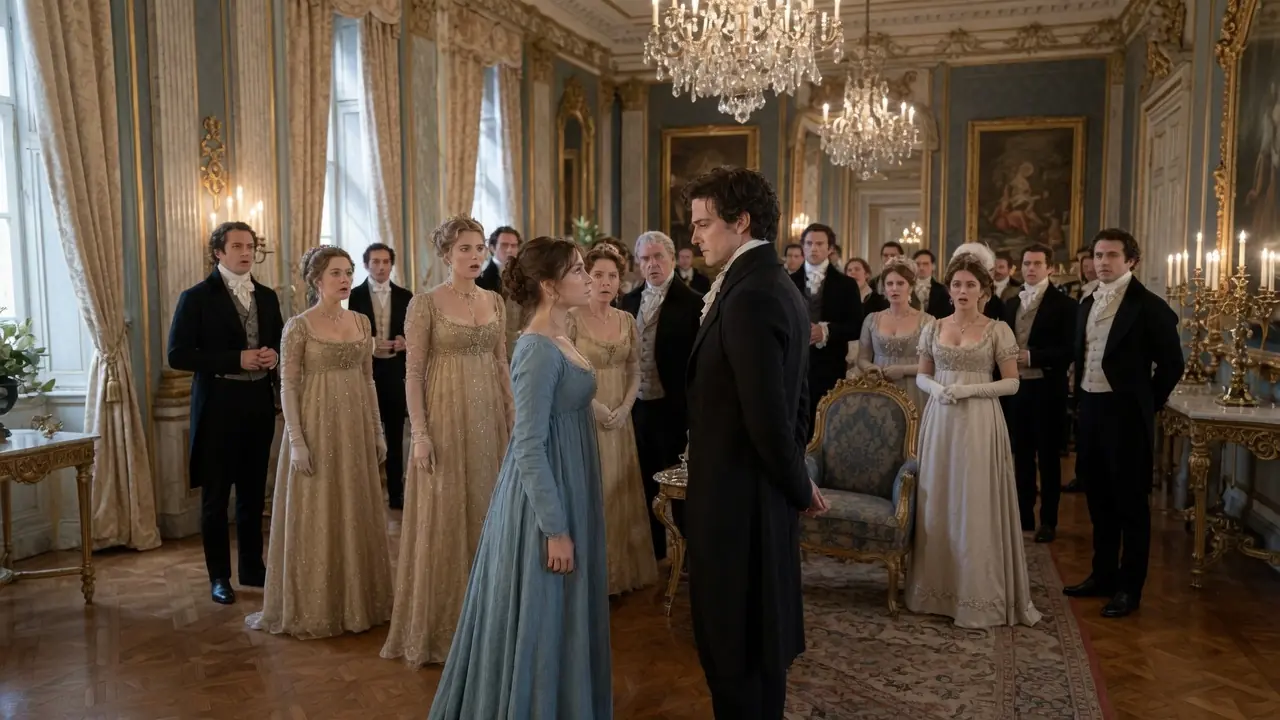
By sunrise, one family stood on the edge of ruin. Their debts would be called. Their name would be destroyed. Their future would vanish with a single signature. Yet, the daughter they had forgotten all their lives quietly stepped forward.
Not the beautiful one. Not the favored one. The invisible one. The sister whose sacrifices were never noticed. The woman everyone overlooked.
She climbed into a carriage alone and rode through a relentless storm to the estate of the kingdom's most feared nobleman. She had no plan. No promise of mercy. Only a single sentence she prayed would save her family. "I heard you needed a bride." She expected anger.
She expected rejection. She never expected the Duke to look into her eyes and answer, "Maybe you." But, this is not simply the story of a marriage. It is the story of a forgotten daughter who spent her entire life living in someone else's shadow until the coldest man in the kingdom became the first person to truly see her. And sometimes the greatest love stories are born not from being chosen first, but from finally being seen. The rain came down in cold gray sheets over London the night Elara Vance did the most reckless thing she had ever done in 22 years of careful quiet living.
She knocked on the Duke of Ravenscroft's door. Arthur Pemberton, Duke of Ravenscroft, was not a man people visited uninvited. He was feared in Parliament and avoided at parties. He had eyes the dark gray of a sky before a serious storm and the kind of jaw that made people straighten their posture without knowing why. He was also the man her younger sister Clarissa was supposed to have married 3 hours ago.
Was supposed to have, had not. Because Clarissa had eloped with a penniless poet from Devonshire sometime between the afternoon fitting of her wedding gown and the evening the carriages were meant to leave. Elara had found the note on Clarissa's dressing table. She had read it twice with the calm of someone who has spent her life cleaning up disasters she did not create. Then she had put on her travel cloak and given the coachman an address that was not her family's townhouse.
The footman who opened the door looked at her with the expression of someone presented with an event his training had not covered. She was soaked. Her hair was escaping its pins. She looked, she was fairly certain, like a woman who had made a very hasty decision and was committed to it regardless. "I need to see the Duke," she said.
His expression as he reached the bottom and looked at her was the particular blankness of someone who has disciplined himself beyond ordinary feeling and considers this an achievement. "You are not Clarissa Vance," he said. "No," she agreed. "I am her sister, the elder one." He stepped closer, his gray eyes moving over her face with attention that was not rude, but was very thorough. She held still.
She had learned, growing up as the unremarkable one, that stillness was better than fidgeting under scrutiny. "The one nobody mentions." "That is accurate," she said. "Then what are you doing in my house?" Elara lifted her chin. She had rehearsed several versions of this in the carriage, and discarded all of them.
The plain version was the only one that made sense. "Clarissa has eloped," she said, "with a poet from Devonshire." "She will not be coming." She paused. "Your engagement contract with the Vance family requires a bride. Without one, you are within your rights to call in every debt my family owes you immediately, which would ruin them completely." She met his eyes steadily. "I heard you needed a bride, Your Grace." Something moved in his expression.
Very small. Very brief. A flicker that might have been surprise, or something rarer. He stepped closer still. She did not step back.
He was searching for something. Fear, perhaps, or the calculation of a woman attempting a maneuver she lacked the resources for. She let him look. She had nothing to hide. Plain necessity had a quality that was difficult to misread.
The edge of his mouth moved, not quite a smile. The expression of a man presented with an unexpected development, and deciding whether to find it irritating or interesting. "Maybe," he said slowly, his eyes still on her face. "You." The contract was signed before midnight. His solicitor was roused.
The documents were amended, names substituted, witnesses found among the household staff, Elara signed her name with the same steady hand she used for household accounts. Arthur signed without ceremony. By eleven minutes past midnight, they were, in the eyes of law and obligation, bound. He showed her to the study afterward. A fire was lit.
He sat across from her and delivered his terms with the directness of a man who considers clarity a form of mercy. "We are bound by law, title, and duty," he said. "You will manage this household and appear beside me when society requires it. Beyond that, do not expect affection from me. I do not offer what I do not have." Elara looked at him.
He was watching for her reaction. This speech had clearly been delivered before, and the response generally told him something. "I never have," she said simply. He went very still. She meant it entirely.
Not as performance or punishment, but as plain truth, said with the ease of someone stating a fact about weather. She had not expected affection from anyone in particular. Her parents had always been occupied with Clarissa, the beautiful one, the accomplished one, the one worth investing in. Elara had managed and organized and been invisible, and found her satisfaction in the work rather than the recognition. She watched the Duke absorb this and find he did not quite know what to do with it.
"Very well," he said after a moment. "Mrs. Holt will show you to your rooms." "Thank you, Your Grace," she said, nothing more. No wounded eyes, no bright performance. She simply stood and followed the housekeeper down the corridor, and behind her, she heard Arthur Pemberton sit back in his chair and say nothing at all for a very long time. The London gossip sheets gave them a fortnight before declaring the marriage a curiosity and moving on.
The consensus was that the Duke had settled, that having been abandoned, he had done the practical thing and substituted the lesser sister, the plain one, the one nobody had occasion to mention. "The drab replacement," one sheet called her, with the cheerful cruelty that distinguished that particular publication. Elara read this at breakfast, set the paper aside, and went to find the head groundskeeper, because the rose garden on the east side of the estate had not been attended in 3 years, and she intended to change that. The country estate of Ravenscroft was large and beautiful in the way things are when they are very old and very badly neglected.
The bones were extraordinary. The management was a quiet catastrophe. The tenant ledgers had not been properly reconciled in two seasons. The household staff of 12 moved through their days with the subdued air of a group that had learned not to attract attention. Elara spent the first week watching and listening.
The second week, she began. She did not announce intentions or call meetings. She sat with Mr. Harrison, the butler, a man of rigid propriety and deep professional skepticism, and went through the household accounts line by line. Not to criticize, but to understand. She visited the kitchen and talked to the cook about what was actually needed versus what was being ordered, and found the two lists quite different.
She went to the village twice on foot and spoke to the tenant families directly. Mr. Harrison found this alarming. He mentioned it. "Your Grace," he said, with the expression of a man watching his professional standards being gently disassembled, "it is not customary for the Duchess to carry a ledger through the village in the rain." "The accounts were not going to carry themselves," she said, "and the Whitmore family's roof is leaking onto the east bedroom. Did you know that?" He had not known that.
"The timber merchant owes the estate for last autumn's delivery," she said. "I have proposed a trade. The roof will be repaired within the week." Mr. Harrison looked at her with an expression moving slowly and against his will from skepticism toward something he did not yet have a word for. The roses took longer. The east garden had been abandoned so completely that she spent several afternoons on her knees in the beds in old clothes with soil on her gloves working from memory of a pattern she had studied in an old portrait in the gallery.
Arthur found her there one afternoon, trowel in hand, hair comprehensively escaped from its arrangement, having a quiet discussion with a climbing rose that was not cooperating. He stood in the conservatory doorway before he spoke. She did not see him. He watched her coax a bent cane onto a new support with careful patience and felt something occur in his chest that he did not immediately have a category for. "This is not what most duchesses consider their responsibility," he said.
She looked up without embarrassment. "The roses were dying of neglect," she said. "Much like the staff's morale." She pressed the cane against the trellis. "A little dirt will not tarnish the family crest, your grace, though it might do your posture some good to bend occasionally." He looked at her. He was standing very straight.
It was, he conceded privately, possible that she had a point. He asked about the Whitmore roof and the Morrison tenancy arrears and the outstanding invoice with the grain merchant. She answered all three in plain, specific terms that took less than 5 minutes and resolved questions that had been vaguely sitting at the edge of his attention for months. He asked if he could review her updated ledger. They spent two hours in the study that evening, side by side over the account books, and Arthur said very little, but listened to everything with the complete attention of a man encountering something he had not expected.
Through October and into November, the estate changed. Not dramatically. The changes were the kind that built on each other quietly, the way warmth builds in a well-fired room. The staff moved with a different energy. Tenants raised their hats when her carriage passed.
Twice, Arthur came downstairs to find the cook laughing at something Elara had said. Once, Mr. Harrison was grinning in the hallway. Mr. Harrison, who had been butler at Ravenscroft for 22 years, with the emotional range of a well-polished salver, was grinning. Arthur found himself watching from the study window when she crossed the courtyard. He told himself this was because the courtyard happened to be in the direction he was looking.
He was a man of many carefully maintained self-deceptions, and that was one of the thinner ones. He found the letters on a Thursday evening in November in a box of old estate papers sent from the London solicitor's office. He had intended only to verify the contents and pass the box to Mr. Harrison, but something in the earliest folder caught him. Receipts from seven years ago during the worst of the Vance family's financial troubles, when workers on the Vance property in Kent had gone three months without wages. He read the receipts carefully.
Then he found letters filed beneath them, correspondence between a jeweler in Cheapside and a buyer who had sold, over eight months, a modest collection of heirloom pieces, a garnet brooch, a pair of pearl earrings, three rings of no significant monetary value, a small sapphire pendant sold two weeks before the Kent wages were finally paid in full. The buyer had signed with initials only, E.V. He went through the estate management records attributed in family correspondence and social understanding to the Vance family's general resourcefulness. Every innovation, every careful economy that had kept a struggling household solvent, each one traced carefully backward through the documentation pointed to decisions made by someone named nowhere in the credit. Someone who had arranged things and stepped back and let others claim the arrangement.
He was still sitting with this when the study door opened. Elara came in with a tray of tea, made herself because the kitchen closed early on Thursdays, and she had noticed and adjusted accordingly. She set it on the desk with automatic competence, looked at his face, and stopped. He held up the receipts. Not an accusation, in something closer to bewilderment.
The Kent wages, he said, "Seven years ago." She was still for a moment, then she set the tray down carefully, and her expression moved through something he could not read before it settled back into composure. "Who told you to look?" she asked. "Nobody," he said. "The papers came from London." He set the receipts down. "Why did you let them take the credit?
Why did you let them keep you invisible when you were the one holding everything together?" She crossed to the window. The lamp on his desk threw her shadow long against the wall. "Because it didn't matter who got the praise," she said. "It only mattered that the people didn't starve." She paused. "I am used to being the shadow, your grace.
The tenants were fed, the household survived. The outcome was the same whether anyone knew my name or not." He stood. He came around the desk toward her. "That is the answer of someone told, repeatedly and by people who should have known better, that they do not deserve to be seen," he said. "That is not truth.
That is damage." She turned from the window. "You are no shadow, Elara." He stopped in front of her. His voice was lower than he intended. "You are the only bright thing in this entire valley. And I will not stand here and watch you pretend otherwise." She looked at him.
The composure held, barely, and beneath it something moved, something raw and long kept. The expression of a woman who has not allowed herself to want things for so long that being offered one has caught her entirely unprepared. He took the tea tray and set it aside. He took both her hands in his, carefully, with the deliberateness of a man who means the action to be understood. Her hands were cold from the garden.
He felt her register his warmth. "Arthur." A sharp sound of carriage wheels on gravel came through the window, then voices in the foyer, then Mr. Harrison's voice carrying the particular strained quality of a man exercising extreme professional restraint. Elara's jaw tightened in a small controlled way that told him everything before she said a word. "My sister," she said, "tends to arrive without warning." Clarissa Vance swept into the Ravenscroft parlor with the energy of a woman who has suffered a significant setback and has decided the solution is to present herself as the aggrieved party before anyone else can organize a contrary narrative.
She had been crying recently enough that her eyes were still luminous with it. Her parents followed behind her with the expressions of people waiting to see which way a battle falls before committing to a position. Clarissa stopped when she saw Elara. Her carefully arranged expression shifted in a way she did not control. "I see you have made yourself very comfortable," she said.
"I live here," Elara said simply. "For now." Clarissa turned to Arthur with an expression reconfigured for vulnerability. "Your Grace, I owe you an explanation. I was coerced. That poet, he told me things.
"He You wrote the note yourself," Elara said. "You were very clear about your intentions." "Elara." Her mother's voice carried warning. Arthur looked at Clarissa with the expression he used for things that did not particularly interest him. "You chose to leave," he said. "That is not a coercion.
That is a decision." Clarissa's expression moved through calculation. She turned to Elara with the smile she used when she was going to say something she would later describe as concern. "You cannot truly expect this arrangement to last. His Grace married you out of necessity. He needed a Vance bride, and you presented yourself.
That is not a foundation. Miss Vance." Arthur's voice did not rise. It had a quality of absolute finality, more effective than volume, the verbal equivalent of a door locked from the inside. "This conversation is over." Clarissa stared at him. "You are a guest in this house at my wife's tolerance, which I would not test further." He looked at her with unhurried clarity.
"My wife's character and her position in this household are not subjects on which I require your commentary." Clarissa opened her mouth and closed it. She looked at Elara with genuine bewilderment, the expression of someone who has been the recipient of everyone's primary regard her entire life, and has just entered a room where that arrangement does not apply. "You are choosing her," she said, as though it were a category of event she had not previously considered possible. I chose my wife when she stood in my foyer and told me the truth, Arthur said.
This is not a new choice. It is the same one. He informed Lord and Lady Vance with minimum courtesy that they were welcome to the east guest rooms for the night and would receive a letter regarding financial matters within the week. Then he walked back down the corridor and found Elara in the study. She stood at the window, turned when he came in.
The composure was showing its seams slightly. The particular look of someone who has just watched something they had carried for a very long time be set down for them. He closed the door. There is something I need to tell you, he said. Eight years ago there was a carriage accident near the edge of the Vance estate in Kent.
My brother was with me. He did not survive. He sat on the edge of the desk, not behind it. A small but deliberate choice. I sat in the garden afterward, alone.
A young woman came. She did not introduce herself. She spoke with a kindness I did not deserve and she gave me her handkerchief for the wound on my hand and she sat with me until the shock had passed. He paused. My advisers told me it was Clarissa.
I agreed to the engagement partly in honor of that memory. Where was Clarissa that evening? Inside, Elara said quietly. There was a gathering. She did not know you were in the garden.
She reached into her pocket, a habitual gesture he realized, something she carried always. She drew out a faded scrap of embroidered silk. A handkerchief, old and worn at the edges, with a small repeated motif embroidered around the border. He recognized the pattern. It was the same one on a piece of needlework in her sitting room.
A pattern she used without thinking because it was hers. "It was you," he said, "the entire time." She looked at the silk in her fingers. "You were sitting on the stone bench near the east wall. Your hand was bleeding and you did not look like a duke. You looked like a person in a great deal of pain." She folded the silk carefully as she always did with things she meant to preserve.
"I only sat with you. I did not do anything significant. You stayed," he said. "That was the only significant thing." She looked up at him. "I never forgot it," he said.
"Eight years and I never forgot it. I gave the credit to the wrong person and built an entire decision on it and you never said a word. "It was not mine to say," she said. "You needed a reason to trust and you had one and the reason was real whether or not the name was right." He looked at her for a long time. "You are doing it again," he said.
"Doing what? Making yourself smaller than what you are. Making other people's comfort the excuse for your own erasure." He stood and crossed to her. "I am asking you to stop doing that at least with me." She looked at him. Something moved in her eyes, the slow dissolution of a long-held habit.
"Arthur," she said and it was the first time she had used his name. "The man on that bench," she met his gaze directly. "He was worth staying for." She left him alone with that. He sat in the study for a long time with the lamp burning low and thought about stones in quiet water and how far the circles travel. The Vances did not leave quietly.
Lord Vance, emboldened by Clarissa's presence and the particular courage that comes from having nothing left to lose, sent a demand to Arthur's solicitor the following morning. He wanted the settlement terms revised. He wanted what was owed to the family, to the Vance name, to the circumstances that had made this marriage, in his words, an improper substitution. When none of that produced results, he did what men in his position have done for centuries when private maneuvering fails. He took it public.
The Winter Assembly at Whitmore Hall was the largest social gathering of the county season. Everyone came. And Lord Vance had been talking to everyone who would listen for 3 days before the event. The whispers were already running through the assembly room when Elara and Arthur arrived. She felt them the way she had always been able to feel them.
A particular quality of air in a room where people are saying things about someone. She kept her chin level and her pace even. Arthur noticed. He noticed everything she did. He had stopped pretending otherwise some weeks ago.
Lord Vance made his move in the third hour when the room was full and attention well distributed. He positioned himself at the center of the main floor and said, in a voice pitched to carry, that the Duchess of Ravenscroft was a fraud, that she had inserted herself into a contract not intended for her, that she had manipulated a distracted man, that the true intended Duchess had been wronged, and that anyone of good conscience in this room should know it. The room went silent the way rooms do when something has been said that cannot be unsaid. Elara stood still.
She was very good at that. Arthur stood beside her and his stillness had a different quality entirely. The stillness of something about to move. He looked at Lord Vance for one moment, then at the room, then down at Elara, and the look he gave her was not for the room's benefit. It was simply the true one, direct, warm, and certain in the way of a thing that has been decided and does not require reconsideration.
He turned to face the assembly. "She came to my house," he said, "measured and clear, carrying without effort. She came alone, in the rain, without prior arrangement, without knowing what she would find." The room held its breath. "She asked for nothing." He paused, one deliberate beat, because he had learned from watching Elara that timing was a form of honesty. She did not ask to be admired.
She did not ask for comfort or luxury. She told me what had happened, offered what she had, and expected nothing in return. Lord Vance had the expression of a man who has started a fire and is discovering the room's relationship with fire is different than anticipated. "I have spent the past several months watching my wife manage an estate I had neglected. I have read what she did for her family's tenants 7 years ago, when she sold her own jewelry so that workers she would never meet would be fed through a winter.
I have learned that she sat with me in a garden 8 years ago on the worst night of my life and gave me the only kindness available. And I spent 8 years crediting it to the wrong person." His voice was steady. So was his gaze. "My wife came to my house with nothing but her word and her character." He paused. "And today, everything I possess is hers, because she has earned what no one in this room and no one in her family ever could." He looked at the assembly without apology.
"My absolute trust." The silence lasted a moment, then Lord Whitmore, who had been listening from across the room with the expression of a man who knows the quality of what he is witnessing, lifted his glass. Several others followed. The quality of the quiet changed. It became the quiet of a room that has reached a verdict rather than the quiet of one holding its breath. Lord Vance looked at his wife.
His wife looked at Clarissa. Clarissa looked at her hands. None of them looked at Elara, which was, Elara thought, the first intelligent decision they had made in several days. Arthur turned back to her. She looked at him with nothing practiced in her expression.
The direct, clear gaze of a woman who has just been seen fully and in public for the first time in her life and is still learning what that feels like. "Are you all right?" he asked quietly. "Yes," she said. And then, because she was not in the habit of imprecision, "I think I might need a moment." "Take all the moments you need," he said. They stepped through the side doors onto the terrace into cold November air and stood for a while in the quiet.
The light from the assembly room fell in warm rectangles across the dark stone. The county lay beyond the gardens, still and vast. "You did not have to do that," she said. "I know," he said. "It will have consequences." "The Vances will adapt," he said. "They are practiced at it." He turned to look at her.
"I should have said it privately first. Three nights ago, in the study, when I was holding your hands and your expression was doing something I have been thinking about ever since." He paused. "I am not naturally fast at this." "At what?" she asked. "At saying true things when they concern myself," he said. "I am considerably better at truth when it concerns ledgers and legal documents.
The personal variety takes me longer." He held her gaze. "I am saying it now if you will hear it." She looked at him in the cold, pale light. This woman who had come to his door in the rain and changed everything by the quiet, comprehensive fact of being herself. "I love you," he said. It came out plainly, without architecture, the way she said true things.
"I have been working toward admitting this for approximately 6 weeks, and I am told it is better said than unsaid." She looked at him for a long moment. Something moved through her expression, the particular quality of someone receiving something they have trained themselves not to hope for, arriving anyway, arriving whole. "I love you, too," she said. "I have known this for somewhat longer than 6 weeks, and have been managing it quietly." "Of course you have," he said. "It is what I do," she said.
He took her hands, both of them, as in the study, carefully and with full intention. She was cold from the terrace air. He was warm. "No more managing quietly," he said. "Not with me. I would like to know the full accounting." "That is a significant request," she said. "I am prepared for the volume," he said.
She laughed, real and surprised and entirely herself, bright in the cold air. He felt it like light coming through a window that had been closed a long time and decided he intended to make her laugh as often as possible for the foreseeable future. The months that followed were, by the measure of things worth measuring, the best the Ravenscroft estate had seen in a decade. The tenants flourished. The household staff developed what Mr. Harrison described to the under-butler as unseemly levels of contentment, which was his highest available praise.
The East Garden's roses came back in spring with a vigor that the county's gardeners discussed at length. Arthur developed, to the mild alarm of his parliamentary colleagues, a reputation for arriving at meetings with accurate and current knowledge of his estate's operations. He had always been feared for his intelligence. He was now, slightly reluctantly, also respected for his household management, which he permitted people to credit to good staffing, and did not correct. On a bright afternoon in May, Elara came into the study and found him at the window, looking at the garden rather than at the papers on his desk.
She stood in the doorway with a book in one hand and the expression she wore when considering whether to interrupt him. "You are watching the roses," she said. "I am watching the person who planted those roses," he said. "And I find that considerably more interesting than the parliamentary report." She came to stand beside him. The east garden was in full early bloom, not a formal garden's tidy display, but something wilder and more generous, the way things grow when given what they need and left to do it in their own time.
She looked at it with the quiet pleasure she had for things made with her own hands, neither boasting nor diminishing. Then she looked at him, and the smile at the corner of her mouth was the one she kept for him specifically. "Tell me, Your Grace," she said. "Do you still need a bride?" He turned from the window. He took both her hands and drew her toward him and kissed her forehead gently.
And with the careful attention he brought to things that mattered, "No," he said softly, holding her close, the May light falling warm across the study floor. "I only need my wife."