Nobody in the diner paid attention to the man sitting alone in the corner booth.
His jacket was worn at the elbows. His boots were scuffed past the point of polish, and the coffee in front of him had gone cold an hour ago.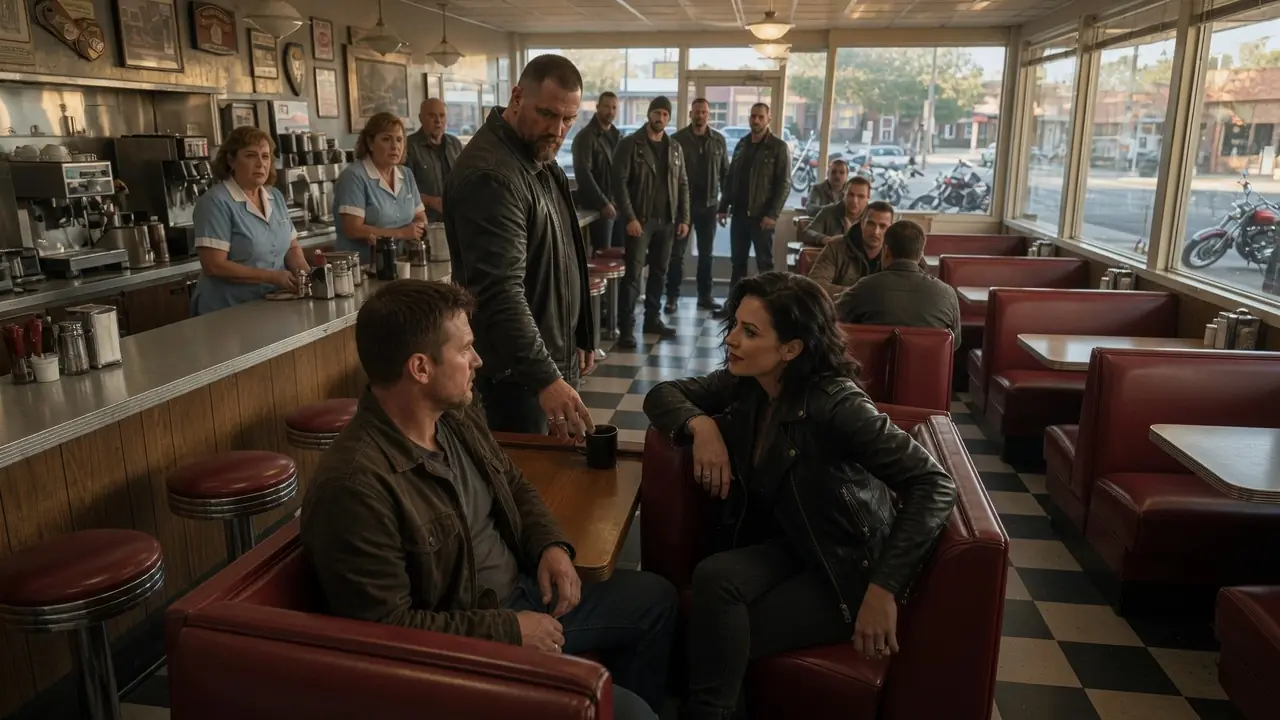
He looked like exactly what the regulars assumed he was, a tired single father trying to get through another long day on a budget that never quite stretched far enough.
Nobody noticed the way his eyes moved across the room every few seconds, never settling, never resting, the way a man checks exits in a building he has never been inside before.
Nobody noticed the scar that ran along the side of his neck, thin and pale, the kind of mark that only comes from something sharp moving very fast.
They saw a quiet man drinking coffee, and that was all they cared to see.
Then the door swung open hard enough to rattle the glass, and the woman who walked in was someone every person in that diner already knew by name and by reputation.
Cassandra Reed did not enter rooms.
She claimed them.
And when she scanned the diner for the one customer who would not flinch at her presence, her eyes landed on the quiet man in the corner.
She had no idea she had just chosen the most dangerous person in the entire building.
She had no idea the man drinking lukewarm coffee had once been trained by the United States Navy to do things most people only see in nightmares.
By the end of that afternoon, the whole town would know his name.
But for now, he was just Jack, sitting quietly, waiting for a moment he hoped would never come.
Outside, the late afternoon light slanted low across the parking lot, catching the chrome of motorcycles parked carelessly across two reserved spaces. Somewhere behind the counter, an old radio played a song nobody seemed to be listening to anymore.
Jack Turner was forty-two years old, and to anyone who did not know his history, he looked like a man the world had quietly forgotten.
He had buried his wife five years earlier. It had been a slow illness that took eighteen months to finish what it started, and in that time, Jack had learned how to grieve while still getting up every morning to make breakfast for his daughter.
He raised her alone after that, packing lunches, attending school plays, learning to braid hair from instructional videos at midnight when she was too young to do it herself.
His daughter, Emily, was nineteen now, away at a state university four hundred miles north, studying marine biology because she said the ocean reminded her of the stories her father used to tell before bed.
Jack worked at the marina just outside of town, repairing hulls and rewiring old fishing boats for men twice his age who trusted him because he never overcharged and never complained.
His hands were thick with calluses, the kind that came from rope burn and metal and salt water. His forearms carried faint lines that looked like old scratches if you did not look too closely.
Every evening after his shift, he walked the six blocks to the same diner, sat in the same booth in the corner, and ordered the same black coffee.
No cream.
No sugar.
Just heat and bitterness to mark the end of another day.
The waitress, a woman named Donna who had worked there for eleven years, knew his order before he sat down.
But she did not know much else about him.
She knew he was polite. She knew he tipped well even when the bill was small. She knew he rarely spoke unless spoken to. And when he did speak, his voice was low and even, like a man who had learned long ago that shouting rarely solved anything.
One older man at the counter once said he probably worked some boring desk job before the marina, that men like him never had much fight in them, that he looked too soft to ever raise his voice, let alone his fists.
A teenage busboy joked once that Jack looked like the kind of dad who would apologize if someone stepped on his foot.
They laughed about it.
The harmless, quiet man in the corner booth.
None of them noticed how his gaze flicked toward the door every time it opened. How his shoulders tensed for half a second before relaxing again. How he always chose the seat that gave him a clear line to every exit in the building.
If they had looked closely at his neck, they might have asked about the scar that ran from his collarbone almost to his jaw, a thin silver line that did not come from any accident a normal man would have stories about.
If they had looked at his eyes in stillness, they might have noticed they were never quite still at all.
He kept a small notebook in his jacket pocket, the kind a man uses to track invoices and parts orders for the boats he repaired, but tucked behind the receipts was a single photograph of his late wife.
The edges were soft from years of handling, a private reminder he never showed to anyone.
Some nights, after closing the marina, he drove out to the breakwater alone and sat in his truck, watching the water for an hour before finally going home.
He never explained to anyone why he needed that hour.
Not even to himself, in words he was willing to say out loud.
But people rarely look closely at men who do not ask to be looked at.
And Jack Turner had spent years making sure nobody ever did.
That evening, as he lifted his cup for another sip of coffee that had gone cold without his noticing, the low growl of motorcycle engines rolled in from the street outside, growing louder, closer, until the windows themselves seemed to hum with the sound.
The first thing that changed in the diner was the silence.
Conversations did not stop all at once. They faded the way light fades at dusk, slowly enough that nobody noticed exactly when the room went quiet.
Cassandra Reed stepped through the door like she owned the building, the linoleum floor, and every person standing on it.
She was thirty-eight years old, with sharp eyes that missed nothing and a presence that filled a room before she ever opened her mouth.
People in town did not just fear her. They organized their lives around avoiding her, rerouting walks, switching shifts, paying her so-called fees without ever filing a single complaint because everyone knew what happened to people who complained.
Six men followed her inside, fanning out near the entrance the way trained dogs positioned themselves around a target.
The diner’s owner, a heavyset man named Walter who had run the place for almost two decades, felt his stomach drop the moment he saw her face.
He had paid her group before, more than once, quiet cash handed over in the back office so his windows would stay unbroken and his cooks would stay unbothered.
He thought he had bought enough peace to last the month.
He was wrong.
Cassandra walked straight to the counter, rapping her knuckles twice against the surface like she was announcing a verdict rather than asking a question.
She told Walter the price had gone up, that protecting a business in this economy cost more than it used to, that perhaps he had forgotten how generous she had been by not raising the rate sooner.
Walter’s hands trembled as he reached for the small lockbox beneath the register.
But Cassandra was not finished.
She wanted everyone in the diner to understand the lesson, too, not just the owner.
She turned slowly, surveying the room like a predator deciding which animal looked weakest.
A young waitress near the kitchen door, barely out of high school, froze mid-step with a tray of plates rattling in her hands, tears already gathering at the edges of her eyes.
Cassandra smiled at that.
She liked fear.
Fear was currency, and currency was control, and control was the only thing that had ever made her feel safe in a life that had taught her safety was something you took rather than something you were given.
Her eyes swept across the room, booth by booth, face by face, cataloging reactions, filing away who looked down first and who dared to hold her gaze even for a second.
Most people looked down immediately.
A few looked physically ill.
But in the corner booth, the quiet man in the worn jacket simply lifted his coffee cup and took another sip, completely unbothered, as if a dangerous woman and six armed men had not just walked through the door at all.
That single detail caught Cassandra’s attention immediately, the way a single off-note catches the ear of someone with perfect pitch.
She had built her entire reputation on being impossible to ignore.
And here was a nobody who had not even glanced up.
It needled something deep and old inside her, something that had nothing to do with this diner or this town, and everything to do with years of being underestimated long before she ever wore a leather jacket or commanded a crew.
She had grown up in a string of cramped apartments above other people’s businesses, moving every year or two whenever rent became unmanageable, learning early that nobody was coming to rescue her if she did not first make herself impossible to overlook.
By sixteen, she had already learned that fear traveled faster than reputation, that a single sharp word delivered at the right moment could buy more safety than years of being polite ever had.
She did not like being ignored.
She had never liked being ignored, not since she was a child nobody listened to. And she had spent her adult life making absolutely certain nobody could ignore her again.
Slowly, deliberately, she turned away from Walter and the frightened waitress and began walking toward the booth in the corner. Her boots clicked against the floor with each unhurried step, and her men watched with the kind of anticipation people reserve for entertainment they already know will be enjoyable.
Cassandra slid into the booth across from Jack without asking, dropping into the seat as though she had been invited, though no invitation had ever been extended.
She leaned forward, elbows on the table, studying him the way someone studies an insect they are deciding whether to squash or simply flick away.
“Look at me when I’m speaking to you,” she said, her voice carrying just enough volume to ensure the entire diner could hear the exchange.
Jack lifted his eyes from his cup, met hers calmly, and said in a quiet, even tone, “I’m just trying to enjoy my coffee. I mean no disrespect. I’m not interested in trouble of any kind.”
It was the kind of answer designed to de-escalate, the kind of answer a man gives when he genuinely wants a situation to end peacefully.
Her men found it hilarious.
Laughter rippled through the group standing near the entrance, the sound sharp and mocking, the kind of laughter meant to remind everyone present exactly who held the power in the room.
One of them stepped closer to the booth and knocked Jack’s coffee cup off the table with a casual swipe of his hand. The ceramic shattered against the floor, dark liquid spreading across the tile in a slow stain.
Another grabbed the back of Jack’s chair and yanked it hard enough to scrape against the floor, jostling him sideways, though he did not lose his balance.
Donna, the waitress, gasped from behind the counter, one hand pressed against her mouth.
Other customers shrank lower in their booths, suddenly very interested in their phones or their food, anything that was not the unfolding scene in the corner.
Jack still did not react with anger.
He looked down at the broken cup, then back up at Cassandra, his expression unreadable.
His posture remained relaxed in a way that somehow read as more unsettling than fear would have.
Cassandra mistook his calm for cowardice, the same mistake people had been making about quiet men for as long as quiet men had existed.
She decided right there that she would make an example out of him.
Not because he had done anything threatening, but precisely because he had not. Because his stillness in the face of her power felt like an insult she could not let stand in front of an audience.
She gestured lazily toward one of her men, a broad-shouldered enforcer named Derek, who had a reputation for enjoying his work a little too much.
The instruction was simple.
Hit him.
Make him understand who he was dealing with.
Derek grinned, rolled his shoulders, and stepped forward with the easy confidence of a man who had thrown this exact punch dozens of times before against people who had no idea how to defend themselves.
He had spent years building a small, ugly legend around himself in this town, the kind of legend built entirely on other people’s bruises, and he saw this moment as another easy contribution to that legend.
Another forgettable man who would learn his place the hard way and never speak of it again.
The diner held its breath collectively.
Every eye locked on the corner booth, waiting to see a tired single father get hurt for the crime of simply sitting quietly with his coffee.
The punch never landed where it was supposed to.
Derek’s fist moved fast, a clean shot aimed directly at Jack’s jaw, the kind of strike meant to drop a man instantly and send a message to anyone watching.
But Jack’s head shifted barely an inch, a small tilt that looked almost lazy, almost accidental, and the fist sailed past his face by a margin so narrow that most people in the diner did not even register what had happened.
They simply saw Derek’s arm swing and Jack still sitting there, unharmed, as if the laws of physics had quietly excused him from the encounter.
Most people missed the movement entirely because it happened too fast and too smoothly to register as anything deliberate.
But one man sitting near the window, a retired police officer named Harold who had spent twenty-six years on the force before his knees gave out, saw it clearly, and something cold settled in his stomach.
He had seen that kind of reflexive evasion exactly once before, years earlier, during a training exercise with a former military instructor brought in to consult on close-quarters defense for the department.
It was not luck.
It was not an accident.
It was muscle memory built through thousands of repetitions, the kind of training that rewires a body’s instincts so deeply that conscious thought becomes unnecessary.
Harold’s hand tightened around his own coffee cup, his eyes narrowing as he watched the man in the corner booth with newfound and uneasy attention.
Cassandra, however, saw none of the warning signs Harold recognized.
She only saw her man’s punch miss, which embarrassed her in front of her crew. And embarrassment, for Cassandra, always demanded escalation rather than retreat.
She snapped at Derek to try again, her voice sharper now, edged with the frustration of someone watching control slip slightly out of her hands.
But before Derek could move, Jack rose slowly from the booth, reached into his pocket, and placed a few crumpled bills on the table to cover his coffee and the broken cup.
His voice, when he finally spoke directly to Cassandra, was quiet but carried an unmistakable weight, a tone that had nothing to do with volume and everything to do with certainty.
“Don’t do this,” he said. “There is still time to walk away from whatever is about to happen. I have no desire to hurt anyone in this room.”
Cassandra laughed out loud at that.
The sound echoed through the now silent diner, genuinely amused by what she interpreted as a pathetic attempt at intimidation from a man who had just watched his own coffee get knocked to the floor.
She told her crew that the quiet man was scared, that he was trying to talk his way out of a beating because he knew exactly what was coming if he stayed.
She had built her entire identity on reading fear in other people’s faces, and she was certain, absolutely certain, that fear was exactly what she was reading now.
For the first time since she had sat down across from him, Jack lifted his eyes and looked directly into hers.
No longer glancing.
No longer deflecting.
Staring with a kind of stillness that made the hair on the back of Cassandra’s neck rise without her fully understanding why.
Something shifted behind Cassandra’s eyes when Jack finally held her gaze.
Though she would never have admitted it, it was not fear exactly.
Not yet.
But it was the first flicker of doubt she had felt in longer than she could remember.
She pushed the feeling down quickly, burying it beneath bravado, and turned to her men with renewed sharpness in her voice.
“Teach the old man a real lesson this time,” she said. “No more half measures.”
Three of them moved at once, fanning out around the booth the way trained men do when they intend to overwhelm rather than fight fair.
Jack exhaled slowly.
A long breath that seemed to carry more weight than the moment alone could explain.
As though it released years rather than seconds.
In that brief space between breath and motion, memories surfaced that he had spent years trying to keep buried beneath the ordinary rhythms of civilian life.
Afghanistan returned to him first.
The dust and heat.
The particular silence that settled over a compound seconds before everything erupted into chaos.
He remembered a hostage rescue operation that had gone sideways in the final minutes. He remembered the weight of a child he carried out through gunfire. He remembered the brothers beside him who did not make it home to see their own children grow up.
He remembered the funeral of his closest friend, a man named Marcus, who had pulled him out of a collapsed building eighteen months before dying in an operation that should have been routine.
He remembered the long flight home from that funeral, staring out the small window at clouds that looked like nothing and everything at once, wondering how many more names he would have to carry before the weight finally became too much to keep moving under.
He remembered promising himself, kneeling beside a flag-draped casket, that he was done with violence forever, that he would build a quiet life and protect it fiercely, that his daughter would never have to know what her father had done in deserts half a world away.
He had kept that promise for five years, through grief and solitude and the slow rebuilding of an ordinary existence, choosing patience and walking away from every small provocation life had thrown at him since.
But promises have limits.
And today, in this diner, surrounded by people who had done nothing to deserve the terror radiating through the room, Jack felt that limit arrive with quiet, absolute clarity.
The three men closed the distance fast, confident in their numbers, confident in the element of surprise their training had never actually prepared them for.
Jack set his coffee cup down on the table with deliberate gentleness, the small, careful motion of a man putting away one version of himself to make room for another.
His shoulders dropped. His weight shifted onto the balls of his feet. His hands rose just slightly from his sides.
In an instant, the tired single father who repaired boats for a living was gone, replaced by something the people in that diner had never seen before and would never forget.
What happened next lasted exactly fifteen seconds, though to everyone watching, it felt like time had folded in on itself entirely.
The first man reached for Jack’s shoulder, intending to spin him around for an easy strike, but Jack moved before the hand ever made contact, pivoting low and driving an elbow into the man’s ribs with enough precision to fold him instantly without breaking a single bone that would require hospitalization.
The second man swung a wild punch, anger replacing strategy, and Jack redirected the momentum with the small twist of his wrist, sending the man crashing into a nearby table with a clatter of dishes and silverware that echoed through the stunned diner.
The third man pulled a short blade from his jacket, the metal catching the overhead light for half a second before Jack’s hand closed around his wrist with a grip that bent the joint at an angle joints were never designed to bend.
The knife clattered to the floor.
The man dropped beside it, gasping, clutching his arm against his chest.
There was no wasted motion in anything Jack did. No excess force beyond what was strictly necessary to end each threat as quickly and cleanly as possible.
He did not yell.
He did not smile.
His face remained almost eerily calm throughout the entire exchange, the expression of a man performing a task he had once performed thousands of times under far worse conditions than a small-town diner.
It was the calm of someone who had long ago separated necessity from emotion, who understood that hesitation in moments like this cost more than any amount of force ever could.
Within fifteen seconds, three grown men lay incapacitated across the floor, groaning and disoriented.
None of them were seriously injured.
All of them were thoroughly and completely defeated.
The remaining members of Cassandra’s crew stood frozen near the entrance. The laughter from earlier had been replaced entirely by stunned, disbelieving silence.
Customers throughout the diner sat motionless, forks halfway to mouths, phones forgotten in trembling hands, every single person witnessing something that did not fit into their understanding of who Jack Turner was supposed to be.
Harold, the retired officer by the window, finally spoke into the silence, his voice low but carrying clearly across the stillness.
“I recognize that kind of movement,” he said. “I’ve seen it exactly once before. Whoever this man is, he didn’t learn to fight like that in any ordinary place.”
Cassandra stood frozen at the booth.
The bravado that had carried her into the diner completely drained from her posture. Her eyes were wide with something she had not felt in longer than she could remember.
Genuine and immediate fear.
Jack straightened his jacket calmly, glanced around at the men still recovering on the floor, and then looked directly at Cassandra and the remaining members of her crew.
His voice, when he finally spoke, was steady and almost gentle, carrying none of the satisfaction someone might expect after such a decisive display.
“Does anyone else want to continue this conversation?”
The silence that followed answered the question far more completely than words ever could have.
For a long moment, nobody moved at all.
Not the customers frozen mid-bite in their booths. Not Walter standing pale and motionless behind the register. Not even Cassandra, whose carefully maintained composure seemed to be cracking in real time under the weight of everything she was suddenly forced to reconsider.
It was one of Cassandra’s men, a younger member of the crew named Tyler, who had been hanging back near the door throughout the entire confrontation, who finally noticed something the others had missed in their panic.
As Jack rolled up his sleeve briefly to check a small scrape on his forearm from the chaos, a tattoo became visible along his upper arm, faded slightly with age but unmistakable in its design to anyone who knew what to look for.
Tyler’s hands shook as he pulled out his phone, fingers fumbling across the screen, searching frantically for information that might explain what he and everyone else had just witnessed.
It did not take long.
The symbol matched a special operations unit insignia, and a search of Jack’s name paired with details from old, partially declassified news articles began returning results that made Tyler’s stomach drop somewhere into his boots.
Jack Turner had served multiple tours overseas, attached to operations that the articles described only in vague, redacted terms.
The kind of language reserved for missions too sensitive for full public disclosure, even years later.
There were references to a hostage rescue operation in which he had personally extracted several civilians under heavy fire, an action that had earned him a commendation he had never once mentioned to a single person in this town.
There were brief mentions of additional operations, details thin and scattered, but consistent enough to paint a clear picture of a man who had spent years operating in some of the most dangerous environments on earth, executing missions most people would never be permitted to learn the full truth about.
Tyler showed the screen to the man standing beside him, who showed it to another.
Within a minute, the information had spread through the remaining members of Cassandra’s crew like a current running through water.
Their faces shifted from confusion to horror as the reality of the situation settled over them fully.
They had not simply provoked an ordinary man into self-defense.
They had walked into a diner and physically assaulted someone trained by one of the most elite military forces in the country.
Someone who had spent years being shot at by people far more dangerous than a local street gang.
Someone who had shown an almost unbelievable amount of restraint by ending the confrontation with nothing more than three temporarily incapacitated men on a diner floor.
None of them said it aloud, but each of them understood privately that the encounter could have ended very differently.
The man sitting quietly in the corner had chosen the gentlest possible outcome available to him.
And that realization sat heavier in the room than the violence itself ever had.
Cassandra felt her own composure crack as she watched her crew’s expressions shift around her. She watched the fear in their eyes transfer from Jack to her, as if they were silently asking how she could have possibly led them into something this catastrophic.
She had built her reputation on always knowing who to target, always choosing victims who could not fight back, always calculating risk before acting.
Today, for the first time in years, her calculations had been catastrophically, publicly wrong.
One of her men, standing near the shattered coffee cup that had started this entire disaster, finally voiced what everyone in the group was thinking.
His voice was barely above a whisper, but loud enough to carry through the stunned silence of the diner.
“We picked a fight with the wrong person.”
Nobody standing there could find a single word to disagree with him.
Cassandra knew she had lost the moment the room’s attention shifted entirely away from her and toward Jack.
Every instinct she had built over years of commanding fear told her that retreat was now the only remaining option. But retreat without some final assertion of control felt unbearable to someone who had spent her entire adult life refusing to back down from anyone.
She straightened her jacket, lifted her chin, and forced her voice into something resembling composure.
“You won today,” she told Jack. “I’ll remember this.”
The words carried a faint threat, even as everyone in the room understood the threat held no real weight anymore.
Jack shook his head slowly, his expression neither triumphant nor angry, simply tired in a way that seemed to stretch far beyond this single afternoon.
“This was never about winning or losing,” he said quietly. “I take no satisfaction in what just happened. Violence has never once made me feel powerful. Only exhausted and sad in ways most people never have to understand.”
Cassandra’s jaw tightened, old defenses rising automatically.
But something in Jack’s tone made it difficult to summon the usual anger that protected her from moments like this. There was no judgment in his voice. No cruelty. Nothing that resembled the satisfaction she had braced herself to hear.
And that absence of cruelty somehow unsettled her more than anger ever could have.
“I lost a wife to illness,” Jack said. “I lost friends to wars most people back home barely remember happened. I have carried more grief through my life than I ever wanted to carry. Watching someone choose fear and intimidation as a way of feeling powerful only reminds me how much unnecessary suffering already exists in the world.”
Then he asked her directly, his voice low enough that only she and the closest tables could hear.
“What kind of person do you actually want to become? Is this it? The fear, the control, the small kingdom built entirely on other people’s terror? Is that truly the legacy you want to leave behind when everything else falls away?”
For the first time in longer than she could remember, Cassandra had no immediate answer ready.
The silence stretched between them, heavy and uncomfortable, and beneath the carefully maintained armor she had built over years of survival, something cracked just slightly.
Just enough for a flicker of the frightened, overlooked person she had once been to surface in her eyes.
She had spent years convincing herself that strength meant never showing weakness, that respect could only be earned through fear, that softness was a luxury afforded only to people who had never needed to fight for anything.
Jack’s question did not accuse her of anything.
It simply asked her to look honestly at herself.
That honesty was somehow more disarming than any physical confrontation could have been.
The diner remained almost completely silent around them, every customer and employee watching a moment that felt entirely separate from the violence that had preceded it.
They were watching a woman who had terrorized this town for years stand utterly speechless in front of a man who had defeated her entire crew without raising his voice once.
The sound of sirens approaching from several blocks away finally broke the heavy silence that had settled over the diner, and within minutes, two police cars pulled up outside, their lights washing red and blue across the windows.
Someone, likely one of the kitchen staff who had slipped into the back during the chaos, had called for help the moment the confrontation began escalating toward violence.
Officers moved through the door cautiously, hands resting near their holsters, uncertain what scene they were walking into, until they saw three men still recovering on the floor and a room full of customers who all seemed eager, almost desperately eager, to explain exactly what had happened.
What followed surprised everyone present, including Jack himself.
Customers who had spent years too frightened to report Cassandra’s group to anyone began speaking up rapidly, almost as if a dam that had held back years of silence had finally broken under the weight of what they had just witnessed.
Walter, the diner’s owner, found himself explaining the protection payments he had been forced to make for the better part of two years, his voice shaking but determined as an officer took careful notes.
Donna described threats made against her and other employees on previous visits, details she had never dared report before today because reporting had always felt more dangerous than simply enduring.
Harold, the retired officer, offered his own professional observations about the confrontation, lending credibility to accounts that might otherwise have been dismissed as exaggeration born from fear.
One by one, voices that fear had silenced for years finally found the courage to speak.
Cassandra watched her carefully constructed empire collapse in real time, witness statement by witness statement, each one chipping away at the foundation of intimidation she had spent so long building.
It was strange watching it happen, how quickly the things she had assumed were permanent revealed themselves to be nothing more than habit.
A town had simply forgotten it was allowed to speak, until someone reminded them that speaking was possible.
Her remaining crew members, the ones still able to walk, slipped quietly toward the door the moment officers became distracted with paperwork, abandoning her with the same casual disloyalty she had likely shown countless others throughout her years of leadership.
She understood, watching them disappear without a single backward glance, that fear had never actually bound them to her.
Not real loyalty.
Not anything resembling genuine respect.
Only the temporary safety of standing beside someone more frightening than whatever else they were afraid of.
Now that safety had evaporated entirely, and there was nothing left holding them in place.
Jack did not gloat as the scene unfolded around him.
He did not approach Cassandra with words of triumph or vindication. He did not seek out praise from the customers who were beginning to look at him with something between awe and gratitude.
He simply stood quietly near his booth, answering an officer’s questions calmly and briefly, his demeanor as understated in victory as it had been in confrontation.
Cassandra, surrounded now by police officers and the wreckage of an empire that had taken her years to assemble, finally lowered her head.
Not in defeat exactly, but in something closer to the exhausted recognition of a person finally facing consequences she had spent her entire life running from.
Several weeks passed before the diner returned to anything resembling its normal rhythm.
Though the normal it returned to felt different than before.
Warmer somehow, as though the entire building had exhaled a tension nobody realized it had been holding.
Word of what happened that afternoon spread quickly through the small town, the kind of story that gets repeated at dinner tables and barbershops until every version contains slightly different details, but the same essential truth at its core.
Business at the diner actually improved in the weeks that followed. People returned who had once avoided the place out of fear. New customers stopped by simply because they had heard there was a place in town where bullies finally got what was coming to them.
People who once walked past Jack without a second glance now nodded respectfully when he passed.
Though he never seemed entirely comfortable with the attention, often deflecting conversation back toward ordinary topics whenever someone tried to ask about his past in detail.
Walter insisted on giving Jack free coffee for life, a gesture Jack accepted graciously while quietly leaving generous tips that more than covered the cost anyway.
Donna told anyone who asked that Jack remained exactly as polite and unassuming as he had always been, that nothing about him seemed to have changed despite everyone else’s perception of him shifting entirely overnight.
Cassandra, facing charges related to extortion and assault, ultimately received a lighter sentence than many in town expected, largely due to her cooperation with investigators and her enrollment in a court-mandated rehabilitation and counseling program designed for individuals attempting to leave behind patterns of violence and intimidation.
The judge, reviewing the case, noted that this appeared to be a woman who had built fear as a substitute for a stability she had never been given growing up, and that punishment alone was unlikely to address whatever void had driven her down this path in the first place.
Several months into her sentence, Cassandra wrote a letter, hesitant and imperfect, addressed directly to Jack, attempting to articulate something she had struggled to put into words since that afternoon in the diner.
She admitted in the letter that his question about what kind of person she truly wanted to become had stayed with her every single day since, surfacing during quiet moments when the noise and bravado she had once relied on no longer offered any comfort.
She wrote that she did not expect forgiveness, that she understood the fear she had caused mattered far more than any explanation she could offer for why she had become who she became.
Jack read the letter twice before responding.
His reply was brief but sincere, telling her simply that he forgave her, not because what she had done was acceptable, but because he had learned long ago that carrying anger toward people who had already faced consequences only weighed down the person carrying it, not the person who deserved the weight.
He wrote that he hoped the counseling program taught her something more useful than guilt, that guilt alone rarely changed anyone, but the willingness to ask hard questions about oneself sometimes did.
And he had seen, briefly in a diner months earlier, that she was capable of asking those questions when given the chance.
He told her he hoped she found whatever peace she needed to build a different life.
Then he returned to his own ordinary routine, repairing boats at the marina, eating dinner alone in his quiet house, occasionally calling his daughter to hear about her classes and her new life four hundred miles away.
He kept the letter folded inside the same notebook where he kept the photograph of his late wife, not because he needed to be reminded of what happened, but because some part of him believed that small, ordinary objects were the only honest record anyone really needed of the things that mattered.
He never sought out interviews or recognition for what happened that day. He never told the story himself, never embellished it, never allowed it to define how he moved through the world.
The marina owner who employed him noticed no change at all in his work ethic or his quiet manner, and continued handing him the same difficult jobs he always trusted Jack to finish properly and on time.
One afternoon, months later, a new customer sitting near the counter noticed the quiet man in the corner booth and asked Walter, almost in passing, who exactly he was.
Walter smiled, glancing toward Jack with quiet affection and respect.
“He’s just a single father who likes his coffee black and his afternoons peaceful,” Walter said. “Nothing more complicated than that.”
Jack, unaware of the exchange happening just a few tables away, lifted his cup and took a slow sip as late afternoon sunlight spilled through the diner’s front windows, settling across the worn wood of his familiar table.
The bell above the door chimed softly as someone new walked in, and the world around him moved on exactly the way he had always hoped it eventually would.
Ordinary.
Unremarkable.
And finally, completely at peace.