“I don’t want a lady.”
Those were the first words Bo Rollins spoke after Reverend Price asked him to repeat his wedding promises.
The little wooden church in Copper Creek became so quiet that I could hear autumn wind pushing dry cottonwood leaves against the windows. Forty or fifty townspeople occupied the pews behind us, and every one of them seemed to lean forward at the same time, waiting to see whether the foolish Philadelphia woman standing before the largest cowboy in Montana Territory would finally realize what she had done.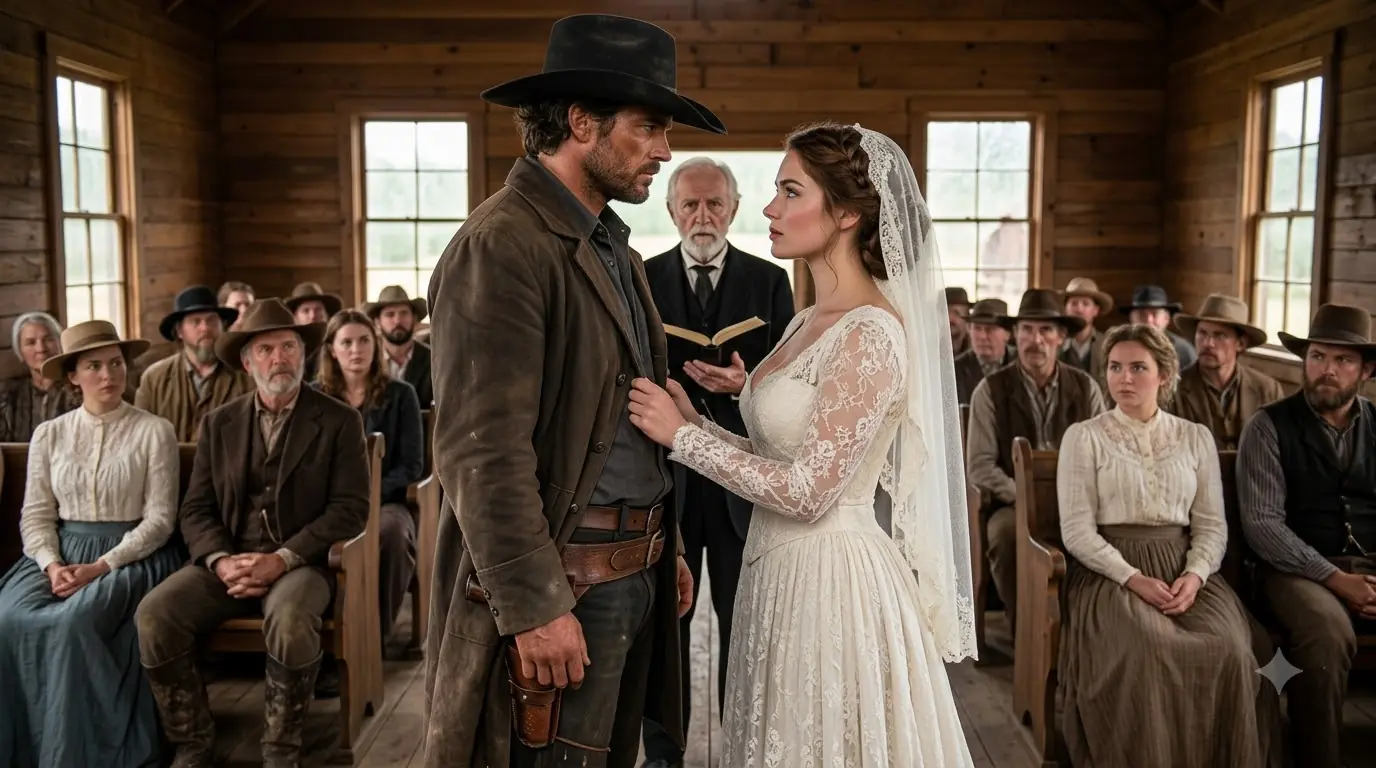
Bo stood six feet five inches tall in mud-marked riding boots, broad enough through the shoulders that his dark-brown coat seemed constructed around a barn door. A weathered black cowboy hat remained on his head, despite Reverend Price having cleared his throat twice in disapproval. Dark hair curled beneath the brim, heavy stubble covered his jaw, and his gray-blue eyes held mine with a directness I had encountered in very few men.
“I want someone who can survive a blizzard,” he continued. “Someone who rides beside me when things turn bad instead of waiting behind a window for somebody else to fix them.”
A woman in the second row gasped.
Another whispered my name as though I had been injured.
Reverend Price shifted the Bible in his hands. “Mr. Rollins, perhaps these matters might be discussed after the ceremony.”
“They should have been discussed before it.”
“They were,” I said.
The reverend blinked.
Bo looked at me.
I had known him fourteen days.
For twelve of those days, half of Copper Creek had taken turns warning me that Bo Rollins was impossible, stubborn, unsociable, unrefined, intimidating, and altogether unsuited for a woman raised in Philadelphia society.
They apparently believed those descriptions would frighten me.
They had no idea what Philadelphia society had already taught me to fear.
Bo continued.
“I want a woman who understands that cooking for people you love isn’t servitude if the work is shared. I want honesty. Loyalty. Someone strong enough to argue with me when I deserve it.”
A few men chuckled nervously.
Bo did not.
His eyes never left mine.
“And I want children,” he said. “Sons, daughters, however God sends them. I want them raised knowing their mother helped build what they inherit.”
Then came the sentence Copper Creek would repeat for years.
“I don’t want a lady, Annabeth. I want a fighter who’ll cook, love, and bear sons.”
Mrs. Fairchild sucked in a horrified breath.
“That is barbaric,” she announced.
Bo's jaw hardened.
Before he could answer, I turned toward her.
Mrs. Fairchild was a widow in her fifties who wore black silk and possessed the remarkable ability to insert herself into matters that had survived perfectly well without her participation.
“Did Mr. Rollins ask you to marry him?” I said.
Her mouth opened.
“No.”
“Then I believe we are safe.”
Someone laughed.
Mrs. Fairchild reddened.
I turned back to Bo.
The giant cowboy looked almost amused.
Almost.
“You finished?” I asked.
“With the truth?”
“Yes.”
“For now.”
“Good.”
I stepped closer and curled my fingers into the front of his coat.
His expression changed.
Only slightly, but enough.
“I did not cross two thousand miles to sit behind different curtains, Mr. Rollins.”
The congregation quieted again.
“I spent twenty-seven years surrounded by beautiful rooms where servants were permitted to make more decisions than I was. I have no interest in replacing a Philadelphia cage with a Montana one.”
Bo's gaze sharpened.
“What did you come for?”
“Purpose.”
For the first time since I had met him, Bo smiled.
It transformed his face so completely that several unmarried women behind me probably reconsidered their previous opinions.
“Then we understand each other,” he said.
I lowered my voice.
“Not entirely.”
His eyebrow rose.
“If you expect a fighter, cowboy, you'd better be prepared for a woman who fights you sometimes.”
The corner of his mouth moved.
“I’m counting on it.”
Reverend Price sighed.
“May we finish the wedding now?”
We did.
My name became Annabeth Rollins at eleven seventeen on an October morning in 1887.
Two weeks earlier, I had been Annabeth Caldwell, daughter of one of the wealthiest industrialists in Philadelphia and a woman with enough money in her purse to survive perhaps twenty-seven days if she ate carefully.
The difference between those two women could not be measured in miles.
My father, Edward Caldwell, owned banks, textile mills, railway shares, warehouses, and an assortment of buildings bearing our family name. I grew up in a limestone townhouse filled with carpets imported from France, clocks from Switzerland, porcelain from China, and adults who discussed my future as though I were not in the room.
My mother died when I was twelve.
Afterward, my father delegated most of my upbringing to governesses.
I became excellent at piano, passable at French, competent at watercolor, and almost entirely useless at anything involving actual survival.
I could identify the proper spoon for six separate courses.
I could not bake bread.
I could discuss European poetry.
I had never saddled a horse.
I had been trained to enter a room gracefully and leave without causing anyone discomfort.
That, my father explained, was what distinguished a lady.
At twenty-six, he selected my husband.
Julian Mercer belonged to another old Philadelphia family and possessed the polished manners society mistook for character. He was handsome, wealthy, educated, and particularly attentive whenever someone important was watching.
When we were alone, he was different.
He criticized how I dressed.
He disliked my friends.
He read letters left on my writing desk.
He once explained that marriage would improve me because I had “far too much confidence for an unmarried woman.”
My father laughed when I complained.
“Marriage requires adjustment.”
Three weeks before the ceremony, I entered Julian's study searching for a book he had promised to lend me.
Instead, I found letters.
They concerned his first wife.
I had known that Julian had previously been married. Society described Lydia Mercer as fragile and unstable. The accepted story was that she had suffered a breakdown shortly after inheriting a considerable fortune from her mother.
Julian had arranged treatment.
Lydia eventually disappeared from Philadelphia.
Some claimed she had died.
Others said she remained in a private institution.
The letters told a different story.
Julian had paid Dr. Frederick Wallace to describe Lydia as irrational, hysterical, and incapable of managing her property.
One note discussed increasing her medication before a legal examination.
Another described transferring control of her trust.
A third contained a sentence I still remembered word for word.
Once the court accepts incapacity, there is no practical obstacle remaining.
I confronted Julian that evening.
He listened without interrupting.
Then he smiled.
“Your father already knows.”
Those four words destroyed the last illusion I possessed.
I went home.
My father was in his library.
I placed the letters on his desk.
“Tell me he lied.”
Father removed his spectacles.
“Julian's first marriage is none of your concern.”
“He imprisoned his wife.”
“Lydia was unstable.”
“He paid a doctor.”
“Annabeth.”
“Did you know?”
Silence.
That was my answer.
My father leaned back.
“You are allowing emotion to interfere with practical matters.”
“What practical matters?”
“The Mercer-Caldwell partnership will create opportunities neither family should ignore.”
I stared at him.
“My marriage?”
“Yes.”
“Or my transfer?”
His expression hardened.
“Do not become melodramatic.”
I understood something then that had probably been true my entire life.
My father loved me.
But he loved control more.
I was not simply his daughter.
I was an asset.
That night I packed one trunk.
At dawn I boarded a train west.
The advertisement that changed my life had been folded inside a newspaper abandoned at a station outside Pittsburgh.
Western rancher, age thirty-six, financially established, seeks practical woman of good character for marriage. Hard work required. Honesty essential. No interest in society accomplishments.
I laughed when I first read it.
Then I read it again.
At the bottom was the address of a matchmaking office.
I wrote before courage disappeared.
Bo's reply arrived in Chicago.
It consisted of one page.
His handwriting was ugly.
His honesty was not.
He owned more than four thousand acres west of Copper Creek. The ranch was profitable but difficult. Winters could isolate the house for days. There were cattle, horses, irrigation ditches, fences, hired men, and a kitchen that according to Bo “needed someone who knows what food is supposed to taste like.”
He wrote one sentence twice.
I am not looking for obedience.
Then:
I am looking for partnership.
I continued west.
When the stagecoach finally reached Copper Creek, Bo stood beside the hitching rail wearing his black cowboy hat.
He looked at my gloves.
Then my polished boots.
Then my fitted traveling coat.
“You're Annabeth Caldwell?”
“Yes.”
“You ever ridden a horse?”
“Of course.”
“A proper horse?”
I frowned.
“What other kind is there?”
“One of those city animals that walks in circles while rich people pretend they're outdoors.”
I lifted my chin.
“A horse is a horse, Mr. Rollins.”
His mouth moved.
“You'll learn.”
That was our courtship.
The marriage began more painfully.
On my first morning at Rollins Ranch, I attempted breakfast.
The biscuits could have been used as defensive weapons.
The bacon caught fire.
In my panic, I dropped the burning pan into a bucket beside the stove.
Bo entered thirty seconds later and stared at the smoking bucket.
“My saddle leather was soaking in there.”
I looked down.
A brown strap floated beneath the bacon.
“I see that.”
He looked at the biscuits.
“What happened to those?”
“I cooked them.”
“You certain?”
I glared.
Bo picked one up.
He tapped it against the table.
It made a sound remarkably similar to a hammer striking wood.
“That could stop a bullet.”