The axe slipped because Clara Vance could no longer feel her fingers.
She had been working since before sunrise, splitting oak beside the north wall of the cabin while a thin November wind came down from Raven Pass and cut through every seam in her cream work dress. Forty cords of wood stood stacked beneath the lean-to, but Clara had calculated that she needed at least fifty-six if winter came as hard as it had the previous year. Every log mattered because there was no husband coming through the snow to finish the job, no hired hand expecting supper, and no neighbor likely to ride six miles just because a widow had run out of firewood.
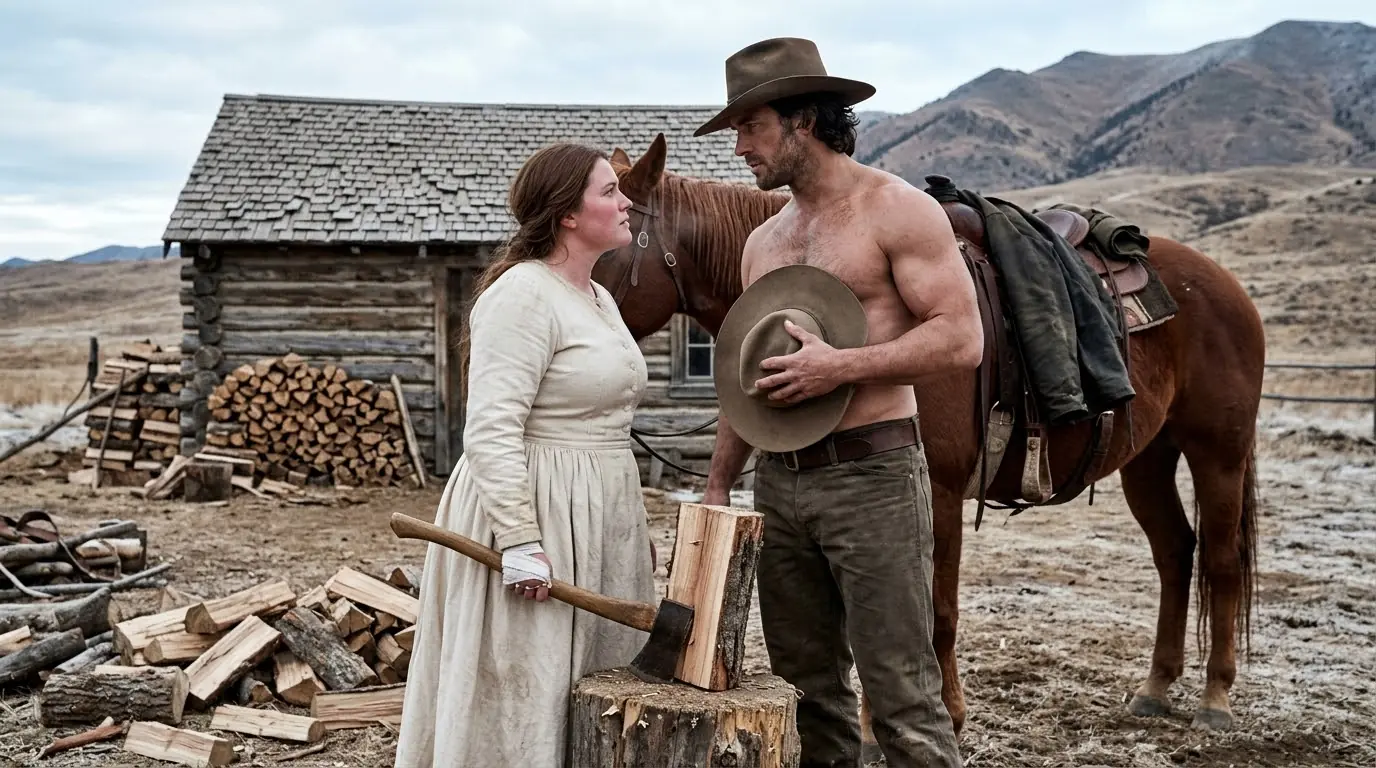
The blade glanced against the side of the block.
Clara jerked back.
Pain came a moment later.
A fresh red line opened across the heel of her right palm beneath the old wrapping, joining two cracks that had never properly healed. Blood darkened the cloth almost immediately.
“Damn.”
She dropped the axe beside the stump.
That was when she heard the horse.
Not the light rhythm of a trader’s pony or the uneven trot of one of the Vance place’s aging work mares. These hoofbeats were slow, deep, and heavy enough that Clara felt them through the frozen ground before the rider appeared beyond the line of leafless cottonwoods.
A massive chestnut stallion emerged first.
Then the man riding it.
Clara stopped wrapping her hand.
She had seen large men before.
Miners.
Lumbermen.
Cattle drovers.
None looked like this one.
The stranger seemed built for another scale entirely. He sat high in the saddle with shoulders so broad they nearly matched the horse’s chest, his dark coat stretching across them when he moved. A weathered brown hat shadowed a hard, handsome face covered in several days of dark stubble, and wavy black hair curled against his collar.
The stallion stopped ten feet from the chopping block.
Pale gray eyes settled on Clara.
Not on the axe.
Not the failing cabin.
Her.
Clara immediately hated how aware she became of herself.
Her wide hips beneath the gathered skirt.
Her soft stomach.
Her thick arms.
The roundness of her cheeks.
All the parts of herself that other people noticed before anything else.
She straightened.
“If you’re lost, Raven Pass is north.”
The stranger swung down from the saddle.
He was even larger standing.
Well over six feet four.
Perhaps more.
He removed his hat.
“Mrs. Vance?”
Clara stared.
“Who wants to know?”
“Gideon Stone.”
That name she knew.
Everyone in three counties knew it.
The Mountain.
That was what people called him.
Gideon Stone owned nearly eight thousand acres above Raven Pass, along with timber claims, cattle, three springs that never froze, and enough influence that bankers in Bismarck supposedly answered his letters before those of elected officials. Stories followed him wherever men drank whiskey.
He had carried a ranch hand with a broken leg eleven miles through snow.
He had once stopped a runaway wagon by catching the lead horse’s bridle.
He had fought three cattle thieves alone and left all three conscious enough to regret the decision.
Clara had assumed half the stories were nonsense.
Looking at him now, she reconsidered.
“What does Gideon Stone want with me?”
His eyes went to her hand.
“You’re bleeding.”
“I noticed.”
“You should clean that.”
“I intend to.”
He took one step closer.
Clara instinctively reached toward the axe.
Gideon stopped immediately.
That surprised her.
Most men who believed themselves powerful did not notice when women wanted distance.
He did.
“I’m not here to hurt you.”
“Men usually say that before asking for something.”
One corner of his mouth moved.
“Fair.”
“What do you want?”
Gideon rotated his hat between his large hands.
For the first time, Clara noticed something almost ridiculous.
The Mountain was nervous.
Not frightened.
Nervous.
Of her.
“I came to make you an offer.”
“What kind?”
“Marriage.”
Clara stared.
Then laughed.
She did not mean to.
The sound burst out of her so sharply that Gideon’s eyebrows lifted.
When she realized he was serious, the laughter stopped.
“No.”
“You haven’t heard the terms.”
“I heard marriage.”
“That’s the important part.”
“No.”
Gideon glanced toward the cabin.
The roof sagged slightly above the eastern room.
One shutter hung from a single hinge.
The barn door had been repaired with mismatched boards.
Three chickens scratched in the frozen dirt beside the porch.
Clara’s humiliation became anger.
“You came here because you heard Jonah left me poor.”
“No.”
“Then because Dry Creek enjoys discussing the size of my pantry along with the size of my backside?”
Gideon’s expression hardened.
“Who said that?”
She almost smiled.
“Half the town.”
“Names.”
“Are you planning to fight all of them?”
“If necessary.”
The answer came so calmly she almost believed him.
Clara folded her arms.
“That still doesn’t explain why you want to marry me.”
Gideon looked toward the stack of wood.
“You cut all that?”
“Yes.”
“Alone?”
“Do you see anybody else?”
His eyes moved over the property.
The repaired fence.
New shingles covering only half the roof.
A wagon wheel braced against the barn.
A vegetable garden covered with straw against the frost.
“You kept this place operating for two years.”
“Barely.”
“Still operating.”
“So?”
Gideon looked back at her.
“So I’ve watched men with twice your money and half your problems lose farms because they quit.”
Clara said nothing.
“You didn’t.”
“I had nowhere else to go.”
“That doesn’t make it less impressive.”
She hated the way the words affected her.
Insults were easy.
Insults could be rejected.
Kindness made openings in places she had spent years sealing shut.
Clara picked up the axe.
“If that is your proposal, Mister Stone, it needs work.”
Gideon exhaled.
“I want a family.”
The axe stopped.
“There.”
He nodded.
“That’s the part you weren’t saying.”
“I’m saying it now.”
“You want children.”
“Yes.”
“And you have land.”
“Yes.”
“Money.”
“Enough.”
“Cattle.”
“Too many.”
“But no wife.”
“No.”
Clara leaned the axe against the block.
“So you rode down from your mountain and picked the largest woman you could find because you assume these hips guarantee sons?”
Gideon’s eyes flashed.
“No.”
“Then explain it.”
He put the hat beneath one arm.
“I picked the strongest woman I know.”
“You don’t know me.”
“I know enough.”
“No, you know gossip.”
“I know you buried Jonah Vance during the worst storm of the spring.”
Clara stiffened.
“I know you refused the collection Dry Creek tried to raise because you said you wouldn’t take charity from men who never visited while he was dying.”
Her throat tightened.
“I know you brought forty acres of barley in with two horses and one fourteen-year-old hired boy last harvest.”
“That boy quit.”
“I heard.”
“He stole my silver spoons.”
“I heard that too.”
Clara almost smiled.
Gideon continued.
“I know your north fence went down in February, and you rebuilt it alone.”
“How?”
“I rode past.”
“You watched me?”
“Yes.”
Something in his tone changed.
Clara noticed.
“How often?”
Gideon’s jaw shifted.
“Enough.”
“Enough to propose marriage?”
“Yes.”
She studied him.
He looked almost embarrassed.
That made him more dangerous than arrogance would have.
Clara whispered:
“You could marry half the unmarried women in Dakota.”
“I could.”
“Younger women.”
“Yes.”
“Thin women.”
His gaze sharpened.
“Yes.”
“Pretty women.”
“I’m looking at one.”
Clara’s breath caught.
She looked away immediately.
“Don’t.”
“What?”
“Say things because you think I need to hear them.”
“I don’t say things I don’t mean.”
“That must make conversation exhausting.”
“It does.”
She rubbed her injured hand.
Gideon noticed again.
“May I?”
“No.”
He waited.
Clara sighed and held out the hand.
Gideon stepped closer.
His hands looked enormous around hers, but his touch was careful as he unwound the bloodstained cloth.
Clara expected him to grimace.
Instead, he frowned.
“These need rest.”
“So does my roof.”
“I’ll fix the roof.”
“I didn’t ask you.”
“I know.”
He tore a clean strip from a cloth inside his saddlebag and wrapped her palm.
Clara watched his hands.
“You came prepared to bandage women?”
“I came prepared to bandage horses.”
“How flattering.”
Gideon smiled.
It transformed his face.
Clara suddenly understood why women in Dry Creek lowered their voices when discussing him.
She pulled her hand away too quickly.
“What exactly are your terms?”
“Come to Stone Ridge.”
“And abandon this land?”
“No.”
“What happens to it?”
“You keep it.”
She frowned.
“After marriage?”
“Yes.”
“In my name?”
“Yes.”
That surprised her.
Married women did not always receive such freedom, especially on frontier property where custom often mattered more than statutes.
“My money?”
“Yours.”
“My livestock?”
“Yours.”
“My decisions?”
“Depends.”
Clara’s eyes narrowed.
Gideon lifted both hands.
“That was a joke.”
“It wasn’t a good one.”
“I’m learning.”
“What do you receive?”