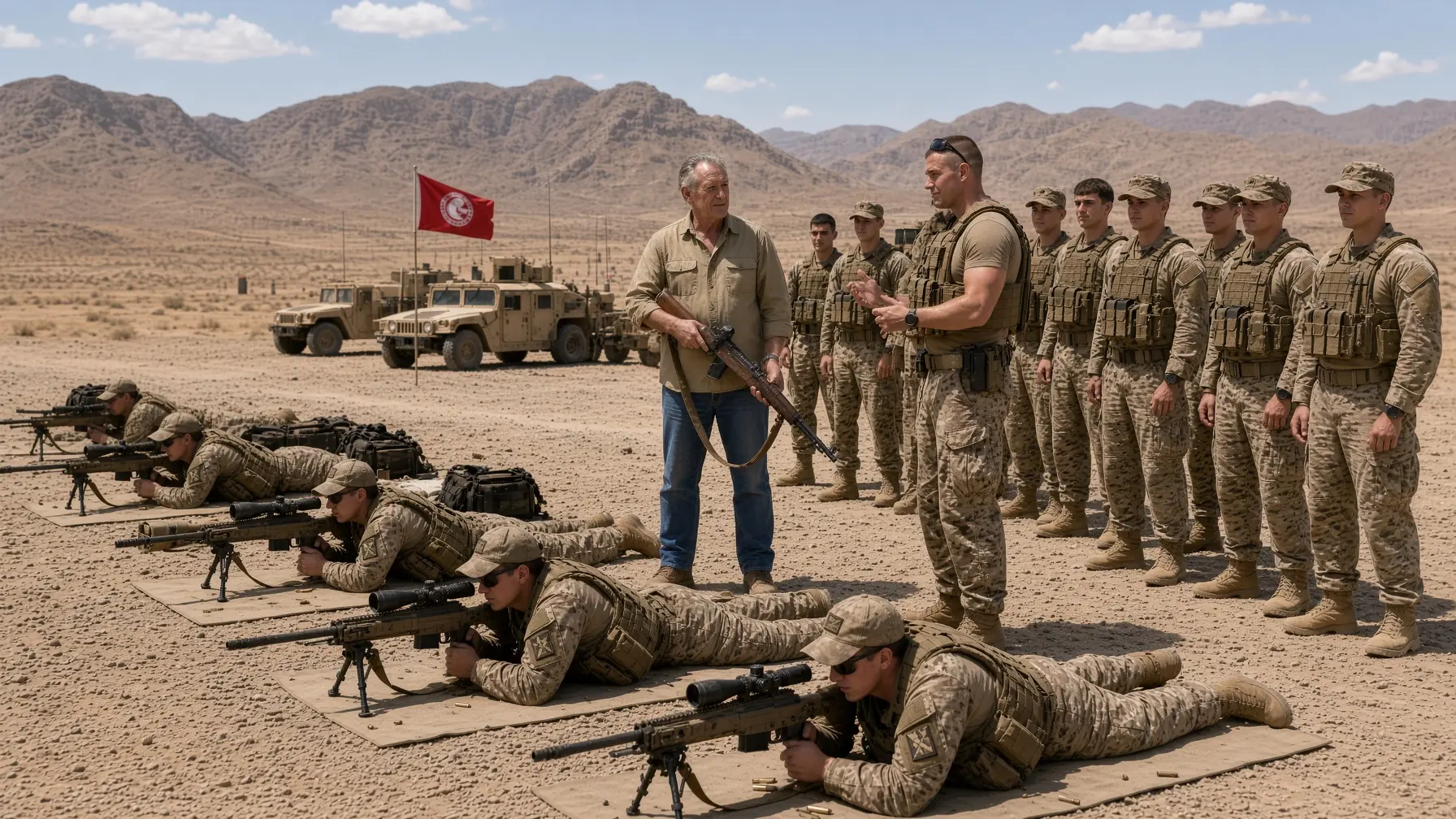
“Sir, step away from the firing line.”
Gunnery Sergeant Travis Rowe did not say it like a request.
He said it like a man used to being obeyed before anyone asked why.
The old man standing behind the sniper line did not move. He held a long object wrapped in faded canvas across both hands, and his pale gray eyes stayed fixed on the far end of Copperhead Ridge Range. The wind pulled at his loose work shirt and pushed dust across his boots, but he seemed to be listening to something nobody else could hear.
Rowe took one step closer.
“This is a restricted live-fire range,” he snapped. “Force Recon sniper evaluation. Civilians do not wander in here because they feel curious.”
The old man finally turned.
His face was lined deeply, sunburned in the permanent way of men who had spent their lives outdoors. He was maybe eighty, maybe older, thin at the waist but still straight through the shoulders. He wore worn jeans, a faded tan shirt, and a pair of old work boots polished only by dust and time.
His name was Walter Keane.
Most people on base knew him as Walt from grounds maintenance.
The quiet old man who trimmed grass near the barracks, fixed sprinkler heads, collected spent brass when range crews got lazy, and nodded to Marines without asking for conversation. He kept to himself, drove a dented green pickup, and ate lunch beneath the same cottonwood tree every day with a thermos of black coffee and two boiled eggs wrapped in wax paper.
Nobody on that line knew much more than that.
Certainly not Gunnery Sergeant Rowe.
Rowe was thirty-six, hard-bodied, sharp-jawed, and wrapped in the kind of modern tactical confidence that made younger Marines nervous and older Marines tired. He wore a ballistic computer on his wrist, a rangefinder clipped to his chest rig, and a rifle that looked like it had been built in a laboratory by men who never got dirt under their nails.
Behind him, six Marines lay near their mats, rifles pointed downrange, scopes glinting under the hard California sun.
They had been failing all morning.
The target was a small steel silhouette set beyond 1,700 yards, half hidden against broken rock and scrub. It was not impossible by the book. Their equipment said it was solvable. The laser rangefinders had given distance, the ballistic apps had given elevation, the Kestrels had given wind data, and the rifles were capable of reaching farther than that.
But the steel had not rung once.
Rounds had gone left.
Then right.
Then low.
Then somewhere nobody wanted to admit.
The wind seemed to change its mind halfway down the valley, and every firing solution the men trusted came back wrong.
Walter looked toward the target again.
“Wind’s crossing in layers,” he said quietly.
Rowe stared at him.
“What?”
“It’s not one wind today. It’s three.”
A couple of the younger Marines shifted.
Lance Corporal Jonah Reed lowered his spotting scope just slightly.
He had been watching the mirage all morning, the heat shimmer dancing over the rocks in a way he could not make sense of. The flags at 700 yards and 1,200 yards had disagreed with each other. The grass near the left ravine kept bending against the main current. Something about what the old man said touched the edge of what Reed had been afraid to say aloud.
Rowe laughed.
Not because it was funny.
Because he needed everyone to know it was beneath him.
“Three winds,” he said. “Listen to that, gentlemen. Groundskeeping wisdom.”
No one laughed loudly.
That made him angrier.
Rowe crossed his arms and looked Walter up and down.
“Sir, I don’t know what you think you heard from the picnic tables, but we’re dealing with spin drift, barometric pressure, aerodynamic jump, Coriolis, and a valley that keeps shifting every five minutes. This is advanced long-range marksmanship, not guessing by how your knees feel before rain.”
Walter gave a small shrug.
“Your computer sees the number you feed it. It doesn’t see that warm air climbing off the rocks at a thousand yards. It doesn’t see the sink coming out of that cut on the left. And it doesn’t know the flag near the target is lying because the last fifty yards aren’t the same as the first thousand.”
The silence after that was different.
The Marines heard it.
Rowe heard it too, which was why he dismissed it faster.
“You think you can read air better than military-grade equipment?”
Walter looked at the range.
“No.”
“Good.”
“I think the air is telling you what the equipment is missing.”
Rowe’s smile disappeared.
His morning had already gone badly. His team had missed every shot. His senior evaluator would be reading the report by evening. Now an old man with grass stains on his sleeves was standing behind his line, calmly explaining the one thing he had failed to solve.
Pride rarely chooses wisdom when humiliation is nearby.
Rowe pointed toward the canvas-wrapped object in Walter’s hands.
“What’s that, anyway?”
Walter looked down at it.
“A rifle.”
Rowe’s mouth curled.
“Of course it is. Let me guess. Grandpa’s deer gun?”
Walter did not answer.
He unwrapped the canvas slowly.
The rifle that appeared was not sleek.
It had no modular chassis, no carbon fiber, no folding stock, no suppressor mounted like a modern assumption. It was wood and steel, old walnut darkened by years of oil, sweat, rain, and handling. The stock bore scratches, dents, and one deep gouge near the bolt that looked almost like a scar.
A few Marines lifted their heads.
Reed whispered before he could stop himself.
“Is that an M40?”
Walter rested the rifle lightly across his palms.
“It is.”
Rowe stared at it, then laughed again.
This time, the laugh came with relief.
The old man had given him something easy to mock.
“You brought a museum piece onto my range?”
Walter’s thumb moved once along the worn stock.
“She still holds true.”
“That barrel is probably older than my father.”
“Likely.”
“You think that antique can touch steel at 1,700 yards?”
Walter looked toward the target.
“If the man holding it does his part.”
Rowe stepped closer and pointed at the stock, his finger hovering near the gouge.
“What happened here? Drop it out of a tree stand?”
For half a second, Walter was not at Copperhead Ridge.
The dry California range dissolved into rain.
The world turned green and wet and loud.
He was twenty-one again, belly down in mud under triple-canopy jungle, rain tapping leaves above him like fingers on a coffin lid. The air smelled of rot, cordite, wet canvas, and fear. Somewhere ahead, an enemy machine gun had opened from a ridge that should have been empty, pinning down a Marine squad caught in elephant grass.
The gouge in the stock was fresh then.
A mortar fragment had struck near his face, chewing wood from the rifle and cutting his cheek just below the eye. He remembered wiping blood away with the back of one hand, not because it hurt, but because it blurred his scope.
He had watched the rain.
Not the flags.
There were no flags.
He watched how drops slanted across a gap in the trees, how fern tips trembled in two directions, how smoke from a burned ration can flattened, rose, then vanished into a current the enemy could not see.
He breathed halfway out.
Held.
Squeezed.
The machine gun stopped.
The memory withdrew as quietly as it had come.
Walter looked back at Rowe.
“Mortar fragment.”
Rowe blinked.
“What?”
“You asked about the gouge.”
For the first time, Rowe did not have an immediate answer.
Then he recovered himself.
“I’ve had enough. This is an active range, and you’re standing here with an unregistered weapon, interrupting training, and distracting my Marines.”
Walter’s expression did not change.
“I’m not here to distract them.”
“Then why are you here?”
Walter looked past him toward the target.
“I heard the misses.”
That sentence landed like an insult even though it was only a fact.
Rowe’s face hardened.
“Put the weapon down and leave the range.”
Reed’s stomach tightened.
He had heard stories about the groundskeeper before, never officially, never from anyone who seemed sure. Old armory Marines sometimes got quiet when Walt’s name came up. One corporal had said the old man used to be somebody. Another had laughed and said, “Somebody? Son, some people are not supposed to be remembered in public.”
Reed had never known what that meant.
But now he was looking at the old M40, the calm hands, the way Walter had described a wind pattern none of their gear had explained.
Something in him moved.
“Gunny,” Reed said, standing abruptly. “My spotting scope is fogging inside. I think the heat cracked the seal. Permission to run it back to the armory?”
Rowe turned on him.
“Now?”
“It’s not reading clean.”
Rowe waved him off, irritated.
“Fine. Move.”
Reed grabbed the scope and jogged toward the vehicles.
He did not go to the armory.
He ducked behind a row of Humvees, pulled out his phone, and called Master Gunnery Sergeant Roy Talbot, the senior man at the base armory and the closest thing Copperhead Ridge had to a living index of Marine Corps history.
The line rang twice.
“Armory.”
“Master Guns, this is Lance Corporal Reed from Charlie Recon.”
“What did you break?”
“Nothing, Master Guns.”
“Then why do you sound guilty?”
Reed glanced back toward the firing line.
“I’m at Copperhead Ridge. Gunny Rowe is about to have that old groundskeeper removed from the range.”
There was a pause.
“What old groundskeeper?”
“Walt. Walter Keane.”
The silence went cold.
Reed swallowed.
“He brought an old M40 with him.”
Another pause.
Longer.
When Talbot spoke again, the gravel had left his voice.
“Say that name again.”
“Walter Keane.”
“White hair? Limp in the right leg? Scar under the left eye?”
“Yes, Master Guns.”
“Is Gunnery Sergeant Rowe touching him?”
“Not yet.”
“Then you listen carefully, Lance Corporal. You keep it that way.”
Reed felt the hair rise on the back of his neck.
“Master Guns?”
“Do not let anyone put hands on Walter Keane. Do you understand me?”
“Yes.”
“I’m calling the colonel.”
The line went dead.
Reed stood behind the Humvee, staring at the phone.
He had the sudden feeling that the range problem had changed shape.
Back at the line, Rowe’s patience had broken.
He stepped into Walter’s space, close enough that dust from his boots brushed the old man’s pant leg.
“I will not ask again,” Rowe said. “You are trespassing on a restricted military training range. Put the rifle down, turn around, and walk back to wherever they keep you.”
The words were ugly.
Everyone heard them.
Walter heard them too.
He only looked at Rowe with an old sadness that somehow made the insult feel smaller than the man who had spoken it.
“I know where I am.”
“No, you don’t.”
Walter’s eyes moved to the flags.
“Yes,” he said. “I do.”
Rowe reached out and placed one hard hand on Walter’s shoulder.
It was meant to steer him.
To move him.
To make the scene end under Rowe’s control.
Walter did not resist.
He also did not move.
He simply looked down at the hand on his shoulder, then back into Rowe’s face.
The pity in his eyes was worse than anger.
That was when the sirens came.
At first, everyone thought it was the wind against the metal range shed.
Then the sound grew sharper.
A convoy came hard down the dirt road from the main base, throwing dust behind it in a long brown tail. Two black command Humvees and a military police cruiser rushed toward the firing line, lights flashing under the pale sun.
The range went still.
No one spoke.
Rowe’s hand remained on Walter’s shoulder for one second too long.
The vehicles skidded to a stop, doors opening before the dust settled.
Colonel Everett Shaw stepped out first.
He was the commanding officer of the Marine Raider Training Center, a tall man with iron-gray hair, a clean uniform, and eyes that could make a room understand bad news before he said a word. Behind him came Sergeant Major Leland Knox, a hard, silent man whose expression suggested he had personally buried excuses in shallow graves.
Rowe pulled his hand back like the old man’s shoulder had burned him.
Every Marine on the line snapped to attention.
Colonel Shaw did not look at them.
He walked straight to Walter.
His boots stopped in the dust, directly in front of the old man with the M40.
The colonel looked once at Walter’s rifle.
Once at his face.
Then he came to full attention and saluted.
Sharp.
Formal.
Deeply personal.
The range seemed to stop breathing.
“Mr. Keane,” Colonel Shaw said, voice carrying over every Marine, every rifle, every flag. “Sir, I apologize for the disrespect shown to you on this range.”
Rowe’s face drained of color.
The young Marines stared.
Even Sergeant Major Knox looked like he was holding back something dangerous.
Walter returned the salute slowly.
His hand trembled just slightly near the end.
Not from fear.
From age.
“Colonel,” he said.
Shaw lowered his hand only after Walter did.
Then he turned toward Rowe.
The temperature of the range dropped without the wind changing.
“Gunnery Sergeant Rowe.”
“Sir.”
“What happened here?”
Rowe opened his mouth.
Closed it.
Opened it again.
“Sir, we had an unauthorized civilian on a live-fire range with a weapon. I was securing the area.”
Colonel Shaw looked at the rifle.
Then back at him.
“You placed your hand on him.”
Rowe swallowed.
“Yes, sir.”
“You mocked his rifle.”
Rowe said nothing.
“You dismissed his correction.”
No answer.
“You failed to ask who he was before deciding what he was.”
That sentence cut deeper than yelling could have.
Sergeant Major Knox stepped close to Rowe and spoke low enough that only those nearest heard him.
“Gunny, do you have any idea whose shoulder you grabbed?”
Rowe’s eyes flicked toward Walter.
“No, Sergeant Major.”
“You are about to.”
Colonel Shaw turned to the team.
“Marines, listen carefully.”
Every face snapped forward.
“This man is Chief Warrant Officer Five Walter Keane, United States Marine Corps, retired.”
The words moved through the line like electricity.
Shaw continued.
“He served in Vietnam, Laos, and places most of your clearance levels will never allow you to read about. He helped write early Marine field doctrine on extreme crosswind marksmanship, high-angle observation, and long-range shots in broken terrain.”
Rowe’s jaw clenched.
Not in anger now.
In horror.
The colonel’s voice hardened.
“In 1971, enemy forces in the A Shau Valley had another name for him. They called him the Old Ghost.”
Reed, standing near the Humvees, felt his breath catch.
He had heard that phrase once from Master Guns Talbot.
Only once.
It had sounded like legend then.
Now legend stood on the firing line in dusty boots, holding an old rifle wrapped in canvas.
Colonel Shaw looked across the snipers.
“You have been failing this target all morning because you are trying to calculate one wind. Mr. Keane told you there are three. Instead of listening, your leader treated him like an inconvenience.”
No one moved.
No one wanted to be noticed.
Shaw faced Walter again.
“Mr. Keane, sir, would you be willing to show them?”
Walter looked downrange.
Then at the old M40.
“I’m a little stiff.”
Shaw’s mouth moved faintly.
“We can wait.”
Walter shook his head.
“Target won’t.”
He walked to the firing mat.
Not quickly.
There was no performance in him.
He moved with the spare economy of a man who had learned long ago that wasted movement could get people killed. He lowered himself slowly, one knee resisting, then settled behind the rifle with his rucksack under the fore-end.
The young Marines watched every motion.
This was not how they shot anymore.
No bipod.
No digital readout.
No tablet beside the stock.
Just wood, steel, a simple scope, and a man whose eyes moved across the range as though reading a page written in air.
Walter rested his cheek against the stock.
For a few seconds, he did not touch the turrets.
He looked.
He watched the flags, but not only the flags. He watched dust dragging along the road. He watched grass at the 600-yard berm lean one way, then stop. He watched the shimmer above the rocks at a thousand yards climbing like heat from a stove.
He spoke without looking back.
“The first wind is quartering from your right.”
The Marines leaned in.
“Not strong. Just enough to invite you to believe it owns the whole valley.”
A few eyes moved toward Rowe.
He did not move.
“The second is rising off the rocks at a thousand. Warm air pushes the bullet up and left if you pretend it isn’t there. The third is falling from that cut on the left before the target. That’s why your last two shots went high right when your numbers said they should have held.”
Reed looked through his scope.
The mirage showed exactly what Walter described.
He felt both amazed and embarrassed.
Walter made three small adjustments.
Click.
Click.
Click.
Then he settled.
The range became silent enough to hear canvas shift under his elbow.
Walter breathed in.
Let half of it out.
Held.
The old M40 cracked.
The sound was different from the modern rifles.
Sharper.
Older.
More final.
For almost three seconds, nothing happened.
Then the steel at 1,700 yards rang clean and bright across the valley.
Dead center.
The sound came back like a bell from another century.
No one cheered at first.
They were too stunned.
Then Reed let out a breath he did not know he was holding.
A young corporal whispered, “Holy—”
Sergeant Major Knox cut his eyes toward him.
The corporal stopped.
Then Colonel Shaw smiled, just once.
That gave the line permission to breathe.
Applause broke out, rough and sudden, not like a crowd at a game, but like Marines releasing the weight of being corrected by greatness. Some clapped. Some nodded. One young sniper simply stared through his scope at the mark in the steel as if it had personally changed his religion.
Walter pushed himself up slowly.
Rowe stepped forward.
His face was pale.
“Mr. Keane,” he said, voice rough. “Sir, I owe you an apology.”
Walter looked at him.
“Yes.”
The answer was simple enough to hurt.
Rowe swallowed.
“I was out of line.”
“Yes.”
“I disrespected you.”
“Yes.”
“I embarrassed myself and my Marines.”
Walter looked toward the firing line.
“You taught them something.”
Rowe’s eyes lifted.
Walter tapped the old rifle’s stock.
“Just not what you intended.”
Colonel Shaw turned back to Rowe.
“Gunnery Sergeant, your pride nearly cost your team a lesson no schoolhouse can buy. You have mistaken equipment for mastery and authority for wisdom.”
Rowe stood rigid.
“Yes, sir.”
“You and this team will report for one week of remedial wind and fieldcraft instruction.”
“Yes, sir.”
“Your instructor will be Mr. Keane, if he is gracious enough to accept.”
Every Marine turned toward Walter.
He looked down at the M40.
Then at the target.
Then at Rowe.
“One week won’t be enough.”
Colonel Shaw nodded.
“I suspected that.”
Walter’s eyes softened, but only slightly.
“We’ll start tomorrow at dawn.”
Nobody complained.
The next morning, the team arrived before sunrise.
There were no rifles on the mats.
Walter had ordered them left in the racks.
That alone made the Marines nervous.
He sat on an overturned ammo crate with a cup of black coffee in one hand and a blade of dry grass in the other. His old M40 rested against the crate, wrapped halfway in its canvas like something sleeping but not retired. Rowe stood at the front of the group, silent, face clean of swagger.
Walter held up the grass.
“What does this tell you?”
One Marine said, “Wind direction.”
Walter shook his head.
“That’s the lazy answer.”
Another said, “Speed.”
“Still lazy.”
Reed studied the blade.
“How long the wind holds one thought before changing it?”
Walter looked at him.
A faint smile crossed his face.
“That’s closer.”
For seven days, he taught them to see.
Not look.
See.
He taught them that mirage was not distortion but information. That dust moved differently when wind rolled instead of pushed. That birds landing into a current told the truth better than flags nailed to poles. That the smell of rain could change density. That shade cooled a pocket of ground enough to bend a bullet’s path at distance.
He made them sit for an hour watching a hillside without touching equipment.
At first, the Marines hated it.
Then they began to notice things.
A ribbon on a range marker twisted one way while the grass below it barely moved. Heat shimmer leaned against the valley wall at midmorning, then flattened near noon. The ravine on the left breathed cold air downrange until the rocks warmed.
Walter never raised his voice.
He did not need to.
When a Marine answered carelessly, Walter simply waited until the silence became more uncomfortable than correction.
By the third day, Rowe stopped trying to look like he already understood.
By the fourth, he began asking real questions.
By the sixth, the team hit the steel five times in a row.
Not because the wind became easier.
Because they became less arrogant about it.
On the last afternoon, Walter made them shoot without ballistic computers.
Rowe looked at him.
“All of us?”
“All of you.”
“Sir, that’s not how we normally—”
Walter raised one eyebrow.
Rowe stopped.
“Yes, sir.”
The shots were not perfect.
But they were honest.
The Marines read, estimated, adjusted, missed, corrected, and learned. Each ring of steel sounded less like victory and more like conversation. By sunset, even Rowe seemed to understand that the point was not to abandon technology.
The point was to stop worshiping it.
After the final shot, Walter stood beside the line and looked at the young Marines.
“The rifle is not the weapon,” he said.
No one spoke.
“The scope is not the weapon. The computer is not the weapon. Your rank is not the weapon.”
He tapped his temple.
“This is.”
Then he pointed downrange.
“And this is the classroom.”
A month later, Gunnery Sergeant Rowe saw Walter at a hardware store outside town.
It was Saturday afternoon.
Rowe was in civilian clothes, holding a bag of potting soil and looking at tomato cages with the seriousness of a man facing a decision above his training. Walter stood in the next aisle, reading seed packets, his canvas rifle case nowhere in sight.
For a moment, Rowe almost left.
Then he took a breath and walked over.
“Mr. Keane.”
Walter looked up.
“Gunny.”
Rowe looked at the seed packets.
“Planting tomatoes?”
“Trying to.”
“You ever grown them?”
“No.”
Rowe blinked.
Walter gave him a sideways look.
“You assumed I knew everything?”
Rowe almost smiled.
“No, sir. I learned not to assume that much.”
Walter nodded.
“Good.”
Rowe shifted the bag of soil under one arm.
“I wanted to thank you. For the week.”
Walter waited.
“And for not making it worse than I deserved.”
Walter studied him for a moment.
“I didn’t need to make it worse. You were already doing a fine job.”
Rowe looked down, then laughed quietly.
It was the first clean laugh he had managed about the whole thing.
“I was wrong,” he said.
“Yes.”
“I treated you like you were in the way.”
“Yes.”
“You were the lesson.”
Walter looked at the seed display.
“Most lessons are in the way at first.”
Rowe nodded.
For once, he did not try to fill the silence.
Walter picked up a packet of heirloom tomatoes and frowned.
“You growing any?”
“Yes, sir. Second year.”
“How close do I plant them?”
Rowe smiled.
“Farther apart than you think. They need room.”
Walter looked at him.
“So do Marines.”
Rowe took that in.
Then nodded.
“Yes, sir.”
The Peters Wind Doctrine did not keep its old name because Walter would not allow his name on it.
Colonel Shaw tried.
Sergeant Major Knox tried.
Master Gunnery Sergeant Talbot tried twice and received the kind of quiet stare that ended campaigns.
So the course became known unofficially as the Old Ghost Block.
Every advanced sniper class at Copperhead Ridge spent three days without computers, learning to read terrain before touching screens. They watched grass, dust, birds, heat, shadows, smoke, rain, and their own impatience. They were told the story of the old man who walked onto the range with an M40 and made modern arrogance sit down in the dirt.
The rifle was eventually displayed in the armory.
Not behind glass.
Walter refused that too.
“It’s a rifle,” he said. “Not a saint.”
So it rested in a locked wooden rack near the training classroom, taken out twice a year for instruction, handled only under supervision, cleaned afterward by students who understood by then that reverence did not require worship.
The gouge near the bolt remained.
Walter would not let anyone repair it.
“That scar paid rent,” he said.
Years later, young Marines still whispered about the shot at Copperhead Ridge.
Some said it was 1,700 yards.
Some said 1,800.
Some added dust devils, impossible crosswinds, and a hawk that flew across the range at the moment of the shot.
Stories grow when Marines tell them.
Walter never corrected the distance unless he was asked directly.
Then he said, “Far enough.”
Rowe eventually became a master gunnery sergeant himself.
He taught differently after that.
Still hard.
Still demanding.
Still allergic to excuses.
But he stopped treating questions as disrespect. He stopped mocking what he did not recognize. He learned to ask old men their names before deciding they were lost.
On the wall of his office, he kept a framed blade of dry grass pressed between two sheets of glass.
Beneath it, he wrote one sentence.
The wind does not care about your rank.
Reed, the lance corporal who made the phone call, went on to become one of the finest instructors at the school. He told every new class that courage did not always look like charging a hill. Sometimes it looked like stepping away from the line and calling someone who knew better.
When Walter Keane died, the funeral was small by his request.
No big ceremony.
No parade.
No speeches longer than a weather report.
But Copperhead Ridge closed for the day.
Marines came anyway.
Old ones.
Young ones.
Snipers who had learned from him directly.
Officers who had only heard the story.
Groundskeepers who knew him as the man who fixed sprinklers with a pocketknife and complained about overwatered grass.
Colonel Shaw, older now and wearing civilian clothes, stood beside the coffin and saluted.
So did Rowe.
So did Reed.
So did every Marine who understood that some legends spend years mowing grass because they have no need to announce where they have been.
Walter was buried with the old canvas wrap folded at his feet.
Not the M40.
He had left instructions.
The rifle stayed with the school.
“Let the young ones learn from her,” his note said. “She still has things to say.”
The first class after his death gathered at dawn at Copperhead Ridge.
The instructor placed the old M40 on the mat.
No one touched it at first.
The wind came down the valley in layers, as it often did. One flag leaned right. Dust crawled left. Heat lifted off the rocks at a thousand yards and bent the morning into shimmering ribbons.
Master Gunnery Sergeant Rowe stood behind the line.
His hair had gone gray at the temples.
His voice still carried.
“Marines,” he said, “what do you see?”
A young sniper looked through his scope.
“Wind from the right, Master Guns.”
Rowe waited.
The student looked again.
Then lowered the scope.
“No. Three winds.”
Rowe smiled slightly.
“Now we can begin.”
The lesson continued.
Not because Walter Keane had made one impossible shot.
Not because a colonel saluted him.
Not because a young Gunny once got humbled in front of his team.
Those things were only the story people liked to tell.
The real lesson was quieter.
A man can carry more history than his clothes reveal.
A tool can look outdated and still hold truth.
A young leader can know every number and still fail to understand the field in front of him.
And wisdom, real wisdom, often arrives without rank on its collar, without shine on its boots, and without needing permission to stand near the line.
Walter Keane had spent a lifetime listening to wind.
In the end, he taught a generation of Marines to listen too.
Not just to the valley.
Not just to the rifle.
But to the people pride tells them to dismiss.
Because the next old man standing quietly behind the line may not be lost.
He may be the reason the line exists at all.