I truly believed grandparenting would be easier than parenting.
How could it not be?
By the time my grandchildren came into my life, I had already lived through everything people once warned me about. I had survived sleepless nights with babies who refused to settle, years of packing school lunches before the sun came up, seasons of wondering whether I was making the right decisions, and the quiet heartbreak of watching my children slowly grow into adults who no longer needed me in the same ways they once had. I had already experienced the worry, the mistakes, the exhaustion, and the joy. Surely, I thought, becoming a grandmother would be the beautiful reward waiting on the other side of all of that.
I imagined a season where I could simply enjoy.
I pictured weekends filled with baking cookies, reading storybooks, and watching little faces light up over the smallest things. I imagined laughter without responsibility, love without fear, and family gatherings where my only job would be to spoil my grandchildren a little before sending them home with hugs, kisses, and perhaps one too many homemade treats.
I thought experience would make me calmer.
I thought wisdom would make me more confident.
Most of all, I thought the worrying would finally stop.
I couldn't have been more wrong.
No one prepared me for this part.
Not the practical part.
The emotional part.
The part where your heart somehow grows larger than you ever believed possible, yet becomes more fragile at exactly the same time.
No one told me that I would love these little people with a fierceness so overwhelming that it would sometimes feel physical—as though my heart had somehow moved outside my body and begun walking around in tiny shoes.
People often say that grandchildren are life's greatest blessing.
They are.
What they don't often say is that the greatest blessings are also the ones that leave us most vulnerable.
Because once someone carries that much of your heart, every joy becomes brighter.
Every disappointment becomes heavier.
Every goodbye lasts a little longer.
Every prayer becomes more urgent.
Before I became a grandmother, I assumed the hardest part of parenting had been raising children.
Now I know there is another kind of love altogether.
A quieter love.
A love that has fewer decisions to make but far more helplessness to endure.
When you are a mother, there is so much you can do.
You make the appointments.
You wipe away tears.
You bandage scraped knees.
You enforce bedtime.
You decide what is for dinner.
You comfort nightmares.
Your love has hands.
Your love has authority.
Your love has permission to step in.
Grandmotherhood is different.
You still love with your whole heart.
Perhaps even more than before.
But suddenly you discover that loving someone deeply does not always mean you are the one who gets to help them.
That realization is one of the most humbling experiences I have ever known.
No one tells you how strange it feels to watch your own child become the parent.
One day, without realizing exactly when it happened, the little girl whose tears you once wiped away is now wiping away someone else's tears.
The little boy whose fever once kept you awake all night is now staying awake beside his own child's bed.
You watch them do the very things you once did.
Sometimes they do them differently.
Sometimes they do them better.
Sometimes they struggle in ways that instantly transport you back twenty or thirty years, reminding you of nights you thought you had forgotten.
And something inside you awakens.
Not because you doubt them.
Not because you think they are incapable.
But because a mother's heart never quite stops responding when her child is hurting.
Even when that child has children of her own.
That surprised me more than anything.
I assumed motherhood would gradually fade into memory once my children became adults.
Instead, I discovered that motherhood simply changes addresses.
It no longer lives in the everyday routines of packing lunches or helping with homework.
Instead, it quietly settles into your prayers.
It lives in the way your heart tightens when your daughter sounds unusually tired on the phone.
It lives in the way you notice the exhaustion behind your son's smile even when he insists everything is fine.
It lives in the instinct to fix problems that no longer belong to you to solve.
That instinct never disappears.
It simply loses permission to act.
And perhaps that is one of the greatest hidden sorrows of grandparenting.
You can see.
You can understand.
You can remember.
But you cannot always intervene.
There is a particular kind of heartbreak in watching your own child carry burdens you recognize so well.
You know what sleepless nights feel like.
You know the weight of wondering whether you're making the right choices.
You know what it feels like to love a child so completely that every decision suddenly feels enormous.
You remember standing in the kitchen long after everyone else had gone to bed, questioning yourself over conversations no one else would even remember by morning.
You remember crying in the shower because it was the only place quiet enough to let the tears come.
You remember praying desperate prayers that no one ever heard.
And now, somehow, your child is living that very same story.
There is something almost sacred about watching history repeat itself in the people you love.
There is also something incredibly painful about it.
Because experience gives you perspective.
It does not give you the power to prevent someone else's struggles.
If anything, it makes you recognize them sooner.
You hear the weariness hiding behind the words, "We're doing okay."
You notice the forced smile during family dinners.
You recognize the quiet guilt that every parent carries but rarely admits aloud.
You see it because you once wore it yourself.
Every instinct tells you to step in.
To make dinner.
To take the children for the weekend.
To offer advice.
To reassure them that this difficult season will pass.
Sometimes those opportunities come, and they are precious gifts.
But many times they don't.
Many times the greatest act of love is simply standing nearby with an open heart while resisting the urge to take over.
That may be one of the hardest lessons God has ever asked grandparents to learn.
When we were young parents, love often looked like doing.
Doing more.
Helping more.
Sacrificing more.
Fixing more.
Now, love often looks like waiting.
Listening.
Trusting.
Praying.
At first, that can feel like doing nothing at all.
But perhaps that is because we underestimate the quiet work that God accomplishes in places where our own hands can no longer reach.
Still, if I am honest, there have been moments when I wished I could go back—not because I wanted to raise children all over again, but because I wanted just one more chance to make everything easier for the people I love.
Just one more chance to carry the weight before it reached their shoulders.
Just one more chance to protect them from the fears I already know too well.
Of course, that isn't how life works.
Every generation must walk its own road.
Every parent must discover certain lessons firsthand.
No amount of love can spare someone from becoming who God is shaping them to be.
Knowing that truth doesn't necessarily make it easier to live.
Sometimes it simply gives us the courage to keep trusting when our hearts are begging us to interfere.
And somewhere in the middle of all of that, another realization quietly begins to settle in—a realization I never expected.
I had always believed that grandparenting would require less of me than parenting had.
Instead, I discovered that it required something entirely different.
It asked me to surrender in ways motherhood never did.
Not because I loved my grandchildren more than I loved my own children.
But because loving them would teach me that some of the deepest forms of love are also the ones that require the greatest restraint.
That lesson, more than anything else, was the beginning of understanding why no one had ever prepared me for this part.
There is one image that has stayed with me more than almost any other since becoming a grandmother.
It isn't a holiday dinner or a birthday party.
It isn't a photograph of everyone smiling around the Christmas tree.
It is much quieter than that.
It is the image of watching my own child trying so hard to be a good parent while believing they aren't enough.
I recognize that look because I wore it once.
The tired smile.
The second-guessing.
The apology that comes after losing patience.
The silent tears that arrive long after the children are asleep.
The constant wondering whether love is enough to make up for every mistake.
When I see those moments now, every instinct inside me wants to step forward.
I want to say, "You're doing better than you think."
I want to remind them that children don't need perfect parents. They need parents who keep showing up.
I want to tell them that one difficult afternoon will never erase a thousand ordinary acts of love.
Most of all, I want to take some of the weight off their shoulders.
But grandparenting has taught me something motherhood never could.
Sometimes the people we love most do not need us to rescue them.
They simply need us to believe in them while they learn to stand on their own.
That sounds beautiful when you read it.
It feels much harder when you have to live it.
Because there is a part of every mother that never stops wanting to protect her child.
Age doesn't erase that instinct.
Gray hair doesn't soften it.
Retirement doesn't replace it.
If anything, the years deepen it.
The difference is that motherhood once gave us permission to act.
Grandparenting often asks us to trust instead.
That transition can feel almost unbearable.
I cannot count how many times I have replayed conversations in my head after visiting my children.
Should I have said something?
Should I have stayed quiet?
Would my advice have helped?
Or would it simply have made them feel judged when what they really needed was encouragement?
Those questions have followed me home more times than I care to admit.
People often imagine that wisdom makes life simpler.
I have discovered the opposite can also be true.
The more life teaches us, the more carefully we choose our words.
Experience doesn't just teach us what to say.
It teaches us when silence may be the kinder gift.
That silence, however, is rarely easy.
Sometimes it feels as though you are biting your tongue so hard it could bleed.
You notice that your granddaughter is spending too much time in front of a screen.
You notice how exhausted your son looks.
You notice that your daughter has forgotten to care for herself because she has been caring for everyone else.
You notice little things that only years of living have trained your eyes to see.
You also know those observations are no longer yours to manage.
That realization carries its own kind of grief.
Not because your children have pushed you away.
Not because they don't respect you.
But because the role God has given you has changed.
For years, your voice carried authority.
That can feel like a loss if we aren't careful.
Especially for women whose entire adult lives were built around caring for their families.
For decades, people needed us.
Children needed us.
Teachers called us.
Doctors spoke to us.
We knew everyone's schedules, everyone's allergies, everyone's fears, everyone's favorite bedtime stories.
We were the center of daily family life, not because we wanted attention, but because responsibility naturally placed us there.
Then, almost without noticing, life quietly shifted.
Someone else became the one packing lunches.
Someone else became the one making doctor's appointments.
Someone else became the one deciding what was best for the children.
As it should.
But knowing something is right does not mean it is easy.
Perhaps that is why so many grandmothers silently wrestle with a feeling they hardly dare admit.
Sometimes we are still needed.
Just not in the ways we once were.
That sentence alone carries enough emotion to fill an entire lifetime.
There are seasons when your grandchildren cannot wait to see you.
They race toward the front door before you even knock.
They climb into your lap before you've taken off your coat.
They ask if you can stay just a little longer.
Those memories become treasures we carry forever.
Then another season quietly arrives.
The children grow.
School becomes more demanding.
Friends become important.
Sports fill the weekends.
Teenagers begin building lives that naturally stretch beyond family.
Again, this is exactly what healthy growing looks like.
We prayed for independent, confident grandchildren.
We wanted them to flourish.
And they do.
Yet there are moments when flourishing feels surprisingly similar to letting go.
Not because love has grown smaller.
But because childhood itself is moving on.
One day your granddaughter reaches for your hand without thinking.
A few years later, she walks beside you carrying her own purse, talking about college, friendships, and dreams that extend far beyond your little town.
You smile because you are proud.
Then you drive home with tears in your eyes because you suddenly realize how quickly little girls become young women.
Both emotions are true.
Pride and grief often sit side by side in a grandmother's heart.
One does not cancel the other.
There have been moments when I have wondered whether my grandchildren will someday remember all the ordinary things that meant so much to me.
Will they remember baking cinnamon rolls together on Saturday mornings?
Will they remember the silly songs we sang in the car?
Will they remember the afternoons spent collecting seashells or building blanket forts in the living room?
Perhaps they will.
Perhaps they won't.
Children rarely understand, while they are living them, which moments will become someone else's lifelong treasures.
I certainly didn't.
When I think back to my own grandparents, I don't remember every conversation.
I remember how they made me feel.
Safe.
Welcomed.
Delighted.
Completely accepted.
That realization has comforted me more than once.
Maybe my grandchildren won't remember every cookie we baked or every birthday present I wrapped.
Maybe they won't remember every bedtime story.
But perhaps they will remember that whenever they walked through my front door, there was someone whose face lit up simply because they had arrived.
Perhaps they will remember that there was one place where they never had to earn love.
If they remember that, perhaps they will remember everything that truly mattered.
Still, there are days when I wish I could do more.
Days when prayer feels painfully small because I would rather be holding a hand than folding my own.
Days when I would gladly trade every ounce of my experience for the ability to fix one difficult situation.
Those are the days I have to remind myself that prayer is not what remains after everything else has failed.
Prayer is often the greatest gift a grandmother has left to give.
That was not an easy lesson for me to learn.
For much of my life, love looked like action.
If someone was hurting, I cooked a meal.
If someone was overwhelmed, I showed up.
If someone was afraid, I stayed beside them.
Now there are situations where my presence is impossible.
Miles separate us.
Responsibilities separate us.
Life itself separates us.
All I can do is whisper their names before God.
At first, that felt helpless.
Now I wonder if it has been one of the most powerful acts of love I have ever offered.
Because perhaps there comes a season when God gently asks grandmothers to stop carrying burdens that no human heart was ever designed to carry alone.
Perhaps He allows our hands to empty so that our prayers can finally become full.
I never expected that becoming a grandmother would make me feel less capable than becoming a mother once did.
But maybe that was never the point.
Maybe the point was never becoming more confident in myself.
Maybe it was learning, little by little, to become more confident in the One who has loved my children—and my grandchildren—long before I ever held them in my arms.
Somewhere along the way, another sorrow quietly entered my heart—the kind no one warns you about because it doesn't arrive through tragedy. It arrives through reality.
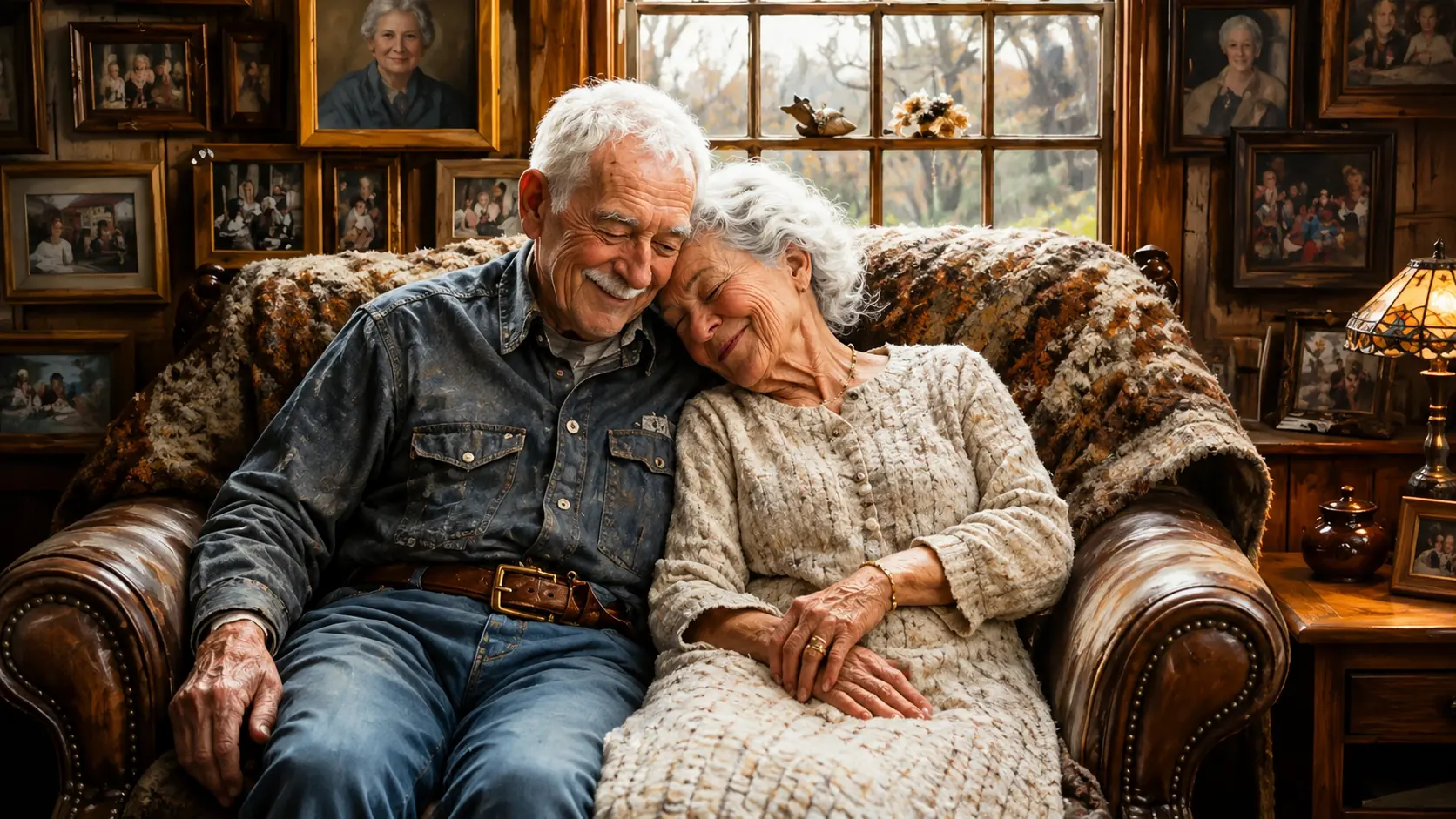
I had imagined grandparenting long before it ever became my life.
I imagined spontaneous sleepovers whenever we wanted.
Afternoons spent baking pies in the kitchen while flour somehow ended up on every surface except the bowl.
Christmas mornings with everyone crowded into one house.
Summer vacations where cousins laughed until they fell asleep on the couch before anyone remembered to carry them to bed.
I imagined living close enough to watch school plays, piano recitals, baseball games, and ordinary Tuesdays that would never appear in family photo albums but would become precious simply because we lived them together.
It seemed so natural when I pictured it.
Families stay close.
Grandparents are always around.
The grandchildren grow up knowing that Grandma's house is only a short drive away.
That was the picture I carried in my heart for years.
Life painted something different.
Not worse.
Just different.
Children grow up.
Jobs take them across the country.
Military service calls them away.
Dream opportunities appear in cities we never expected them to call home.
Marriages blend traditions from two different families.
Calendars become crowded with responsibilities that didn't exist when we were raising our own children.
No one is making the wrong choice.
No one is choosing career over family or family over love.
Everyone is simply trying to build the life God has placed before them.
Yet that doesn't erase the quiet grief of discovering that the grandparenting we dreamed about is not always the grandparenting we receive.
I think many grandmothers carry guilt over feelings they have never actually spoken aloud.
We feel guilty for wishing we lived closer.
Guilty for feeling disappointed when another holiday passes too quickly.
Guilty for hoping our phone will ring.
Guilty for noticing that weeks have somehow turned into months.
Then, almost immediately, we feel guilty for feeling guilty.
After all, we tell ourselves, we should simply be thankful.
And we are.
Deeply thankful.
But gratitude has never required pretending that something doesn't hurt.
Those two emotions have always been capable of living together.
I can thank God for every one of my grandchildren while still missing them so much that some evenings the house feels louder in its silence than it ever did when little feet were running through it.
I can celebrate the beautiful life my children have built while quietly wishing geography had written a different story.
I can rejoice that my grandchildren are becoming independent young people while grieving the little versions of them who once believed Grandma could fix absolutely everything.
Those feelings do not compete with one another.
They simply reveal how deeply love stretches the human heart.
There is another kind of grief that surprised me even more.
It is grieving a relationship that isn't broken.
Nothing terrible has happened.
No harsh words were exchanged.
No family argument divided us.
Everyone still loves one another.
The relationship simply changed.
Children become teenagers.
Teenagers become adults.
The little boy who once wanted to tell you every detail about his day now answers your questions with a gentle smile and, "Everything's good, Grandma."
The little girl who once reached for your hand automatically now reaches for her car keys.
You are no longer the center of their little universe.
You were never meant to be.
Still...
Knowing something is natural does not stop your heart from noticing it.
One of the hardest things about grandparenting is realizing that there are no dramatic endings.
Childhood doesn't announce when it's leaving.
It simply slips away.
One bedtime story becomes the last bedtime story.
One sleepy hug becomes the last time they ask you to carry them.
One summer becomes the last summer they still think building sandcastles with Grandma is the greatest adventure in the world.
You don't recognize those moments while they are happening.
You only recognize them years later.
Sometimes I look through old photographs and find myself smiling before tears quietly follow.
Not because I want to go backward.
I don't.
Every season has held gifts.
But photographs have a way of reminding us that time never asks permission before moving on.
That little face looking back at me from twenty years ago no longer exists.
The tiny voice I can almost hear while holding the picture has become deeper.
The little hands wrapped around my neck now belong to someone taller than I am.
Time keeps every promise it makes.
Children grow.
Families change.
Life keeps unfolding.
The difficult part is that a grandmother's love doesn't shrink to match those changes.
If anything, it grows.
It simply has fewer places to land.
Perhaps that is why I have found myself praying more than I ever prayed as a young mother.
That realization surprised me.
When my children were little, I certainly prayed.
I prayed over fevers.
I prayed over first days of school.
I prayed over financial worries, broken friendships, and uncertain futures.
But there was always something else I could do after praying.
I could drive to the school.
I could hold a crying child.
I could schedule an appointment.
I could make dinner.
I could solve at least some of the problem.
Grandmotherhood has introduced me to a different kind of prayer.
A prayer offered from empty hands.
There are days when prayer is the only thing left that I can do.
At first, I mistook that for weakness.
I wondered whether I had somehow become less useful.
Less necessary.
Less capable than I once was.
Now I think perhaps God has been teaching me something I never could have learned while I was still busy believing everything depended on me.
Perhaps faith becomes deepest precisely when our own ability reaches its limit.
Perhaps prayer was never meant to be the last resort.
Perhaps it was always meant to become the greatest expression of love once our own hands could no longer carry what only God can hold.
There have been mornings when every one of my grandchildren's names has found its way into my prayers before breakfast.
I pray for the things they tell me about.
I pray even more for the things they don't.
For friendships I know nothing about.
For decisions they have not yet made.
For temptations they will never mention.
For conversations I will never hear.
For fears they hide behind brave smiles.
For spouses they have not yet met.
For children they may someday hold.
For the generations I will probably never live long enough to see.
That is one of the quiet miracles of becoming a grandmother.
Your prayers begin reaching farther than your lifetime.
You slowly realize that the greatest legacy you may leave your grandchildren is not an inheritance.
It is the countless conversations you had with God about them that they never even knew took place.
And maybe...
Just maybe...
That is the grandparenting I never imagined.
Not the one where I was always present.
Not the one where every holiday unfolded exactly as I hoped.
Not the one where I always knew the right words or had the right answers.
But the one where love slowly stopped depending on my ability to fix everything and began resting in God's ability to hold everyone.
That realization did not erase the grief.
It transformed it.
Because grief offered to God slowly becomes trust.
And trust, over time, becomes peace.
I used to think that if I loved my family well enough, worried enough, sacrificed enough, and prayed enough, I would eventually arrive at a place where fear no longer had a voice. I thought there would come a season when experience would replace uncertainty, when years of raising children would somehow qualify me to walk into grandparenthood with complete confidence. I believed I would finally feel like I was enough.
Instead, I discovered something much more beautiful, and much more humbling.
Grandparenting did not remove my fears. It simply changed them.
As a young mother, I worried about scraped knees, report cards, fevers in the middle of the night, and whether I was making the right decisions for my children. As a grandmother, the fears became quieter but somehow deeper. I worried about the burdens my grandchildren would one day carry that I would never fully know about. I worried about the pressures this generation faces that look so different from the ones my own children encountered. I worried about the kind of world they were growing up in and the battles they would eventually fight long after I was no longer here to stand beside them.
There were moments when those thoughts overwhelmed me. I wished I could somehow leave them a map that would protect them from every disappointment, every broken heart, every wrong decision, every lonely season, and every pain life inevitably brings. But the longer I have walked with God, the more I have realized that no grandmother has ever been given that kind of power. We are called to love them deeply, but we were never asked to control their future. We are invited to influence their lives, but we were never promised the ability to protect them from every storm.
For a long time, accepting that felt like surrendering something precious. Now I understand that surrender was never the end of the story. It was the place where faith finally began to grow.
Perhaps that is why grandparenting has brought me closer to God than any other season of my life. When I was younger, I often believed my strength was part of the answer. I could work harder, plan better, stay up later, solve one more problem, or somehow hold everything together through determination alone. Age has gently exposed the illusion behind that way of thinking. There comes a point when you realize that love is simply too large for one human heart to carry by itself. The people you love become too many. Their burdens become too complex. Their lives begin unfolding in places your own hands can no longer reach.
That realization could have filled me with despair.
Instead, it slowly filled me with dependence.
I no longer pray because prayer is all I have left. I pray because I have finally learned that prayer was always the greatest gift I could give. Every whispered prayer for my grandchildren places them into hands infinitely stronger than mine. Every tear I cry over them is noticed by the God who loved them before I even knew their names. Every hope I carry for their future rests in the heart of a Father whose love for them is infinitely more perfect than my own.
There is profound comfort in knowing that when I cannot watch over them, He can. When I cannot calm their fears, He is already present in the places that frighten them. When I cannot guide every decision they make, His wisdom remains available long after my own voice grows quiet. The responsibility I once tried so desperately to carry has never truly belonged to me. It has always belonged to Him.
Looking back now, I realize that the grandmother I imagined becoming was never the grandmother God intended me to be. I imagined someone who always knew exactly what to say, who always had the right advice, whose experience would make every family challenge easier to navigate. God, in His kindness, shaped something different. He has been teaching me that my grandchildren need less of my certainty and more of my faith. They need less of my ability to fix every circumstance and more of my willingness to trust the One who already stands inside every tomorrow they will ever face.
That does not mean the ache disappears.
I still miss them when the house grows quiet.
I still wish I could freeze certain moments forever.
I still wish childhood lasted a little longer, family visits stretched a little further, and goodbyes came a little less often.
Love still aches.
I suspect it always will.
But the ache no longer convinces me that something is wrong.
It reminds me that something is precious.
It reminds me that every hug mattered, every bedtime story mattered, every cookie baked together mattered, every prayer mattered, every ordinary afternoon mattered. None of those moments were wasted simply because they came to an end. Love is never measured by how long a season lasts. It is measured by the faithfulness with which we lived inside it while God entrusted it to us.
If I could sit beside every grandmother carrying quiet guilt today, I would not tell her to stop loving so deeply. I would never ask her to care less in order to hurt less. That is not how God designed a grandmother's heart. Instead, I would gently remind her that guilt and love are not the same thing. We often confuse them because they occupy the same places inside us. We assume that if we still ache, we must have failed. If we still worry, we must not have trusted enough. If we still wish we could do more, perhaps we did not do enough.
None of those conclusions are true.
The truth is much gentler.
The aching comes because we have loved well.
The longing remains because our hearts were never created to stop loving simply because seasons change.
The tears still come because gratitude has never cancelled grief.
And the prayers continue because love always reaches for God when it arrives at the edge of its own strength.
I have come to believe that this is one of His greatest gifts to grandparents. He allows us to discover, late in life, that dependence is not weakness but wisdom. After decades of believing we had to hold everything together, He lovingly teaches us that He has been the One holding all of us together from the very beginning.
So yes, I thought grandparenting would be easier than parenting.
I was wrong.
It asked me to surrender more than I ever expected.
It asked me to trust more deeply than I ever imagined.
It asked me to love without controlling, to give without expecting, to remain present even when life carried the people I love in directions I could not follow.
Most of all, it asked me to place my grandchildren, my children, my hopes, my fears, and even my own heart into the faithful hands of God again and again.
And perhaps...
Perhaps that was never the hardship.
Perhaps that was always the invitation.
Because this kind of love is too big for any grandmother to carry alone.
It always has been.
It always will be.
And maybe that has been God's gentle plan all along—not to make us stronger than our love, but to remind us that His love has always been stronger than ours.
In the end, that is where my heart finally finds rest. Not in believing I have done everything perfectly. Not in believing I have all the answers. Not even in believing that every dream I once had for grandparenting came true. My peace comes from knowing that the same God who entrusted these precious children to my love has never stopped holding them in His own. Long before they knew my voice, they knew His. Long after mine grows silent, His never will. And that, more than anything else, allows me to loosen my grip without ever letting go of my love.