Three unmarked trucks come grinding down a gravel road at first light, backing toward four dead ponds nobody has farmed in six years. The valves open.
Thousands of silver fish pour into water everyone in the county swears will kill them by morning.
Up on the road, pickups slow to watch. Men lean out windows and laugh, certain they know how this ends.
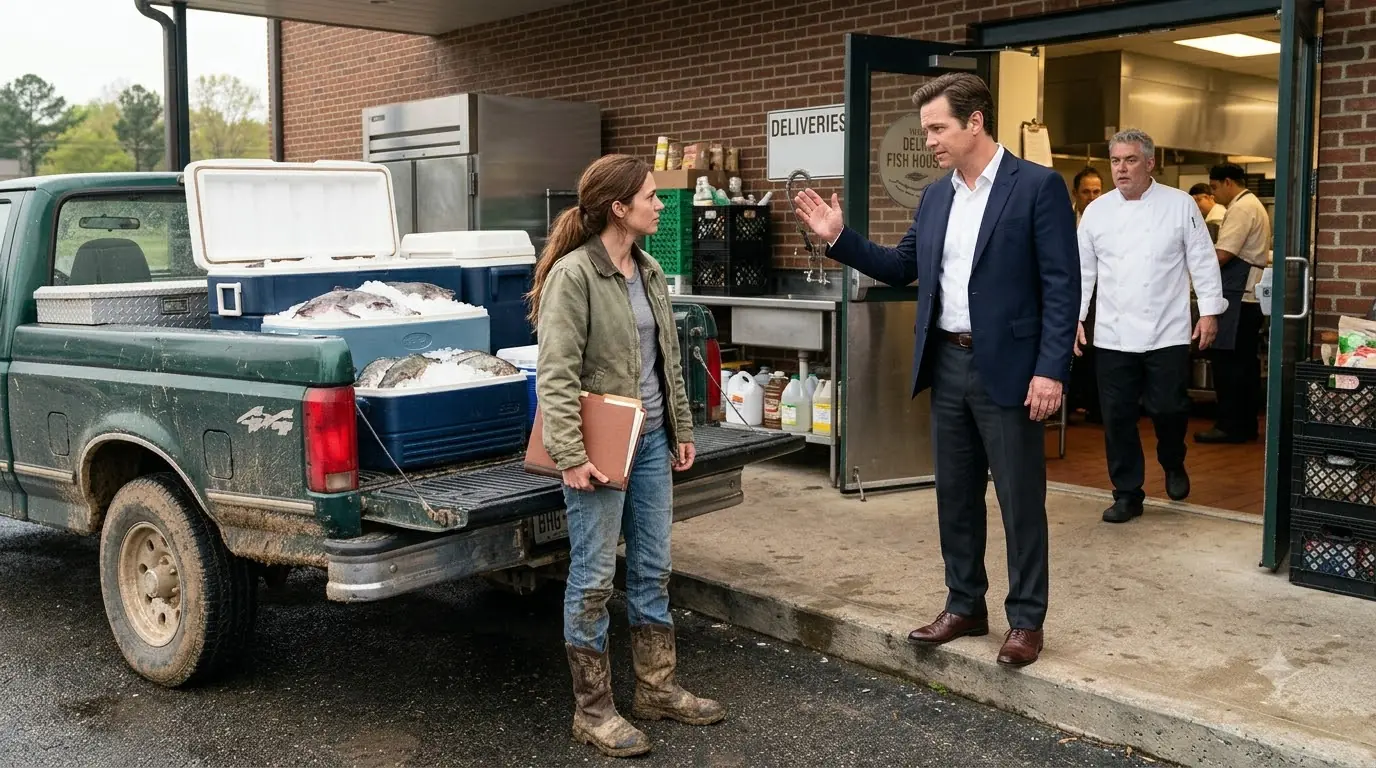
Down at the water's edge kneels a woman barely 26, boots sinking in mud that hasn't held a footprint in years. A dead man's note folded in her coat. She isn't asking the hatchery for fewer fish. She's asking for more. Then a refrigerated truck worth more than everything she owns eases onto the shoulder.
It doesn't stop. It only watches. A powerful man has come to see what she's keeping alive. She doesn't know yet what lies buried under that mud, but he does, and he means to have it.
The trucks arrived on a Tuesday, which meant nothing to anyone except that Tuesdays in that part of eastern Arkansas were slow and slow days made spectacles louder. Three of them came down the washboard gravel toward the drained bottomland, where the old Halverson ponds sat like scars nobody had bothered to heal, not one of the trucks wearing a name on its door.
The drivers weren't the talking kind. They swung the rear valves open with the bored efficiency of men who'd done this a thousand times and out spilled the fingerlings, silver and frantic, thousands upon thousands of them pouring into water that hadn't fed a living thing worth eating in the better part of six years. The sound of it carried across the flat morning a wet continuous rushing like rain that fell only in one place and under it the smaller sound of the fish themselves striking the surface as they hit a stippling pattern that made the whole dead pond seem for a few minutes almost alive.
Cars slowed on the county road above the embankment. Pickups that had no reason to stop found reasons anyway, easing onto the shoulder so their drivers could lean an elbow out the window and squint down at the commotion. A few of them laughed the way men laugh at a thing they're certain about because certainty was cheap in a county this size and everybody kept a surplus of it. They all knew what those ponds were. Mud holes.
A tax dodge somebody's cousin had once bragged about at a fish fry. The graveyard where a man named Halverson had buried a catfish operation two decades back and where the only thing that had thrived since was the story of how badly it failed. That story got told at the feed store and the diner and the tailgate of every truck at the sale barn polished smoother each year until the ponds weren't ground anymore so much as a lesson the county recited to itself about the foolishness of trying.
So when the surface began to churn when the shallows turned to boiling quicksilver under a hard morning sun, the question rose up on its own and traveled truck to truck along the shoulder. Why would a person haul good fish out to a dead place and set them loose to die a second time? The answer once it got around only made the whole thing stranger because the person crouched at the water's edge with a clipboard balanced on one knee, her boot sinking slow into muck that hadn't taken a footprint in years, wasn't a fish farmer, wasn't a biologist, wasn't the daughter of anybody who'd ever kept so much as a bowl of guppies on a windowsill. She was a stranger to every part of what she was doing, and she knew it better than the men on the road did, which was the one thing they'd have never guessed about her.
She was 26 years old and she'd done a thing the hatchery's own crew still couldn't wrap their heads around. She had asked for more fish than they'd meant to unload on her. Not a smaller batch to start easy. More. The oldest driver, a leathery man who'd been hauling stock and tanks since before she was born, took her aside before he climbed back into the cab.
And what he told her stayed with her a long while, though never for the reason he intended. He wiped his hands on a rag gone stiff with fish slime and looked at her the way a man looks at someone he's decided to pity in advance. "These are worthless," he told her, plain as weather.
"Off-grade. The kind of stock nobody grades, nobody buys, nobody wants to be caught selling. You understand what I'm telling you? Somebody sold you a dream and charged you nothing for it, and that's about what they're worth." She thanked him for the honesty like it was a gift she'd been waiting on.
Then she asked when the next load could come. The old man just shook his head, a slow, disbelieving roll of it, and hauled himself up into the cab. And she watched the dust hang in the air behind the trucks long after they'd gone and thought the same thing she'd been thinking all morning.
Everybody's so sure. Everybody's always so sure. And being sure has never once dug a fish out of the water for them.
Her name was Sadie Grenell. One year before that morning, she couldn't have told a fingerling from a shiner if her rent depended on it, which in a manner of speaking, it now did. She'd come up two counties east, raised most of the way by her grandfather after her folks split when she was nine, and neither of them fought very hard to keep her. That was a wound she'd stopped probing years back the way you stop probing a tooth the dentist has already told you he can't save. Her mother went to Little Rock and then farther, sending birthday cards that arrived in the wrong months.
Her father took work on a pipeline crew and became a voice on the phone twice a year, cheerful and useless. What was left when the dust of all that settled was an old man and a girl in an orchard. And it turned out that was enough or close enough, which in her family was the same thing.
Elias Grenell was not a water man. He'd worn 40 years down to the nub running a hardscrabble orchard of apples and a few stubborn peach rows on ground that never gave more than it had to an operation that limped through most seasons and refused out of what seemed like pure orneriness to ever fully die. He knew every tree on those acres the way some men know scripture by chapter and temperament. And he could tell from a 100 feet which one was sulking and which one was sick and which one was only pretending to be finished so it could rest a season and come back heavy. People thought that was sentiment.
It wasn't. It was attention sustained across decades until it hardened into something that looked like magic from the outside and felt like plain work from the inside.
He was a man who fixed things other people threw out. A busted hinge, a seized motor, a cracked handle, a radio that had gone silent in somebody's barn 20 years back. He'd take it onto the porch and sit with it, turning it in his hands, not forcing anything until he understood why it had quit. Then he'd coax it back to living. Sadie could still see him at it on a summer evening, a carburetor spread across a feed sack in pieces that looked to her like a thing beyond all saving, and Elias not hurrying, humming something tuneless, waiting for the machine to confess.
He believed down in the marrow of him that almost nothing was ruined past use if you had the patience to see what it was really asking for. And he said as much to her more than once, not as a lesson, but as an observation, the way another man might remark on the weather. Most folks throw a thing away the minute it stops being easy, he'd tell her. That's not the thing failing. That's the person.
He passed the winter before all this began. Went quiet in his sleep. The way he'd have preferred no fuss, no hospital, no long ugly decline for anybody to sit through.
Sadie found him in the morning looking like he'd only meant to close his eyes a minute. In the gray weeks that followed, moving through a house that still smelled like him, sorting the small pile of what he'd left, she found a folded deed she'd never once heard him mention. It was tucked inside a Bible he'd never been much for reading in the flyleaf, as though he'd wanted it found by someone patient enough to look everywhere.
6 acres. Four aquaculture ponds cut into them decades ago. Only three still holding water. The whole parcel bought for pocket change off a bankrupt catfish man back when nobody wanted swamp ground you couldn't plant. Elias had never worked it, never drained it, never stocked it, never so much as run a strand of wire around it.
He just paid the tax on it year upon year. A small check written each fall to hold on to ground that gave him nothing anyone could name. She'd have thought it a mistake an old man forgetting he owned a thing except that a man who wrote the check every single year for 20-odd years had not forgotten. He'd been keeping it, waiting on it.