In the gilded cages of 1815 London, a woman’s fortune is often her only currency and her greatest curse. But Phoebe Grant has no intention of being traded like a prize mare. By pitting the intellect of the ton against a botanical impossibility, she seeks to weed out the wicked and the weak. Little does she know, the most dangerous predator is not the one who wants her gold, but the one who understands her mind.
The air in the ballroom of the Duchess of Burwick was thick with the cloying scent of ambergris and the desperate ambition of second sons. Phoebe Grant felt the familiar suffocating weight of her stays. But it was the weight of a thousand predatory gazes that truly stole her breath. Ever since the passing of her father, the renowned Silas Grant, and the subsequent revelation of her staggering inheritance, Phoebe had become the most hunted creature in the Mayfair jungle.
“Miss Grant,” purred Lord Ponsonby, a man whose waistcoat was significantly more vibrant than his intellect. “I hear your father’s greenhouses in Surrey are quite expansive. I have always had a passion for a well-kept lawn.” Phoebe forced a smile that felt like cracking porcelain. “How charming, my lord, though I suspect my father’s carnivorous Drosera might find your passion—and perhaps your fingers—rather too tempting.”
As Ponsonby stammered and retreated, Phoebe felt a sharp spike of irritation. She was tired of being a ledger with a pulse. She stepped toward the center of the room, her silk gown hissing against the floorboards, and signaled for the music to pause. The silence that followed was brittle. “Gentlemen,” she announced, her voice clear and ringing with a defiance that would have made her governess faint. “I am aware of the sudden horticultural interest my presence has inspired. To save us all the tedium of further posturing, I propose a challenge. Find the legendary silver moonflower and successfully cultivate it to bloom within my conservatory.”
A murmur rippled through the crowd. “But Miss Grant,” a voice called out, “that plant is a myth, a traveler’s tale from the high Andes.” “Precisely,” Phoebe replied, her eyes flashing. “I should think a fortune such as mine is worth a bit of myth hunting. Would you not agree?” From the shadows near the punchbowl, Alistair Finch, the Earl of Thorne, a man whose reputation for debauchery was only matched by his rumored brilliance in the natural sciences, watched her with narrowed eyes. He didn’t see a rich prize. He saw a woman throwing down a gauntlet made of ice and intellect. He liked it.
Two days later, the smell of old parchment and beeswax filled Alistair’s study. He sat hunched over a desk littered with sketches, dried petals, and botanical journals. “She is clever,” he muttered, tracing the vein of a leaf in a reference book. “She knows the Lunaria cannot survive the English damp. She isn’t looking for a husband. She’s looking for a reprieve.” He leaned back, a slow, predatory grin spreading across his face. He didn’t need to find a myth. He needed to create one.
The Royal Botanical Society’s lecture hall was drafty and smelled faintly of damp earth and intellectual ego. Phoebe sat in the front row, her chin tilted high, listening to a tedious discourse on the classification of ferns. “I find the speaker’s assessment of the Polypodiopsida to be lamentably narrow,” a rich baritone voice remarked from the row behind her. Phoebe turned. Alistair Finch sat there, looking entirely too comfortable in his buckskins and midnight-blue coat.
“Lord Finch,” she said, her voice cool. “I was unaware you frequented lectures. I thought your interests were more nocturnal.” “The most interesting things happen in the dark, Miss Grant,” he replied, his gaze dropping momentarily to her lips before meeting her eyes with unsettling intensity. “Including the growth of certain rare flora. I found your challenge quite spirited, though a bit cynical.”
“Cynicism is a necessary armor when one is surrounded by sieges,” she retorted. Alistair leaned forward, his voice dropping to a conspiratorial whisper that sent a traitorous shiver down her spine. “And what if a man isn’t interested in the siege, but the architecture of the fortress itself? Your silver moonflower is a master stroke of evasion, but nature is malleable, Miss Grant. And so am I.”
“Are you suggesting you have found it?” she asked, her heart tripping. “I am suggesting that I am a man who dislikes losing,” he said, his eyes gleaming with a mixture of challenge and something softer, a genuine spark of recognition. “I shall see you in a fortnight, Phoebe. Prepare your best soil. I have something that will make your myth look like a common weed.” He stood, bowed with a grace that felt like a provocation, and left her sitting in the drafty hall, the scent of his sandalwood cologne lingering in the air like a promise or a threat.
The atmosphere within Phoebe’s private conservatory was a world apart from the biting April wind that rattled the glass panes above. Here the air was a thick, humid soup of damp moss, turned earth, and the intoxicating heavy sweetness of blooming jasmine. It was a sanctuary of green until the heavy oak doors groaned open to admit a man who looked entirely too much like a storm.
Alistair Finch entered, trailed by two footmen carrying a wooden crate as though it contained the crown jewels. He looked out of place among the delicate fronds of maidenhair fern, his rugged stature and the stark black of his greatcoat cutting a jagged silhouette against the verdant backdrop. “You are late, my lord,” Phoebe said, though her voice lacked its usual bite. She was standing by a potting bench, her sleeves rolled up to reveal pale, capable wrists stained with charcoal and peat. She did not look like an heiress. She looked like a creator.
“A gentleman never rushes a lady, Miss Grant. And a botanist never rushes a miracle,” Alistair countered. He signaled the footmen to set the crate upon the central stone dais. With a flick of his wrist, he dismissed them. Phoebe approached the crate, her pulse drumming a frantic rhythm against her stays. She expected a farce, a common lily dusted with silver powder. What Alistair revealed when he pried back the lid, however, made the breath hitch in her throat.
Nestled in a bed of dark, rich loam was a plant of ethereal, haunting beauty. Its leaves were thick and velvety, shimmering with a natural metallic luster that caught the flickering candlelight and turned it into moonlight. The stem was a deep bruised purple, and at its crown sat a cluster of tightly furled buds that looked like drops of molten mercury. “The Argentum Lunaria,” Alistair murmured, stepping closer until he stood just behind her shoulder. The heat of his body radiated through her thin muslin gown. “Or at the very least, a variant that has survived the transit from the altitudes. It requires a specific pH in the soil—highly acidic—and a light touch with the watering can.”
Phoebe reached out, her fingers trembling. She touched a leaf, expecting the cold slickness of oil or paint. Instead, she felt the living, breathing texture of a plant. It was cool, turgid, and undeniably real. “How?” she whispered, her scientific mind warring with her skepticism. “The records say the seeds lose viability within days of harvest.” “I used a Wardian case of my own design,” Alistair said, though the pride in his voice was genuine—pride in the craftsmanship of the graft, the surgical precision with which he had fused the silver-leafed succulents with the night-blooming Cereus, and perhaps a bit of sheer arrogant luck.
He turned to her, his gaze dropping to the smudge of dirt on her cheek. Before she could recoil, he reached out, his thumb brushing the stray mark away. The contact was brief, but it felt like a brand. “The challenge, if I recall, was not just to find it, but to make it bloom,” he reminded her, his voice dropping to a low, intimate vibration. “Which means, Miss Grant, you are stuck with me for the duration of the cultivation.”
The weeks that followed were a slow, burning torture of proximity. Alistair arrived every third day, ostensibly to monitor the Lunaria’s progress. At first, Phoebe remained guarded, her wit a sharpened blade designed to keep him at a distance. She questioned his methods, challenged his understanding of soil composition, and waited for the rake to reveal his true colors. But the Alistair who worked beside her in the humid silence of the greenhouse was not the Alistair of the London gossip rags.
This man knew the Latin names of every weed in her garden. He spoke with reverence of the interconnectedness of the natural world. He listened, truly listened, when she explained her theories on cross-pollination. One Tuesday, as they bent together over a tray of seedlings, their heads nearly touching, Phoebe felt the constraints of her world begin to fray. “Why plants, my lord?” she asked softly. “Most men of your station prefer horses or cards, things that provide a quicker return on the investment.”
Alistair paused, a pair of pruning shears in his hand. He looked at a small, struggling sprout. “Plants don’t lie, Phoebe. They don’t flatter for favor or marry for estates. They simply are. If you give them what they need, they flourish. If you neglect them, they die. There is a terrifying honesty in that.” Phoebe felt a hollow ache in her chest. For years she had viewed her intellect as a shield, a way to keep the world from seeing the lonely girl beneath the horticultural heiress title. But Alistair was looking at her as if he could see through the glass, through the fortune, and straight into her soul.
“You’re falling for your own ruse,” she told herself that night, staring at her reflection in the darkened window. She looked at the Lunaria on her nightstand. She had moved it to her chambers to watch it more closely. It was thriving, but her guilt was thriving alongside it. She had started this to expose the greed of men. Yet she found herself falling for a man who seemed to value her mind more than her gold. And yet a nagging doubt remained. He was too perfect. His knowledge was too convenient.
She began to feel trapped, not by her trustees or the fortune hunters, but by the terrifying possibility that the only man she had ever respected might be the greatest deceiver of them all. As she watched the silver buds swell, preparing to burst into a flower that shouldn’t exist, Phoebe realized she was no longer sure what she feared more—that the plant was a fake or that her heart was finally, irrevocably real.
The morning of the great reveal began with a deceptive golden clarity. The sun streamed through the greenhouse glass, turning the humid air into a haze of dancing dust motes. On the central dais, the Argentum Lunaria stood in triumph. Its buds had finally unfurled during the night into spectacular star-shaped blossoms of a translucent metallic white. They looked as though they had been hammered from the moon itself.
Phoebe stood before the plant, her hands clasped tightly in front of her. She should have felt victorious. Instead, she felt a cold, leaden weight in her stomach. Every time she looked at the flower, she saw Alistair’s face—the way his eyes crinkled when they debated the merits of Linnaean classification, the steady heat of his hand when he guided her fingers along a delicate stem. The sound of approaching footsteps shattered her reverie. It wasn’t Alistair.
“Phoebe, my dear girl, a miracle—a literal miracle.” Emerging from the greenery was Sir Humphrey Banks, a man whose face was as wrinkled as a dried raisin and whose botanical expertise was the only thing Phoebe’s father had ever truly respected. He had been traveling in the Levant and had only just returned to London. “Sir Humphrey,” Phoebe said, forcing a smile. “I am glad you could come. I wanted your professional eye on this.”
Humphrey adjusted his spectacles, leaning so close to the blossom that his nose nearly brushed the petals. He hummed. He peered. He pulled a magnifying glass from his waistcoat and peered at the junction where the leaf met the stem. The silence stretched, becoming brittle and sharp. “Extraordinary,” Humphrey whispered. Then his voice flattened. “Quite extraordinary theater.”
Phoebe’s heart skipped a beat. “Theater, Sir Humphrey?” The old man looked up, his expression softened by a pity that felt like a physical blow. “The graft is masterful, Phoebe. Truly, I have never seen such surgical precision. The silvering of the leaves is a natural trait of certain Andean succulents. But the blossom—it has been forced and grafted onto a night-blooming Cereus base. It is a biological phantom, a beautiful, brilliant lie.”
The world seemed to tilt. The scent of the jasmine, once sweet, now felt cloying, like the smell of a funeral. “Are you certain?” she whispered, though she already knew the answer. The doubt that had been a dull ache now bloomed into a searing agony. “I spent three years in the Andes, Phoebe. The Lunaria does not have a woody stem. This—this is a work of art, not of nature.”
Humphrey’s departure was a blur of sympathetic pats on the shoulder. Phoebe stood alone in the center of her glass kingdom, staring at the silver monstrosity. She felt foolish. She felt exposed. She had thought herself so clever, so immune to the charms of the ton, and yet she had let a rake lead her by the hand into a garden of delusions. The doors opened again. Alistair.
He walked in with a buoyancy she had never seen. His face lit with a genuine smile. “Phoebe, the blooms. They are even more magnificent than I imagined. We have done it.” “We?” The word came out as a ragged snarl. Alistair stopped, his smile faltering as he took in her rigid posture, the white-knuckled grip she had on the edge of the potting bench. “Phoebe, what is it?”
“How long did it take you?” she asked, her voice trembling with a lethal quiet. “To perfect the graft, to find the right solution, to turn the petals that specific shade of silver. Was it before or after you decided I was a mark worth the effort?” Alistair’s face drained of color. The silence that followed was deafening. He didn’t reach for a lie. He didn’t offer a charming deflection. He simply stood there, his shoulders dropping as the mask of the triumphant suitor fell away.
“Phoebe, I can explain.” “Explain what? That you saw a woman who valued her mind and decided the best way to ruin her was to mock that very thing? You didn’t just want the fortune, Alistair. You wanted to prove you were smarter than the girl who dared to set the terms.” “It wasn’t like that.” He stepped forward, his hand outstretched, but she flinched back as if he were a viper. “I began it as a game. Yes, I thought you were another bored heiress playing at science. But then I met you. I saw how you looked at the world. I fell in love with the way your mind works, Phoebe. I couldn’t stop the lie because I was terrified that if I told you the truth, I’d lose the only real thing I’ve ever found in this wretched city.”
“The only real thing?” She gestured wildly at the fake plant. “This is the foundation of us, Alistair. A fabrication. A graft. You didn’t fall for me. You fell for the challenge, Miss Grant.” A new voice cut through the tension. It was Mr. Grimston, the lead trustee of her father’s estate, a man who looked like he had been carved from a block of damp limestone. He was flanked by Lord Ponsonby, who was wearing a smirk of oily triumph.
“We have heard the report from Sir Humphrey,” Grimston said coldly. “The challenge has not been met. Lord Finch, you are disqualified for fraud, and as the terms of the will state that a husband must be settled upon Miss Grant within the year to secure the Surrey holdings, and no man has met the botanical requirement—” He turned to Ponsonby. “Lord Ponsonby has offered a most generous settlement that would keep the estates intact. Since the intellectual route has failed, Miss Grant, we shall proceed with the traditional one. Propriety and the preservation of the fortune demand it.”
Phoebe looked from the cold, calculating eyes of the trustee to the desperate, shattered gaze of Alistair. She had tried to build a wall of glass and logic to protect herself, and now it was shattering, the shards cutting deep. She was no longer a botanist or a woman of wit. She was a prize to be handed to a man she despised, all because she had let herself believe in a silver moonflower and a rake’s silver tongue.
The drawing room of the grand estate felt like a tomb despite the afternoon sun bleeding through the velvet drapes. Phoebe sat immobile, her fingers tracing the jagged edge of a dried leaf she had kept in her pocket, a relic of a dream. Across from her, Mr. Grimston shuffled papers with a dry, rhythmic sound that reminded her of a shovel hitting dirt. Lord Ponsonby stood by the mantel, preening, already surveying the room as if deciding which family portraits to burn.
“The contracts are ready, Miss Grant. Your father’s legacy requires a steady hand, not a girl’s flights of horticultural fancy. You have had your season of games.” Suddenly the heavy double doors swung open. Alistair Finch did not enter with his usual feline grace. He looked disheveled, his cravat loosened, his eyes bright with a feverish, desperate clarity. He carried no silver plant. He carried only a single mud-stained ledger.
“Leave us, Finch,” Ponsonby sneered. “The fraud has been exposed. You’ve no business here.” “I have the only business that matters,” Alistair snapped, his voice vibrating with an authority that silenced the room. He walked straight to Phoebe, ignoring the trustees. He didn’t look for her hand. He looked for her eyes. “Phoebe, I have spent the last forty-eight hours dismantling my life. You were right. The Lunaria was a lie. It was a monument to my own arrogance.”
“And what is this?” she whispered, nodding toward the ledger. “Another clever graft?” “It is a deed of gift,” Alistair said, turning to Grimston. “I have officially signed over the Finch Collection—the largest private botanical assembly in the empire—to the city of London. It is to be used to establish the Silas Grant Memorial Botanical Garden. It is endowed by my entire personal liquid fortune. I have nothing left but my title and the clothes I stand in.”
The room went silent. Even Ponsonby’s smug expression faltered. To give away a collection worth a king’s ransom was madness. It was social and financial suicide. “Why?” asked Phoebe, her heart beginning a slow, painful thrum. “Because you once told me that plants don’t lie,” Alistair said softly. “I wanted to give you a truth that couldn’t be faked. This garden is not a challenge to be won. It is a public good, a sanctuary where your mind can thrive without the threat of a marriage contract. I am not here to claim your hand, Phoebe. I am here to set you free from the need to sell it.”
He turned to the trustees. “The challenge stated she would marry the man who could cultivate the Lunaria. I failed that. But the spirit of the challenge was to find a man who valued her work above her wealth. I have just proven that her wealth is the thing I value least in this world. If you force her to marry Ponsonby now, you are not protecting the estate. You are destroying the very intellect that built it.”
Phoebe stood, her legs trembling, but her spirit suddenly, violently alive. She looked at the ledger, then at Alistair’s weary, honest face. She saw the sacrifice, the loss of status, the loss of comfort—all for the sake of her respect. “Mr. Grimston,” Phoebe said, her voice regaining its steel. “The terms of the will require a husband of suitable character and shared purpose who meets my challenge. Lord Finch has not grown a myth. He has grown a legacy. He has cultivated the very thing my father loved most—the advancement of science for all, not just for the elite. He has met the spirit of the law. And I accept him.”
“Phoebe,” Alistair breathed, the hope in his eyes almost too much to bear. “On one condition,” she added, a small, familiar spark of wit returning to her gaze, “that you never, ever attempt to graft a succulent to a Cereus again. It was a botanical abomination, Alistair.” He laughed, a raw, relieved sound, and stepped forward, finally taking her hands in his. “I promise. From now on, only the truth, no matter how long it takes to grow.”
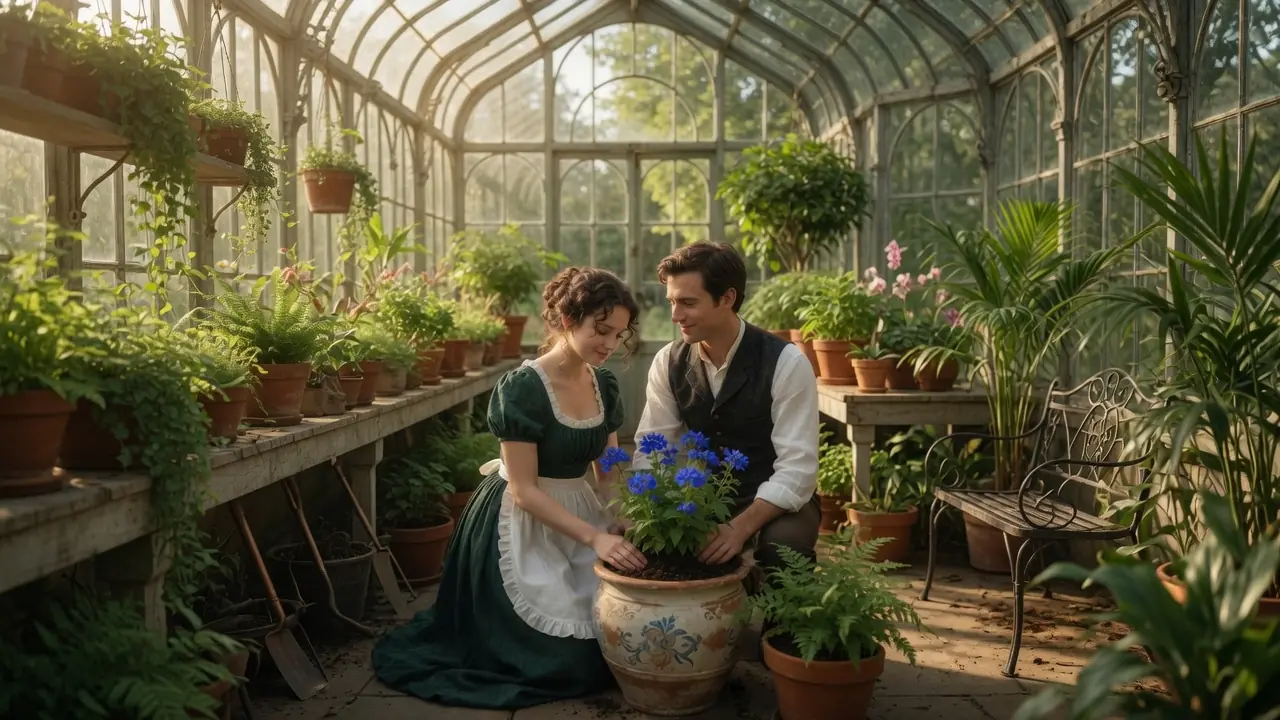
Months later, the air was cool and sweet in the newly broken earth of the memorial garden. There were no silver myths here. Instead, Phoebe and Alistair knelt together in the dirt, their fine clothes forgotten, their hands stained dark by the soil of their shared life. Between them sat a small, unassuming green seedling, a rare genuine specimen of Cinchona. It wasn’t flashy, and it didn’t shimmer in the moonlight, but its roots were firm, and its life was real.
As Alistair’s hand covered Phoebe’s to firm the earth around the stem, the electricity of the touch was no longer forbidden. It was the steady, grounding pulse of a love that had been weeded of its lies and allowed finally to bloom in the sun. In the end, she realized that the most beautiful things in nature are rarely those that dazzle the eye at a distance, but those that survive the storm and remain rooted when the illusions fade. They had planted a garden that would outlive them both. A testament to the fact that while gold may tarnish and myths may shatter, a truth cultivated in love is the only thing that truly grows forever.