Walter Hayes first noticed the roof where no roof should have existed.
It was a bright Tuesday morning in late September, the kind of Texas morning that still carried summer heat even though the calendar insisted autumn had begun. Walter was driving the north fence line of his 214-acre ranch in an old Ford pickup when sunlight flashed from something between two clusters of mesquite trees. He slowed, leaned toward the windshield, and saw the dark metal roof of a building rising beyond the ridge.
Walter stopped the truck.
For several seconds, he simply stared.
The north ridge belonged to him.
There was no question about that.
His father had bought the first eighty acres in 1968, Walter had added another parcel in 1989, and the final western tract came into the family in 2002. The boundaries had been surveyed more times than Walter could count, particularly after a suburban development called Cedar Hollow Estates appeared along his eastern boundary fifteen years earlier.
Walter climbed from the truck.
At sixty-eight, he no longer moved quickly unless livestock required it, but he moved with the steady confidence of a man who had spent most of his life walking uneven ground. His brown cowboy hat was faded along the brim, his dark leather ranch jacket carried permanent dust around the cuffs, and his boots knew every low spot between the creek and the northern ridge.
He crossed the pasture.
Then stopped again.
Someone had built a house on his land.
Not a shed.
Not a hunting blind.
A house.
The structure was roughly eighteen hundred square feet, built from cedar siding and pale stone with a wraparound porch, black-framed windows, a vaulted roof, and a detached fire pit surrounded by expensive landscaping stones. A temporary construction fence stood along one side, and two workers were unloading decorative beams from a trailer.
Walter approached the nearest man.
“Morning.”
The worker looked up.
“Morning.”
“Who owns this project?”
The man gestured toward the cabin.
“Cedar Hollow.”
Walter looked around.
“What part of Cedar Hollow?”
“The HOA.”
Walter nodded once.
Then asked:
“Who told you this land belongs to them?”
The worker stopped smiling.
His name was Miguel Santos, and Walter quickly realized Miguel knew almost nothing about the boundary issue.
Miguel worked for Stonecrest Residential, a regional construction company hired to build what project documents described as the Cedar Hollow Community Retreat Cabin. The building was intended for board meetings, guest stays, private functions, and neighborhood events. According to the site plan Miguel carried in his truck, the HOA property extended almost three hundred feet beyond the existing subdivision fence.
Walter studied the photocopied plan.
“Who gave you this?”
“Project manager.”
“Name?”
“Dennis Ward.”
Walter pulled a small notebook from his jacket pocket.
He wrote the name.
Then:
“Permit number?”
Miguel hesitated.
Walter looked up.
“You have one?”
“I’m just site crew.”
“That means no.”
“I didn’t say that.”
Walter handed the plan back.
“I’m not blaming you.”
Miguel visibly relaxed.
Walter continued.
“But before you pour another yard of concrete or drive another nail, tell your project manager the landowner was here.”
Miguel frowned.
“The HOA is the owner.”
Walter looked toward him.
“No.”
“I am.”
Walter drove straight to the county records office.
He already had copies of his deed at home, but he wanted certified documents.
At 11:17 a.m., clerk Nancy Gilbert pulled the property record.
Parcel 47-B.
Walter Hayes.
No transfer.
No easement granting the HOA construction rights.
No lease.
No recorded boundary adjustment.
No sale.
Nothing.
Nancy printed the chain of title.
Walter paid the fee.
Then requested the latest certified plat.
The survey line ran precisely where he remembered.
The new cabin sat approximately 126 feet inside his property.
Not inches.
Not an ambiguous fence-line difference.
One hundred twenty-six feet.
Walter folded the documents carefully and drove home.
He did not call Brenda Collins yet.
That surprised his daughter Rachel Hayes, who arrived that evening after he sent her photographs.
Rachel was forty-one and worked as a civil engineer in Fort Worth. She stood at Walter’s kitchen table looking through the county records.
“They built an entire cabin?”
“Yes.”
“One hundred twenty-six feet over?”
“Yes.”
“And you haven’t called them?”
“No.”
Rachel stared at him.
“Dad.”
“What?”
“You are disturbingly calm.”
Walter poured coffee.
“Buildings don’t move faster because I get angry.”
“That’s not what I mean.”
“I know.”
Rachel leaned toward the documents.
“What are you going to do?”
Walter smiled faintly.
“Find out whether they made a mistake.”
“And if they didn’t?”
He took a sip.
“Then I find out how deliberate it was.”
Brenda Collins arrived the following afternoon.
She did not call first.
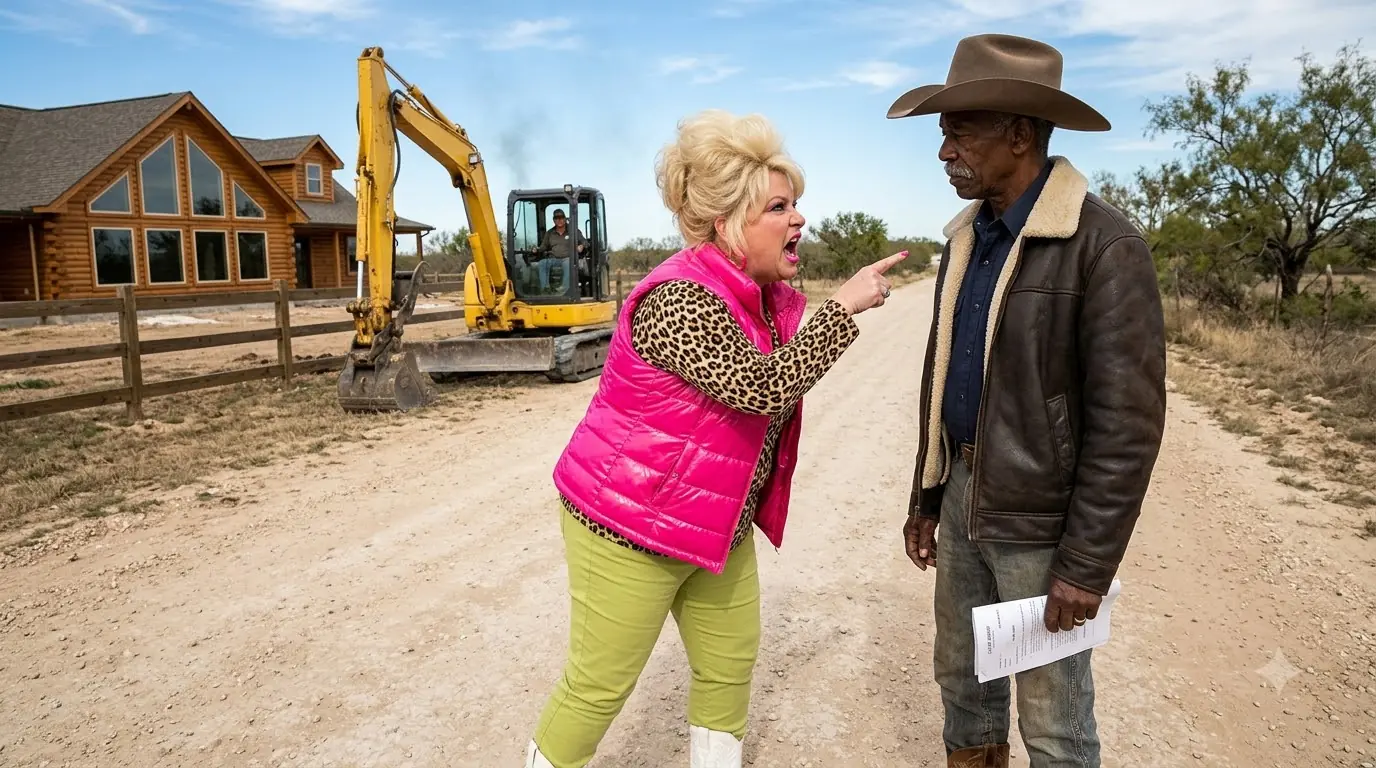
A white luxury SUV came down Walter’s ranch road at nearly twice the speed he permitted vehicles to travel, stopped near the barn, and Brenda stepped out wearing lime-green pants, a leopard-print blouse, a glossy hot-pink vest, heavy gold jewelry, and the expression of someone who believed volume was a substitute for documentation.
Walter had met Brenda twice before.
Neither meeting had been memorable.
She became HOA president three years earlier and quickly developed a reputation for enforcement letters, architectural restrictions, landscaping disputes, and conflicts with residents who had committed the apparent crime of painting mailboxes the wrong shade of brown.
Walter was not part of Cedar Hollow.
His ranch predated the development.
That had never stopped Brenda from sending him letters.
One complained about his cattle trailer being visible from subdivision property.
Another requested that he “coordinate agricultural noise” with community quiet hours.
Walter had thrown both away.
Now Brenda approached him beside the barn.
“You went onto our construction site yesterday.”
Walter looked toward her.
“I walked onto my land.”
Brenda sighed dramatically.
“Here we go.”
Walter waited.
She continued.
“That parcel belongs to Cedar Hollow.”
“No.”
“Our development maps show it does.”
“County records show it doesn’t.”
Brenda crossed her arms.
“The HOA attorney already reviewed this.”
“What’s his name?”
“Excuse me?”
“The attorney.”
“Why?”
“I’d like to know who told you to build on my property.”
Her face tightened.
“You need to stop calling it your property.”
Walter nodded.
“Bring me a deed.”
“We don’t need to show you anything.”
“Then stop building.”
Brenda laughed.
“You’re not shutting down a $640,000 community project because you don’t understand modern development boundaries.”
Walter looked at her.
“Six hundred forty thousand?”
She realized she had given him a number.
Too late.
“Yes.”
Walter wrote it in his notebook.
Brenda stared.
“What are you doing?”
“Learning.”
The construction continued.
That mattered later.
Walter sent a certified cease-and-desist letter the next morning.
He attached the deed.
Certified survey.
Photographs.
Parcel map.
He sent copies to Brenda, Stonecrest Residential, the HOA management company, and the county development office.
Stonecrest stopped work for two days.
Then restarted.
Walter photographed everything.
New framing.
Electrical service.
Roofing.
Interior drywall.
Landscaping.
Stonework.
Each photograph carried a date.
Rachel visited every weekend and helped organize records.
“What did Stonecrest say?”
Walter handed her an email.
The project manager wrote that the HOA had provided contractual assurances of site ownership and instructed the contractor to proceed.
Rachel frowned.
“They’re shifting liability.”
“Correct.”
“What did the HOA say?”
“Nothing in writing.”
“That’s deliberate.”
Walter nodded.
He thought so too.
Three weeks later, Brenda called a special HOA meeting.
Walter did not belong to the association, but three Cedar Hollow residents invited him after learning about the dispute.
He arrived wearing jeans, boots, a navy work shirt, and his hat.
Brenda looked offended simply by his presence.
“This is a private association meeting.”
Resident Paul Dempsey answered:
“He’s here as my guest.”
Brenda stared at Paul.
Then at Walter.
“Fine.”
Nearly eighty homeowners filled the clubhouse.
Brenda stood at the front beside a projector displaying the luxury cabin.
She described it as a future community asset.
A retreat.
A gathering place.
An investment.
Then someone asked:
“Is it on Mr. Hayes’s land?”
The room became quiet.
Brenda smiled.
“No.”
Walter did not move.
Another homeowner asked:
“Then why is he here?”
Brenda’s smile tightened.
“Because there is a minor historical surveying disagreement.”
Walter finally spoke.
“One hundred twenty-six feet is an ambitious definition of minor.”
Several people laughed.
Brenda’s face changed.
“Mr. Hayes, you were not given the floor.”
Walter nodded.
“Then I’ll wait.”
Homeowner Jessica Lang raised her hand.
“Can we see the HOA deed?”
Brenda ignored her.
Paul asked:
“Was a permit issued?”
Brenda answered:
“The contractor handled all permits.”
Walter watched carefully.
Not:
Yes.
The contractor handled all permits.
Important difference.
After the meeting, Jessica approached Walter in the parking lot.
“I’m on the finance committee.”
Walter nodded.
“Then you probably know more than I do.”
“I know the cabin cost is closer to seven hundred thousand than six-forty.”
Walter’s eyebrows rose.
“How?”
“Change orders.”
She lowered her voice.
“And Brenda pushed it through quickly.”
“Why?”