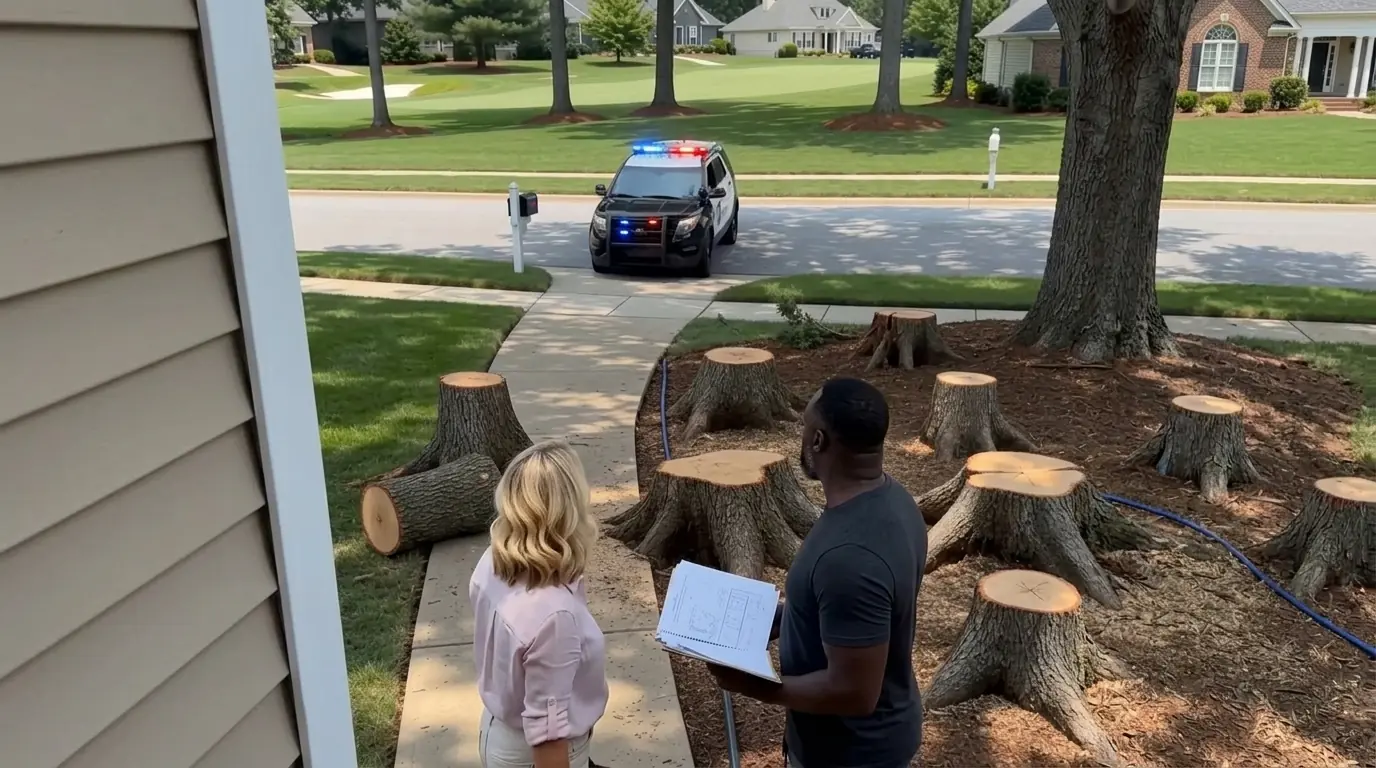
The sound that pulled Elijah Brooks away from the kitchen window was not a chainsaw. He had heard enough chainsaws during the previous week to know exactly what they sounded like, and this was different. It was a short metallic crunch followed by another, then the heavy clatter of something dropping against concrete. Elijah set his coffee down and walked toward the side door.
Saturday afternoon had been supposed to be quiet. He was barefoot in black lounge pants and an old gray T-shirt, reviewing an email from a fencing contractor while waiting for replacement cedar panels to arrive. Quiet had become difficult in Briarwood Greens, an expensive golf-course community outside Charlotte, North Carolina, ever since the homeowners association announced what its president called a neighborhood “view enhancement initiative.” Elijah had begun calling it something else.
People destroying property they did not own.
He stepped through the side door and stopped.
A woman was crouched beside the electrical service panel attached to his house. She wore white cropped pants, a powder-blue blouse, tan leather gloves, and low wedge sandals that looked absurd beside the dirt and sawdust scattered across the walkway. Her highlighted blonde hair had been curled carefully around her shoulders.
In both hands she held a pair of long-handled bolt cutters.
“Denise.”
Denise Whitaker looked over her shoulder.
She did not look frightened.
She looked annoyed.
“Oh, good.”
Elijah stared at the cutters.
“What are you doing beside my electrical panel?”
Denise stood.
Behind her stretched what remained of the western edge of Elijah’s property. One week earlier, eighteen massive oak trees had stood between his backyard and the sixth fairway of Briarwood Greens Country Club. Some of the trunks had been wider than his chest.
Now there were eighteen stumps.
The fresh-cut wood looked almost white beneath the afternoon sun. Chipped branches covered patches of soil, the grass had been crushed beneath heavy equipment, and a clear line of sight now ran from the golf course directly toward three homes sitting uphill from Elijah’s property. Those houses had never had uninterrupted fairway views before.
Denise pointed at the service box.
“You failed to provide access to the landscaping contractor.”
Elijah looked at her.
“For what?”
“They need power for restoration equipment.”
“Restoration.”
“Yes.”
“You mean cleaning up the trees your HOA cut down.”
Denise crossed her arms.
“They were not your trees.”
Elijah’s expression changed.
She saw it.
Ignored it.
“They were part of the Briarwood visual buffer.”
Elijah stepped closer.
“The what?”
“The golf corridor buffer.”
“That phrase is not in my deed.”
“It appears in the updated community landscape plan.”
“You are standing on my land with bolt cutters.”
Denise sighed.
“Please stop turning everything into a confrontation.”
Elijah looked down at the tool.
“I didn’t bring industrial cutters to your house.”
“The panel was locked.”
“Because it belongs to my house.”
“The association has maintenance access.”
“No, it does not.”
Denise’s mouth tightened.
“I have served as HOA president for eight years.”
“I have owned this property for thirteen.”
“I know the covenants.”
“Good.”
Elijah nodded toward the stumps.
“Then show me where they authorize the board to remove eighteen mature trees from a private parcel.”
Denise glanced toward the golf course.
“The landscape committee approved it.”
“That wasn’t my question.”
“Elijah.”
“Which covenant?”
She did not answer.
He waited.
Then repeated it.
“Which covenant, Denise?”
Her jaw moved slightly.
“You should be grateful.”
Elijah almost laughed.
“For losing eighteen oak trees?”
“They were blocking the golf course.”
“I liked that.”
“They were obstructing premium sight lines.”
“They were trees.”
“They were aging trees.”
“Some were healthier than I am.”
Denise shook her head.
“You are taking this emotionally.”
Elijah became completely still.
She interpreted his silence as an opening.
“The trees dropped leaves into the drainage channel, reduced sunlight, created maintenance problems, and blocked the visual character intended for golf-adjacent homes.”
Elijah looked behind her.
His grandfather had hung a tire swing from one of those trees when Elijah was seven. His mother had taken family photographs beneath another the summer Elijah graduated from Wake Forest. His father had built a rough wooden bench beside the creek under the largest oak.
All of it was gone.
Denise knew none of that.
He suspected it would not have changed anything.
“You entered my property without permission.”
“We issued notice.”
“You taped a notice to my mailbox after the crews started cutting.”
“The notice was dated earlier.”
Elijah looked at her carefully.
The words settled.
“Earlier by how much?”
Denise hesitated.
“Several days.”
“It rained for three straight days before the cutting started.”
“So?”
“The envelope was dry.”
Her eyes narrowed.
Elijah continued.
“The letter supposedly sat outside through seventy-two hours of rain without getting wet.”
“Maybe management delivered it late.”
“So the date was false.”
“That is not what I said.”
“You just said it.”
Denise lifted the bolt cutters.
“None of this changes the board’s authority.”
Elijah looked at the worn brown folder tucked beneath his left arm.
Denise finally noticed it.
“What’s that?”
“My grandfather’s paperwork.”
She gave a short laugh.
“Your grandfather died years ago.”
“Seventeen.”
“I’m sorry, but I fail to see how old family documents override current HOA regulations.”
Elijah looked toward the stumps.
“I thought the same thing until Wednesday night.”
Denise glanced at her watch.
“I have other homeowners to deal with.”
“No.”
She frowned.
“You have a volunteer board position.”
Her face hardened.
“This association manages more than nine million dollars in neighborhood assets.”
“And somehow you decided that made my backyard one of them.”
Denise raised the cutters again.
“If you continue refusing contractor access, the association can begin daily penalties.”
Elijah nodded.
“Do it.”
She blinked.
“What?”
“Fine me.”
“You think I won’t?”
“I hope you do.”
Denise studied him.
Elijah held the folder against his chest.
“Write down exactly why.”
A pause.
“Cite the authority.”
Another.
“And sign your name.”
Denise laughed.
“You think some old paperwork is going to frighten me?”
Elijah looked toward the brown file.
“No.”
His voice remained calm.
“I think what’s inside it might.”
Seven days earlier, Elijah had been in Atlanta overseeing a medical-office renovation. He owned a mid-sized commercial construction company specializing in healthcare clinics, restaurants, and office conversions across the Carolinas and Georgia. The work was not glamorous, but it made him extremely familiar with permits, surveys, setbacks, easements, change orders, and the expensive consequences of assuming property lines instead of verifying them. He had built his business on the principle that paper remembered what people conveniently forgot.
Tuesday morning, his neighbor called.
His name was Ethan Caldwell.
Ethan lived two houses north.
“Elijah.”
“What’s up?”
“You know there are contractors behind your house?”
Elijah assumed he meant golf maintenance.
“What contractors?”
“Tree crew.”
Elijah sat upright in the hotel bed.
“What tree crew?”
“Two trucks.”
Another pause.
“A chipper.”
Elijah got to his feet.
“Whose trees?”
Ethan went quiet.
That answered the question.
“Ethan.”
“Yours.”
Elijah packed in twelve minutes.
By the time he reached Charlotte that afternoon, most of the damage had already been done. Eighteen trees stood marked by fresh stumps along his western and southern property line. Each had been painted with an orange number before removal.
That detail mattered.
This was not an accidental boundary mistake.
Somebody had selected individual trees.
Elijah found the contractor loading equipment.
The company name printed across the truck door read PIEDMONT ARBOR SERVICES.
A foreman named Hector Alvarez approached.
“You own this lot?”
“Yes.”
Hector became uncomfortable.
“We were hired through Briarwood Greens HOA.”
“To cut trees on my property?”
“We were told this strip belonged to the association.”
“Who told you?”
Hector looked at his paperwork.
“Authorization came from Denise Whitaker.”
Elijah asked to see it.
Hector hesitated.
Then handed over a copy.
The project title read:
WESTERN FAIRWAY SIGHT-LINE RESTORATION — LOTS 84 THROUGH 91.
Elijah’s property was Lot 88.
Each of the eighteen removed trees was listed by number.
They had not crossed the property line accidentally.
The HOA ordered every one.
Elijah called Denise.
No answer.
He called Briarwood’s management company.
A property manager named Melissa Crane answered.
She told him the HOA board had approved a “fairway vegetation improvement project.”
Elijah asked for the recorded board vote.
Melissa promised to email it.
She never did.
That evening, Elijah walked the back property line until dark.
He photographed every stump.
Measured distances.
Located survey pins.
Compared the current parcel map to the tree locations.
His anger slowly changed into something more useful.
Questions.
His survey clearly showed most of the stumps inside his boundary.
One notation near the rear creek line caught his attention.
SUBJECT TO HISTORIC DRAINAGE AND CONSERVATION INSTRUMENT — DEED BOOK 2177, PAGE 604.
Elijah had never read it.
His closing attorney years earlier had summarized the notation as an old drainage easement left from the property’s agricultural period.
Then Elijah remembered the steel filing cabinet.
The house had not always belonged to him.