Blue and red light tore across Hawthorne Glen Court, turning the quiet Atlanta cul-de-sac into something that looked less like a neighborhood than a crime scene. Sixteen-year-old Isaiah Brooks was bent against the hood of a patrol cruiser, his cheek pressed to hot metal while Officer Mason Crowley twisted one arm behind his back. Sweat from an evening basketball game soaked the collar of Isaiah’s T-shirt, and every attempt to breathe made his ribs scrape painfully against the hood. Across the street, HOA president Charles Pembroke watched from his driveway with the tight little smile of a man who believed authority had finally arrived to confirm everything he had been saying.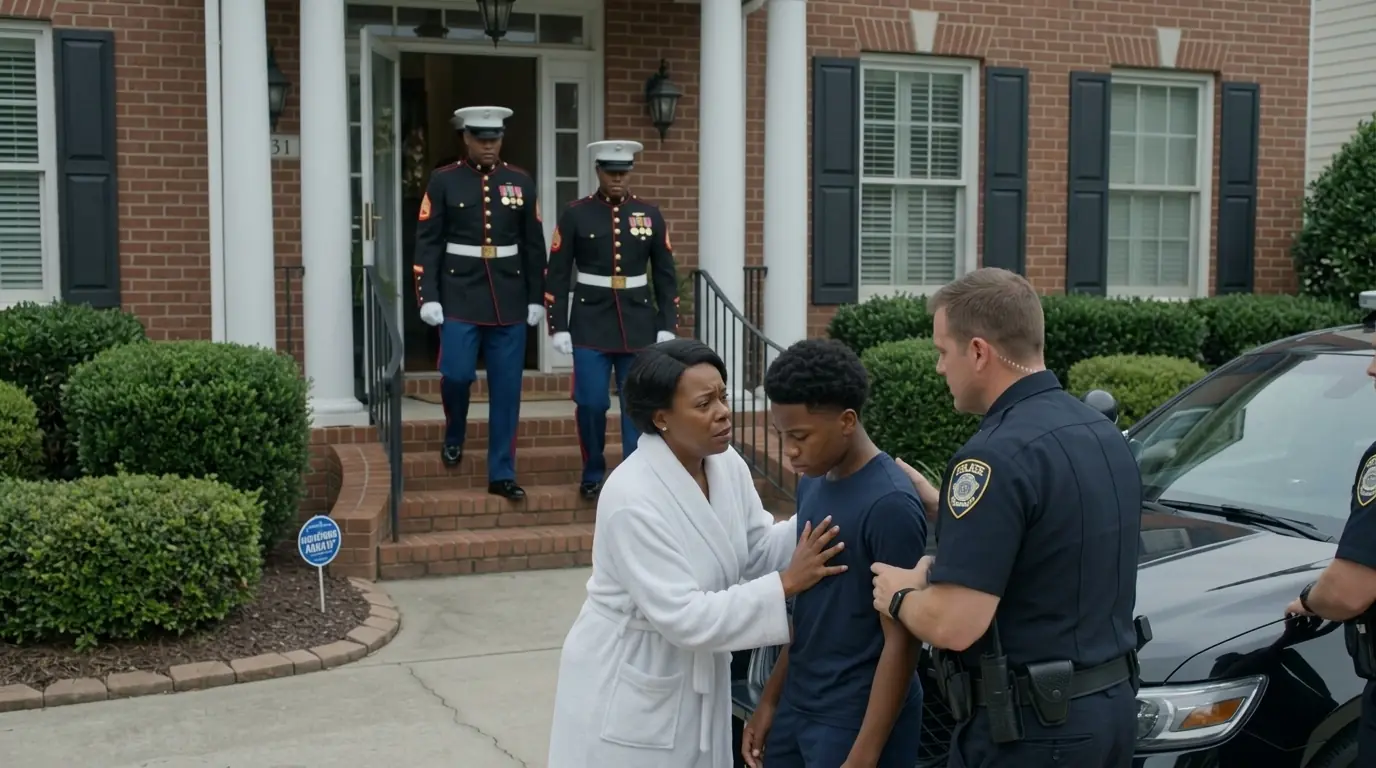
“ID,” Crowley snapped, pushing two fingers harder between Isaiah’s shoulder blades. “You’re trespassing, wandering around, acting suspicious, and now you’re refusing to cooperate.” Isaiah tried to turn his head enough to breathe without his face dragging across the paint. “I live here,” he managed. “My house is right there.”
The front door of the brick house behind them flew open before Crowley answered. Denise Brooks ran across the lawn wearing slippers and a loose house robe, one hand still carrying the dish towel she had been using in the kitchen. “Isaiah!” she screamed when she saw her son pinned against the cruiser. “What are you doing to my child?”
Crowley did not release him. “Ma’am, stay back.” Denise stopped only because the second officer stepped toward her with one hand raised. “He lives here,” she said. “His bedroom is ten yards from where you have him.”
Several neighbors stood along porches and sidewalks holding phones. A woman near the corner whispered, “That’s Denise’s boy,” but her husband pulled gently on her elbow before she could step forward. A teenager filmed from beside a mailbox, his camera shaking slightly whenever he zoomed in. Everyone recognized Isaiah, yet nobody seemed certain whether recognition gave them enough courage to challenge an armed man in uniform.
Charles Pembroke looked toward the gathered residents. “This is exactly why we have standards,” he said, pitching his voice loudly enough for people around him to hear. “You let one kind of behavior slide and pretty soon the whole neighborhood changes.” An older neighbor stared at him. “Charles, he was playing basketball.”
Pembroke pretended not to hear. He lifted an empty coffee mug toward his mouth even though the last sunlight had already disappeared from the roofs. The satisfied expression on his face was becoming harder to hide. He had spent years learning that a rule did not have to be fair if enough people were afraid of becoming its next target.
Isaiah tried the breathing rhythm his basketball coach drilled into the team before free throws. Four seconds in, hold, then release slowly. Fear shredded the rhythm before he reached three. Crowley tightened the arm lock again and told him to stop moving.
“I’m not moving,” Isaiah said. The words came thin beneath the pressure. “You’re hurting me.” Crowley answered with the phrase officers used when they wanted witnesses to hear a different story than the body in front of them. “Then stop resisting.”
Denise stepped forward again. “He is not resisting you.” The second officer blocked her path. “Ma’am, do not interfere.”
“Interfere with what?” Denise demanded. “My son was shooting baskets in his own driveway.” Crowley glanced over his shoulder. “We received a report of a suspicious male wandering between residences.”
Denise looked directly across the street toward Pembroke. His eyes shifted away for the first time. “You called them.” It was not a question. Charles straightened his back and said he had called because several homeowners had expressed concern.
“No, we didn’t,” a man from two houses down said quietly. Charles turned toward him. The man immediately looked at the pavement, but the words had already escaped. Denise heard them.
Something changed near the Brooks house. The front door opened again, slower this time. Two men stepped onto the porch and stopped beneath the porch light.
Neither wore a uniform. One was tall and lean with close-cropped gray hair, wearing dark jeans and a charcoal polo shirt. The other was broader, older by several years, and walked with the controlled stiffness of someone whose knee had been rebuilt more than once.
Their names were Andre Wallace and Victor Grant. They had arrived at the Brooks home three hours earlier carrying a small black case, a sealed letter, and memories Denise had spent eight years both wanting and fearing to hear. Both had served beside her late husband, Staff Sergeant Nathan Brooks.
Andre and Victor did not run toward the cruiser. They crossed the lawn at an even pace, hands visible, eyes moving through the scene. Andre looked first at Isaiah’s neck and back, then Crowley’s elbow position, then the second officer, then the phones recording from three different angles. Victor subtly moved toward Denise so that she ended up behind his shoulder without anybody needing to explain why.
Neighbors quieted. Even Charles Pembroke stopped speaking. The two men carried no legal authority on the street, but the way they moved made every person there understand that neither was confused about what he was seeing. Crowley finally looked up.
“Stay back,” he ordered. Andre stopped several feet away. “Ease the pressure on his shoulder.”
Crowley’s jaw tightened. “This is police business.” Andre’s expression did not change. “You’ve got his wrist high enough that his shoulder is rotating forward.”
“I said step back.” Victor’s voice came next, low and controlled. “Nobody’s touching you.”
“We’re talking.” He looked toward Isaiah. “That kid is barely getting a full breath.”
Denise gripped Victor’s sleeve. “Please.” Victor glanced toward her. “We see him.”
That morning had begun with nothing more dangerous than a basketball bouncing on warm concrete. Hawthorne Glen was the kind of subdivision developers described using words like established, peaceful, and exclusive, though most houses had been built less than twenty years earlier. Lawns were trimmed to nearly identical heights, mailboxes had approved colors, and homeowners received notices if garbage cans remained visible too long after collection.
Isaiah loved the driveway because the hoop belonged entirely to him. His father had installed it when Isaiah was seven, two summers before Nathan died overseas. The black backboard had faded around the edges, and one bolt had to be tightened every few months, but Denise refused to replace it. Whenever the ball hit the rim, she sometimes imagined Nathan standing underneath with a wrench, complaining that manufacturers did not build anything properly anymore.
Isaiah had spent most of Saturday practicing pull-up jumpers. He wanted more minutes on varsity when school resumed, and Coach Daniels had told him his shot looked good when his feet were disciplined. The steady thump of the basketball echoed between houses while sprinklers clicked across the lawns. Most neighbors ignored it.
Charles Pembroke did not. He stepped onto his porch shortly after nine wearing pressed khaki shorts, loafers, and the expression of a man inspecting property he believed belonged partly to him. At fifty-eight, Charles had served as Hawthorne Glen’s HOA president for nearly nine years, three years longer than any rule permitted until he persuaded the board to rewrite the limit.
His name appeared beneath every violation letter. Flower pots were too bright. Fences were three inches too high. Holiday decorations remained up four days too long.
The Brooks family had learned that Charles discovered rules more aggressively whenever those rules applied to them. Denise once received a warning because Isaiah’s bicycle leaned beside the garage for twenty minutes. Another letter complained about relatives parking on the street during Nathan’s memorial dinner.
Nothing Charles did looked dramatic alone. That was how he preferred it. Discrimination dressed in paperwork could survive much longer than discrimination spoken honestly.
Charles watched Isaiah dribble between his legs. “That is not what driveways are for,” he muttered. Susan Keller, a widow walking a golden retriever past his house, heard him.
“He’s practicing basketball.” Charles took a sip of coffee. “He’s making the place look like an apartment complex.”
Susan stopped. The phrase carried enough meaning that both of them understood what he meant without him saying anything explicit. She looked toward Isaiah, then back at Charles. “It looks like a kid playing ball.”
Charles smiled without warmth. “This neighborhood did not stay desirable by letting everyone do whatever they want.” Susan walked away. She did not answer.
From the kitchen, Denise saw the exchange through the window. She could not hear the words, but she recognized Charles’s stare. She had seen variations of that look at PTA meetings, neighborhood meetings, expensive stores, and traffic stops.
It was a look that placed people into categories before they spoke. Nathan used to tell her not to let somebody else’s suspicion become their shame. After he died, living by that advice had sometimes required more strength than she wanted to admit.
Denise stirred a pot of chicken stew and looked at the framed photograph above the dining-room cabinet. Nathan wore desert camouflage and smiled beside an armored vehicle, one hand raised because he disliked formal poses. Isaiah had his eyes. People mentioned it less as he grew older because everything else about the boy had become longer and more angular.
Denise touched the edge of the frame. “Keep an eye on him today.” She smiled at herself afterward. Eight years had passed, and she still spoke to Nathan as though he might walk through the door complaining about traffic.
Isaiah came inside around eleven dripping sweat. He drank directly from the cold-water bottle despite Denise telling him there were glasses. “You have practice Monday?”
“Conditioning.” He opened the refrigerator. “Coach says if I improve my defense, I might start some games.”
Denise smiled. “Then improve your defense.” Isaiah rolled his eyes. “Incredible coaching, Mom.”
She almost told him to stay closer to the house. Then she stopped herself because he was already standing inside his own home. She was tired of giving her son instructions designed not around his safety but around other people’s prejudice. Still, when Isaiah returned outside, Denise watched longer than usual.
At three-forty, a dark gray sedan turned into the cul-de-sac. It stopped in front of the Brooks house rather than pulling into the driveway. Two men climbed out.
Denise recognized neither. The taller one held a narrow black case. The other carried a large sealed envelope.
She opened the door before they reached the porch. “Can I help you?” Andre stopped at the bottom step.
“Mrs. Brooks?” Denise nodded cautiously. “I’m Andre Wallace.”
“This is Victor Grant.” Victor lifted one hand in greeting. Andre swallowed before continuing. “We served with Nathan.”
For a moment Denise could not speak. The name coming from a stranger’s mouth had enough force to rearrange the afternoon. Her grip loosened on the door.
“Come in.” Isaiah appeared from the hallway when he heard his father’s name. Andre saw him and went silent.
Victor looked from the framed photograph to the teenager. “That is Nathan’s boy.” Isaiah’s shoulders stiffened slightly. He had grown used to adults seeing his father before seeing him.
Andre seemed to recognize that. “Your dad used to talk about you.”
Isaiah gave a small smile. “I was eight when he died.” Andre nodded.
“He talked about your jump shot when you were five.” Isaiah laughed. “I didn’t have a jump shot at five.”
“That’s what I told him.” Andre smiled. “He considered that disrespect.”
The tension broke. Denise invited them into the dining room. Victor placed the black case on the table.
Inside was a twisted piece of dark metal mounted against black velvet. A small brass plate underneath read Kandahar Province, 2018. Denise touched one hand to her mouth.
“What is that?” Isaiah asked. Victor sat across from him.
“The piece that hit the wall beside us.” He pointed toward one corner. “Your father dragged me behind concrete about two seconds before the blast.”
Andre lowered his eyes. “That is why Victor is sitting here.”
Victor nodded. “Your dad saved my life.”
Silence filled the table. Isaiah stared at the metal. He had heard his father called brave at memorials, funerals, school ceremonies, and once by a politician who mispronounced their last name.
This felt different. Victor remembered the exact sound of Nathan laughing. Andre remembered how Nathan drank coffee so strong everyone accused him of melting the cup.
They told stories. Nathan once filled a lieutenant’s sleeping bag with packing peanuts after the man bragged he could sleep through anything. He had a habit of humming old R&B songs whenever everyone else became nervous.
When rain turned their camp into mud for days, Nathan made soldiers compete over who could invent the worst meal using military rations. Isaiah laughed until his stomach hurt. For the first time, his father sounded less like a photograph and more like a person.
Then Andre grew serious. He reached into his pocket and placed a heavy unit coin in front of Isaiah. “Your father carried one like this.”
Isaiah picked it up. The metal was colder than he expected. “What am I supposed to do with it?”
“Nothing special.” Andre leaned back. “It’s not magic.”
Victor smiled. “It’s a reminder.” He tapped his chest. “When everything gets loud, shoulders down.”