The gun pressed hard enough into my ribs that I could feel the front sight through my shirt.
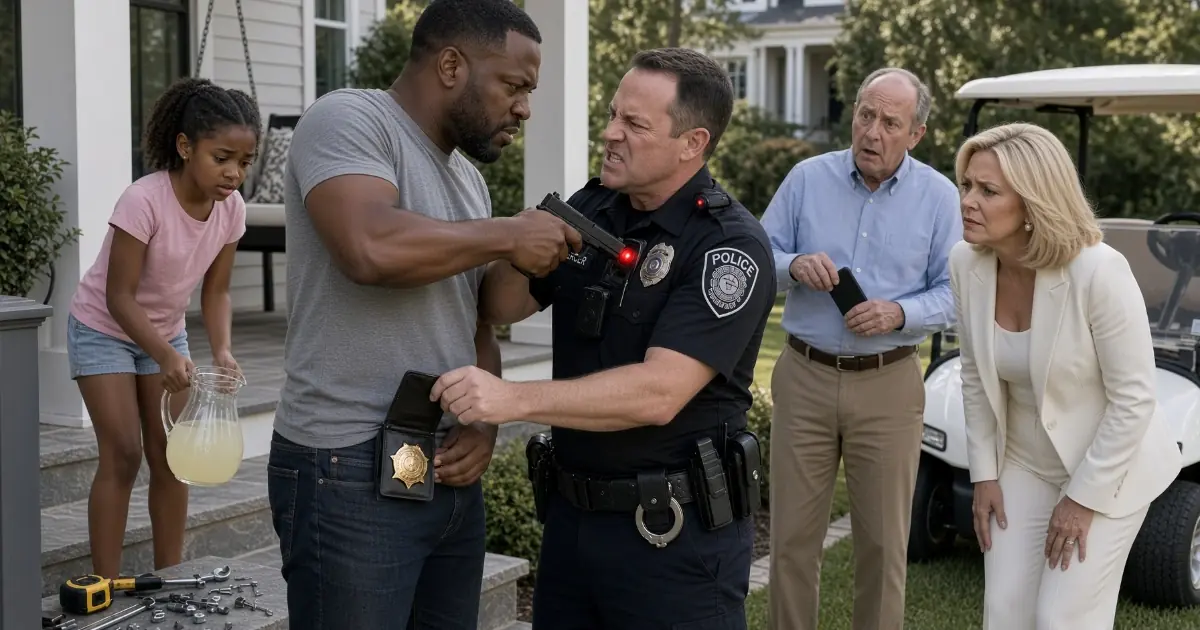
My daughter was six feet away.
Eleven years old.
Barefoot on the porch.
Still holding the glass pitcher of lemonade she had brought outside for me.
The man with the gun leaned close enough that I could smell mint gum on his breath.
“One more step, hero, and your daughter watches you drop.”
I did not move.
Across the driveway, Gloria Whitcomb stood beside her white golf cart in pearl earrings and a spotless white pantsuit.
She smiled.
Not nervously.
Not uncertainly.
She looked satisfied.
“Maybe next time you’ll learn to obey community rules.”
I kept both hands where everyone could see them.
The man holding the gun wore navy tactical pants, a black uniform shirt, a plastic badge, handcuffs, and patches designed to make a person notice the word POLICE before noticing everything missing around it.
No city.
No county.
No agency.
No radio identifier.
No marked vehicle.
His nameplate was plastic and slightly crooked.
MERCER.
Above his shirt pocket was a small body camera.
A red light blinked.
Good.
Let it record everything.
“Lily,” I said quietly.
Her face had gone white.
“Put the pitcher down.”
“Dad—”
“It’s okay.”
It wasn’t.
But an eleven-year-old child did not need the truth of that moment.
“Put it down.”
Her hands were shaking badly enough that ice knocked against the glass.
She crouched slowly.
The bottom of the pitcher touched the porch boards.
Click.
Mercer pushed the muzzle harder into my side.
“Wallet.”
I looked at him.
“What?”
“Identification. Slowly.”
That was the first moment I understood that this might end much faster than Gloria expected.
I looked past him at her.
“You want him to see my identification?”
Gloria laughed.
“For once in your life, cooperate.”
“All right.”
I told Mercer exactly which pocket held my credentials.
I waited until he ordered me to reach.
Two fingers.
Slowly.
No sudden movement.
I pulled out the leather case.
Opened it directly beneath the blinking red light of his own camera.
The gold star caught the morning sun first.
Then the lettering.
UNITED STATES MARSHALS SERVICE
Mercer’s face emptied.
The gun moved away from my ribs without him seeming to realize he had moved it.
Behind him, Gloria frowned.
“What is that?”
Before I answered, another voice came from across the street.
The nervous man who had been carrying Gloria’s clipboard for nine days stood at the edge of the road with his phone in his hand.
His name was Henry Bell.
Until that moment, I had barely heard him speak above a mumble.
Now he looked directly at Gloria.
“I saved every notice she made us send.”
Gloria turned.
“What?”
Henry swallowed.
His hands shook.
But he did not lower the phone.
“All of them.”
For the first time since I had met Gloria Whitcomb, she stopped smiling.
Nine days earlier, my wife Rebecca, our daughter Lily, and I had moved into Pine Hollow Estates because Rebecca’s cancer clinic was ten minutes away.
That was the whole reason.
We were not looking for a prestigious neighborhood.
We were not interested in golf-cart culture, decorative mailboxes, or whatever social status came from living behind stone pillars with PINE HOLLOW ESTATES carved across them.
We needed proximity.
Rebecca was forty-one.
She had been diagnosed with lymphoma eight months earlier.
The first treatment cycle had gone well.
The second had not.
By summer, she was scheduled for another round that required more frequent clinic visits and occasional overnight observation.
Our actual home was almost an hour away.
That drive became unbearable.
A federal colleague knew someone with a rental in Pine Hollow.
Furnished.
Month-to-month.
Quiet.
Ten minutes from the clinic.
I signed the lease.
Rebecca cared about only one thing.
“Does it have a porch?”
It did.
Wide enough for a swing.
That mattered because of the old cedar porch swing stored in our garage.
Rebecca’s father had built it before we were married.
She had sat on it while pregnant with Lily.
Later, when Lily was a baby, Rebecca rocked her there through entire summer evenings.
By the time we moved temporarily to Pine Hollow, the swing had been stored for almost three years.
The first thing Lily asked when we saw the rental was:
“Can Mom’s swing go there?”
The property owner, Michael Tran, gave written permission.
I checked the lease.
Checked the HOA documents we had been provided.
Nothing specifically prohibited porch swings.
So on our first Saturday morning, I started hanging it.
At 8:17, Lily sat cross-legged on the porch sorting bolts into little groups while I balanced a socket wrench in one hand and coffee in the other.
Rebecca was at the clinic for an infusion.
We wanted the swing up before she came home.
Lily had developed a need for small surprises during her mother’s illness.
A favorite soup.
Clean sheets.
A card tucked into Rebecca’s bag.
The porch swing was the biggest one yet.
I had just tightened the first ceiling bracket when an electric motor whined from the street.
A white golf cart turned sharply into our driveway and stopped sideways across it.
Three women sat inside.
All wearing tennis visors.
One of them already had her phone out.
A nervous-looking man rode on the rear seat holding a clipboard.
At the wheel was Gloria Whitcomb.
She was perhaps sixty.
Silver-blond hair shaped perfectly into place.
Pearl earrings.
White pantsuit.
White shoes that somehow remained spotless despite the mulch around our driveway.
She looked up at the swing bracket.
Then at me.
“You are installing an unauthorized exterior fixture.”
I looked around.
“Good morning.”
“This is not approved.”
“It’s a porch swing.”
“It’s visible from the street.”
“That’s generally where porches are.”
The nervous man behind her accidentally laughed.
Just one short sound.
Gloria turned her head.
He immediately looked down at his clipboard.
Lily smiled.
Gloria noticed.
Then she began reading.
“Trash receptacle remained visible after collection.”
“Pickup was twenty minutes ago.”
“Commercial vehicle stored in driveway.”
I glanced at my truck.
A dark government-issued SUV would have drawn more attention, so I had driven my personal Ford.
“That’s my personal truck.”
“Grass exceeds neighborhood standard.”
“It was cut yesterday.”
“Front entry mat inconsistent with approved color palette.”
I stared at our brown welcome mat.
She continued.
“Children’s items stored on porch.”
There was one cardboard box beside Lily.
Inside it was unopened blue sidewalk chalk.
Gloria’s friend lifted her phone higher and pointed it toward us.
Lily’s posture changed immediately.
Her shoulders folded inward.
Her knees came up.
That bothered me more than the violations.
My daughter had spent half a year learning how adults behave when something bad is happening.
Whispering outside hospital rooms.
Smiling too brightly.
Stopping conversations when she entered.
Watching her mother lose hair.
Watching her father pretend not to be afraid.
She recognized public tension instantly.
I stepped between Lily and the camera.
“We’re renters. The homeowner approved the swing in writing. Trash collection was this morning. The truck is legally parked. The lawn was cut yesterday.”
Gloria smiled.
“Pine Hollow isn’t the sort of neighborhood where people get clever with the board.”
“I’m hanging a swing.”
Then she looked past me.
Directly at Lily.