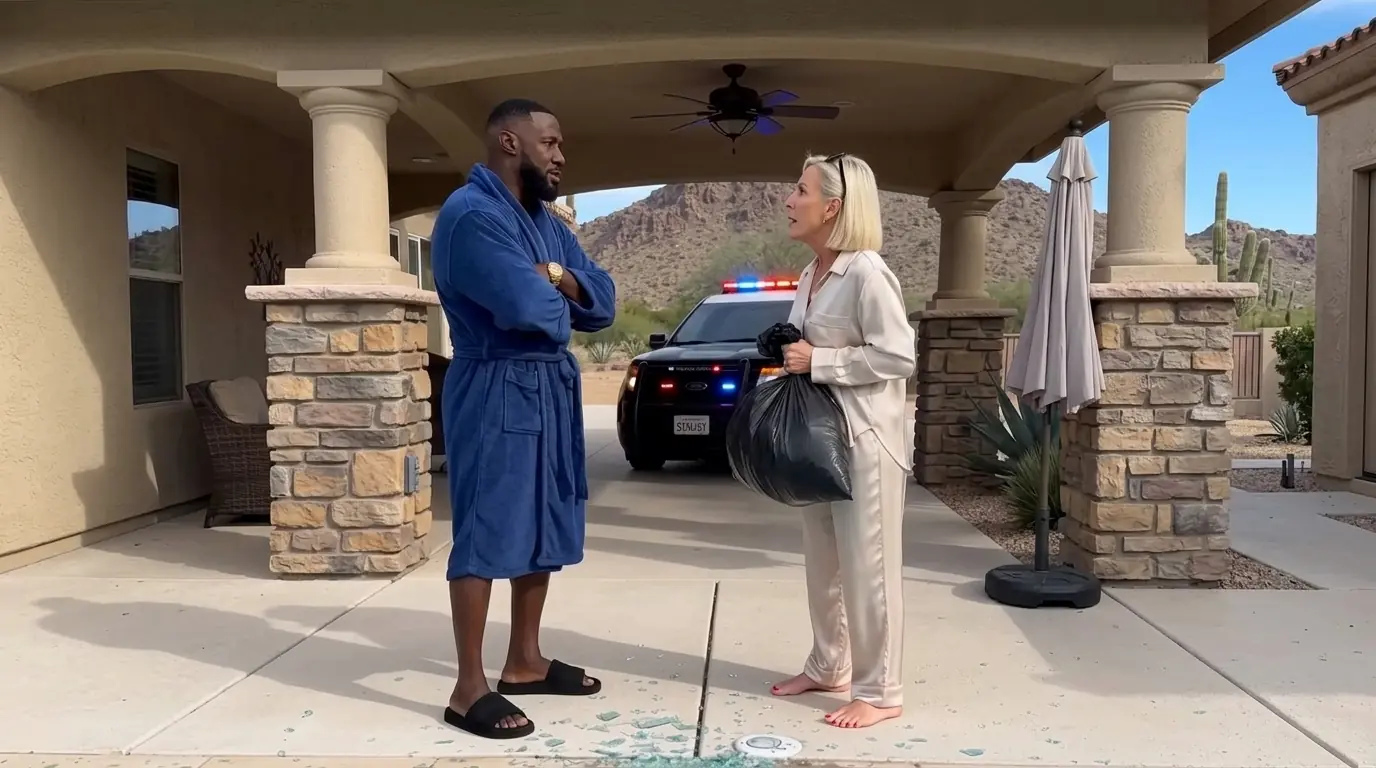
Darius Walker knew something inside his house was wrong before he made it past the laundry room. Forty minutes earlier, he had pulled away from his Scottsdale home planning to spend the weekend in Sedona with his older sister Renee, while his ten-year-old daughter Maya had gone ahead Friday night with Darius’s father. He had been halfway to Loop 101 when he remembered the company phone sitting beside the espresso machine, still charging with Monday’s inspection reports stored on it. Darius turned around irritated with himself, believing the mistake would cost him ten minutes.
The garage door closed behind his SUV, and that was when he heard water moving in the backyard. Not the steady hum of the pool pump, but several sharp splashes separated by silence, as if somebody were dropping things into the shallow end. His pool service came on Thursdays, his landscaper every other Tuesday, and nobody else had permission to be behind the locked side gate. Darius left his suitcase in the garage and moved quietly toward the kitchen.
Through the wide glass doors, he saw a woman standing beside the pool. Her platinum-blonde hair had been cut into the same perfect shoulder-length style she wore to every neighborhood meeting, and even at nine thirty on a Saturday morning she somehow looked prepared for an argument. She wore cream-colored silk lounge pants, a matching top, oversized sunglasses pushed onto her head, and white sandals that probably cost more than Darius’s first apartment rent. He recognized Cynthia Harrow immediately.
Cynthia was forty-eight years old and president of the Sunstone Ridge Homeowners Association. She had held that position for six years and spoke about the neighborhood as if the title had been inherited rather than elected. When she said “our standards,” she usually meant her preferences, and when she said “community concern,” somebody was about to receive a fine. Darius had learned that difference during the eleven months since Cynthia decided his house required unusually close attention.
She held a heavy grocery bag above the shallow end of his pool. Darius initially thought she was emptying rocks or landscaping debris, which would have been strange enough. Then the morning sun caught one object as it fell. A triangular piece flashed silver before disappearing beneath the water.
Glass.
Darius moved closer to the window. Cynthia tilted the bag again, and dozens of broken pieces spilled into the pool, some large enough to see clearly and others so fine they vanished almost immediately against the pale-blue tile. Jagged fragments spread across the first submerged step and drifted toward the drain. Maya jumped from those steps barefoot almost every afternoon during summer.
Darius stopped breathing for a second. He imagined his daughter coming home unexpectedly, dropping her sandals near the patio door as she always did, then running into the water without checking where she stepped. One deep cut would be bad enough, but the smaller pieces could disappear completely until they opened a foot, calf, or knee underwater. His anger arrived so fast that he actually took one step toward the patio door before another thought stopped him.
Cameras.
Four months earlier, after Cynthia had been photographed peering through the gap beside his side gate, Darius installed three exterior cameras. One watched the gate, one covered the patio, and a third showed nearly the entire pool. He pulled his work phone from the counter, opened the security application, and Cynthia appeared on all three live feeds.
The recordings were already being stored automatically, but Darius manually saved them anyway. The gate camera showed Cynthia approaching with the grocery bag, looking toward the empty driveway, then using something thin and metallic near the latch until it opened. The patio camera showed her walking directly toward the pool instead of inspecting anything else. The pool camera showed the contents of the bag clearly enough that nobody could later call them leaves.
Darius looked down at himself and almost laughed despite the fury building inside him. When he returned for the phone, he had spilled coffee across the shirt he planned to travel in, removed it, and pulled on the dark charcoal bathrobe hanging near the downstairs shower because he expected to be inside for two minutes. Now he was standing barefoot in a bathrobe preparing to confront the president of his HOA over attempted sabotage involving broken glass. His brother was going to enjoy that detail far too much.
Darius opened the patio door.
“Put the bag down, Cynthia.”
She spun so quickly that one final piece slipped between her fingers. The shard struck the stone coping, bounced once, and disappeared beneath the water. Cynthia’s face showed unmistakable fear before years of practice rearranged it into offense. “You’re supposed to be in Sedona,” she said.
Darius stopped several feet away.
Neither moved.
Then Darius slowly lifted the phone.
“You knew I left.”
Cynthia glanced toward the side gate.
“That isn’t what I said.”
“You said I was supposed to be in Sedona.”
“I saw you load your vehicle.”
“And waited until I drove away.”
Cynthia straightened her pajama cuff as if the conversation had become administrative.
“I was conducting a safety inspection.”
Darius stared at the broken glass glittering beneath the water.
“A safety inspection.”
“There have been concerns regarding your backyard modifications.”
He pointed toward the pool.
“What concern required bringing a bag of glass?”
Cynthia’s jaw tightened.
“You are making accusations.”
“I watched you.”
“You saw me handling debris.”
“I watched the debris come out of the bag you carried through my locked gate.”
“You cannot establish where I found it.”
Darius lifted the phone slightly higher.
“No?”
Cynthia looked toward it.
Darius pointed above the patio.
“Camera one.”
Then toward the side wall.
“Camera two.”
Finally toward the roofline covering the pool deck.
“Camera three.”
Cynthia’s eyes followed each gesture.
“One watched you come down the side path carrying the bag.”
Darius’s voice remained calm.
“One recorded you forcing my latch.”
He pointed toward the pool.
“And that one has a beautiful view of you shaking broken glass into the shallow end where my ten-year-old daughter walks barefoot.”
The silence became heavy.
Then Cynthia did something so absurd Darius almost admired the instinct.
“Those cameras were never approved.”
He stared at her.
“What?”
“Exterior surveillance equipment may require architectural review.”
Darius blinked.
“You forced your way into my backyard and dumped broken glass into a pool used by a child, and you want to discuss camera approval?”
“I did not force anything.”
Darius pointed toward the gate.
The latch hung crooked.
Fresh scratches cut through the bronze finish.
“You picked the lock.”
“It opened.”
“Because you made it open.”
Cynthia crossed her arms.
“I had reasonable concern that an unsafe condition existed on the property.”
Darius looked toward the glass.
“What unsafe condition existed before you arrived with the bag?”
Cynthia said nothing.
Darius waited.
The desert heat had already begun pressing downward even though the morning was young. Somewhere beyond the wall, a landscaper’s blower started and stopped. Otherwise, the backyard felt completely still.
“You have challenged me at every opportunity since you came here,” Cynthia finally said.
Darius almost laughed.
“I live here.”
“You undermine association leadership.”
“You’re president of an HOA.”
He took one step closer.
“You are not law enforcement.”
Another.
“You are not the city.”
Then he pointed toward his house.
“And you sure as hell do not own that.”
Cynthia’s mouth tightened.
“You have no idea how difficult homeowners like you make community management.”
Darius stared at her.
“Homeowners like me.”
“That is not what I meant.”
“You should leave.”
“I am contacting association counsel.”
“Please.”
“And the full board.”
“Even better.”
She walked toward the gate.
Darius called her name.
Cynthia stopped but did not turn.
“Maya is ten.”
Her shoulders stiffened.
“She doesn’t inspect the pool before she jumps in because children are supposed to believe their own backyard is safe.”
Darius looked at the almost invisible fragments under the water.
“If I hadn’t forgotten my phone today, I wouldn’t have seen this before she came home tomorrow.”
Cynthia turned her head slightly.
“Prove I intended anyone to be hurt.”
Darius looked at the cameras.
“I don’t need to prove what you hoped would happen before I prove what you did.”
She walked out.
Darius closed the damaged gate behind her, slid the secondary bolt, and checked it twice. When he turned back toward the pool, some of his anger disappeared and something colder took its place. From five feet away, the water still looked clean.
That was the frightening part.
Darius lowered himself into a patio chair and stared at the first step where Maya always entered. His hands began shaking only after Cynthia was gone. He hated that reaction, but years managing complex construction projects had taught him that bodies sometimes waited until danger passed before admitting anything happened. Darius stayed there for nearly a minute, then stood.
Evidence first.
Fear later.
Cynthia Harrow had accidentally taught him the importance of that order.
The conflict between them had begun with something so small Darius barely remembered being angry about it. Eleven months earlier, he received a notice claiming the palo verde tree beside his driveway created an obstruction to pedestrian traffic. He took a measuring tape outside and discovered the lowest branch ended more than four feet from the sidewalk. Still, he trimmed it because seventy-five dollars was not worth an argument.
Two weeks later, another violation arrived.
INSUFFICIENT CORRECTIVE ACTION.
Fine: $125.
Darius emailed photographs showing the entire sidewalk.
Nobody replied.
Then the fine increased to $250.
That got his attention.
Darius attended the following HOA meeting carrying the notices, the landscape guidelines, photographs, and measurements. Cynthia sat at the center of the board table wearing a pale blue blazer, gold earrings, and the expression of someone irritated that homeowner comments existed. Four other directors sat beside her.
When Darius’s name was called, he placed his photographs on the table.
“The notice says my tree interferes with pedestrian access.”
Cynthia glanced down.
“The Landscape Committee found your correction inadequate.”
“What clearance is required?”
She looked up.
“Excuse me?”
“I read the landscaping rules.”
Darius opened the document.
“I cannot find a minimum branch clearance from the sidewalk.”
Cynthia leaned back.
“Mr. Walker, this is an HOA meeting, not a deposition.”
“I know.”
“Then perhaps stop treating routine neighborhood standards like litigation.”
Darius kept his voice calm.
“I’m asking which rule justifies a two-hundred-fifty-dollar fine.”
Several residents behind him shifted.
Cynthia noticed.
The fine disappeared three days later.
Nobody apologized.
Nobody explained.
Darius considered the matter finished.
Cynthia apparently considered it insubordination.
The next notice concerned his trash bins.
According to the violation, they remained visible after the permitted collection window. Darius checked his doorbell footage and found himself rolling both bins behind the side gate at 6:11 p.m. The governing documents allowed residents until seven.
He sent the footage.
Violation withdrawn.
Then came the porch light.
Withdrawn.
A ceramic planter near his entry.
Withdrawn after Darius photographed nearly identical planters outside six other homes.
Maya left her scooter beside the garage for one afternoon.
Warning.
Darius began saving every letter.
Documentation came naturally to him. At work, he managed large commercial construction projects where a missed date or undocumented conversation could become a six-figure disagreement months later. He understood schedules, photographs, signatures, change orders, and the difference between what somebody remembered and what the records proved.
So he built a folder.
Then another.
Emails.
Notices.
Photographs.
Board minutes.
Screenshots.
Dates.
By spring, he had enough documentation to recognize that the problem was not random enforcement.
It was Cynthia.
The conflict escalated when Darius submitted plans to renovate his backyard. The existing pool equipment was fifteen years old, several patio sections had cracked, and the summer sun made the western side of the property almost unusable after four in the afternoon. He hired a licensed architect and submitted plans for a shade structure, energy-efficient pumps, an outdoor grill station, and drought-friendly landscaping.
The shade structure sat below the privacy wall.
Nothing could be seen easily from the street.
Every proposed material appeared on the approved design list.
Darius paid the application fee and waited.
Thirty days passed.
Then forty-five.
His contractor warned that material pricing would expire.
Darius emailed the management company.
They told him the board needed additional review.
He asked what information was missing.
Nobody answered.
Cynthia appeared at his front door three evenings later.
“Mr. Walker.”
“Cynthia.”
She looked past him into the house before returning her attention to his face.
“We should discuss your proposed improvements.”
“Sure.”
“They are extensive.”
“That’s why I submitted drawings.”
“Some board members have concerns.”
“About?”
“Community compatibility.”
Darius waited.
“What does that mean?”
Cynthia smiled.
“You tend to approach review as if every decision is negotiable.”
“No.”
He leaned one shoulder against the doorway.
“I approach it like there are written rules.”
“This is permission.”
Darius became still.
“Permission?”
“Yes.”
“To modify property I own according to standards I already followed.”
Cynthia’s expression changed.
“That attitude makes cooperation difficult.”
Darius understood her then.
She did not believe rules limited her authority.