At 6:42 on a bright Tuesday morning, Julie Hargrove believed nobody was watching.
That was why she came early.
Willow Creek usually woke slowly.
Garage doors began opening around seven.
School buses came closer to seven-thirty.
Dog walkers appeared in pairs after coffee.
But at 6:42, the street was quiet.
Sprinklers clicked.
Birds moved through the maple trees.
Morning light spread across stone driveways and trimmed hedges.
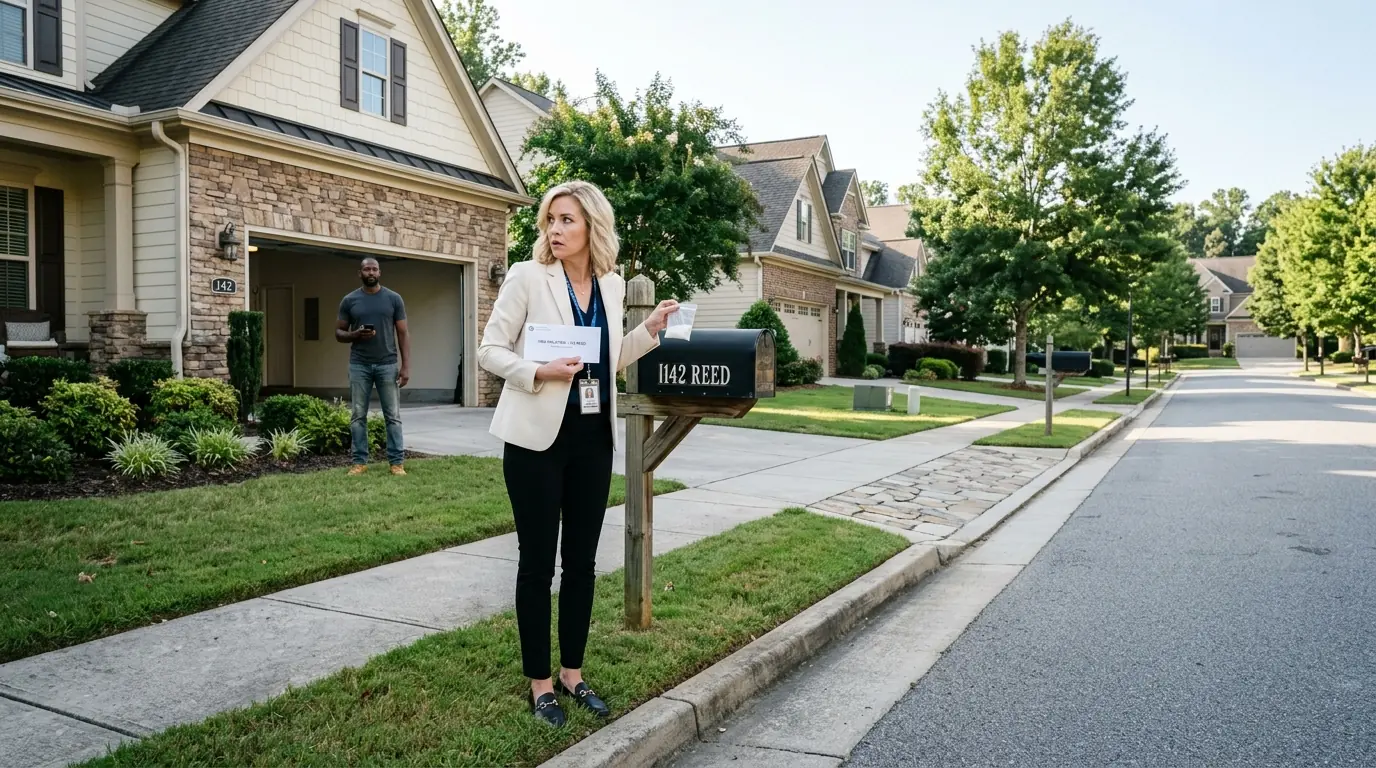
And Julie Hargrove stood beside Marcus Reed’s mailbox holding two things.
An HOA violation envelope.
And a small sealed plastic packet containing white powder.
She looked over one shoulder.
Then the other.
Nothing moved.
Julie smiled.
Across the street, almost invisible beneath the shadow of a large oak branch, a small surveillance camera adjusted its angle by three degrees.
Julie did not see it.
Marcus did.
He stood inside his open garage with one hand resting against the frame.
Forty-five years old.
Black.
Six feet two.
Gray T-shirt.
Jeans.
Work boots.
No uniform.
No badge.
Nothing about him suggested that he had spent eighteen years learning what people did when they believed there would be no witness.
He had been waiting for twenty-three minutes.
Not for Julie specifically.
For whoever had been opening his mailbox.
Someone had tampered with it three times in two weeks.
Nothing valuable stolen.
No packages missing.
Just mail shifted.
A bank statement opened and returned.
An HOA warning appearing inside without postage.
Then an unsigned note:
PEOPLE WHO DON’T FOLLOW COMMUNITY RULES EVENTUALLY LEAVE.
Marcus had not confronted anyone.
He had not posted about it online.
He had not stormed into a board meeting.
He had simply started documenting.
That was something his late father used to call “letting foolish people finish their own sentence.”
Julie opened the mailbox.
She slid the HOA envelope inside.
Then she lifted the plastic packet.
Marcus watched from the garage.
The packet was small.
Clear.
Sealed.
White powder packed inside.
He could not identify the substance from twenty yards away.
That did not matter.
He watched Julie slip it underneath the HOA envelope.
Then she closed the mailbox.
Her shoulders relaxed.
She pulled out her phone.
The satisfied little smile that crossed her face was the first thing that made Marcus angry.
Not the packet.
Not yet.
The smile.
It was the face of somebody who believed the difficult part was over.
Marcus stepped out of the garage.
“What did you put in my mailbox?”
Julie spun around.
The smile disappeared so quickly it looked almost painful.
For half a second, fear crossed her face.
Then she remembered who she was supposed to be.
Julie Hargrove.
Vice president of the Willow Creek Homeowners Association.
Keeper of standards.
Sender of certified letters.
Self-appointed guardian of hedge height, fence stain, driveway appearance, and the moral decline represented by recycling bins left visible after noon.
She straightened.
“Marcus.”
“What did you put in my mailbox?”
Her eyes flicked toward the box.
Then back to him.
“An official HOA notice.”
“And the packet beneath it?”
Julie froze.
Only for a moment.
But Marcus saw it.
“What packet?”
“The one you just put inside.”
Her voice hardened.
“Stay away from the mailbox.”
Marcus stopped.
That surprised her.
He did not move toward her.
Did not raise his voice.
Did not even take his phone out yet.
Julie mistook restraint for uncertainty.
That gave her courage.
“Actually,” she said, “you need to go back onto your property.”
Marcus looked at the mailbox.
It stood at the curb directly in front of his house.
“My property is behind me.”
“You know what I mean.”
“No.”
Julie lifted her phone.
“Maybe the police will finally deal with a troublemaker like you.”
There it was.
Marcus’s expression did not change.
“What did you put in my mailbox?”
Julie’s lips tightened.
“Whatever they find in there is your problem.”
Marcus stared at her.
She realized too late what she had said.
He lifted his phone.
“You really want that statement recorded?”
Julie’s eyes narrowed.
“You’re recording me?”
Marcus tapped the screen once.
Across the street, the small camera beneath the oak branch rotated.
Quietly.
Almost delicately.
Julie noticed the movement.
Her face changed.
Marcus looked at the camera.
Then back at her.
“Because that camera wasn’t installed for you to notice.”
For the first time that morning, Julie stopped talking.
To understand why she was standing beside Marcus Reed’s mailbox at 6:42 with a suspicious packet in her hand, you have to understand Willow Creek.
It was the kind of neighborhood real estate agents described with words like established, desirable, and carefully maintained.
Seventy-six homes.
Wide streets.
Stone entrances.
A clubhouse nobody used enough.
A small pool that generated more arguments than enjoyment.
And an HOA that had been ordinary for most of its twenty-two-year existence.
Then Julie joined the board.
At first, people liked her.
She was organized.
That mattered because the previous board had been lazy.
Dues notices went out late.
Landscaping contracts were renewed without comparison bids.
The neighborhood directory still listed two people who had moved to Florida six years earlier.
Julie fixed things.
Budgets became cleaner.
Meetings started on time.
Violations were documented.
That was the useful version of Julie.
Then people began noticing that her definition of “organized” depended heavily on everybody doing exactly what she wanted.
A basketball hoop became a violation.
A child’s chalk drawings remained on a sidewalk too long.
A contractor’s pickup sat in a driveway overnight.
A widow placed two garden statues beside her porch.
Julie cited the statues as “unapproved exterior ornamentation.”
When residents questioned her, she became more formal.
When they pushed back, she became personal.
Marcus first came to her attention because of a fence.
Not even his fence.
His next-door neighbor, Dr. Helen Brooks, was replacing a damaged section after a storm.
Her contractor accidentally installed two panels eight inches taller than the approved height.
Julie sent a violation notice.
Fair enough.
Helen scheduled a correction.
Then Julie added a daily fine immediately.
Marcus happened to be standing outside when Julie arrived to photograph the fence.
Helen was sixty-nine and recently widowed.
She tried explaining the contractor was returning Friday.
Julie responded:
“Rules don’t stop because you have a personal situation.”
Marcus heard it.
He walked over.
“Julie.”
She looked at him.
“The board rules allow a cure period before daily fines.”
Julie’s eyes changed.
“What?”
“Section 8.4.”
“You're not on the board.”
“No.”
“Then this doesn't involve you.”
Marcus nodded toward Helen.
“She asked me to help review the notice.”
That was true.
Helen had brought it over the night before because Marcus was known around the neighborhood as the man who actually read things before signing them.
Julie folded her arms.
“The board has discretion.”
“Not unlimited discretion.”
Her mouth tightened.
“Are you an attorney?”
“No.”
“Then perhaps you should leave legal interpretation to people who understand these documents.”
Marcus almost smiled.
He did not.
Instead he said:
“Give Helen the cure period.”
Julie stared at him.
Then left.
The daily fine disappeared the next morning.
Julie never forgave him for that.
Not because he embarrassed her.
Because he had shown somebody else that her authority could be questioned.
People like Julie could survive being disliked.
They had a harder time surviving being checked.