I did not mean to follow him.
That was the first thing I told my sister later, when she asked how I ended up crying in the hallway of St. Mercy Children’s Hospital over a man I had never met. I told her I was just waiting for my nephew’s lab results, sitting in a plastic chair near the lobby vending machines, watching a nurse argue softly with a printer that had clearly chosen violence that morning.
Then the front doors opened.
And a biker walked in carrying a purple stuffed elephant in one hand and a bunch of star-shaped balloons in the other.
You would have looked too.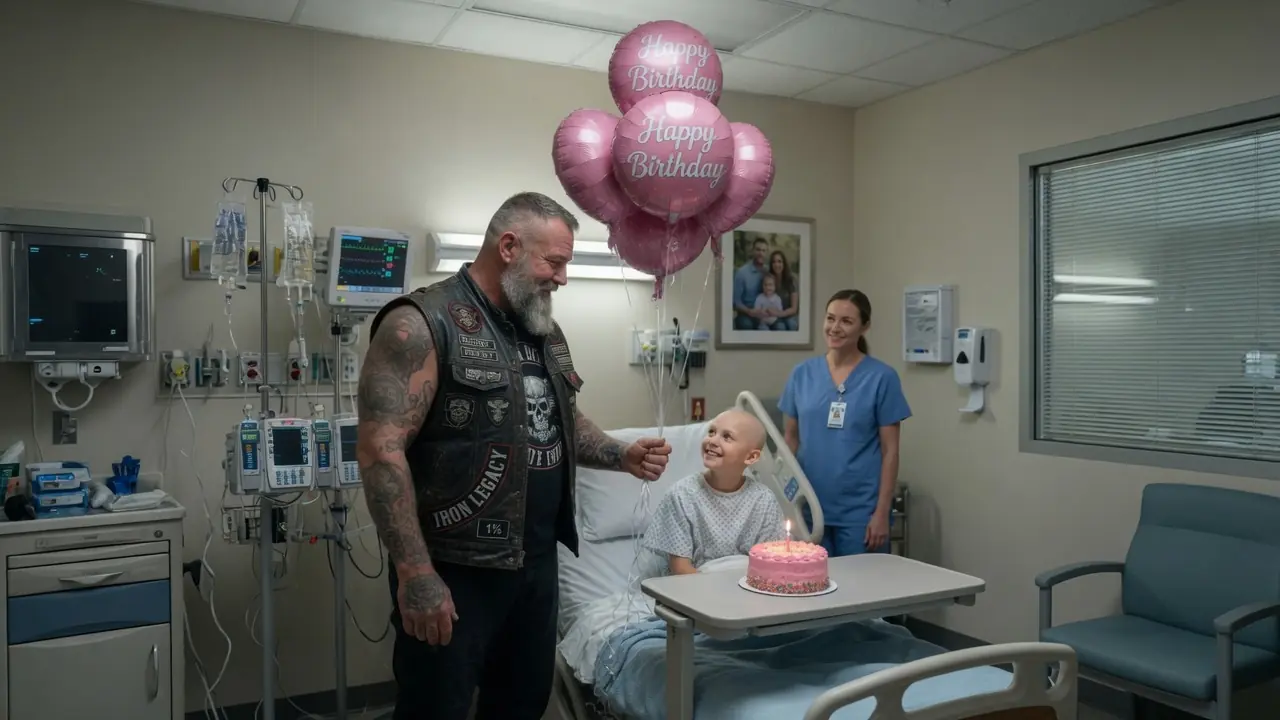
He was a massive man, the kind who changed the shape of a room the second he entered it. His shoulders nearly filled the doorway. His beard was thick and gray at the chin, and tattoos ran down both forearms beneath the sleeves of a faded black leather vest. Heavy boots struck the shining hospital floor with a sound too rough for a place full of wheelchairs, cartoons, and children in soft knit hats.
But what held my attention was not his size.
It was the way he held the stuffed elephant.
Careful.
Awkward.
Like the toy might break if he gripped it wrong, or like he was afraid it belonged to a life he had lost permission to touch.
A nurse met him near the information desk.
She was maybe fifty, with warm brown skin, kind eyes, and the tired steadiness of someone who had carried too many families through bad news and still came to work gentle. Her badge read Ellen Pierce, Pediatric Oncology.
“You came,” she said.
The biker looked at the elevators.
His face changed.
Not much.
Just enough.
“No elevator.”
Ellen watched him for a second.
“Wyatt.”
He shook his head.
“Stairs.”
She did not argue.
That was when I leaned forward.
Because people say no to elevators for plenty of ordinary reasons. Claustrophobia. Bad knees. Too many people crowded inside. But this was different. His whole body had gone rigid when the elevator doors opened, like the past had reached out from inside and grabbed him by the throat.
My nephew, Milo, looked up from his coloring sheet.
“Aunt Jess?”
“What?”
“Why does that scary man have a birthday balloon?”
I looked at the biker again.
“I don’t know.”
But I wanted to.
His name was Wyatt Kane, though I did not know it then.
Most people who knew him called him Bear, partly because of his size and partly because he had spent most of his adult life pretending he was less soft than he was. He rode with a motorcycle club called the Stone River Riders, a group of men and women who looked like trouble from across a gas station but were usually the first people to show up when trouble actually arrived.
They fixed roofs after storms.
They paid rent for widows who did not ask.
They escorted funeral processions for veterans, brought food to families after fires, and once rebuilt a wheelchair ramp in a single afternoon because a man named Duke refused to “wait on city paperwork while a little boy’s mama had to carry him down steps.”
Wyatt was the one they called when nobody knew what to do.
Flat tire at midnight.
Broken furnace in January.
Teenager stranded two towns over.
Club brother too proud to say he was falling apart.
Wyatt came.
Always.
But there was one place he had not entered in nine years.
St. Mercy Children’s Hospital.
The nurse touched his arm gently.
“Room 614,” Ellen said. “Sixth floor.”
Wyatt nodded once.
Behind him, two other riders came through the doors.
One was a woman in her sixties with short white hair, a denim vest, and a leather pouch full of knitting needles tucked under one arm. The other was a younger man, maybe twenty-five, carrying a glittery gift bag covered in rockets and moons.
The woman looked at Wyatt.
“You don’t have to do this alone.”
Wyatt gave a humorless laugh.
“I keep hearing that.”
“Maybe because it keeps being true.”
He did not answer.
The young rider lifted the gift bag.
“Nurse said she likes the moon.”
Wyatt froze.
“The moon?”
The younger man nodded.
“Space stuff. Rockets. Planets. Glow-in-the-dark stars.”
For a moment, all the blood seemed to leave Wyatt’s face.
Ellen saw it too.
So did the woman with the knitting needles.
The lobby kept moving around them, but the four of them stood inside a silence that felt separate from the rest of the hospital.
Then Wyatt turned toward the stairwell.
One step.
Then another.
The balloons floated above his shoulder, bright and foolish against all that grief.
I told myself I was going to the cafeteria.
That was not true.
I followed at a distance because whatever was happening felt too human to ignore.
The sixth floor of a children’s hospital has a silence unlike any other place on earth.
Emergency rooms are frantic. Waiting rooms are anxious. Surgical floors are careful. But pediatric oncology is something else entirely, a place where courage is taped to doors in crayon drawings and paper stars hang from ceiling tiles above children who should have been worrying about spelling tests and scraped knees.
Wyatt reached the sixth floor breathing harder than the stairs required.
He stopped at the hallway entrance.
At the far end was Room 614.
The door was open.
Inside, a little girl sat propped against white pillows, wearing a yellow cardigan over hospital pajamas and a soft blue cap on her head. One arm was connected to an IV. In the other, she held a stuffed turtle so worn its shell had gone flat from being hugged.
A handmade sign hung above the bed.
HAPPY BIRTHDAY, EVIE.
There was a cupcake on the tray beside her.
One candle.
Unlit.
No family in the room.
No pile of presents.
No singing.
Just a nurse adjusting the blanket while the little girl tried very hard to look like she did not mind being alone.
Wyatt stopped so suddenly the young rider behind him almost walked into his back.
Ellen stepped into the room first.
“Evie,” she said softly, “someone came to bring you birthday balloons.”
The little girl looked up.
Her eyes landed on Wyatt.
Instead of fear, her whole face brightened.
“Are you the motorcycle man?”
Wyatt opened his mouth.
Nothing came out.
The older woman rider turned away and pressed her hand against her lips.
The younger one stared hard at the floor.
Because they knew something I did not yet understand.
This enormous man had ridden through storms, fistfights, back roads, grief, and whatever else life had thrown at him. But standing in front of one lonely child on her birthday seemed to be the thing that nearly brought him to his knees.
Evie waved.
“Hi.”
Wyatt swallowed.
“Hi, kid.”
Then a woman in a navy suit appeared at the nurses’ station.
She had the brisk walk of someone whose job required rules to have sharp edges. Her badge identified her as Claire Monroe, Hospital Operations Director. She looked from Wyatt to the other bikers, then to the room, then back at Wyatt’s vest.
“Excuse me,” she said. “What is going on here?”
Ellen stepped into the hallway.
“He’s visiting Evie.”
Claire frowned.
“Is he family?”
“No.”
“Then he needs prior visitor approval.”
The hallway grew quiet.
Wyatt lowered his eyes at once.
Not because he was angry.
Because he was already preparing to leave.
And somehow that hurt worse than if he had shouted.
He held the balloons out toward Ellen.
“Give these to her.”
Evie sat up straighter.
“Wait.”
Her voice was small, but it stopped him completely.
She looked at Claire.
“He came for my birthday.”
Claire’s face softened, but only halfway.
“I understand, sweetheart. But we have policies.”
Evie looked down at her cupcake.
The candle leaned slightly to one side.
Wyatt stared at that candle like it had become a doorway in the floor.
Then he whispered, “I can’t do this again.”
The older woman rider, whose name I later learned was Bonnie Vale, stepped closer.
“Bear.”
Wyatt did not move.
His hand went beneath his vest and touched something hidden there.
Again.
Then again.
Claire opened her mouth, probably to repeat the policy.
Before she could, Wyatt turned toward the wall opposite Room 614.
There was a framed photograph there that I had passed without noticing.
A little girl with dark curls sat in a hospital bed, smiling with one missing tooth. Beside her was a younger Wyatt Kane, same leather vest, same broad shoulders, less gray in his beard, one hand holding a paper crown over his daughter’s head.
The plaque below the photograph read:
THE SOPHIE KANE MOONLIGHT FUND
Supporting children and families at St. Mercy since 2015.
The hallway went still.
Wyatt touched the glass with two fingers.
“My daughter was here,” he said.
No one spoke.
His voice dropped.
“This was her room.”
Evie looked from the picture to Wyatt.
“That’s your daughter?”
Wyatt nodded.
“What was her name?”
“Sophie.”
Evie studied the photograph.
“She looks funny.”
Wyatt’s mouth trembled into the smallest smile.
“She was.”
Bonnie looked at the ceiling.
The young rider wiped his face with the back of his hand and pretended he had not.
Ellen turned toward Claire.
“Wyatt has funded this floor for years.”
Claire’s expression changed.
“Funded?”
“The family meal cards. Birthday gifts. Holiday trees. Gas vouchers. The little comfort bags for parents staying overnight.”
Ellen’s voice thickened.
“That’s him.”
Claire looked back at Wyatt.
For the first time, she really looked.
Not at the vest.
Not at the tattoos.
At the father standing in front of his daughter’s picture.
“He never comes inside,” Ellen said. “He sends everything through the foundation.”
Wyatt kept his fingers against the glass.
“I couldn’t come back.”
And just like that, the frightening biker became something else in the eyes of everyone watching.
Not smaller.
Not weaker.
More human.
Nine years earlier, Sophie Kane had lived in Room 614.
She was seven years old and convinced the moon followed her because it liked her personally. She covered every inch of her hospital room with glow-in-the-dark stars. She named the IV pole Gerald. She told nurses her father was not scary, he was “just built loud.”
Wyatt had been a different man then.
Still rough.
Still guarded.
Still the kind of person people judged from across parking lots.
But Sophie softened him without ever trying.
He slept in the chair beside her bed, knees bent wrong, neck stiff every morning. He learned which hospital pudding tasted least terrible. He learned how to make shadow animals on the ceiling when she could not sleep. He learned to braid hair badly, then better, because Sophie said hospital mirrors were rude and she needed “fancy warrior hair” for treatment days.
His hands, scarred from motorcycles and road work, learned gentleness in that room.
Sophie called his bike the thunder horse.
She called his beard a forest.
She said his tattoos were maps of places he had survived.
When the doctors said leukemia, Wyatt heard a language he could not fight.
He could repair engines.
He could rebuild carburetors.
He could pull a brother out of a ditch in the rain and hold pressure on a wound until an ambulance came.
But he could not fix blood.
That truth nearly destroyed him.
One night, during a round of chemo that had left Sophie too tired to sit up, she looked at him and asked, “Daddy, does brave mean you’re not scared?”
Wyatt wanted to lie.
He had always wanted to be the kind of father who could make fear leave the room.
But Sophie knew his lies.
He said, “No, baby. Brave means you’re scared and you stay anyway.”
She thought about that.
Then she took his finger in her small hand.
“Then you’re brave.”
He almost broke right there.
The day Sophie died, it rained so hard the windows blurred.
Wyatt remembered the sound of it.
The machines.
The nurse crying quietly in the hall.
The way Sophie’s hand grew lighter in his.
He remembered begging her to stay in a voice no grown man should have to hear from himself.
But love does not get to win every fight.
After the funeral, Wyatt tried once to return to St. Mercy.
He made it through the front doors.
Then the elevator opened, and he smelled the same mix of disinfectant, coffee, and rain-soaked coats. His legs stopped working. He stood in the lobby until Ellen found him and walked him outside before anyone could stare.
After that, he sent checks.
He sent gifts.
He sent stuffed animals, balloons, blankets, gas cards, meal vouchers, and Christmas trees.
He paid for things anonymously until the hospital attorneys insisted the foundation needed a name.
So he gave it Sophie’s.
But he never crossed the threshold of the sixth floor again.
Until Evie.
Ellen had called him two days before.
She told him about a little girl turning eight with no relatives able to come because her mother had lost her car and her aunt was stuck three counties away with work. She said Evie loved space, especially the moon.
Wyatt said no.
Then Ellen said, “She reminds me of Sophie.”
That was the end of the argument.
Now Wyatt stood outside the same room where his daughter had died, holding another child’s birthday balloons and trying not to run.
Claire stepped aside.
“I’m sorry,” she said.
Wyatt nodded.
He had heard sorry before.
Sorry was a small blanket against a cold mountain.
Evie lifted one hand.
“Can I still have the elephant?”
Wyatt looked at the purple toy.
Then at the doorway.
Then at Sophie’s photograph.
He took a breath.
“Yes.”
Evie smiled.
“Are you coming in too?”
The hall held still again.
Bonnie did not encourage him.
Ellen did not push.
The young rider did not speak.
Some doors can only be crossed from the inside of a person.
Wyatt stepped forward.
One boot crossed the threshold.
Then the other.
Room 614 did not change.
The past did not vanish.
Sophie did not come back.
But Wyatt Kane entered the room anyway.
Evie looked him up and down.
“You’re huge.”
Wyatt blinked.
“That your first thought?”
She nodded seriously.
“Like a bear.”
Bonnie laughed through tears in the hallway.
Wyatt sat carefully in the chair beside the bed.
“People do call me that.”
“I know,” Evie said. “Nurse Ellen told me.”
“You still wanted me to visit?”
Evie hugged the stuffed elephant.
“Bears are good if they’re on your side.”
Wyatt looked down at his hands.
For a second, he had to work hard to breathe.
The younger rider put the gift bag on the tray.
“I brought space stickers,” he said.
Evie’s eyes widened.
“Really?”
He nodded.
“Planets, rockets, stars, moon stuff.”
She opened the bag and pulled out a sheet of shiny stickers.
Then she looked at Wyatt’s vest.
“That needs one.”
Wyatt went very still.
His vest carried his club patch, old road dust, and on the inside left seam, a tiny moon bracelet Sophie had made during one of her good weeks. No one touched that vest unless he allowed it. Most adults understood that without being told.
Evie did not.
She peeled off a silver moon sticker and held it up.
“For Sophie,” she said. “And me.”
Wyatt stared at the sticker.
Then at her.
Something in his face opened.
Not all the way.
Just enough for grief to let a little light through.
He took the sticker carefully and pressed it onto the inside edge of his vest beside Sophie’s bracelet.
Evie smiled.
“Now you remember two girls.”
Wyatt covered his mouth with one hand.
Ellen turned away.
Claire cried silently beside the nurses’ station.
I stood near the hallway corner with my nephew’s lab papers in my hand, unable to move because I knew I was witnessing the kind of moment people pretend is small only because it is too sacred to explain.
After that day, Wyatt came back.
Not every day.
Not at first.
The first Thursday he returned, he stood outside the hospital for nearly ten minutes before walking in. The second time, he made it to the lobby, then sat on a bench until Ellen came down and stood beside him without saying a word. The third time, he climbed the stairs to the sixth floor carrying a toolbox because a child’s battery-powered jeep had stopped working and Evie had told everyone “Bear fixes things.”
He did fix it.
He fixed the jeep, three squeaky bed trays, a nurse’s stuck locker, a broken music box, and one hospital recliner that had been hurting parents’ backs for months.
The Stone River Riders began coming with him.
Quietly.
No roaring engines near the entrance.
No cameras.
No speeches.
They parked across the street and carried in what families needed.
Blankets.
Gift cards.
Gas money.
Puzzle books.
Soft hats.
Phone chargers.
Clean socks.
The things people forget matter until life shrinks to a hospital room.
At first, some staff watched them carefully.
That was human.
A dozen bikers in leather walking into a children’s hospital will test people’s assumptions quickly. But then Bonnie taught a grandmother how to knit while her grandson slept through treatment. Duke carried a cooler of meals to the family room. The young rider, whose name was Levi, sat on the floor with two boys and helped them build a cardboard spaceship out of medical supply boxes.
Fear does not survive repeated kindness very well.
Not when the kindness is ordinary and specific and asks for nothing back.
Claire Monroe, the operations director who had nearly turned Wyatt away, became one of his strongest advocates.
One afternoon, she found him taping glow-in-the-dark stars above a teenager’s bed.
“I was wrong about you,” she said.
Wyatt kept working.
“You were doing your job.”
“No,” Claire said. “I was doing my fear.”
That made him look at her.
She took a breath.
“I saw your vest and your tattoos and decided what I thought you were before I asked why you were here.”
Wyatt pressed another star to the ceiling tile.
“People do that.”
“That doesn’t make it right.”
“No.”
She looked toward Room 614.
“Are you still afraid when you come up here?”
Wyatt’s hand paused.
“Yes.”
“Every time?”
“Every time.”
“Then why keep coming?”
He stepped down from the chair and looked at the stars.
“Because a little girl once told me brave means you stay scared and stay anyway.”
Claire did not answer.
There was nothing to add.
Evie’s treatment was not a straight road.
Stories like that never are.
Some days she laughed loud enough to make nurses peek in just to hear it. Some days she was too tired to open her sticker book. Some days Wyatt sat beside her without saying anything at all, because he had learned long ago that not every pain needed words thrown at it.
Presence was a language too.
Evie understood it.
One afternoon, she looked at the moon bracelet inside his vest.
“That was Sophie’s?”
Wyatt nodded.
“She made it here.”
“Do you miss her?”
“Every day.”
“Does it get better?”
Wyatt thought about lying.
Then remembered who had taught him not to.
“It changes.”
Evie frowned.
“That’s not an answer.”
“It’s the only true one I have.”
She accepted that.
Children often do, when adults are honest enough to stop polishing pain.
He continued.
“At first missing her felt like falling down a well. Then one day it felt like carrying a stone in my pocket. Still heavy. Still there. But I could walk.”
Evie touched the purple elephant in her lap.
“And now?”
Wyatt looked toward Sophie’s photograph in the hallway.
“Now it feels like a light I have to take care of.”
Evie nodded slowly.
“Then you’re doing good.”
He smiled.
“You think so?”
“Yes.”
“Good thing I asked.”
A year after Wyatt first walked back into St. Mercy, the hospital held a small celebration on the sixth floor.
Nothing fancy.
Cupcakes.
Paper decorations.
A banner the nurses made by hand.
The Stone River Riders stood near the back pretending they were only there to carry boxes. Everyone knew better. Bonnie cried openly because she said she was too old to waste dignity on pretending. Duke stood beside her wearing sunglasses indoors, which fooled no one.
Evie was there in a silver dress with a purple cardigan and a crown covered in star stickers.
Her hair had begun growing back in soft dark curls.
She still loved the moon.
She still bossed Wyatt around with the confidence of someone half his size and twice his authority.
Ellen handed Wyatt a wrapped frame.
“What is this?”
“Open it.”
Inside was a photograph of Wyatt sitting beside Evie’s hospital bed. He was wearing the same vest. Evie was laughing so hard her eyes were squeezed shut. On the inside edge of his vest, Sophie’s bracelet and Evie’s silver moon sticker were both visible.
Under the photograph were the words:
Love does not end. Sometimes it learns where to go next.
Wyatt stared at it for a long time.
Then he looked away.
Bonnie put a hand on his shoulder.
“You all right, Bear?”
He cleared his throat.
“No.”
She nodded.
“Fair.”
Then he looked around the room.
At Ellen.
At Claire.
At Evie.
At the children and families eating cupcakes under paper stars.
At the riders who had become something softer without becoming less strong.
He touched the frame.
“But I’m here.”
Bonnie smiled.
“That’s better than all right.”
That evening, Wyatt rode home alone.
The highway stretched open beneath a clear night sky. The moon was high, bright enough to silver the road ahead. For years, every mile had carried him away from St. Mercy, away from Room 614, away from the smell of disinfectant and rain and goodbye.
Now the road felt different.
Not easy.
Different.
He pulled off at an overlook where the city lights flickered below and the hospital stood far off, glowing among them.
He removed his helmet.
The wind moved softly through the trees.
“Hey, Sophie,” he said.
His voice did not break this time.
Not fully.
“I went back.”
He looked up at the moon.
“You probably know that.”
A small laugh left him.
“There’s a kid there who would have driven you crazy. Bossy. Sticker problem. Thinks bears are good if they’re on your side.”
He touched the inside of his vest, where the bracelet and moon sticker rested together.
“I think you’d like her.”
For nine years, Wyatt Kane believed grief was a locked room.
He believed healing meant staying away from the place where the worst thing happened. He believed love could be protected by never letting anything new come close enough to touch it.
He was wrong.
Grief was not a locked room.
It was a door he had been afraid to open.
And when he finally opened it, he did not find the past waiting to destroy him.
He found a little girl with a purple elephant.
A cupcake with one crooked candle.
A nurse who knew when to push and when to wait.
A hallway full of stars.
A group of bikers learning that sometimes the strongest thing a man can carry into a hospital is not money, muscle, or pride.
Sometimes it is balloons.
Sometimes it is memory.
Sometimes it is the courage to walk back into the room where your heart broke and discover there is still love inside you, looking for somewhere to go.
Years later, people at St. Mercy still told the story.
Some remembered the huge biker everyone misjudged in the hallway.
Some remembered the foundation with the little girl’s name.
Some remembered how the Stone River Riders changed the way families survived long hospital stays.
But Evie remembered something simpler.
She remembered her eighth birthday.
The unlit cupcake.
The purple elephant.
The tall man who looked scary until he sat down and listened.
And the silver moon sticker she placed beside another girl’s bracelet, because even at eight years old, she somehow understood what adults forget all the time.
Love is not used up by grief.
It grows around it.
And sometimes a broken heart does not heal by leaving the room where it shattered.
Sometimes it heals by walking back in.
Carrying balloons.
Carrying a stuffed elephant.
Carrying the name of the child who made you brave enough to stay.