The morning Harold Brennan walked into Coladin County Implement with cash folded in his shirt pocket, every man in that showroom could smell the dust on him before they saw his face. It was August 1967, middle of a drought summer that had turned half the topsoil in southern Kansas into something closer to ash than earth. And Harold had driven his battered '59 Chevy pickup 17 miles from his place outside Meridian just to look at tractors he probably couldn't afford.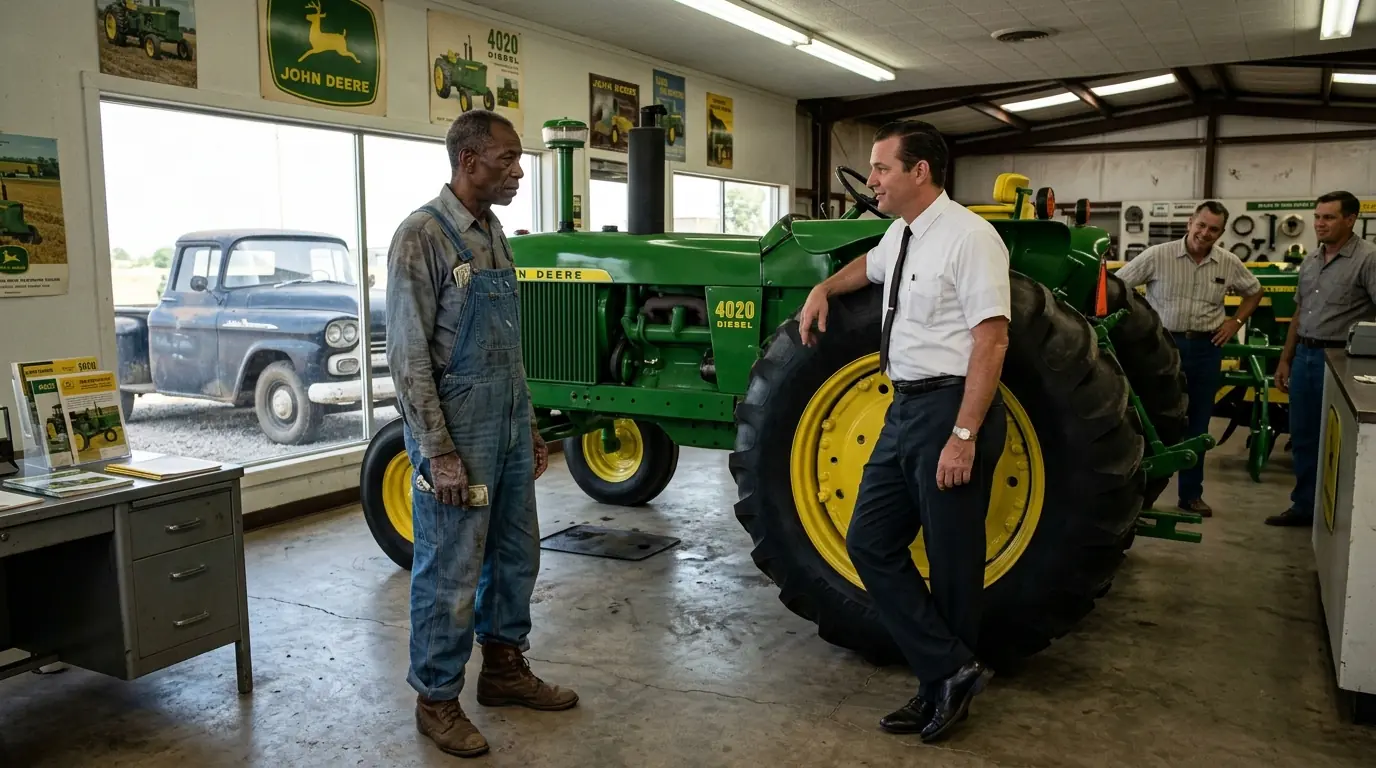
The dealer, a man named Vernon Pitts with slicked hair and a tie even in 100-degree heat, took one look at Harold's worn boots and faded denim, and decided right then this wasn't a customer worth his Saturday morning. Harold was 32 that summer, lean as fence wire with hands that told the story of every rock he'd ever pulled from a field and every engine he'd ever coaxed back to life with nothing but stubbornness and borrowed parts.
He farmed 420 acres his grandfather had broken with mules back in '09—land that rolled gentle along Blackjack Creek where the cottonwoods still grew thick enough to offer shade when the sun turned vicious. He ran wheat mostly, some milo, kept a dozen head of Hereford cows more out of habit than profit, and he did it all with equipment that other farmers had already traded away or left to rust behind their barns.
His main tractor was a 1949 Farmall M. Red paint faded to something closer to pink in places, with a wide front end and enough hours on the engine that the serial number plate had worn smooth. Harold's father had bought it used in '53 and Harold had learned to drive it when he was 8 years old, standing between his father's knees on the seat, small hands gripping the steering wheel while his father worked the clutch and throttle. That tractor had plowed every acre on the Brennan place for 18 years, pulled every wagon, powered every belt, and Harold knew its quirks the way some men knew their wives—knew exactly how much choke it needed on cold mornings, and which cylinder was light to miss when the timing drifted.
But standing in that implement dealership showroom with the new John Deere 4020 gleaming under the fluorescent lights, green and yellow paint so bright it almost hurt to look at, Harold felt something he didn't much like feeling. He felt small and behind and old-fashioned in a world that was racing forward whether he kept up or not.
Vernon Pitts finally wandered over, hands in his pockets, smile that didn't reach his eyes. "Help you with something?"
Harold nodded toward the 4020. "Like to know what you're asking for one of those."
Vernon's smile widened just a fraction. "That's a serious machine. 95 horsepower, power steering, 8-speed transmission, hydraulic remote valves. That's the future of farming right there. We're asking $4,800, but for a serious buyer, I might find some room."
Harold did the math in his head, compared it to what he had in savings, what the wheat had brought in July, what he still owed the bank on his land note. The numbers didn't work. Not even close. But he asked anyway, "What would you give me on trade for my Farmall?"
Vernon's expression changed, got a little harder around the edges. "Which Farmall?"
"'49 M model. Runs good. New clutch last spring. Rebuilt the carburetor myself 2 years back."
Vernon actually laughed, short and sharp. "A '49 M? Hell, friend, that thing's old enough to vote. I couldn't give you more than $200 for it, and that's only if I'm feeling generous. Probably end up scrapping it for parts."
The showroom had gone quiet. Two other men browsing near the implement section had stopped to listen, and Harold could feel their eyes on him, could feel the judgment in the silence.
"$200," Harold said slowly. Not a question, just letting the number sit in the air between them.
"That's charity," Vernon said, warming to his subject now, playing to his audience. "Nobody wants those old M's anymore. They're slow. They're small. They're obsolete. You're probably burning more in repairs every year than that tractor's worth. Smart farmers are upgrading, getting equipment that can cover ground, that can make them profitable. Guys still running that old Farmall International junk..." Well, he let the sentence hang, shrugged. "That's why half the small operators are selling out."
Harold felt heat rise in his chest, but kept his voice level. "That tractor's pulled every pound of wheat I've grown for 14 years."
"And that's exactly my point," Vernon said, leaning against a 4020's rear tire, getting comfortable. "You're working twice as hard to grow half as much. This machine here, you could cut your field time in half. Pull a bigger plow, cover more acres. That's how the successful operations are doing it now. But hey," he spread his hands, "if you want to keep nursing that old relic along, that's your business. Just don't come crying when you can't compete anymore."
One of the other men in the showroom, someone Harold didn't recognize, actually chuckled at that. Harold stood there another moment, looking at the 4020, doing the math one more time, even though he knew it wouldn't change. Then he nodded once, turned, and walked out into the August heat without another word. The drive back to the farm felt longer than 17 miles.
Harold's wife, Sarah, met him at the kitchen door when he got home, saw his face, and knew without asking how it had gone. She'd been a farm wife of 9 years by then, had learned to read drought in the sky and disappointment in her husband's shoulders, and she had her own opinions about new tractors and debt.