On a Tuesday afternoon in March of 1963, a 20-year-old woman named Margaret Holcomb walked into Dennison’s John Deere dealership in Russell, Kansas, and asked to see their used tractors.
Roy Dennison looked up from his desk, looked her over once, and laughed. Not a quiet laugh. The kind that carries across a showroom floor and makes everyone turn around to see who’s being humiliated.
Margaret was 5 ft 4, wore her father’s work jacket two sizes too big, had dirt under her fingernails, and hadn’t slept in 3 days. Her father, Frank Holcomb, had collapsed in the barn the previous Friday morning. Massive stroke. Dead before the ambulance left town. He was 51 years old.
Frank had farmed 240 acres of dry land wheat and grain sorghum west of Russell for 26 years. Good farmer, quiet man, never owed anyone a dollar he couldn’t pay back by harvest. He’d raised Margaret alone after her mother died of pneumonia in 1951.
Taught her to drive a tractor at 12, taught her to weld at 14, taught her to read soil the way most people read books, slowly, carefully, looking for what’s underneath the surface. Now, Frank was gone, and Margaret had 240 acres, a farmhouse with a leaking roof, and no tractor.
Frank’s only tractor, a 1951 Farmall M, had thrown its crankshaft 2 months before he died. He’d been planning to rebuild it over the spring. Never got the chance.
So, Margaret walked into Dennison’s John Deere, the only equipment dealer within 30 miles, looking for something she could afford. Roy Dennison was 46 years old. Big man, firm handshake, always wore a pressed shirt. He’d been selling John Deere equipment in Russell County since 1952 and had strong opinions about who belonged in farming and who didn’t.
“Can I help you, sweetheart?” Roy said, still smiling from his laugh.
“I need a tractor. Something I can run 240 acres with. What do you have used?”
Roy leaned back in his chair. “I heard about your daddy. Sorry for your loss. Frank was a good customer.”
“Thank you.”
“So, what are you planning to do with the farm?”
“Farm it.”
Roy’s smile got wider, the kind of smile that isn’t really a smile at all. “Farm it? By yourself?”
“Yes, sir.”
“Sweetheart, you’re 20 years old. You can’t farm 240 acres alone. That’s a man’s operation. Your daddy ran that place by himself for years and it nearly broke him. Why don’t you lease the ground out to one of the neighbors? Harold Brewer’s been expanding. He’d probably give you a fair price per acre or better yet, sell it. Buy yourself a nice little house in town. You’re a pretty girl. You’ll find a husband. Let him worry about farming.”
Margaret looked at Roy Dennison, looked at his clean hands, his pressed shirt, his confident smile. She thought about her father’s hands, cracked and calloused, strong enough to pull a calf and gentle enough to replant a seedling.
“Mr. Dennison, do you have a used tractor for sale or not?”
Roy sighed like he was dealing with a child who wouldn’t listen to reason. “I’ve got a 1958 John Deere 730. $12,000. It’s a fine machine. I can finance it for you. 10% down, 7 years at 9%. Your payment would be about 160 a month.”
Margaret did the math. $160 a month. 1920 a year. Over 7 years, she’d pay close to 15,000 for a $12,000 tractor. $3,000 in interest alone.
“That’s more than I can spend.”
“That’s what equipment costs, sweetheart. Farming isn’t cheap. You need capital to compete.”
“I’m not trying to compete. I’m trying to survive.”
Roy stood up, walked around his desk, put his hand on Margaret’s shoulder like a father talking to a confused daughter. “Margaret, listen to me. I knew your daddy. He was a good man, but he was stubborn. Farmed with old equipment, never upgraded, never expanded. He left you 240 acres and a broken tractor. That’s not a legacy. That’s a burden. The smartest thing you can do is sell that land, take the money, and start a life for yourself.”
Margaret stepped back, so his hand fell off her shoulder. “My father taught me everything I know. And one thing he taught me is that the people who tell you what you can’t do are usually the ones who are afraid you’ll prove them wrong.”
She walked out of the dealership. Behind her, she heard Roy say something to his mechanic. She caught two words. Little girl.
Let me tell you what happened next. Because what Margaret Holcomb did over the following 20 years would make Roy Dennison eat those two words with a side of humble pie.
Two weeks after walking out of Dennison’s, Margaret heard about a farm auction 40 miles east in Ellsworth County. Old equipment, estate sale, the kind of auction where things sell cheap because nobody’s looking for what’s being sold.
She drove out on a Saturday morning with $1,100 in cash. Everything she had, money her father had kept in a coffee can in the workshop, money Margaret had saved from two summers working at the grain elevator in town.
The auction was small, maybe 30 people. Mostly older men looking for parts. Two tractors were listed. A 1949 Farmall M and a 1953 Farmall Super M. Both faded red, both showing their age, both overlooked by everyone there.
Margaret knew those tractors. She’d grown up working on her father’s Farmall M. She knew the engine, knew the transmission, knew every bolt and bearing. These were the same machines, same bones, same blood.
The 1949 M went first. The auctioneer asked for a thousand, got silence, asked for 500. Margaret raised her hand. 400. More silence. Sold for $100. The 1953 Super M went next. Margaret bid 500. A man in the back bid 550. Margaret bid 600. Silence. Sold for $1,000 for two tractors. She had a hundred dollars left.
An older man walked up to her after the sale. Tom Weber. Farmed 300 acres near Ellsworth. He’d been watching her bid. “Those are solid tractors, young lady. You know how to work on them?”
“I rebuilt my father’s Farmall before I was 18.”
Tom looked at her differently than Roy Dennison had, not with pity or amusement, but with recognition. The way one farmer looks at another. “Your father taught you well.”
“He did.”
“Then you’ll be just fine.”
Margaret borrowed a flatbed from a neighbor and hauled both tractors home. The M needed a clutch and new hydraulic seals. The Super M needed a fuel pump rebuild and an electrical overhaul.
Margaret spent 3 weeks in her father’s workshop using her father’s tools, following notes her father had left in a battered repair manual on the shelf. By the middle of April, both tractors were running.
Let me tell you about Margaret’s first year because this is where most people would have quit. She planted 120 acres of winter wheat that her father had already seeded before he died and put the remaining 120 into grain sorghum. She did everything herself. Plowing, planting, cultivating, harvesting, up before dawn, working until she couldn’t see her hands in front of her face.
The neighbors watched, talked, shook their heads. That Holcomb girl is going to kill herself trying to farm alone. Somebody should talk some sense into her. She’ll be done by fall, guaranteed.
Roy Dennison heard the talk, drove out to her place in June, found Margaret under the Super M replacing a hydraulic line. “Margaret, I’m not here to sell you anything. I’m here as a friend of your father’s.”
Margaret slid out from under the tractor, grease on her face, wrench in her hand. “What do you need, Mr. Dennison?”
“I just want to make sure you’re okay out here. People are worried about you.”
“People are talking about me. There’s a difference.”
Roy looked at the two old Farmalls, looked at the workshop, looked at the fields stretching out to the horizon. “Those old tractors aren’t going to last, Margaret. They’re 15 and 10 years old. Parts are going to be hard to find. You’re going to have breakdowns at the worst possible times, and when that happens, you’re going to lose your crop.”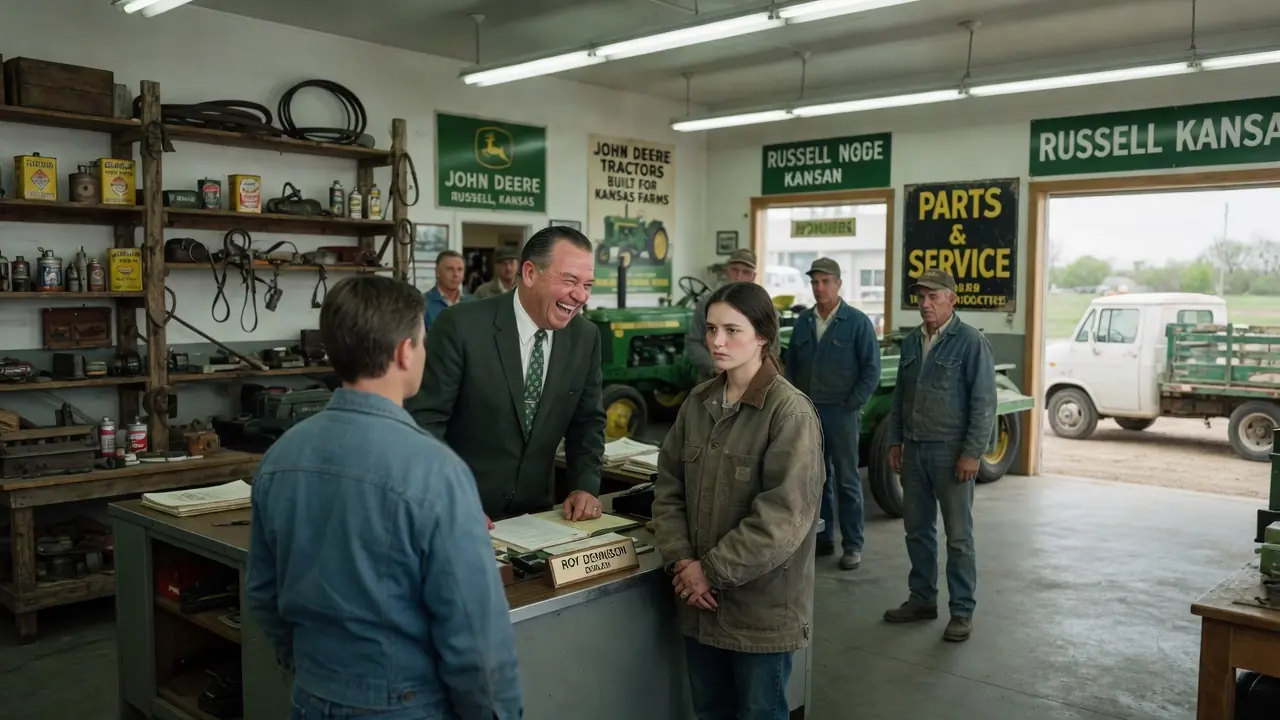
“They’ll last. I know how to take care of them.”
“Your daddy thought the same thing, and his tractor threw a crankshaft.”
That one landed. Margaret felt it in her chest, but she didn’t flinch. “My father’s tractor had 200,000 hours on it. These have half that. I’ll take my chances.”
Roy shook his head. “I hope you know what you’re doing.”
“I do.”
He left. Margaret went back under the tractor, but her hands were shaking, and not from the cold.
Harvest came in September. The wheat made 28 bushels an acre. Not great, but not bad for dry land Kansas in a dry year. The sorghum made decent yields, too. She sold everything, paid her property taxes, set aside money for seed and fuel, and had $4,200 left. She put every penny in the bank.
But let me tell you about November, because this is the part Margaret doesn’t like to talk about. The harvest was done. The fields were empty. The days got short, and the wind came down off the high plains the way it does in western Kansas, cold and steady and relentless.
Margaret was alone in that farmhouse for the first time since her father died, and the silence was louder than anything she’d ever heard. She sat at the kitchen table one evening with her bank statement and a pencil. $4,200. That was everything. One bad year, one drought, one equipment failure she couldn’t fix, and she was finished.
The numbers didn’t lie. She was one disaster away from losing the farm. For the first time since she’d bought those two Farmalls, she thought about Roy Dennison’s words. Sell it. Buy a house in town. Let someone else handle it.
The next morning, Margaret drove into Russell. She told herself she was going to the feed store, but she didn’t drive to the feed store. She drove to Dennison’s John Deere, parked across the street, sat in her truck with the engine running.
She watched farmers walk in and walk out. Men with clean boots and new hats. Men who belonged in that building in ways she never would. She thought about how easy it would be. Walk in, tell Roy she’d changed her mind, ask him to help her find someone to lease the ground. The payments would come in every year. She could get a job in town. She could stop worrying about rain and rust and whether the Super M would make it through another season.
Her hand was on the door handle when she saw her reflection in the side mirror. Her father’s jacket. Her father’s hands, or close enough. Dirt under the nails, calluses on the palms.
She thought about her father driving that Farmall M through 30 Kansas summers without complaint. She thought about him coming home covered in dust, washing his hands at the kitchen sink, sitting down to dinner like it was the most natural thing in the world. She thought about the way he’d look out the window at his fields and smile, not because the work was easy, but because the work was his.
Margaret took her hand off the door handle, put the truck in gear, drove home. She never told anyone about that morning, never mentioned it to a single person in 45 years of farming.
Margaret took her hand off the door handle, put the truck in gear, and drove home. She never told anyone about that morning, never mentioned it to a single person in 45 years of farming.
Let me tell you about the next 17 years, because this is where patience becomes power. Margaret farmed those 240 acres from 1963 to 1980 with the same two old Farmalls she bought at auction. She followed her father’s seven-year rotation exactly. She planted cover crops every fall while her neighbors laughed at her. She lived below her means, saved every dollar she could, and never took on a single dollar of debt.
The results were slow but undeniable. By the early 1970s, Margaret’s wheat yields were consistently 10 to 15 percent higher than the county average. Her sorghum survived dry years better because her soil held more moisture. In the drought of 1974, when half the county lost their wheat crop, Margaret’s fields still produced 22 bushels an acre while her neighbors averaged only 11.
People started noticing. Not with respect at first, but with confusion. How was the Holcomb girl outproducing farms with new tractors and heavy fertilizer? The answer was in the soil, but nobody asked her. After all, who would ask a woman about agronomy?
Roy Dennison continued stopping by her farm once a year. Always the same conversation. “Still farming with those two junk tractors?” “Still farming with those two junk tractors.” “You know, Margaret, I’ve stopped trying to sell you a tractor. I just come out here to see if they’re still running. It’s become a personal curiosity.”
By 1980, Margaret had $92,000 in the bank after 17 years of careful saving and no debt. She owned her 240 acres free and clear. While her neighbors were heavily leveraged with new equipment and expanding land, Margaret owed nothing to anyone.
Then 1981 arrived, and the world her neighbors had built came crashing down. Interest rates spiked to 21 percent. Grain prices collapsed. Land values fell through the floor. The Farm Crisis destroyed Russell County. Between 1982 and 1987, 43 farms in the county went into foreclosure.
Roy Dennison’s dealership began bleeding money. Farmers could no longer pay their loans. Margaret watched her neighbors lose everything at auction after auction.
She never gloated. Instead, she showed up at those auctions with cash. In 1983, she bought 160 acres of the Brewer farm for $68,000. In 1985, she bought 80 acres of the Whitfield place for $31,000. In 1987, she bought another 120 acres from an estate sale. All paid in full, no loans.
By 1988, Margaret Holcomb quietly owned 600 acres, all free and clear. She was 45 years old.
It was a Thursday evening in October of 1986 when Roy Dennison’s dealership finally closed forever. That same evening, Margaret was working in her workshop when she heard a truck pull into the yard. Roy sat in his pickup with the engine running, staring at nothing. He looked ten years older.
She walked out and stood by his window. “Roy? Are you all right?”
He turned, eyes red. “I closed the dealership today.”
“I heard. I’m sorry.”
Roy gave a broken laugh. “You’re sorry? I told you to sell your farm. Called you a little girl. And now you’re sorry for me?”
Margaret leaned against the truck. “Losing something you built is painful, no matter who you are.”
Roy was quiet for a long moment. Then he asked, “How many acres do you own now?”
“Six hundred.”
Roy shook his head slowly. “I pushed debt on every farmer in this county for twenty years. And now most of them are gone. But you… you were the only one who did it right.”
He looked at her with genuine regret. “Margaret, I owe you a real apology. For every time I laughed at you. For every time I told you that you couldn’t do it. You were right, and I was wrong.”
Margaret smiled softly. “Thank you, Roy. That means more than you know.”
Roy started his truck. “Those two old Farmalls still running?”
“Every single day.”
He shook his head in disbelief. “Best thousand dollars anyone in this county ever spent.”
Then he drove away into the night.
Margaret Holcomb farmed until 2008. She eventually owned 840 acres, all paid for in cash. She never bought a new tractor. Every piece of equipment came from auctions and was rebuilt in her father’s workshop. The 1949 Farmall M ran for 42 years. The 1953 Super M ran for 51 years.
When she retired, she leased her land to a young couple with the same fair terms she had wished someone had given her in 1963. She also gave them her father’s soil journal.
Margaret is 83 years old now. She still lives in the same farmhouse. The roof no longer leaks. She fixed it herself in 1978.
She says the greatest lesson wasn’t about farming. It was about soil and people. “The land gives back exactly what you put into it. Nothing more, nothing less. The same is true of life. The people who tell you what you can’t do are usually the ones most afraid you’ll prove them wrong.”
And so the little girl with two old tractors and $1,100 in cash proved everyone wrong, not with noise, but with quiet, stubborn, patient work.
The dealer told her to sell the farm. She kept the farm. She kept the tractors. And the land remembered.