The young salesman barely looked up before smirking and saying it.
"Sell the farm, old man."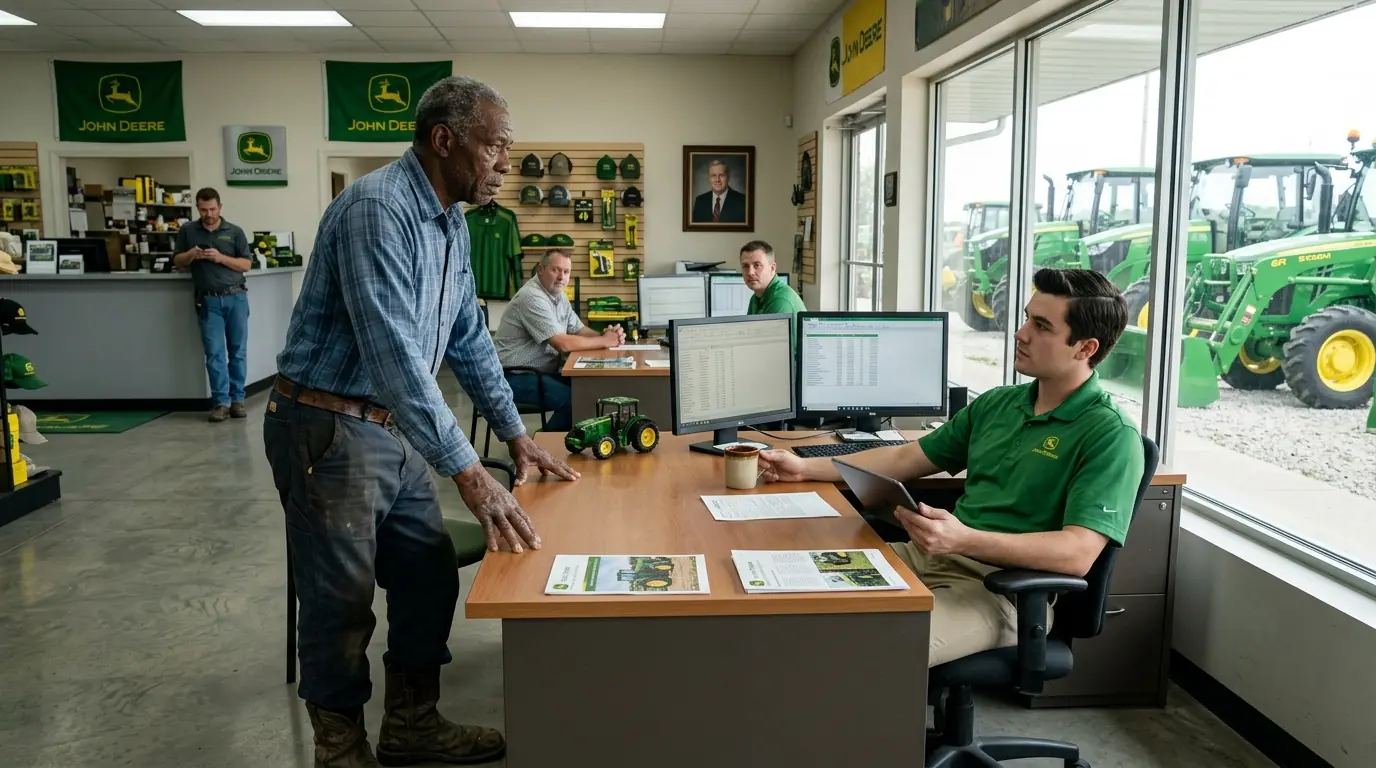
After decades of droughts, debts, and fighting to keep his land alive, it was the last thing he expected to hear, and the one thing he'd never forget. He walked out of that dealership humiliated, empty-handed, and dismissed as someone who was already finished. But he didn't argue. He didn't come back. Instead, he disappeared into the work: long days, longer nights, and a quiet determination no one saw coming.
Five years later, when he finally returned, it wasn't to buy a tractor. It was to sign papers. And what he owned by the end of that day left everyone in that dealership staring at him in stunned silence.
Three weeks before that morning at the dealership, Earl Dawson's John Deere 4440 died in the middle of a soybean field. No warning, no grinding noise, no smoke, no slow fade. The engine just stopped, and 26 years of reliable service ended on a Tuesday afternoon in September.
Earl sat in the cab for a long time. The field stretched flat in every direction, 300 acres of bottomland along the Gasconade River that his grandfather had cleared, his father had planted, and he had held on to for 49 years. The soybeans were thin that season, drought all summer, and now this.
He climbed down and put his hand on the hood. Still warm. He had rebuilt this tractor twice over the years, replaced the hydraulic pump, welded the drawbar back together, patched the exhaust manifold with a coffee can and JB Weld one January when the temperature never got above 12°. Every bolt on this machine he knew by feel, and the sound it made just now, that flat final silence, told him everything he needed to know.
He walked the half-mile back to the house. June would have known what to say. She always had. When the well pump failed in 2014, she sat him down with a glass of iced tea and said, "Earl, we'll fix it or we'll dig a new one. Either way, we'll have water by Friday." And they did.
When the barn roof caved in under ice the following winter, she was the one who called three neighbors and had a tarp up before dark. But June had been gone 2 years.
The kitchen was quiet when Earl came through the screen door. Her chair was still at the table across from his. Her reading glasses sat on the windowsill above the sink, right where she had left them the morning the ambulance came.
Earl poured a glass of water and sat down. He looked at the chair across from him. "Tractor's done, June," he said. Nobody answered, but he had been talking to her like that since the funeral. 47 years of marriage builds a conversation that doesn't stop just because one person leaves the room.
The next morning, he pulled out his ledger and did the math. The farm had cleared $11,000 the previous year after expenses, $9,000 the year before that. 3 years back, he had actually lost money. A replacement tractor, even a used one with decent hours on it, would run somewhere between 40 and 60,000 dollars. The bank would need to see income that justified a loan, and his income told a simple story: a 71-year-old man holding on by his fingernails.
But he needed a tractor. You cannot farm 300 acres with a pickup truck and a prayer.
He called the equipment dealership in Barnwell the next day. The woman who answered put him on hold for 4 minutes, then told him to come in Thursday morning.
Thursday, Earl was up at 5:00, same as every other day of his life since he was 16. He fed the chickens, checked the water troughs for the three head of cattle he still kept, and walked the fence line along the south pasture where three posts were leaning at angles that would have made June furious. She had been the one who kept after him about the fences. "A leaning post is a falling post, Earl. Fix it now or fix it later, but later always costs more."
He had not fixed them. He had not done a lot of things in the 2 years since she died. He showered, put on a clean shirt, and ate two eggs standing at the counter. Then he drove the 14 miles to town.
Barnwell sat along the state highway like it had been set down by accident and nobody had bothered to pick it up. One stoplight, one bank, one diner with a sign that still said open even though the hours had been cut to breakfast and lunch only. A hardware store, a feed supply, a post office, and a church with a parking lot bigger than the building.
At the far end of the main road stood the largest structure in town, Harding Equipment. Green metal walls, the John Deere logo running the length of the roof, and a row of tractors and mowers lined up out front. Dale Harding had built that dealership from a single repair bay in 1972. Earl's father had bought a combine there in '78, and Earl himself had been buying parts and filters from that counter for 30 years.
Dale knew every farmer in the county by first name. He remembered their wives' birthdays and what year they had replaced their last baler. When Dale sold you something, he shook your hand and meant it. But Dale had retired 2 years back. His son, Kyle, had taken over. Earl had never met Kyle.
He parked in the gravel lot and walked through the glass doors. The showroom smelled like new rubber and floor polish. Two salesmen sat at desks along the far wall, both staring at computer screens. A third leaned against the parts counter with a phone pressed to his ear, laughing at something.
Earl stood near the entrance and waited. Nobody looked up. A glass display case by the door held model tractors and branded merchandise—hats, belt buckles, keychains. Above it, on the wall, a framed photograph showed Dale Harding shaking hands with a man in a corporate suit. A plaque underneath read "40 Years of Excellence." The frame was dusty.
One of the salesmen at the desks glanced over, then looked away.
Earl waited another full minute, then a young man came out from the back office, late 20s, clean hands, hair styled with some kind of product in it. Green polo shirt with the dealership logo stitched on the chest. He carried a tablet in one hand and a coffee cup in the other, and he sat down at the biggest desk in the room without looking in Earl's direction.
"Help you?" the young man said, his eyes still on the screen.
Earl walked over. "I'm Earl Dawson. I farm south of town off County Road 14. My tractor gave out last week, and I need to talk about financing a replacement."
The young man tapped something on his tablet. "What kind of operation?"
"300 acres. Soybeans and corn, mostly. Some hay on the west side."
"Revenue last year?"
"About 11,000 clear."
Kyle Harding looked up for the first time. His eyes moved from Earl's boots to his faded but clean shirt to his hands, which were scarred and thickened from 50 years of farm work. It was a quick look, the kind a person gives when they have already decided what they are seeing.
"11,000," Kyle said, "on 300 acres. It was a hard year, Mr. Dawson."
Kyle set his coffee down and leaned back in his chair. "I'll be honest with you. We finance equipment for operations that can service the debt. $11,000 a year doesn't cover the interest on a decent used four-wheel drive, let alone the principal."
"Your father financed my combine in 2001," Earl said. "I paid every installment on time. 7 years, not a single late payment."