When Nolan Kirchner called the John Deere dealership at 7:14 on a Monday morning, he was not asking for a favor.
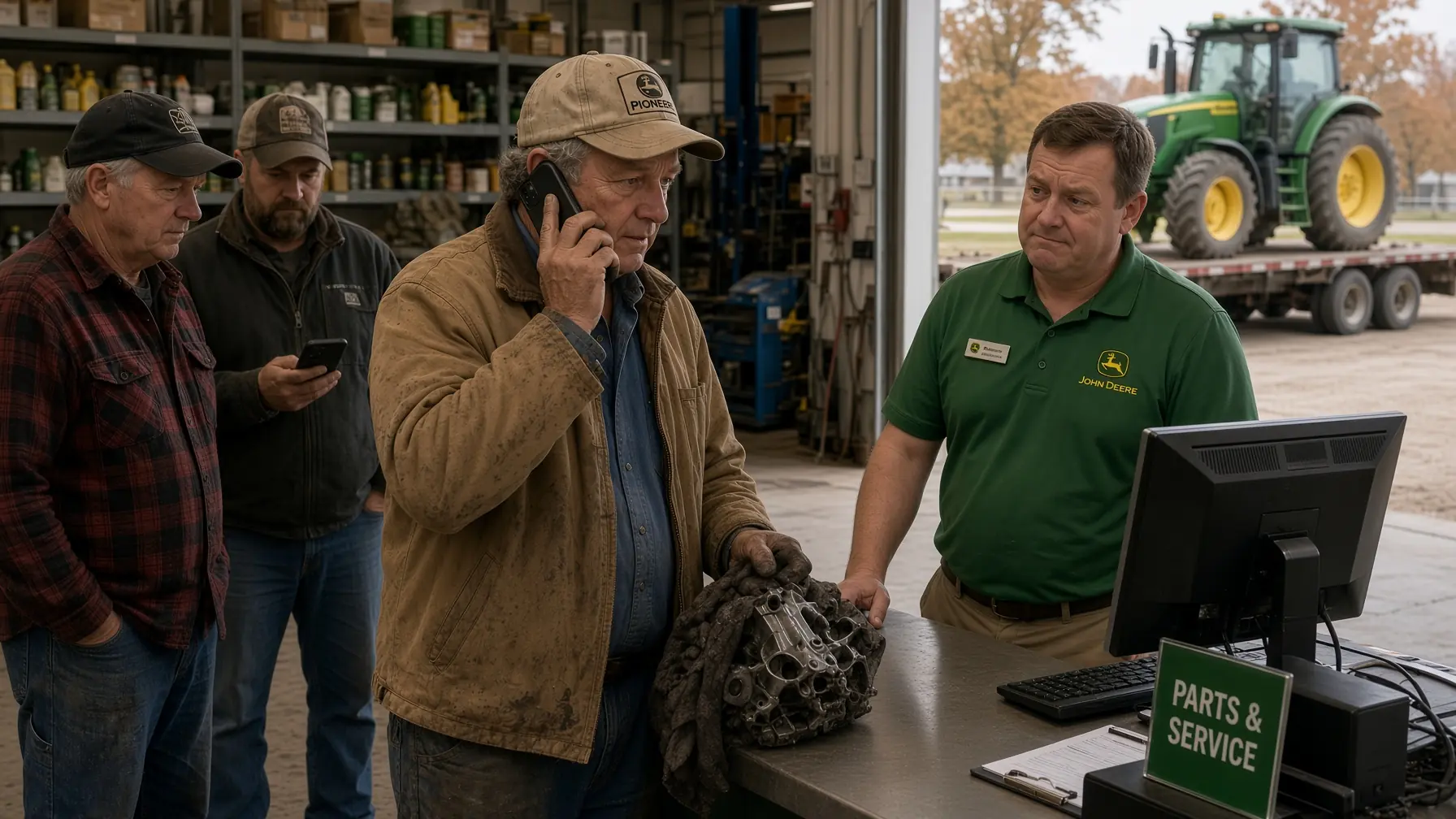
He was asking for service.
His tractor was sitting dead beside a half-finished cornfield.
Seven hundred twenty acres still needed work before the weather changed.
Rain was forecast for Thursday.
And the machine that normally handled the heaviest part of Nolan’s fall schedule would not move.
He had already done everything he knew to do.
Checked fuel.
Checked the obvious electrical connections.
Looked for hydraulic leaks.
Restarted twice.
Nothing.
The engine would fire.
The transmission would not engage properly.
A warning code kept appearing on the display.
Nolan stood beside the tractor with his phone pressed to one ear while cold October wind moved through the dry stalks around him.
The woman who answered at Central Valley Equipment was polite.
That almost made what happened next worse.
“Service department.”
“Morning. Nolan Kirchner. I’ve got a Deere 8335R down about eight miles east of Weller.”
“Okay.”
“Transmission fault. Machine starts, but it won’t move correctly. I need somebody out as soon as you can.”
She asked for the serial number.
Nolan climbed onto the step, wiped dust from the plate, and read it to her.
Keyboard clicking.
Then silence.
“Mr. Kirchner?”
“Yeah?”
“Did you purchase this unit from us?”
Nolan looked across the field.
“No.”
“Where was it purchased?”
“Used. Nebraska. Four years ago.”
Another pause.
“Have we serviced it before?”
“Parts a couple times. Maybe one hydraulic call three years ago.”
More typing.
Nolan waited.
He already knew what was happening.
Every farmer did.
Dealerships had priority systems.
Customers who bought machines there tended to get seen first.
Large operations with service contracts were near the top.
Machines under warranty mattered.
Everybody understood that.
What Nolan did not expect was the number she gave him.
“I can schedule an inspection for November 13.”
He thought he had heard wrong.
“What date?”
“November 13.”
Nolan looked at his phone.
October 16.
“That’s four weeks.”
“We are extremely backed up.”
“I’m in corn.”
“I understand.”
“No, I don’t think you do.”
His tone had sharpened, but he forced it back down.
“I've got seven hundred twenty acres unfinished.”
“I’m sorry.”
“Can you send a road technician just to diagnose it?”
“Our mobile units are fully booked.”
“What if I haul it in?”
“We can put it in the queue.”
“How long?”
“Approximately the same.”
Nolan took off his cap and rubbed his forehead.
The wind felt colder suddenly.
“There’s nobody who can at least look at the code?”
“I can transfer you to parts.”
“I don’t need parts until I know what failed.”
“I understand.”
There it was again.
I understand.
The phrase people used when they needed to end a conversation without changing anything.
Nolan asked:
“Who gets service before me?”
The woman became careful.
“I can’t discuss other customers.”
“I’m not asking for names.”
He looked at the dead tractor.
“I’m asking why a four-week wait is acceptable in October.”
“Our customers with active service agreements and machines purchased through our dealership are prioritized.”
Nolan was silent.
There it was.
At least now it was honest.
“So because I didn’t buy this tractor from you, I wait until harvest is basically over?”
“That isn’t exactly what I said.”
“It’s close enough.”
“I can put you on the cancellation list.”
Nolan almost laughed.
“Do that.”
He hung up.
Then stood beside the tractor for another minute.
A machine worth more than some houses.
Dead.
Corn waiting.
Rain coming.
Four weeks.
Nolan Kirchner was forty-nine years old and farmed outside Weller, Iowa, with his wife, Rachel, and their son Mason.
Kirchner Farms was not one of the giant operations people photographed for agricultural magazines.
It was seven hundred twenty owned and rented acres.
Corn and soybeans.
A small cattle lot.
Two full-time people during most of the year.
Three or four extra hands when harvest got busy.
Enough ground to require serious equipment.
Not enough ground to own duplicates of everything.
That difference mattered.
If a five-thousand-acre operation lost one tractor, another machine could often cover part of the gap.
If Nolan lost his primary high-horsepower tractor during fall tillage, work stopped.
He had purchased the 8335R used because buying new would have tied up money he preferred to keep in land and operating capital.
The tractor had been good.
Very good.
Almost four thousand hours.
Regular maintenance.
No major failures.
That morning, none of those facts mattered.
It was dead.
Nolan called two neighbors.
Both were busy.
He called an independent shop thirty miles away.
Could not get there for nine days.
Another mechanic had recently retired.
Then Nolan remembered a name.
Evan Rusk.
He had heard it twice that summer.
Once from a livestock farmer whose skid steer had lost hydraulics.
Again from a school-district maintenance supervisor who claimed Rusk had repaired an electrical problem two dealership technicians had missed.
Evan worked from a Morton building behind an old acreage west of town.
No dealership sign.
No showroom.
No branded coffee cups.
Just a blue steel building with three service bays and a gravel lot.
Nolan found the number in his phone through a text from another farmer.
He called.
A man answered on the fifth ring.
“Rusk Equipment Service.”
“You Evan?”
“Yeah.”
“Nolan Kirchner. You work on Deere?”
A pause.
“I work on problems.”
That was not the answer Nolan expected.
“I’ve got an 8335R.”
“Year?”
Nolan told him.
“Hours?”
“Thirty-eight sixty.”
“Code?”
Nolan read it.
This time the silence was different.
Not keyboard silence.
Thinking.
Evan asked:
“Did it fail moving or after restart?”
“After restart.”
“Any hesitation yesterday?”
“Little rough backing into the shed.”
“Hydraulic temperature normal?”
“Far as I know.”
“Transmission oil changed when?”
“About three hundred hours ago.”
“Dealer fluid?”
“Yes.”
Another pause.
“Where’s it sitting?”
Nolan gave the road.
“I can be there around ten.”
Nolan looked at the time.
It was 7:31.
“Today?”
“Unless you wanted November.”
Nolan laughed despite himself.
“I’ll take today.”
Evan Rusk arrived at 9:48 in a ten-year-old white service truck.
No logo except small black lettering on the door.
RUSK EQUIPMENT SERVICE
He was forty-two.
Lean.
Brown beard beginning to gray.
Heavy canvas jacket.
No salesmanship whatsoever.
He climbed out, shook Nolan’s hand, then looked at the tractor.
“Tell me exactly what happened.”
Nolan did.
Evan listened without interrupting.
Then plugged a diagnostic laptop into the machine.
He read codes.
Checked pressures.
Climbed underneath.
Removed an inspection cover.
Ran another test.
Forty minutes later, Nolan asked:
“Transmission?”
“Maybe.”
“That sounds expensive.”
“Most guesses are.”
Evan wiped his hands.
“I don't think the transmission itself is gone.”