The gavel came down hard enough to make Sarah Jenkins flinch.
“Motion denied.”
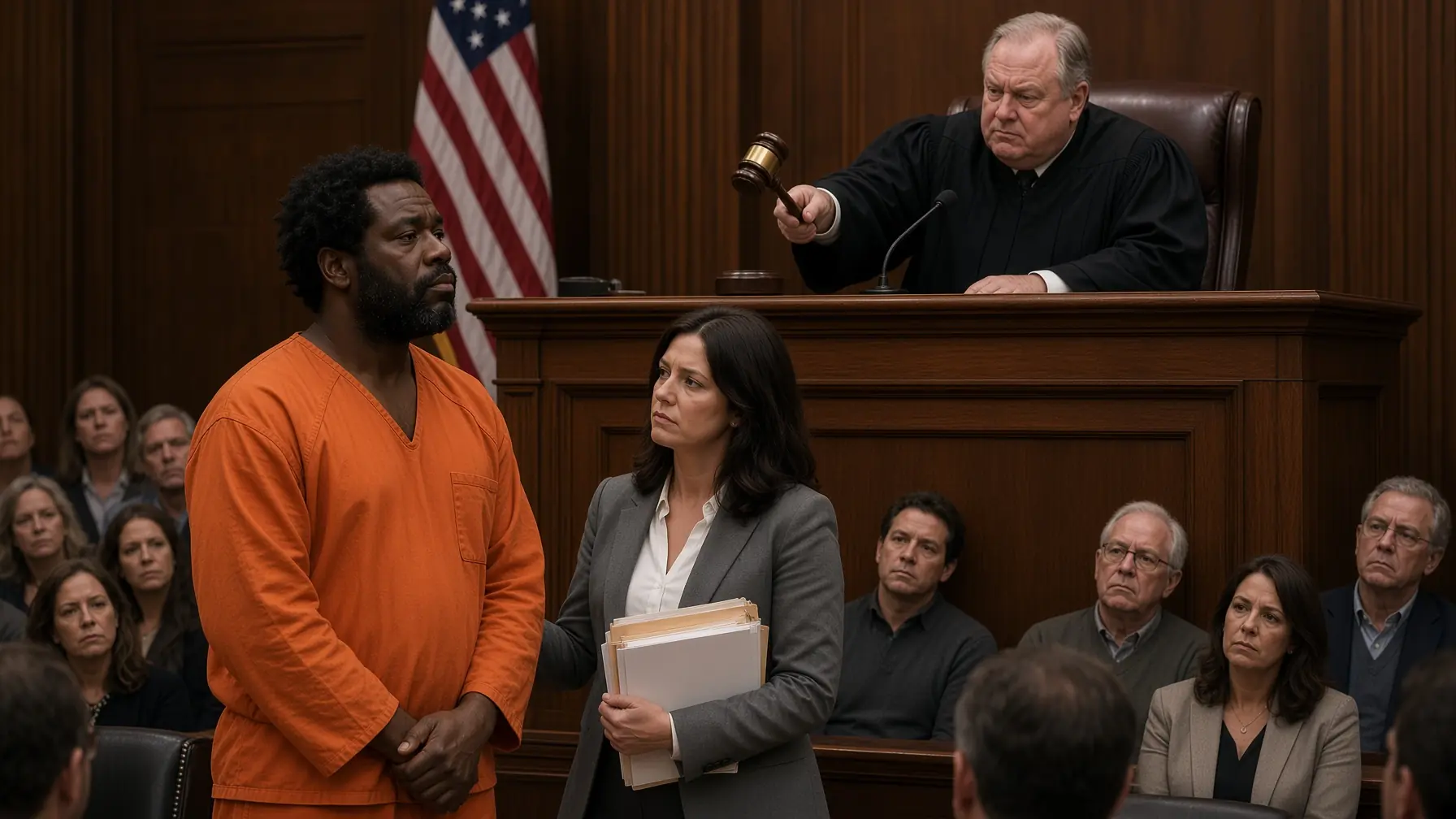
Judge Arthur Harrington did not bother looking at the defense table when he said it. He was already gathering the papers in front of him, his thick fingers moving with the bored efficiency of a man clearing away something unpleasant before lunch. Courtroom 4B of the Oak Haven County Courthouse had spent nearly three hours hearing arguments about a missing section of police video, conflicting chain-of-custody records, and a bag of cocaine two officers claimed they had discovered in the backpack of a Black man named Malik Jones. Harrington had listened to all of it. Or at least he had been physically present for all of it. Now his decision required less than fifteen seconds.
“The court finds Officers Miller and Davis credible,” he continued. “The alleged recording malfunction does not establish misconduct, and the defense has offered nothing beyond speculation to support this increasingly theatrical claim that evidence was planted.”
Sarah rose. “Your Honor, the fleet diagnostic specifically indicates manual deactivation.”
Harrington finally looked at her.
“Ms. Jenkins, I have ruled.”
“The report also contradicts Officer Miller’s testimony that—”
“I have ruled.”
His voice sharpened.
Sarah stopped.
Beside her, Malik Jones remained seated in a county-issued orange uniform, wrists linked by a short chain in front of him. He was forty-five, broad-shouldered, with a close beard and the tired appearance of a man who had spent the previous twelve days sleeping under fluorescent lights. He had said almost nothing during the hearing. He had watched.
That bothered Harrington more than anger would have.
The judge leaned forward.
“Mr. Jones, stand.”
Malik stood.
Harrington studied him.
“You have spent two weeks accusing police officers, challenging lawful authority, and wasting this court’s time with a story unsupported by evidence. You were found carrying nearly sixty grams of cocaine packaged in a manner consistent with distribution. You have no verifiable employment history in this jurisdiction, no family the court can confirm, and no meaningful ties to Oak Haven.”
Sarah opened her mouth.
Harrington held up one hand.
“I’m speaking.”
Malik looked directly at him.
Harrington’s expression hardened.
“Men like you arrive in communities like this, bring poison with you, and then expect the rest of us to apologize when consequences finally arrive.”
The courtroom changed.
Not dramatically.
A court reporter’s fingers stopped for half a second.
A clerk looked toward the judge.
Sarah’s shoulders stiffened.
Prosecutor Robert Vance lowered his eyes.
Malik did not move.
Harrington seemed to realize he had approached a line. He corrected himself without admitting it.
“People engaged in this kind of conduct,” he said, “are a danger to the public.”
Sarah said quietly, “My client has not been convicted of anything.”
Harrington’s eyes snapped toward her.
“And he will receive every process he is entitled to.”
He looked at Malik again.
“Bond remains denied. Defendant is remanded pending trial.”
The gavel fell once more.
For anyone watching casually, that was the end of the hearing.
For the six people in Oak Haven who knew what Malik Jones’s real name was, it was something else entirely.
It was another timestamp.
The man being led toward the holding corridor was not a transient drug dealer.
He was Marcus Thorne, a supervisory special agent assigned to a joint FBI public-corruption and organized-crime task force.
And Judge Arthur Harrington had just done almost exactly what investigators had spent eighteen months waiting for him to do.
Oak Haven was the kind of city politicians liked photographing from the riverfront.
There were restored warehouses turned into restaurants, glass apartment towers, a new baseball park, and a redevelopment district full of banners announcing that the city was “Building Tomorrow Together.” But three miles west of downtown, the pavement cracked. Streetlights went months without repair. Store owners paid cash to people they called security even when everybody understood the money bought something closer to permission.
At the center of that economy was Vincent Costello.
Nobody with a badge called him “the Viper.” That name belonged to newspapers and people trying too hard. Investigators simply called him Costello.
He owned restaurants, waste-hauling companies, two construction firms, a marina, and a commercial real-estate partnership that never seemed to make as much money on paper as the lifestyle surrounding it suggested. His organization made money from illegal gambling, narcotics distribution, extortion, fraudulent municipal contracting, and lending schemes that began with friendly handshakes and ended with businesses changing ownership.
For years, local and federal investigators had attacked different pieces of the organization.
They made arrests.
Costello stayed.
Witnesses changed their stories.
Search warrants produced less than expected.
Defendants connected to Costello received surprisingly favorable rulings while independent dealers and street-level competitors seemed to encounter unusually aggressive prosecutions.
Patterns were not proof.
Then investigators began noticing one courtroom.
Arthur Harrington had been on the county bench for sixteen years. His public reputation was simple: strict, efficient, unsentimental. Local political ads had once praised him for “keeping dangerous criminals off Oak Haven’s streets.”
The statistics looked impressive until someone asked the wrong questions.
Why were motions to suppress granted at dramatically different rates depending on which officers made the arrest?
Why did certain defense challenges vanish after sidebars that were poorly documented?
Why did defendants linked through phone records to Costello’s organization repeatedly receive continuances long enough for witnesses to disappear?
And why did street arrests by Officers Frank Miller and Kevin Davis so often end up in Harrington’s courtroom?
The FBI task force did not begin with a theory that Harrington was racist and build backward.
It began with money.
A shell consulting company called North Lake Advisory paid another company owned by Harrington’s brother-in-law.
That could have been legitimate.
The brother-in-law actually performed some consulting work.
Then forensic accountants noticed payments increased during months when major Costello defendants appeared before Harrington.
Still not enough.
A payment correlation was not bribery.
Next came intercepted calls from a Costello lieutenant named Dominic Ferra.
Federal agents had obtained a Title III wiretap after developing probable cause unrelated to the judge.
Ferra rarely said anything useful.
Then one night he complained that “the old man in four-B wants his landscaping handled before Friday.”
Investigators checked.
Harrington had landscaping work done at his Silver Lake house that week.
The contractor invoice showed $28,400.
Harrington paid $4,000.
A Costello-linked construction company paid the remainder through what its books called “site remediation.”
The task force now had a serious public-corruption investigation.
What it still lacked was proof of the operational mechanism.
Who told the judge which cases mattered?
How were cases steered?
Were police officers participating knowingly or merely benefiting from a permissive courtroom?
And were vulnerable defendants being framed to remove competitors or create bargaining leverage?
That was where Frank Miller and Kevin Davis entered the case.
They were not movie villains.
Miller had twelve years on the department, two commendations for pulling motorists from burning vehicles, and no sustained excessive-force complaints.
Davis had coached youth baseball.
His personnel file contained more praise than discipline.
Both facts would matter later because corruption did not require someone to be terrible every minute of his life.
The task force first linked them to Costello through a dismissed narcotics case.
A confidential informant said Miller and Davis sometimes removed drugs from seizures before the evidence reached the property room.
Investigators checked.
Several evidence weights differed slightly between field estimates and laboratory intake.
That could happen for innocent reasons.
Packaging.
Scale differences.
Moisture.
Sloppy estimates.
Then a larger discrepancy appeared.
A seizure report listed 162 grams of cocaine.
The laboratory received 101.
No supplemental explanation existed.
Body camera covered the seizure.
Dash camera did not cover everything afterward.
Miller and Davis had access to the drugs before sealing.
Still circumstantial.
Marcus Thorne listened to the task-force briefing and asked a question nobody liked.
“What would they do if they thought they found someone who couldn’t fight back?”
Assistant U.S. Attorney Naomi Cole looked at him.
“What are you proposing?”
Marcus pointed toward the case map.
“We keep trying to catch them protecting Costello’s people.”
“That’s because that’s the investigation.”
“What if half the business model is the opposite?”
Cole frowned.
Marcus continued.
“Remove somebody Costello wants gone. Create a case. Feed it into a courtroom where challenges die.”
Special Agent Elena Ramirez, the operational lead, leaned back.
“You’re suggesting a controlled target.”
“Yes.”
“No.”
Marcus looked at her.
“You didn't even let me finish.”
“I've known you eleven years.”
Cole asked, “Who would play the target?”
Ramirez answered before Marcus could.
“He would.”
Marcus smiled.
Cole did not.
Federal undercover operations involving police corruption required layers of approval precisely because they could go wrong in ways ordinary stings did not. An undercover agent could be searched, struck, booked, or placed in proximity to people who had no idea an operation existed. A fabricated local identity had to survive routine checks without exposing the agent. Local jail personnel could not simply be told the truth because every additional person who knew increased the risk of compromise.
The proposal spent weeks moving through lawyers.
The final plan was narrower than Marcus originally wanted.
He would become Malik Jones, a recently arrived day laborer with a plausible background assembled through an authorized undercover identity. He would live in Oak Haven long enough to appear real.
The FBI would not plant drugs.
It would not manufacture a false local prosecution.
The task force would create an opportunity for Miller and Davis to interact with Malik after a Costello source was led to believe he might be a low-level independent courier moving into the city.
Then investigators would watch.
If nothing happened, nothing happened.
If the officers merely stopped him, checked his identity, and released him, the operation ended.
If they committed a crime, federal surveillance teams would preserve what they could without risking immediate exposure.
Marcus accepted the assignment.
For six weeks, he stopped being Supervisory Special Agent Thorne.
Malik Jones rented a second-floor apartment above a closed barber shop.
He unloaded delivery trucks three mornings a week under a cooperating employer.
He washed dishes at a diner on weekends.
He bought groceries with cash.
He walked everywhere.
He learned which storefronts closed early when Costello collectors came through.
He learned which patrol cars slowed near teenage boys for no obvious reason.
He learned something else too.
Powerlessness changed the temperature of every conversation.
As Marcus Thorne, a late return call meant someone was busy.
As Malik Jones, it often meant nobody cared.
As Marcus, a security guard asking him to move became a professional exchange.
As Malik, the same instruction sometimes came with “boy” or “buddy” attached.
He wrote none of that into operational evidence unless it mattered.
Personal impressions were not proof.
But he remembered them.
The arrest happened on a Thursday evening.
Marcus left the diner at 9:06 carrying a canvas backpack.
Inside were work clothes, a paperback, a charger, and half a turkey sandwich wrapped in foil.
No contraband.
He walked four blocks.
A patrol cruiser appeared behind him.
No siren.
Then blue lights.
Marcus stopped beneath a streetlamp.
Miller stepped out first.
“Where you headed?”
“Home.”
Davis came around the passenger side.
“Little late for a walk.”
“Just got off work.”
Miller looked toward the bag.
“What’s in there?”
“Work clothes.”
“ID.”
Marcus handed over the Malik Jones license.
Miller studied it.
“You new here?”
“About a month.”
“What brings you to Oak Haven?”
“Work.”
“What kind?”
“Whatever pays.”
Miller smiled.
“Honest answer.”
He returned the ID.
That should have ended it.
Then Davis said, “Let me see the bag.”
Marcus held it.