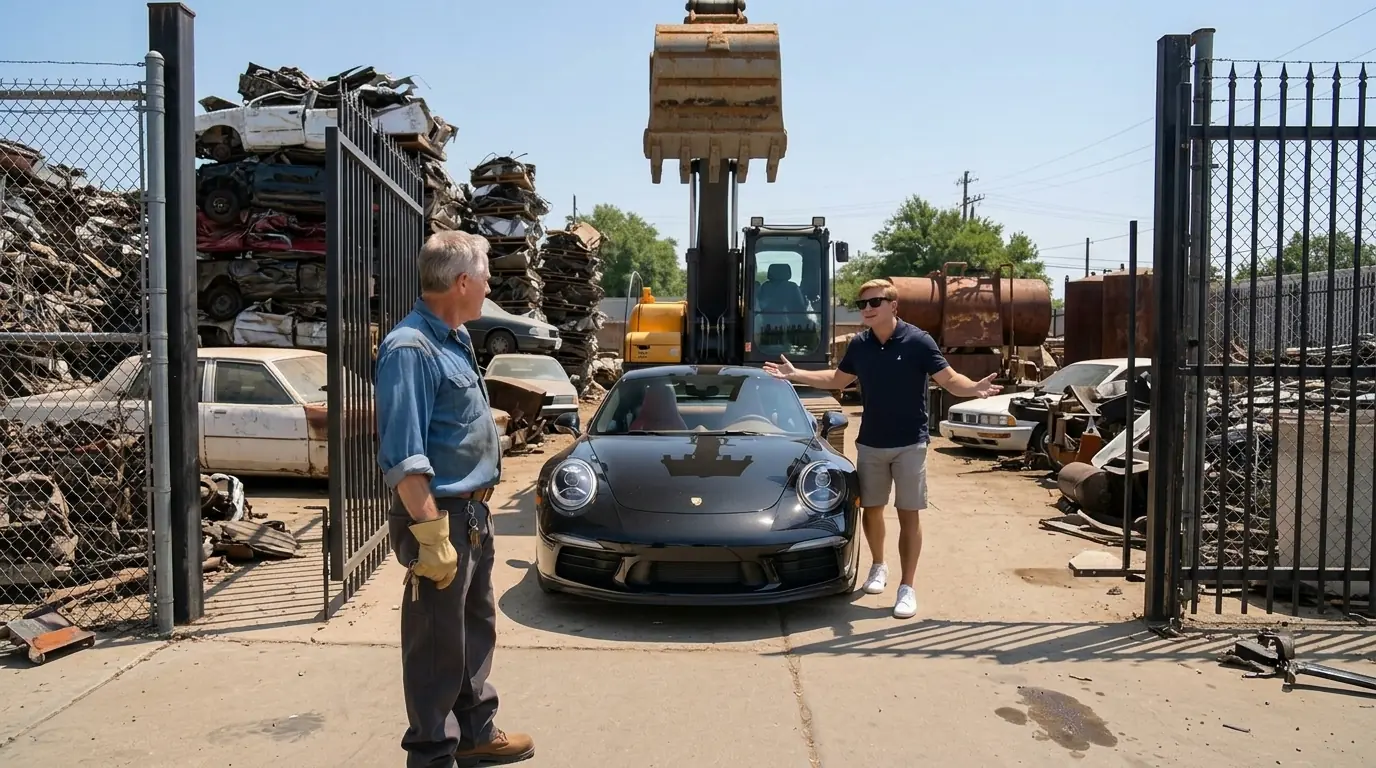
Every morning at 7:18, the silver Porsche arrived like it owned the street.
It did not ease to the curb. It did not pull into a proper parking space. It slid across the end of my driveway at a lazy angle, blocking just enough of the entrance to make leaving impossible and emergency access laughable. Then the young man inside stepped out, stretched like a celebrity arriving at a resort, and walked across my tulip bed toward the office complex behind our neighborhood.
The first morning, I thought it was a mistake.
By the third morning, I knew it was a habit.
By the fifth, I understood it was an insult.
My name is Arthur Bell, and I had lived on Willow Lane for exactly twenty-six days when that car became part of my morning routine. I had moved there for quiet, not conflict. After forty years as a civil engineer for the city and three years as a widower learning how to make coffee for one, I wanted clean air, slow mornings, and the small dignity of keeping my late wife’s garden alive.
Ellen had designed the driveway herself.
I engineered the drainage, the grade, the slope, the concrete thickness, the water runoff. She chose the red tulips, the white river stones, the low solar lights, and the narrow brick border that made the whole thing look warmer than anything I would have built alone. She used to say a driveway was the first handshake a house offered the world.
After she died, I kept it exactly the way she left it.
Not because concrete and flowers could bring her back.
Because caring for the things she loved was the only kind of conversation I still knew how to have with her.
That first morning, I was standing in the kitchen with coffee in one hand and the newspaper under my arm when I heard the engine. It was too loud for our street, too proud of itself, like a sports car trying to impress houses that only wanted to sleep. A silver Porsche rolled around the corner, slowed near my mailbox, then pulled directly across my driveway.
The driver got out like he had rehearsed arrogance in a mirror.
Early twenties, expensive sneakers, white earbuds, sunglasses even though the sun had barely cleared the rooftops. He had a gym bag over one shoulder and a phone already in his hand. Before walking away, he tossed an empty iced coffee cup toward Ellen’s tulips.
It landed among the white stones.
I stood there for a moment, not angry yet.
Just still.
There is a particular silence that comes before anger when something sacred is touched by someone careless. I walked outside, picked up the cup, and looked at the tire marks near the brick border. One tulip had been bent under his shoe.
The Porsche had a personalized plate.
CASHWLD.
Subtlety, apparently, was not one of his gifts.
There was a parking pass hanging from the mirror for the Laurel Ridge Business Park behind the tree line. That explained the route. He was cutting through our neighborhood to avoid the main entrance and using my driveway as his private drop-off lane before walking to work.
I took three photos.
License plate.
Position of the car.
The crushed tulip.
Twenty-four minutes later, he came back.
I was standing beside the driveway when he returned, coffee still in hand, not because I wanted it, but because something about holding it kept me from saying the first thing that came to mind.
“Excuse me,” I said. “Could I speak with you?”
He pulled out one earbud.
“Yeah?”
“You are blocking my driveway.”
He looked at the Porsche, then at the driveway, then back at me.
“There’s room.”
“There is not.”
“I was gone twenty minutes.”
“That is still blocking my driveway.”
He laughed softly, the way people laugh when they have not yet learned they are being recorded by memory.
“Relax, Grandpa. It’s a public street.”
“The street is public. The driveway apron is not yours to block.”
He opened his car door.
“I’ll be gone in two seconds.”
“Will you be parking here again?”
He paused, one foot inside the car, and smiled like I had asked permission to dislike the weather.
“Probably. It’s convenient.”
“I’m asking you not to.”
“And I’m telling you to find a hobby.”
He slid into the Porsche and started the engine.
As he pulled away, his rear tire clipped the white stones and scattered them into the grass.
That evening, I sat in Ellen’s chair and looked at the notes I had written.
Time.
Plate number.
Description.
Approximate duration.
Damage.
I had spent decades in municipal engineering, which meant I had spent a professional lifetime learning two things about people. First, most of them do the right thing when they understand the boundary. Second, the ones who do not understand boundaries usually believe nobody knows how to enforce them.
The Porsche returned the next morning.
This time, I was ready.
I had coffee, my notebook, my phone, and three decades of city procedures arranged neatly in my head. He parked the same way, across the driveway, half on the apron, one tire touching the edge of the decorative stones. Then he got out, took a selfie with the car and my house behind him, and typed something on his phone before walking away.
I smiled when I saw that.
Some people create evidence because they cannot imagine needing a defense.
When he returned thirty minutes later, I was waiting by the tulips.
“Good morning,” I said.
He sighed dramatically and removed one earbud.
“Again?”
“Yes.”
“Look, old man, I already told you. It’s a public street.”
“Your front bumper is extending across my driveway approach. Under city ordinance 18-4C, blocking a driveway approach is prohibited, even if the vehicle is partly on a public street.”
His expression changed.
Just slightly.
Enough.
“You looked that up?”
“I helped write the drainage and access portions of that ordinance thirty years ago.”
He blinked.
“What?”
“My name is Arthur Bell. I spent forty years in civil engineering and municipal planning. I know exactly where private access ends, where public right-of-way begins, and how violations are documented.”
For the first time, he looked less amused.
Then he recovered.
“My mom is a lawyer.”
There it was.
The family shield.
He said it with the confidence of a boy who had spent his entire life watching adults step back whenever his mother’s profession entered the room. I had known people like that in zoning meetings, property disputes, development hearings, and code appeals. They rarely knew the law themselves. They only knew how other people reacted to the threat of it.
“Your mother is Vanessa Grant,” I said.
His face shifted again.
“How do you know that?”
“Public records. Your Porsche is registered to the Grant family trust at 1840 Ashbury Court. Your mother is a family law attorney with an office on DeKalb Avenue. She also petitioned the city twice about traffic patterns near Laurel Ridge Business Park.”
He stared at me now.
No smirk.
No performance.
I continued.
“She lost both petitions.”
His jaw tightened.
“You’re creepy.”
“No,” I said. “I’m retired.”
I handed him a folder.
Inside were printed photos, the ordinance citation, a copy of the city’s driveway obstruction policy, and a written request that he stop using my driveway area for parking or access.
He stared at the papers like they might bite him.
“This is insane. It’s just parking.”
“It became more than parking when you ignored a direct request and damaged my landscaping.”
“That tiny flower?”
“My wife planted that tulip.”
He looked toward the garden.
For half a second, something human crossed his face.
Then ego returned and ruined it.
“Dude, your wife’s flower isn’t my problem.”
I looked at him for a long moment.
“You are going to wish you had chosen a different sentence.”
He got in the Porsche and drove away.
More carefully this time.
That night, Vanessa Grant called.
Her voice was calm in the way polished knives are calm.
“Mr. Bell, this is Vanessa Grant. I understand you have been harassing my son, Preston.”
I was sitting at my kitchen table with Ellen’s notebook open, the old one she used for garden plans.
“I have been documenting your son’s repeated obstruction of my driveway and damage to my property.”
“He told me you approached him aggressively.”
“He parked across my driveway.”
“He is a young man. Young men make minor mistakes.”
“They do. Adults correct them.”
There was a pause.
“Mr. Bell, I am an attorney.”
“I understood that from the bar registration.”
Another pause.
This one longer.
“I think we should avoid escalation.”
“So do I.”
“Good. Then I expect you will stop following my son around with your camera and making legal threats.”
“I have made no threats. I have provided notice.”
“Notice of what?”
“Municipal violation. Trespass. Damage to landscaped property. Continued obstruction of private access.”
She laughed softly.
That was her mistake.
People laugh when they think the other person is bluffing.
“Mr. Bell, you may have worked for the city once, but that does not make you the city.”
“No,” I said. “It makes me very familiar with the forms.”
The call ended three minutes later with no agreement, no apology, and no promise that Preston would park elsewhere.
So I opened a second notebook.
This one was for Vanessa.
By Thursday, the neighborhood had started talking.
Mrs. Delaney from across the street brought over banana bread and three pages of handwritten notes. She was seventy-two, sharp-eyed, and had been a court stenographer before retiring. Apparently, retirement had not dulled her instinct for transcripts.
“That boy has done this before,” she said, sitting at my kitchen table. “Not just here.”
She opened her notebook.
“The Patels on Greenwood. The Murphys on Carter Lane. The old couple near the dog park. Same car. Same excuse. His mother calls afterward.”
“What does she say?”
“She says people are misinterpreting the law.”
“Does she explain the law?”
Mrs. Delaney smiled.
“Never clearly.”
I liked her immediately.
That afternoon, Mr. Patel came by with photos of Preston’s Porsche blocking his driveway two months earlier. Mrs. Murphy emailed screenshots of a neighborhood group chat where Vanessa had dismissed complaints as “elderly overreaction.” A young man named Leo, who worked at the Laurel Ridge office complex, sent me a photo of Preston’s social media post from Wednesday.
The caption read:
Found free VIP parking. Old guy thinks he owns the concrete.
The photo showed my house in the background.
And Ellen’s garden.
Beautiful.
Not morally.
Evidentially.
Friday morning, Preston returned.
This time, there was a young woman in the passenger seat.
She looked uncomfortable before he even parked. He pulled across my driveway anyway, almost defiantly, then said something to her that made her turn toward him with visible irritation. He got out and slammed the door harder than necessary.
She stayed inside.
I walked outside and gently knocked on her window.
She lowered it halfway.
“Good morning,” I said. “I’m Arthur Bell. I live here.”
“I know,” she said quietly. “I’m sorry.”
That was not what I expected.
“Are you his sister?”
“Half-sister. Chloe.”
Her eyes moved toward the office complex, where Preston had disappeared.
“I told him not to park here.”
“But he did.”
“He always does whatever costs him the least effort.”
That sentence carried history.
I leaned slightly away from the window to give her space.
“Has he done this to other people?”
She let out a tired breath.
“Yes. All the time. Mom says people exaggerate because they’re jealous of the car.”
“Do you believe that?”
“No.”
She looked toward Ellen’s tulips.
“He posted about your house. It was gross.”
“I saw it.”
Her face flushed.
“He thinks Mom can fix anything.”
“That’s a dangerous thing for a young man to believe.”
Chloe looked back at me.
“You’re not going to let this go, are you?”
“No.”
“Good.”
When Preston came back twenty-seven minutes later, I was standing beside the Porsche.
He looked from me to Chloe, then back.
“What did you say to her?”
“Good morning.”
“Don’t talk to my family.”
“Then stop bringing your family to my driveway.”
His face darkened.
“You think you’re funny.”
“No. I think you’ve misunderstood the cost of convenience.”
I handed him a certified notice.
He hesitated before taking it.
“This is formal notice under state abandoned vehicle and private property obstruction statutes. If you continue parking across my driveway after the seventy-two-hour notice period, your vehicle may be towed at your expense.”
He scanned the first page, then the second.
His anger became uncertainty.
“You can’t do this.”
“I already did.”
“My mom will bury you.”
“Your mother practices family law. This is municipal code, property access, and vehicle removal procedure.”
He looked toward Chloe.
She stared straight ahead.
He lowered his voice.
“You’re making a mistake.”
“Preston, I made a career fixing mistakes other people poured into concrete. This is not one of mine.”
The marked city vehicle arrived ten minutes later.
Not police.
Code enforcement.
Officer Dana Ruiz stepped out with a tablet, a measuring wheel, and the weary professionalism of someone who had seen every possible version of suburban entitlement.
“Mr. Bell?”
“Yes.”
She reviewed the notice, photographed the car, measured the driveway obstruction, and entered the information into her report. Preston watched, his face slowly draining of color.
“Mr. Grant,” she said, “you have been formally notified. Continued obstruction of this driveway after the notice period may result in citation and vehicle removal.”
He tried one last angle.
“My mom is an attorney.”
Officer Ruiz did not blink.
“Then she can read the ordinance.”
I heard Chloe laugh once from inside the car.
Preston drove away without another word.
For three days, nothing happened.
No Porsche.
No calls.
No threats.
I watered Ellen’s tulips, reset the white stones, and almost let myself believe the lesson had landed.
Then Monday morning came.
At 7:19, the engine returned.
The Porsche rolled around the corner, slowed near my driveway, and stopped. For a moment, it idled there, as if Preston were still capable of making the right decision. Then the car lurched forward and parked directly across my driveway.
This time, he made it obvious.
He stepped out, placed both feet deliberately in the white stones, took out his phone, and started recording.
“Day six of old-man driveway drama,” he said to his camera. “Apparently, boomers think they can own the street now.”
I stood at my front window and watched him walk away.
Then I made one phone call.
“Reed’s Recovery.”
“Mr. Reed, this is Arthur Bell on Willow Lane. The Porsche we discussed is here, in violation of a properly served notice.”
The man on the other end chuckled.
“Be there in fifteen.”
Reed’s tow truck arrived at 7:43.
It was large, white, and completely uninterested in Preston’s self-esteem. Mr. Reed himself was in his sixties, broad-shouldered, calm, and slow in the way only competent people can afford to be. He reviewed my paperwork, photographed the vehicle, the notice, the driveway, and the posted sign near the mailbox.
“Clean file,” he said.
“I try.”
“Retired city man?”
“Engineer.”
“That explains the tabs.”
Mrs. Delaney appeared on her porch at exactly the right moment with a cup of tea and her phone.
“Morning, Arthur,” she called. “Need a witness?”
“Always appreciated.”
By the time Preston came running from the office complex, the Porsche was already lifted.
At first, he seemed too shocked to speak.
Then he found volume.
“What are you doing? That’s my car.”
Mr. Reed handed him a clipboard.
“Legal private property tow. Here’s the recovery address, fee schedule, and paperwork.”
Preston stared at the suspended Porsche like gravity had betrayed him.
“You can’t steal my car.”
“Not stealing,” Reed said. “Towing.”
“I was gone twenty minutes.”
“You were gone in violation of a seventy-two-hour legal notice,” I said.
“You actually did it.”
“I told you I would.”
His phone appeared in his hand.
“Mom, he’s taking my car. He actually got a tow truck. I’m not kidding.”
I could hear Vanessa’s voice sharp enough through the speaker.
“What? Stop him. Put him on.”
Preston shoved the phone toward me.
I did not take it.
“Your mother can call the impound lot.”
His face twisted.
“You’re enjoying this.”
“No,” I said. “I enjoyed quiet coffee before you started parking across my driveway.”
Mr. Reed secured the Porsche fully.
“Fees start at $320. Storage is $55 per day. Administrative processing is $90. Cash or certified funds.”
Preston looked at him.
“I don’t have that.”
“Then you’ll need someone who does.”
The truck pulled away with the Porsche.
Preston stood in the street, phone still pressed to his ear, watching his convenience become a receipt.
Vanessa arrived twenty minutes later.
Black Mercedes.
Pearl earrings.
Legal pad.
Anger dressed as professionalism.
She stepped out and walked straight to me.
“What exactly do you think you’re doing?”
“Protecting access to my property.”
“You had my son’s vehicle towed over a parking misunderstanding.”
“No. I had it towed after repeated violations, written notice, photographic documentation, witness statements, and code enforcement confirmation.”
She opened her mouth.
Then closed it.
She had expected emotion.
I gave her procedure.
Procedure is very hard to intimidate.
She examined the file I handed her.
I watched her eyes move across the certified mail receipt, Officer Ruiz’s report, timestamped photographs, and ordinance references. Her expression changed in small stages. Irritation. Calculation. Annoyance. Recognition.
“You were thorough.”
“I usually am.”
“This could have been handled neighbor to neighbor.”
“It was. Your son chose otherwise.”
She lowered the folder.
“I will be pursuing this.”
“I expected that.”
“You should be careful, Mr. Bell.”
I looked at her for a long moment.
“Mrs. Grant, I spent forty years dealing with developers, contractors, zoning attorneys, city councils, angry homeowners, negligent builders, and one mayor who believed flood maps were suggestions. I am very careful.”
She did not have an answer ready for that.
So she left.
That should have been the end.
But people who confuse pride with dignity often spend money proving a point they cannot afford.
Two days later, Vanessa parked her Mercedes across my driveway.
Not by accident.
She arrived at 7:30 in workout clothes, coffee in hand, phone recording, and the face of a woman preparing a performance.
I stepped outside.
“Good morning, Mrs. Grant.”
“Good morning, Mr. Bell. I’m here to document the hostility my family has experienced.”
“By blocking my driveway?”
“I am standing in a public area.”
“Your vehicle is obstructing private access.”
She smiled.
“I’m sure we can debate that.”
“No,” I said. “We documented that Friday.”
Her smile faltered.
I pulled out my phone.
“Mr. Reed, good morning. This is Arthur Bell again. I have a black Mercedes obstructing the same driveway.”
Vanessa stepped toward me.
“You wouldn’t dare.”
“Mrs. Grant, law is not a dare.”
Her face changed.
Not fear.
Not yet.
Recognition.
She walked briskly back to the Mercedes and moved it before Reed’s truck turned onto the street. Reed still stopped, took one photo, and shook his head.
“Some families need the full curriculum,” he said.
Mrs. Delaney nearly spilled her tea laughing.
That afternoon, Vanessa tried a different route.
She visited the neighbors.
She asked Mrs. Delaney whether I seemed unstable after my wife’s death. She asked Mr. Patel if I had ever threatened him. She asked Mrs. Murphy if I had displayed obsessive behavior. Each person called me afterward, offended on my behalf and slightly delighted to have a fresh story.
By evening, I had six statements describing Vanessa’s attempted character attack.
Mrs. Delaney’s was the best.
“She asked if grief had affected your judgment. I told her grief had affected your patience, but only for foolishness.”
I added it to the file.
The second tow happened on Thursday.
Preston returned at 3:12 p.m., not in the morning, not by accident, not trying to reach the office complex. He drove up, parked across my driveway, got out, and began livestreaming.
“This is what harassment looks like,” he told his phone. “Some retired psycho thinks he can ruin my life because of a parking space.”
I walked outside.
“Preston, you are again obstructing private access.”
He laughed, but it sounded strained.
“I’m not moving.”
“You understand the previous notice still applies?”
“I said I’m not moving.”
“Please say that again.”
His eyes narrowed.
“What?”
“For the record.”
He leaned toward the phone.
“I’m not moving. Tow it if you want.”
I nodded.
“Thank you.”
By the time Reed’s truck arrived, Preston’s confidence had collapsed into panic.
“Wait,” he said. “I’ll move it. I’m moving it now.”
“Process started,” Reed said gently. “Can’t stop once documentation begins.”
“That’s not fair.”
“No,” I said. “It is exactly fair. That is why it feels unfamiliar.”
The second impound cost more.
Repeat violation.
Administrative fee.
Additional storage from the prior tow.
By the time Reed handed him the paperwork, Preston’s face had gone pale.
“Seven hundred twenty-five dollars?”
“Plus daily storage,” Reed said.
“I just paid to get it back.”
“And then you brought it back here,” I said.
For once, he had no insult.
No social media line.
No mention of his mother.
Just a young man standing on a quiet suburban street, realizing convenience had become more expensive than humility.
Chloe came to my door that Friday.
She stood on the porch with both hands tucked into the sleeves of her sweater.
“Mr. Bell, I’m not here to argue.”
“I didn’t think you were.”
“Preston is a mess.”
“I imagine.”
“He deserved it.”
I waited.
She took a breath.
“But my parents are talking about taking a loan to get the car out again. Things aren’t as good as they pretend.”
That did not surprise me.
People who advertise status often do so because the foundation beneath it is cracking.
“Chloe,” I said, “I do not control the impound fees.”
“I know.”
“And I won’t interfere with a legal process because someone finally regrets ignoring it.”
“I know that too.”
She looked toward the tulips.
“He said something about your wife’s flower.”
“Yes.”
“He told me. He laughed when he said it.”
There it was.
The reason she had really come.
Not to beg.
To say what decency required someone in that family to say.
“I’m sorry,” she said. “She must have loved this place.”
“She did.”
“It’s beautiful.”
“Thank you.”
Chloe nodded, wiped one eye quickly, and left before the conversation could become harder.
The city hearing was scheduled for Monday.
Small room.
Gray walls.
A long table.
One hearing officer who looked like she had ended more nonsense than she had started.
Vanessa arrived in a navy suit with Preston and Chloe beside her. Preston looked younger than the first day I met him. No sunglasses. No earbuds. No smirk. Just a tired young man holding a folder with both hands.
The hearing officer reviewed the file.
Two impounds in one week.
Proper notice.
Code enforcement report.
Certified mail.
Witnesses.
Photographs.
Livestream admission.
Repeat violation.
Then she looked at Preston.
“Mr. Grant, do you dispute that you parked across Mr. Bell’s driveway after receiving notice not to do so?”
Preston looked at his mother.
For once, she did not answer for him.
He swallowed.
“No, ma’am.”
“Do you dispute that you returned and did so again after the first impound?”
“No.”
“Why?”
He looked down.
“I thought he was bluffing.”
The hearing officer removed her glasses.
“That is not a legal argument.”
“No, ma’am.”
The fees totaled $1,184.
Vanessa wrote the check with a face like each number was being carved into her pride.
When the hearing ended, Preston approached me in the hallway.
He held himself differently now.
Not humble exactly.
But no longer inflated.
“Mr. Bell,” he said. “I’m sorry.”
I looked at him.
“For what?”
His eyes flicked toward his mother, then back.
“For parking there. For stepping on your wife’s garden. For posting about you. For saying what I said about the tulip.”
That last part mattered.
“I was wrong,” he said. “I knew you asked me not to. I kept doing it because I thought nothing would happen.”
I nodded.
“That is the most honest thing you’ve said to me.”
He absorbed that.
Then he said, “I won’t park there again.”
“I believe you.”
He looked surprised.
“Why?”
“Because now you know it costs something.”
That afternoon, I sat in Ellen’s chair and watched sunlight catch the white stones beside the driveway.
The tulips had recovered.
Most of them.
One stayed bent, its stem damaged from Preston’s first careless step. I thought about replacing it. Then I decided to let it finish the season as it was. Not everything wounded has to be hidden.
The street was quiet again.
But not the same quiet.
This quiet had a spine in it.
Neighbors waved more openly. Mrs. Delaney brought over more banana bread and asked if I needed copies of her notes for “the archive.” Mr. Patel stopped by to say Preston’s Porsche had not been seen near Greenwood Lane again. Mrs. Murphy told me she had finally complained to the business park about employees cutting through the neighborhood.
A week later, the business park installed new employee parking signs.
Two weeks later, the city repainted the curb markings near the driveway aprons.
A month later, the neighborhood association invited me to speak about property documentation, code enforcement, and how to handle disputes without shouting over fences.
I told them the truth.
“Most rights are only as strong as your willingness to document the moment someone violates them.”
Mrs. Delaney applauded too early.
Then everyone joined her.
People asked why I did not call for a tow on the first day.
The answer was simple.
Because a single mistake deserves correction.
A pattern deserves a record.
And some people only understand rules when those rules arrive with invoice numbers attached.
I did not enjoy watching Preston lose his car twice.
I did not enjoy watching Vanessa discover that her title did not outrank the ordinance. I did not enjoy any of it in the way people imagine revenge feels enjoyable. Revenge burns fast and leaves the room smelling bad.
This was not revenge.
This was maintenance.
The same kind Ellen and I had built into the driveway.
Good drainage prevents rot.
Good records prevent lies.
Clear boundaries prevent people from convincing themselves that your kindness is an invitation to step further in.
By spring, the tulips came back brighter than I expected.
The bent one did not survive.
In its place, I planted three new bulbs.
Chloe helped.
She came one Saturday morning with gardening gloves and a paper bag from the nursery. She said Preston was working weekends to pay his parents back for the impound fees. She said he had started parking at the business complex, where parking had apparently been available the whole time.
“He says the walk is annoying,” she told me.
“Good.”
She laughed.
It was the first easy sound I had heard from anyone in that family.
When we finished planting, Chloe stood beside the driveway and looked at the neat row of stones.
“My mother says you humiliated us.”
“No,” I said. “I gave your family the chance to stop before the law did.”
Chloe nodded slowly.
“I think she knows that. She just can’t say it yet.”
“Some people need time.”
“Some need invoices.”
I smiled.
“Also true.”
That summer, Preston came by once.
On foot.
He stopped at the edge of the driveway and did not step onto the stones.
“Mr. Bell,” he said. “The tulips look good.”
“They do.”
He glanced toward the office complex.
“I park over there now.”
“I know.”
“Yeah. I figured you would.”
There was no sarcasm in it.
Just acknowledgment.
He looked at the driveway, then at me.
“I didn’t know this was about your wife at first.”
“It was about my property.”
“I know. But it was also about her.”
“Yes.”
“I’m sorry I treated it like it didn’t matter.”
That was better than the first apology.
Less polished.
More specific.
I nodded.
“Thank you.”
He walked away along the sidewalk instead of cutting across the grass.
Small thing.
Huge thing.
Years from now, he may forget the ordinance number. He may forget the impound fee totals. He may even retell the story to make himself sound less foolish than he was. People do that. Time gives ego new clothes.
But I do not think he will forget standing on the curb watching his Porsche leave on a tow truck.
And I do not think he will forget that an old man he dismissed had built a record strong enough to outlast every excuse.
As for me, I still take coffee by the front window every morning.
I still water Ellen’s tulips.
I still keep a notebook, because age has not made me careless and grief has not made me weak. The driveway remains what Ellen said it was, the first handshake our home offers the world.
It is clean.
It is open.
It is respected.
And every morning when the sun hits the white stones, I remember the lesson she taught me long before any Porsche arrived on Willow Lane.
Ordinary things become sacred when someone loves them well.
And sacred things deserve boundaries.