The first thing Garrett Rourke noticed was not the man standing beside the cash register.
It was the little girl’s eyes.
She could not have been more than six years old, with tangled light-brown hair pulled into a loose ponytail and a yellow T-shirt hanging slightly off one shoulder. One pink sneaker and one gray sneaker covered her feet, and an old stuffed rabbit dangled from her left hand as though she had been holding it for days.
Her eyes were the part Garrett could not ignore.
Children became afraid for hundreds of reasons.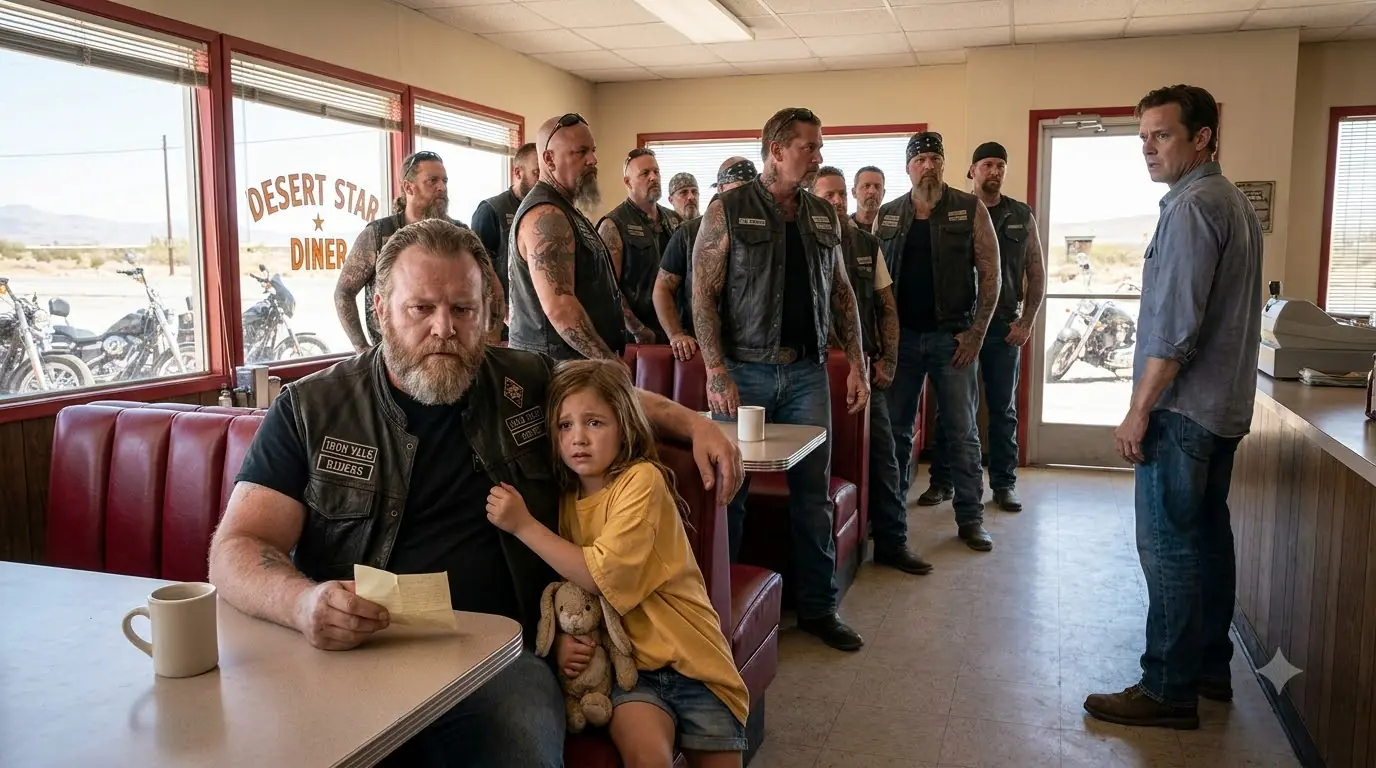
A loud noise.
A strange room.
An unfamiliar face.
But this was not surprise.
This was watchfulness.
The girl kept checking the adult beside her the way someone checks the weather during a storm, always trying to decide whether the danger is getting closer.
Garrett lowered his coffee.
Across from him, Cole Mercer noticed.
“You saw it too.”
Garrett did not answer.
He continued watching.
The Desert Star Diner outside Kingman, Arizona, was crowded enough that afternoon to make subtle observation difficult for most people. Nearly two hundred riders from the Iron Vale Riders and several affiliated clubs had stopped there during the final leg of an annual charity run across western Arizona.
Motorcycles filled almost every parking space.
More stood in neat rows along the shoulder.
Inside, black leather vests occupied nearly every red vinyl booth.
Customers who had been eating before the bikers arrived were now surrounded by tattooed arms, heavy boots, thick beards, patches, helmets, coffee cups, and the low noise of conversations overlapping one another.
Garrett had spent twenty-seven years around riders.
At fifty-two, he had learned to read a room almost automatically.
His official position within Iron Vale was Road Captain, which mostly meant planning routes, watching weather, managing breakdowns, and preventing a hundred independent personalities from becoming a single large disaster.
Unofficially, Garrett watched people.
Hands.
Eyes.
Posture.
Doors.
Who seemed too relaxed.
Who looked too interested.
Who did not belong.
The man with the little girl had bothered him immediately.
Late thirties.
White.
Tall.
Dark hair.
Trim beard.
Faded blue work shirt.
Jeans.
Nothing unusual on the surface.
But the man scanned every window before choosing a table.
He checked the front entrance twice in less than a minute.
When a group of bikers laughed loudly near the counter, his right hand tightened around the girl’s wrist.
Not her hand.
Her wrist.
Cole saw that too.
He set his menu down.
“That’s not comfortable.”
Garrett nodded.
“Could still be nothing.”
Cole looked at him.
“You don’t believe that.”
“I believe we don’t know.”
That distinction mattered.
Garrett had seen people become fools because instincts felt like facts.
Sometimes a nervous man was simply nervous.
Sometimes a quiet child was tired.
Sometimes a parent held a wrist because a six-year-old had a habit of running into parking lots.
You watched first.
You learned.
Then you acted.
The man ordered at the counter.
Fries.
Water.
Nothing for himself.
The girl sat in the booth nearest the front windows.
She did not touch the food when it arrived.
She did not ask for ketchup.
Did not swing her legs.
Did not look at the motorcycles outside with the fascination most children showed.
She sat with her hands folded around the stuffed rabbit.
Waiting.
Cole leaned toward Garrett.
“You ever seen a kid sit that still?”
“Yes.”
“Where?”
Garrett looked at him.
“Places I didn’t like.”
Cole stopped asking questions.
Ten minutes passed.
The man checked his phone repeatedly.
Once, he stood and walked toward the window.
The girl watched every step.
When he returned, her shoulders tightened.
Garrett noticed.
So did Cole.
A waitress named Marcy approached the table.
“Everything okay, sweetheart?”
The girl looked at the man before answering.
He smiled.
“She’s tired.”
Marcy looked at the untouched fries.
“Want me to box these?”
“We’re leaving soon.”
The girl said nothing.
The man thanked Marcy politely.
That made the situation harder, not easier.
He was not shouting.
Not visibly cruel.
Not behaving in a way that gave anyone an obvious reason to intervene.
Yet Garrett’s instincts continued pressing against the back of his mind.
Something was wrong.
He looked toward the girl's shoes again.
Different sizes.
The gray sneaker looked nearly new.
The pink one was badly worn.
Her shirt was oversized.
No jacket despite the cooler desert wind outside.
There was a faint pen mark on the back of her right hand.
Not random scribbling.
Letters.
Garrett could not read them from where he sat.
Then the man stood.
“I’ll pay.”
He pointed at the girl.
“Stay.”
She nodded.
He walked toward the counter.
For the first time since entering the diner, his hand was not close enough to reach her.
The girl waited three seconds.
Then moved.
She slid from the booth without the stuffed rabbit.
Left the fries.
Left the water.
Walked toward the center aisle.
Slowly.
Nobody stopped her.
At first, Garrett thought she might be heading toward the restroom.
Then she passed it.
She walked around a chair.
Between two bikers.
Toward Garrett.
Cole sat straighter.
Garrett did not move.
The girl reached their booth.
Up close, the fear in her eyes was worse.
She stared at Garrett’s leather vest.
Then his beard.
Then the patches sewn across his chest.
Her mouth opened.
No words came.
Garrett softened his voice.
“Hey.”
She glanced toward the counter.
The man had his back turned while paying.
Garrett leaned slightly closer.
“You okay?”
The girl grabbed his vest.
Both hands.
Hard.
Garrett went completely still.
Her fingers trembled against the leather.
She whispered:
“Please don’t let him take me.”
Cole’s chair moved backward.
Garrett looked at him once.
Cole stopped.
Garrett returned his attention to the child.
“What’s your name?”
“Lily.”
“Lily what?”
She swallowed.
“Carter.”
“Okay, Lily.”
Garrett kept his voice low.
“Who’s the man?”
Her eyes filled.
“That’s not my dad.”
Garrett felt the room change before anyone else understood why.
Cole stood.
Not suddenly.
Slowly.
The biker at the table behind him noticed.
Then another.
Garrett remained seated.
He did not want Lily to think something violent was about to happen.
“Do you know him?”
She nodded.
“What’s his name?”
“Dean.”
“Dean what?”
“I don’t know.”
“Is he family?”
She shook her head.
Garrett looked toward the counter.
Dean was still speaking with the cashier.
Garrett asked:
“Where’s your mom?”
Lily’s bottom lip trembled.
“She’s gone.”
Garrett did not ask what that meant yet.
“Your dad?”
The child reached into the pocket of her yellow shirt.
She pulled out a small folded piece of paper.
Old folds.
Dirty edges.
She held it toward Garrett.
“My dad said if something bad happened, find the motorcycle people.”
Garrett stared at the paper.
Behind him, chairs began moving.
Not all at once.
But enough.
Cole's standing posture had been noticed across the diner.
Iron Vale riders were used to reading one another.
When Garrett's closest friend stood and Garrett remained unnaturally focused on a frightened child, conversations died quickly.
A man two booths away rose.
Then another.
Then five more.
Garrett looked around.
“Easy.”
He barely raised his voice.
That single word stopped the room from escalating.
The riders stayed standing.
But nobody moved toward Dean.
Nobody blocked doors yet.
They simply watched.
Garrett accepted the paper.
The girl did not release his vest.
With his free hand, he opened the first fold.
One line.
If Lily reaches the riders, tell them the truth about what happened to her father.