The Whitmore family gathered around the long dining table inside their luxurious mansion for what was supposed to be a peaceful celebration. Crystal glasses sparkled beneath three chandeliers, and servants moved quietly between the chairs with silver trays of roasted vegetables, herb-crusted salmon, and tiny pastries shaped like roses. Beyond the tall windows, rain tapped steadily against the glass, turning the gardens of the Lake Forest estate into a dark blur of hedges and stone paths. Inside, nearly forty relatives, family friends, board members, and longtime employees had raised their glasses to the future of the Whitmore family.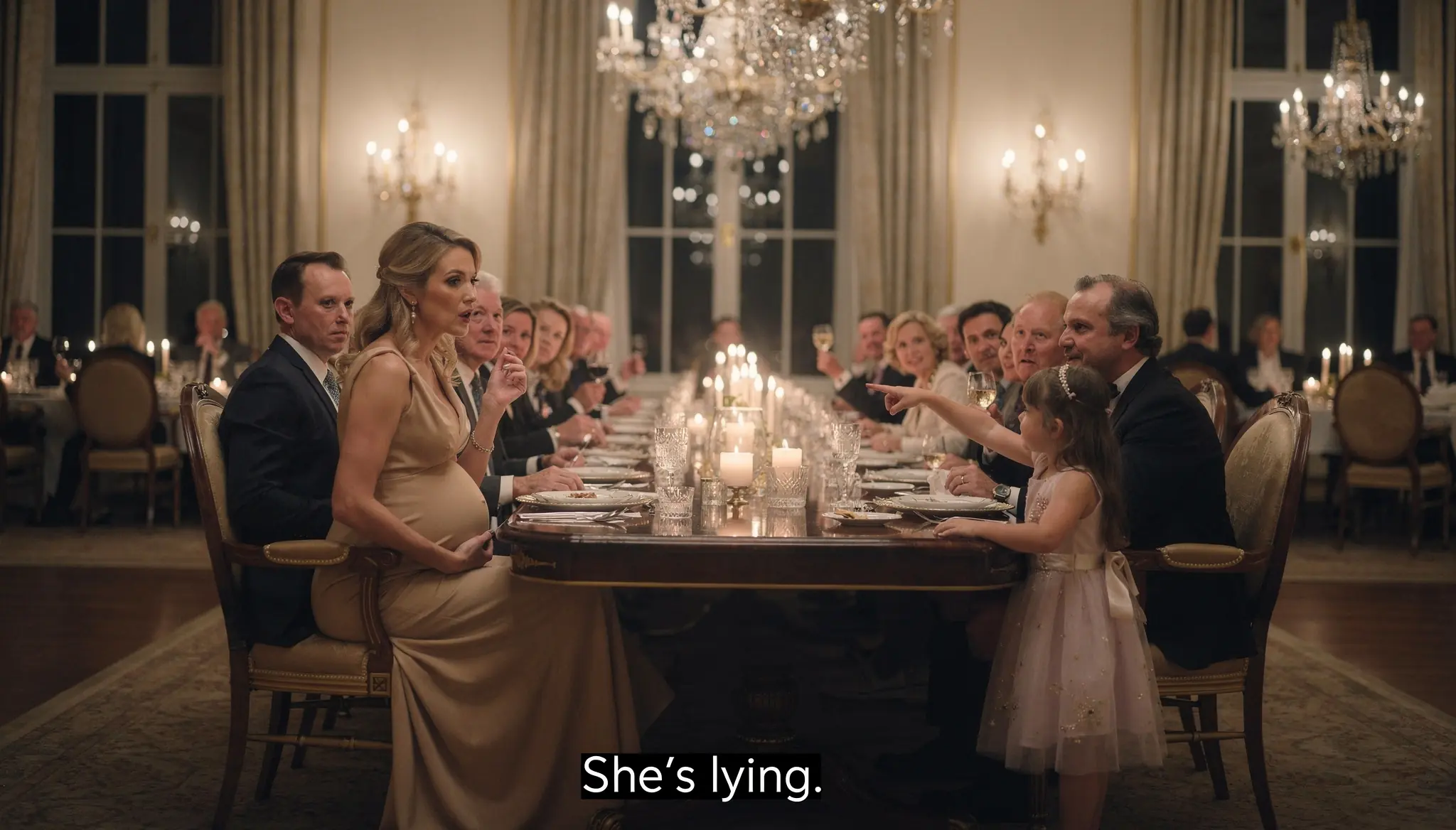
At the center of the table sat Emily Whitmore, dressed in a beautiful beige gown that curved over a round stomach. Her blond hair had been pinned loosely at the back of her neck, and a diamond bracelet flashed each time she lifted her glass of sparkling water. She smiled politely as relatives congratulated her on the exciting news of her pregnancy, although the smile never quite reached her eyes. Beside her, Daniel Whitmore accepted handshakes and warm wishes with the relieved pride of a man who had spent years believing this moment might never come.
Daniel was thirty-seven, the president of Whitmore Residential Group, and the eldest grandson of the late Arthur Whitmore. He had grown accustomed to rooms changing when he entered them, but that night he seemed almost boyish. Every time someone mentioned the baby, he touched Emily's hand as though reassuring himself that she and their future child were truly there. His younger sister, Claire, watched from the far end of the table with a careful expression Daniel had noticed but not yet understood.
Everything appeared perfect until six-year-old Sophie suddenly stood up from her chair.
Sophie was Claire's daughter, a small girl with dark curls, serious gray eyes, and the complete confidence children sometimes possessed before adults taught them to doubt what they saw. She pushed both hands against the tablecloth, looked directly at Emily, and said, "The pretty lady's tummy is a pillow."
For a moment, nobody spoke. Then a few guests laughed softly, assuming it was nothing more than an innocent misunderstanding. One of Daniel's uncles joked that children believed all babies arrived in blankets, and an elderly cousin covered her smile with a napkin. Emily forced a nervous laugh, but her fingers tightened around the stem of her glass.
Daniel looked at Sophie with curiosity rather than anger. Children often said strange things, and everyone expected the conversation to end there. But Daniel noticed that Sophie was not laughing. She was not trying to be funny or attract attention. She genuinely believed what she had just said.
He leaned closer with a gentle smile. "What pillow, sweetheart?"
The room became quiet again. Every guest waited for the child's answer, and Sophie looked around the table as though surprised that something so ordinary required an explanation. "I saw her put it in the closet," she said. "It has flowers on it."
The laughter stopped instantly. A fork slipped from someone's hand and clattered against a china plate. Several guests exchanged confused glances while Daniel slowly turned toward his wife. Emily's hands disappeared beneath the table, but he could still see the tremor moving through her shoulders.
Sophie continued without realizing that every adult in the room had frozen. "She took it from under her dress. Mama saw it too."
Complete silence followed. Guests looked toward Claire, who sat rigid near the end of the table with one hand resting beside her untouched wine. She lowered her eyes, but she did not deny what her daughter had said. Daniel's heartbeat became loud enough that he could hear it beneath the ticking clock in the hall.
Before he could speak, Emily's older sister, Natalie Hale, rose abruptly from her chair. Natalie was elegant, sharp-featured, and accustomed to controlling conversations before anyone else knew they had begun. "She's just a child," she snapped. "Are we really going to turn a family celebration into an interrogation because a six-year-old saw a cushion?"
The violence of the response made the room even more suspicious. Daniel looked back at Sophie. "Are you sure?"
Sophie nodded without hesitation. "It was in the upstairs room where the white coats are. Emily was crying. Mama told me to go downstairs."
Emily pushed her chair backward. The legs scraped against the floor with a sound that made several people flinch. "Daniel, please," she whispered. "Not here."
He stood slowly, his eyes fixed on her. "Then come upstairs and tell me what she saw."
Natalie stepped into his path. "My sister is pregnant. She has been sick all week, and now you're going to drag her through the house because a child misunderstood something? Think about what stress could do to the baby."
Daniel stared at her. That sentence should have made him stop. For months, everyone had used the pregnancy as a reason not to challenge Emily, not to upset her, not to ask why Daniel had never attended an appointment, and not to wonder why every ultrasound had been delivered through a private clinic that refused visitors. For the first time, he heard the pattern instead of the excuses.
He moved around Natalie and walked toward the staircase. Behind him, chairs shifted, whispers rose, and someone asked the servants to close the dining room doors. Daniel climbed without turning around. He knew Emily was following because he could hear the soft brush of her dress and Natalie's sharper footsteps behind her.
The upstairs guest wing smelled faintly of cedar and lavender. Sophie had called it the room with the white coats because the Whitmores used it as a dressing room during formal events. Daniel opened the door and saw a row of winter coats, garment bags, and empty hatboxes. Nothing appeared unusual at first.
"Daniel," Emily said behind him, her voice breaking. "I can explain."
He did not answer. He moved the coats aside and looked along the floor. A white storage chest sat beneath the hanging clothes. When he lifted the lid, he found folded blankets, a spare evening shawl, and a square pillow covered in blue flowers.
For several seconds, he simply stared at it. Then he lifted the pillow from the chest. Two wide elastic straps had been sewn across the back, and one side carried the faint mark of foundation makeup. It was not a decorative cushion. It had been shaped, padded, and fitted to sit beneath a dress.
Daniel turned. Emily stood in the doorway with one hand over her mouth. Natalie remained behind her, pale but defiant. Claire had followed more quietly and now held Sophie against her side at the end of the hall.
"How long?" Daniel asked.
Emily's eyes filled with tears. "Please let me tell you alone."
"How long have you been wearing this?"
She looked at Natalie before answering. The glance lasted less than a second, but Daniel saw it. "Four months."
The words seemed to remove the floor beneath him. He lowered the pillow onto the chest with care because his hands had started shaking. "Four months," he repeated. "You told me you were nineteen weeks pregnant."
"I was pregnant," Emily said quickly. "At the beginning, I was."
Natalie grabbed her arm. "Stop talking."
Daniel looked at Natalie. "Take your hand off my wife."
Daniel's anger collided with grief so suddenly that he had to brace one hand against the closet frame. He remembered the week she meant. Emily had called him twice a day, telling him she was tired but fine, while he rushed through meetings because he wanted to return before her next appointment. When he came home, she had placed a small printed ultrasound image on his desk and told him the doctor said everything looked perfect.
"That picture was from before," she whispered, reading the question in his face. "I couldn't tell you."
"Couldn't?" His voice was quiet now. "Or chose not to?"
Claire covered Sophie's ears and guided her farther down the hall. Natalie closed the bedroom door, but Daniel opened it again immediately. "No more closed doors," he said. "Not tonight."
The guests downstairs were beginning to gather in the entrance hall. Daniel could hear the dull movement of voices under the music that still played in the dining room. He wanted them all gone, yet another part of him understood that Emily and Natalie had relied on privacy, politeness, and his instinct to protect the family's image. He would not make that mistake again.
Emily sank onto a bench near the window. "I thought you would leave me," she said. "Your grandmother kept talking about the trust. Your mother kept asking when the family would have an heir. Every dinner, every holiday, every photograph became about whether I was pregnant. When the doctor told me the baby was gone, I felt as if I had failed before I even came home."
Daniel stared at her. "I never told you I would leave."
"No," Emily said. "You only told me how much you wanted to be a father. You told everyone how the nursery would look. You kept the first ultrasound in your wallet. I saw how happy you were, and I couldn't be the one who destroyed it."
"So you decided to destroy it later?"
She closed her eyes.
Natalie stepped forward. "She was grieving. You have no idea what she went through."
"And you helped her build a fake pregnancy?"
"I helped my sister survive."
Claire's voice came from the hall. "You helped her lie to all of us."
Natalie turned on her. "You had no right to let that child announce this in front of forty people."
Claire's expression hardened. "I didn't tell Sophie to say anything. She saw Emily remove the pillow this afternoon while she was playing hide-and-seek. I sent her downstairs because Emily was crying, and then Emily begged me to wait until after dinner before telling Daniel. I agreed to give her one hour. That was my mistake."
Daniel looked at Claire, hurt passing across his face. "You knew?"
"For less than two hours," she said. "And I was trying to get Sophie home before she said anything. I should have come to you immediately."
Sophie peeked around her mother's dress. "Is Emily sick?"
The question broke something in the room. Emily began to cry without restraint, bending forward until her forehead nearly touched her knees. Daniel wanted to comfort her by instinct, but the flowered pillow lay between them like a body.
He asked Claire to take Sophie downstairs. Then he closed the guest room door, not to hide the truth but to keep the child from hearing what came next. "What was supposed to happen when the baby was due?" he asked.
Emily's crying stopped abruptly.
Daniel felt cold spread through his chest. "You had to have a plan. You couldn't wear a pillow forever."
Natalie answered before Emily could. "There was going to be an adoption."
Emily looked at her sister in alarm. "Natalie."
"He deserves to know enough to understand that nobody planned to hurt anyone," Natalie said. "A young woman wanted a private adoption. The timing was close. Emily would have gone away for a few weeks, and then you would have had a child."
Daniel stared at them. "You were going to bring home someone else's baby and tell me Emily gave birth?"
"The child would have been legally adopted," Natalie insisted. "You would have loved the baby. Emily would have loved the baby. What difference would the biology have made?"
"The difference is consent. The difference is truth. The difference is that you planned to make me sign a birth certificate based on a lie."
Emily stood. "I told her I couldn't do it."
Natalie laughed once, without humor. "You told me that yesterday, after I arranged everything, paid the agency, and protected you for four months."
Daniel looked at Emily. "What agency?"
She did not answer.
He crossed to the dressing table and picked up the house phone. "I'm calling our attorney and the police."
Natalie moved quickly. "That would be a very expensive mistake."
The threat changed the air. Daniel lowered the receiver but did not put it down. "Explain."
Natalie glanced at Emily, but Emily had gone still. "The adoption was confidential," Natalie said. "There are contracts. If you create a scandal, you could expose the mother, the clinic, and your own wife to criminal accusations. Give us one night to fix this privately."
Daniel pressed the security button instead. "No one leaves the property," he told the head of security. "Close the gates. Do not touch anyone, but record every departure attempt. Call Detective Lena Morris and tell her there may be evidence of fraud involving medical records and a planned adoption."
Natalie's composure finally cracked. "You cannot imprison guests in your house."
"They can leave. You cannot."
Emily whispered his name, but he turned away from her. Through the open closet, he saw the white storage chest, and something about its depth bothered him. He removed the blankets and ran his hand along the bottom. The wooden panel lifted easily.
Beneath it lay a silicone pregnancy form, three different sets of elastic straps, sealed envelopes from Harbor Women's Center, a prepaid phone, and a blue folder marked WHITMORE FAMILY TRUST. Daniel opened the folder. Inside were copies of the trust provision granting a block of voting shares to the first child born to him, with the child's mother serving as temporary trustee until the child turned eighteen.
A yellow note had been clipped to the page. In Natalie's handwriting were the words: Birth certificate activates transfer. Timing cannot move past October 17.
Daniel looked up. "This was never only about grief."
Emily stared at the note as if she had never seen it. Natalie said nothing.
Daniel opened another envelope. It contained transfer confirmations totaling two million four hundred thousand dollars from the Whitmore Maternal Health Initiative to a company called New Dawn Family Services. Each approval carried Emily's electronic signature.
"What is this?" he asked.
Emily took one page and went pale. "I didn't authorize these amounts. Natalie told me the fees were sixty thousand."
Natalie backed toward the door. "You are upset and not thinking clearly."
Daniel stepped between her and the hallway. "Then help me think clearly. Who is the woman whose baby you planned to take?"
For the first time, fear replaced anger in Natalie's face.
Downstairs, the mansion's front doors opened and closed as guests began leaving under the supervision of security. Somewhere near the drive, a siren approached through the rain.
Emily looked at the prepaid phone lying in the chest. "Her name is Leah Monroe," she said. "She's twenty-two. Natalie said she had already chosen adoption."
"Where is she?"
"I don't know."
The phone rang.
Everyone froze.
Daniel picked it up and answered without speaking. A young woman's voice came through, thin and frightened. "Emily? They took my phone. Natalie said you changed your mind. Please don't let them move me again."
Daniel looked at Natalie. "Where are you?" he asked.
The caller went silent. Then she whispered, "Who is this?"
"My name is Daniel Whitmore. I am going to help you, but I need to know where you are."
Before she could answer, a man's voice shouted in the background. The line went dead.
Natalie ran.
She shoved past Daniel, crossed the hallway, and reached the service stairs before Claire stepped out from the landing. Natalie struck Claire's shoulder and tried to force her aside, but two security officers came up from below. They stopped Natalie without throwing her to the floor, holding her arms only after she clawed for the banister and screamed that Daniel was destroying his own family.
Detective Lena Morris arrived less than five minutes later. She was a calm woman in her forties who had known the Whitmores long enough to distrust any request for special treatment. After Daniel showed her the pillow, the hidden compartment, the transfer records, and the prepaid phone, she ordered the room sealed and asked everyone to separate.
Emily sat in Daniel's study while rain streaked the windows. She gave her statement with an attorney from outside the Whitmore family present. She described the miscarriage, Natalie's proposal, the fake clinic appointments, and the plan to spend the final weeks of the supposed pregnancy at a private wellness center. She insisted she had never met Leah in person and had believed the adoption was voluntary.
Daniel listened from the other side of the room. Every new detail hurt differently. Emily had invented morning sickness, canceled trips, and placed his hand on a false stomach while telling him she felt movement. She had let him read to a child who was not there. Yet when she described waking from the miscarriage alone in a clinic room while Natalie told her Daniel would eventually choose a woman who could give him an heir, Daniel also heard the fear that had made the first lie possible.
Fear did not excuse what came after. It only explained where the door had opened.
Detective Morris asked about the transfers. Emily said Natalie had used her laptop to submit smaller payments related to adoption services, but she denied approving millions. A forensic technician found remote-access software on Emily's computer and login records tied to Natalie's event-planning office. The fake clinic had received money through New Dawn Family Services, then moved most of it to three property companies owned by Natalie.
At two in the morning, police traced the prepaid call to a house near the Wisconsin border. By sunrise, officers had found Leah Monroe in a locked second-floor bedroom of a rented lake property. She was eight months pregnant, dehydrated, and terrified. Two employees of New Dawn claimed she was free to leave, but the windows had been screwed shut, her identification had been taken, and every call she made had been monitored.
Leah told investigators she had contacted a legitimate adoption counselor after losing her job and being rejected by the baby's father. Natalie approached her with promises of housing, medical care, and the freedom to change her mind. Over time, the promises became rules. Leah was told the Whitmores had already paid for the baby, that she owed hundreds of thousands of dollars, and that changing her mind would send her to prison.
She had never agreed to pretend Emily gave birth. She had never agreed to surrender her identity. When she realized the plan involved a false hospital record, she tried to escape. That was when New Dawn moved her to the lake house.
By morning, the celebration at the Whitmore mansion had become a criminal investigation reported by every news station in Chicago. Photographs of Emily in the beige gown appeared beside images of police vehicles at the gates. The headlines called it the Whitmore heir scandal before anyone outside the house understood that a frightened young woman had been held against her will.
Daniel stood in the silent dining room after the last officer left. Half-filled glasses remained on the table. A slice of celebration cake had collapsed under its own frosting near Emily's empty chair. Sophie’s words seemed to linger beneath the chandeliers, simple and unadorned: Her tummy is a pillow.
The first lie had been exposed by a child. The rest would require adults to decide whether they valued truth more than the family name.
Daniel's mother, Evelyn Whitmore, arrived at the mansion just after seven that morning. She had left the dinner early because of a migraine, missing Sophie's revelation by less than an hour. When she entered the breakfast room and saw detectives carrying evidence bags from the upstairs wing, she demanded to know why strangers were searching a Whitmore home.
Daniel told her everything without softening a single detail. He watched disbelief turn to horror, then to anger directed not at Natalie but at Emily. Evelyn called the fake pregnancy unforgivable, accused Emily of targeting the trust from the beginning, and said the family's attorneys should make certain she never benefited from the Whitmore name again.
Daniel let her finish. Then he placed the blue trust folder on the table and asked, "How many times did you tell Emily that a woman who couldn't give this family a child had no future here?"
Evelyn's face changed. "I never said those words."
"Not in one sentence," Claire replied from the doorway. "You said them in a hundred smaller ones."
Evelyn looked toward her daughter. Claire had changed out of her dinner dress, but she had not slept. Sophie was resting in a guest room with Rosa, the housekeeper, while Claire waited to give a formal statement. "This is not the time to attack me because I cared about the family line," Evelyn said.
"There should never have been a time to talk about a child as a family line," Daniel answered. "Emily made choices that may be criminal. Natalie appears to have done worse. But none of us gets to pretend this pressure came from nowhere."
The conversation ended when Detective Morris entered with a sealed evidence bag. Inside was a small black drive found in the flowered pillow. A slit had been cut beneath one of the blue flowers and sewn closed by hand. Emily had not mentioned the drive in her first statement.
Morris asked Daniel to remain while a forensic specialist copied the contents. There were audio files, photographs of transfer records, messages between Natalie and New Dawn, and a recording made three nights earlier in Emily's dressing room. In the recording, Emily told Natalie she would confess to Daniel after the celebration and contact an independent adoption attorney for Leah. Natalie responded that confession was no longer an option.
"You signed enough papers to go to prison with me," Natalie's recorded voice said. "Daniel will never believe you were a grieving victim once he sees the trust documents. If you ruin this, Leah loses the apartment, you lose your marriage, and I make sure the Whitmores know you moved money from their charity."
Emily answered, "You moved the money."
"Using your access. That distinction matters only if someone believes you."
The final minutes recorded a struggle over the prepaid phone. Emily threatened to call Leah directly, and Natalie told her the young woman had been moved somewhere Emily would never find. The audio did not make Emily innocent. It proved she had allowed the deception to continue for months and had participated in false appointments and financial approvals. But it also proved that she had tried, too late, to end the scheme and preserve evidence when Natalie threatened her.
Daniel listened twice. On the second hearing, he noticed a sound in the background that the technician isolated: the faint mechanical tone of the closet door opening. That was likely when Emily had hidden the drive inside the pillow. She had placed the evidence in the very object that could expose her.
Detective Morris said, "She may have been preparing to tell you."
Daniel stared through the window at the wet lawn. "Preparing is not telling."
"No," Morris agreed. "But the law pays attention to what people did before they were caught, not only after."
Emily was released that afternoon while prosecutors reviewed the evidence. She could not return to the mansion because it remained part of the investigation, and Daniel was not ready to share a home with her. Claire offered her a small guesthouse on property she owned near Evanston, but Emily refused, saying Claire and Sophie had already been dragged too deeply into the consequences of her choices.
She moved into a furnished apartment arranged by her attorney. The place had blank walls, two chairs, and a narrow bed. For the first time in years, Emily had no staff, no family schedule, no formal dinners, and no reason to pretend that she was fine. She placed the beige gown in a trash bag but could not bring herself to throw it away.
For three days, Daniel did not call her. He spoke through attorneys about practical matters and signed consent forms allowing investigators access to shared accounts. At night, he stayed in the library because the bedroom contained too many memories that had changed meaning. He found a stack of children's books he had bought after the pregnancy announcement and sat on the floor beside them until dawn.
Claire visited on the fourth morning. She brought coffee, removed the bottles from his desk, and opened the curtains. "Sophie thinks she did something bad," she said.
Daniel looked up sharply. "Why?"
"Because people at school saw the news. One mother said in the parking lot that children should be taught not to repeat private things. Sophie asked whether the police came because she talked at dinner."
Daniel stood so quickly his chair fell backward. "She told the truth."
"I know. You know. But she is six, and every adult around her looked horrified when she spoke. She needs to hear from you that the horror belonged to the lie, not to her."
Daniel went to Claire's house that afternoon. Sophie sat cross-legged on the living-room rug, drawing a picture of the mansion with rain clouds above it. She did not run to him as she usually did.
He sat on the floor beside her. "Your mother told me you're worried about what happened."
Sophie colored one window blue. "Aunt Natalie said I ruined the baby party."
"Aunt Natalie was wrong. There was no baby party to ruin because the adults had not told the truth. You saw something, and when I asked, you answered honestly. You are not responsible for what happened after that."
"Is Emily going to jail?"
"I don't know. Grown-ups have to answer for their choices, even when they are sad or scared."
Sophie studied him. "Are you mad at her?"
"Yes," Daniel said, because he would not teach her that honesty required comfortable answers. "I'm also sad for her. People can make terrible choices and still be people we once loved. Sometimes we can love them and still need distance."
Sophie nodded as if storing the words for later. Then she handed him the drawing. In one upstairs window, she had drawn a small blue flower.
Leah Monroe remained in a protected medical residence while prosecutors dismantled New Dawn Family Services. An independent attorney explained that she owed no money and could make any decision she wanted about her child. After two days, Leah announced that she intended to keep her daughter. The baby's father had vanished months earlier, but Leah's aunt in Milwaukee agreed to help, and a legitimate nonprofit offered housing without conditions.
Emily asked through her attorney whether she could contribute to Leah's expenses. Leah refused any private payment. "I don't want to owe another rich family anything," she said in a statement delivered to investigators. "If Emily wants to help people, she can do it where she cannot choose who gets saved."
The sentence reached Emily harder than any accusation. She authorized the return of every personal item Natalie had bought with money linked to New Dawn and placed two of her own accounts under court supervision. Later, after consulting Leah's attorney, she donated to a statewide maternal housing fund with no naming rights, no contact with recipients, and no influence over how the money would be used.
Natalie was charged with unlawful confinement, wire fraud, identity theft, conspiracy, and theft from a charitable organization. She denied controlling New Dawn and insisted she had merely introduced Emily to an adoption consultant. The claim weakened when police found files in her office listing Leah's due date, weight, blood type, hair color, and notes about how closely the baby might resemble Daniel.
Another document was titled Presentation Plan. It described a private birth at a clinic in Indiana, a press release announcing that Emily had delivered early, and a temporary restriction preventing visitors because of supposed complications. Natalie had even scheduled a photographer for three weeks after the due date, when the child would be presented to the Whitmore family.
Daniel read the document in Detective Morris's office. The language was cold, efficient, and almost corporate. The baby was called the asset in two paragraphs. Emily was listed as the presenting mother, Leah as the source mother, and Daniel as the uninformed spouse.
He pushed the pages away. "Did Emily see this?"
"We found no evidence that she did," Morris said. "Her lawyer provided messages showing she believed the adoption would be processed after Leah signed at birth. She still knew you were being deceived. But the confinement and the plan to falsify the birth appear to have been Natalie's."
"How did Natalie move two point four million dollars without anyone at Whitmore noticing?"
That question led to Peter Lang, the deputy controller of the Whitmore Maternal Health Initiative. Lang had approved the transfers after receiving instructions that appeared to come from Emily and a confirming call from Natalie. He told investigators he assumed the payments were part of a confidential family fertility program. When auditors asked why no board review had occurred, he admitted Natalie had promised him a senior position after the child was born and the trust shares transferred.
The scheme had not depended on one brilliant criminal. It had depended on several people deciding that the Whitmore name made ordinary rules optional.
Daniel called an emergency meeting of the family trust. Evelyn, Claire, two independent trustees, and the family attorney gathered in a conference room overlooking downtown Chicago. The late Arthur Whitmore's provision was read aloud: upon the birth or legal adoption of Daniel's first child, fifteen percent of the family's voting shares would pass into a trust for that child, with the child's legal mother serving as temporary voting trustee.
Arthur had written the clause thirty years earlier to prevent the company from being sold outside the family. Nobody had expected it to become the engine of a false pregnancy and a coerced adoption.
Evelyn argued that the clause should remain because the scandal resulted from individual corruption, not the trust itself. Claire disagreed. "A rule that turns a baby into fifteen percent of a corporation invites people to treat birth as a transaction. We have proof upstairs in an evidence bag."
Daniel proposed dissolving the provision entirely and transferring the shares to an employee and community trust. The family's attorney warned that doing so would reduce Daniel's future control. Daniel signed the proposal anyway.
Evelyn stared at him across the table. "Your grandfather built this for his descendants."
"He built homes," Daniel said. "Thousands of employees built the company. A child should not be born carrying a voting agreement around its neck."
The measure required four votes. Daniel voted yes. Claire voted yes. The two independent trustees followed. Evelyn voted no, but the clause was dissolved.
When the news became public, Whitmore shares fell for two days and then stabilized. Some investors praised the governance reform; others accused Daniel of surrendering family control during an emotional crisis. He accepted both reactions. For once, he was more concerned with whether a decision was right than whether it looked strong.
Emily watched the announcement from her apartment. The television showed Daniel at a plain podium without the family crest behind him. He did not mention her name. He explained that the company had allowed inheritance, secrecy, and family pressure to distort decisions that should have protected employees and vulnerable parents.
At the end, a reporter asked whether he still loved his wife.
Daniel paused. "That is not a corporate question, and it is not one I will use for public sympathy."
Emily turned off the television and cried for the rest of the afternoon.
Her first court appearance occurred six weeks after the dinner. Prosecutors charged her with conspiracy to commit fraud, falsification of medical documents, and misuse of charitable credentials. They did not charge her with Leah's confinement because the evidence showed she had not known Leah was locked away and had tried to expose Natalie's control before the celebration.
Emily entered a not-guilty plea while negotiations continued. Outside the courthouse, cameras shouted questions about the pillow, the fake ultrasounds, and whether she had ever loved Daniel. She walked past them without speaking.
Daniel attended but sat behind Claire rather than beside Emily. When Emily turned and saw him, relief crossed her face before she forced it away. He had come because the case affected his family and because truth required witnesses. His presence was not forgiveness.
Afterward, they met in a private conference room with their attorneys. It was the first time they had spoken alone since the mansion.
Emily looked thinner. Her hair was pulled into a simple knot, and there was no jewelry on her hands except her wedding ring. "Thank you for coming," she said.
"I didn't come to support a version of the story," Daniel replied. "I came to hear what happens."
She nodded. "That's fair."
"I need to ask you something without Natalie, lawyers, or a recording in the room. When did you stop pretending because you were afraid and start pretending because the trust made it useful?"
Emily's eyes filled, but she did not look away. "The day she showed me the clause."
Daniel felt the answer strike him with the force of honesty. "So there was a day."
"Yes. At first, I lied because I could not say the baby was gone. Then Natalie showed me what the shares would mean. She said we could protect ourselves from your mother, fund the programs I cared about, and make sure no one could push me out of the family. I told myself the child would be loved and that the money would eventually help people. I used good intentions to cover greed and fear."
"Did you ever touch the pillow while I talked to the baby and think about telling me?"
"Every time."
"That doesn't make it better."
"I know."
He walked to the window. For months, he had imagined a confession that would allow him to sort Emily into a simple category: victim or criminal, loving wife or calculating stranger. Her answer gave him neither comfort. She had been grieving, pressured, manipulated, and afraid. She had also chosen deception again and again.
"I have filed for legal separation," he said.
Emily pressed her lips together. "I expected that."
"I don't know whether it becomes divorce. I don't know what remains after this."
"I won't fight you over property."
"This is not about making the exit easy. It is about understanding that I cannot live with you while every memory is under review."
She removed her wedding ring and placed it on the table. "Then keep this until you know what it means."
Daniel did not pick it up. "It belongs to you."
"Right now, it feels like something I obtained under false pretenses."
He left the ring where it was. When the meeting ended, Emily returned and put it back on—not as proof that the marriage was intact, but as a reminder of the promise she had broken and the responsibility she still carried.
Months passed. Natalie remained in custody after investigators proved she had attempted to move money overseas the night of the dinner. Peter Lang agreed to cooperate. New Dawn's director pleaded guilty and revealed that three other women had been pressured into adoptions using invented debts and threats of arrest.
The scandal widened beyond the Whitmores. State regulators began reviewing private adoption intermediaries, confidentiality agreements, and payments disguised as medical support. Leah testified before a legislative committee from behind a privacy screen. She did not mention Emily or Daniel by name. She spoke about what happened when poverty was treated as consent.
"I needed rent and prenatal care," she said. "They decided that meant I needed someone else to own my choices."
Emily listened from the last row. When the hearing ended, she did not approach Leah. She simply stood with everyone else as Leah left through a protected corridor.
Emily accepted a plea agreement the following spring. She pleaded guilty to falsifying medical records and allowing her credentials to be used in fraudulent transfers. The prosecution acknowledged her cooperation, the evidence hidden in the pillow, and her attempt to contact Leah before the scheme was exposed. The judge sentenced her to three years of supervised probation, eight hundred hours of community service under independent oversight, financial restitution, and mandatory counseling.
Before imposing the sentence, the judge asked whether Emily wished to speak.
She stood and faced the courtroom. "I lost a pregnancy and believed my grief entitled me to avoid the truth," she said. "Then I allowed fear, money, and family pressure to turn another woman's child into a solution for my life. I did not lock Leah in that room, but I helped create the lie that made her valuable to the people who did. I am sorry to her, to Daniel, to Sophie, and to every person whose trust I used. I understand that apology does not decide what anyone owes me in return."
Daniel heard no request for forgiveness. That mattered.
Natalie's trial began two months later. She tried to portray Emily as the architect of the entire plan, but the hidden recording, property records, and testimony from New Dawn employees told a different story. Sophie did not testify in open court. Her original statement was admitted through a trained child interviewer, and Claire refused every attempt by the defense to blame a six-year-old for exposing the scheme.
Natalie was convicted on all major counts. At sentencing, she turned toward Emily and said, "I did everything because you were too weak to save yourself."
Emily answered quietly, "You taught me to confuse being controlled with being protected. I will not make that mistake again."
Natalie received eleven years in prison. The property purchased with stolen funds was sold, and most of the money returned to the maternal health initiative and the women harmed by New Dawn.
Leah gave birth to a healthy daughter named Maya. She sent no announcement to the Whitmores. Months later, Daniel learned through the independent housing fund that mother and child were safe, and he accepted that safety was all he had the right to know.
The legal outcomes did not repair the Whitmore family. They merely removed the people who had used secrecy as a weapon and created space in which repair might become possible. Daniel continued living at the mansion for several months, but the rooms felt increasingly like a museum dedicated to appearances. He eventually moved into a modest house near Claire and placed the estate under a long-term plan to become a training and conference center for nonprofit housing organizations.
Evelyn considered the decision an insult to Arthur's memory. She told Daniel the house had hosted senators, governors, and business leaders for nearly a century. Daniel replied that it had also hosted a dinner where forty adults laughed at the truth until a child repeated it clearly enough to make them listen.
Mother and son did not speak for six weeks after that. Then Evelyn appeared at Claire's home during one of Sophie's Saturday art lessons. She carried no gifts and asked if she could sit in the kitchen. Claire agreed on the condition that she not criticize Emily or discuss the criminal case in front of Sophie.
Evelyn watched her granddaughter paint blue flowers on a cardboard box. "Is that the pillow?" she asked.
Sophie nodded. "My teacher said we could paint something that changed a story."
Evelyn looked toward Claire. Her expression held shame rather than outrage for the first time. "I spent my life teaching this family that private pain should stay private," she said. "I thought silence protected us from people who wanted to use our weakness. I did not understand that silence became the place where the worst people in the family could work without being interrupted."
Claire set down her coffee. "Understanding it now doesn't erase what you said to Emily."
"I know."
"Have you told her that?"
Evelyn had not. She wrote Emily a letter that night, but Emily returned it unopened through her attorney. Six months later, after her probation officer approved direct contact, Emily agreed to meet Evelyn in a public garden.
Evelyn arrived early. She looked smaller without the mansion, staff, and family table around her. "I came to apologize," she began, "not to ask you to say that my behavior caused your choices."
Emily sat across from her on a bench. "Good, because it didn't cause them."
"No. But I made the fear useful to Natalie. I asked about heirs when I should have asked about your health. I treated fertility as a qualification for belonging in this family. I praised you when you announced the pregnancy, not because you were happy, but because you had fulfilled a role I wanted filled."
Emily watched children chase one another around a fountain. "When I lost the baby, the first voice I heard in my head was yours."
Evelyn's eyes closed briefly. "I am sorry."
"I believe you. I am not ready to have a relationship with you."
"I understand."
The meeting lasted twelve minutes. Evelyn left without touching Emily or asking to be forgiven. Over the following year, she funded counseling programs for employees facing pregnancy loss, but Daniel required the program to be administered by an outside organization. Evelyn received no naming rights and no seat on its board.
Emily's community service began at a records center that helped women correct fraudulent medical and adoption documents. The work was deliberately administrative. She scanned files, organized appointment histories, copied court orders, and sat beside people while they waited for records that had been withheld from them.
At first, several staff members objected to her placement. They knew her name and believed a wealthy woman convicted in an adoption-related fraud should not be allowed near vulnerable clients. Emily offered to serve elsewhere. The director, a former public defender named Monica Reyes, allowed the placement only after the staff voted and established strict limits.
Emily could not access identifying information without supervision. She could not counsel clients, approve funds, or speak publicly for the organization. She accepted every restriction.
One afternoon, a woman became overwhelmed while trying to request records from a clinic that had closed. Emily brought her water and sat several feet away. She did not say she understood. She had learned that claiming understanding could be another way of taking ownership of someone else's pain.
The woman eventually asked, "Why are you here?"
Emily answered, "Because I helped falsify records, and the court ordered me to work where accurate records matter."
The woman studied her, surprised by the directness. "Do you regret getting caught?"
"I regret what I did before I was caught. Being caught stopped me from becoming worse."
Monica overheard the exchange. Weeks later, she allowed Emily to help design a checklist that required independent confirmation whenever a private adoption agency handled medical information. Emily completed the work without placing her name on it.
Daniel began therapy alone. He had spent months identifying Emily's lies but had avoided examining the habits that made their marriage so easy to manipulate. He had treated money as protection, assumed private clinics were better because they were expensive, and allowed assistants to manage parts of his family life that should have required his presence.
He also confronted the way he had used optimism to silence fear. When Emily expressed anxiety during fertility treatments, he responded with plans for the nursery. When she said she felt judged at family dinners, he told her not to let Evelyn bother her. He had loved Emily, but too often he had offered solutions instead of listening to what she was actually saying.
None of that made him responsible for the false pregnancy. His therapist repeated the distinction until Daniel could hold two truths at once: Emily had betrayed him, and he had failed to see how alone she had become. Accountability did not need to be divided into percentages to be real.
Daniel and Emily saw each other only at legal meetings for nearly a year. Their conversations were polite, brief, and painfully formal. Then Sophie asked both of them to attend her seventh birthday.
Claire held the party in her backyard with paper lanterns, a rented pony, and a cake Sophie had decorated herself. Emily arrived carrying a sketchbook and nothing expensive. She had asked Claire in advance whether her presence would confuse Sophie, and Claire had left the decision to her daughter.
Sophie ran to Emily and stopped a few feet away. "Are you allowed to hug me?"
Emily's eyes filled. "Only if you want me to."
Sophie hugged her tightly. Then she whispered, "I don't tell secrets that can hurt people anymore."
Emily knelt so they were at eye level. "You never did anything wrong by telling the truth. Adults sometimes call something a secret when they mean they don't want consequences. If anyone ever asks you to hide something that makes you scared, you tell your mother."
"Or Uncle Daniel?"
"Or Uncle Daniel."
Daniel stood near the porch, watching. Later, after the other guests left, he and Emily carried folding chairs into the garage. It was the first time they had been alone without attorneys since their separation.
"You look well," he said.
"I sleep better."
"So do I."
They both smiled at the awkwardness. Emily folded another chair and said, "My probation officer approved a request for joint counseling if we ever decide we need it. Not reconciliation counseling. Just a place to talk about the marriage without turning every conversation into a legal record."
Daniel rested the chair against the wall. "Do you want that?"
"I want to answer questions you may still have. I also need to say things about the years before the lie. But I will understand if you don't want contact beyond family events."
He considered the offer for several days. Then he agreed to one session.
The first meeting lasted ninety minutes and accomplished almost nothing except proving how much remained unsaid. Daniel asked why Emily had let him tell his late father about the pregnancy over the phone. Emily asked why Daniel had told Evelyn about every failed fertility treatment after promising to keep them private. He accused her of making his love part of a performance, and she accused him of allowing his family to treat their marriage like a branch of the company.
The therapist stopped them whenever they tried to use one wrong as payment for another. By the end, both were exhausted. Neither planned to return.
Two weeks later, Daniel scheduled a second session.
Over six months, they reconstructed their history in uncomfortable detail. Emily described the miscarriage: the empty examination room, Natalie's hand on her shoulder, and the moment she chose to leave the clinic without calling Daniel. Daniel described returning from Singapore with a stuffed bear and feeling, in retrospect, that something in Emily had gone silent.
He asked about every false appointment. She answered. She showed him the journal she had kept during probation, including pages where she had written the truths she was most tempted to soften.
Emily asked whether he had filed for divorce. Daniel said the papers were prepared but unsigned. "I am not keeping the marriage alive to punish you," he said. "I haven't signed because I don't know yet whether ending it is the honest choice or the frightened one."
"You don't owe me a second chance because I'm doing what the court required."
"I know."
They began meeting outside therapy for coffee in public places. No gifts, no secret weekends, no promises about the future. Emily paid for her own drinks and returned to her apartment afterward. Daniel learned that the slowness, which once would have frustrated him, was the only part that made trust possible.
The Whitmore company changed as well. The employee and community trust received the shares once reserved for Daniel's future child. Samuel Ortiz, a project manager from one of the company's affordable housing divisions, became the first employee-elected trustee. Meetings that had once occurred in private dining rooms now required published agendas and conflict disclosures.
An independent audit found that Natalie had exploited more than weak payment controls. She had relied on the assumption that requests connected to Daniel's marriage would not be questioned. The board established a rule that no family member could authorize charitable payments involving another family member, regardless of amount.
Daniel supported the reforms even when they limited his authority. He stepped down as board chair and remained president under independent oversight. Some relatives accused him of surrendering the Whitmore legacy to strangers.
"They aren't strangers," he told them. "They are the people who work here and live in the homes we build. We were the strangers making decisions about their future from a dining room."
Eighteen months after the celebration, the mansion reopened as the Whitmore Center for Ethical Housing and Community Development. The long dining room remained, but the portraits of former company presidents were moved to a side gallery with descriptions that included labor disputes, failed projects, and governance mistakes alongside achievements.
Sophie was invited to place the first object in a small exhibition about truth and institutional accountability. She chose her cardboard box painted with blue flowers. Beneath it, a plaque explained that a child's observation had exposed a false pregnancy and a wider system of fraud.
The real flowered pillow remained criminal evidence until the appeals process ended. When it was released, Emily had the right to request its return. She declined.
"Destroy it," she told the evidence clerk.
Then she changed her mind. "No. Send it to the center, but display it only if Leah agrees that the exhibit does not identify her or her daughter."
Leah's attorney reviewed the proposal. Leah approved on the condition that the description focus not on a wealthy family's embarrassment but on the coercion of expectant mothers. The pillow was placed behind glass beside information about informed consent, fraudulent adoption debt, and the right of a parent to change an adoption decision before legal surrender.
On the day the exhibit opened, Emily stood in front of the case for a long time. The pillow looked smaller than she remembered. It had once seemed large enough to contain a marriage, a child, an inheritance, and every fear she could not name. Behind glass, it was only fabric, stuffing, straps, and evidence.
Daniel joined her but did not take her hand. "Do you want to leave?"
"No. I spent too long leaving rooms before the truth reached me."
They attended the opening separately and walked out together.
A month later, Daniel invited Emily to dinner at his house. He cooked badly, burned the bread, and served soup in mismatched bowls Claire had given him. There were no servants, chandeliers, investors, or photographers.
After dinner, he placed her wedding ring on the table. It was the same ring she had left in the conference room and later returned to her finger. She had finally removed it before sentencing and given it to her attorney for safekeeping. Daniel had requested it with her permission.
"I don't want to give this back as if nothing happened," he said. "Nothing can make our old marriage innocent."
Emily looked at the ring but did not touch it.
"I also don't want our worst year to become the only true thing about us," he continued. "I am willing to try to build a new marriage with you, if you understand that trying is not a guarantee."
"I understand."
"No secret medical care. No family decisions made through assistants. No using money to avoid ordinary questions. No pretending we are all right because other people are watching."
Emily nodded. "And no child as proof that the marriage deserves to exist."
"Agreed."
She picked up the ring. "Then I want to try."
They did not announce the reconciliation. Emily kept her apartment for another four months while they continued therapy. When she finally moved into Daniel's house, she brought only what she had purchased after the separation. The beige gown stayed sealed in a court evidence photograph, and the rooms they shared contained no objects chosen to impress the Whitmore family.
Their life did not become easy. Daniel sometimes checked Emily's expression when she answered a call, and Emily sometimes heard suspicion in ordinary questions. Instead of pretending those moments were harmless, they named them.
"I am afraid you're hiding something," Daniel would say.
"I am not, but I understand why your body expects it," Emily would answer. Then she would show him what was relevant without surrendering every boundary of her private life.
Emily, in turn, learned to say, "Your mother's opinion is filling this room," when Daniel repeated family expectations without recognizing them. He learned to stop, separate his own desire from inherited pressure, and answer again.
Two years after the dinner, Emily completed probation. The judge noted that she had paid restitution, fulfilled her service hours, cooperated with every investigation, and committed no violations. Outside the courthouse, reporters waited for a statement.
Emily gave one sentence. "Finishing a sentence does not finish accountability."
She returned to the records organization as a regular employee. Monica hired her for a compliance role after the board conducted an independent review. Emily's work focused on detecting altered medical files and financial coercion in private placement agreements. She never handled a client's case alone.
Daniel and Emily eventually decided to stop fertility treatment. The decision was not a surrender and not a punishment. It was the first reproductive decision of their marriage made without an audience.
Six months later, Emily became pregnant naturally.
She discovered it on a Tuesday morning in the small bathroom of Daniel's house. For several minutes, she sat on the closed toilet holding the test and feeling terror rather than joy. The old lie returned in fragments: the clinic room, the pillow straps, Daniel reading to an empty stomach, and Leah's frightened voice on the phone.
Emily did not call Natalie, a doctor selected by the family, or anyone who might tell her what the pregnancy was supposed to mean. She walked downstairs and found Daniel making coffee.
"I need to show you something," she said.
He saw the test in her hand and went still. Hope crossed his face, followed immediately by caution. He did not touch her until she nodded.
"We confirm it with a doctor we choose together," Emily said. "We tell no one until we both agree. And if anything happens, we say what happened. We don't protect each other with lies."
Daniel took her hand. "Yes."
The doctor confirmed the pregnancy but warned that the first weeks carried no promises. Emily and Daniel attended every appointment together unless an emergency made that impossible. They kept copies of records in a shared folder, not because Emily was under surveillance, but because neither of them wanted medical information to become private property inside the marriage.
At eleven weeks, the point at which Emily had lost the earlier pregnancy, she woke before dawn and began shaking. Daniel sat beside her on the kitchen floor while she cried. He did not tell her everything would be fine.
"I am here," he said. "Whatever is true, we will say it together."
The appointment that afternoon showed a steady heartbeat.
They told Claire first. Sophie was nine now, taller and more cautious about family announcements. She looked at Emily's flat stomach and asked, "Is it real?"
The adults fell silent, but Emily answered without offense. "Yes. The doctor confirmed it. You are allowed to ask me that."
"Do you have another pillow?"
"I have a support pillow for sleeping, but I will never put it under my clothes."
Sophie considered this and then hugged her.
Evelyn learned next. She cried, but she did not mention heirs, shares, or the Whitmore name. "How are you feeling?" she asked Emily.
"Scared," Emily replied.
Evelyn nodded. "Then I will not ask you to perform happiness for me."
The family did not hold a gala. There was no formal announcement, no beige gown, and no long table filled with investors. When Emily reached twenty weeks, she and Daniel invited Claire, Sophie, Evelyn, and a few trusted friends to a simple lunch at their house.
Halfway through the meal, the baby moved. Emily placed her palm against her stomach and looked at Daniel. He came around the table, knelt beside her chair, and waited.
"Here," she said, guiding his hand.
The movement was small but unmistakable. Daniel's eyes filled with tears. He did not speak to the room or claim the moment as proof of a restored future. He simply rested his forehead against Emily's shoulder.
Sophie watched from across the table. "Can I feel?"
Emily smiled. "Yes, if the baby moves again."
Sophie approached carefully and placed her hand where Emily showed her. They waited together. When the baby kicked, Sophie's mouth opened in wonder.
"That's not a pillow," she said.
Everyone laughed, including Emily. The laughter did not erase the dinner two years earlier. It transformed the memory by allowing the truth to remain in the room without terror.
Emily gave birth to a daughter in early winter. She and Daniel named her Grace Leah Whitmore. They asked Leah Monroe's permission before using the middle name. Leah agreed but declined any public explanation, and the Whitmores respected that boundary.
Grace's birth did not restore the dissolved inheritance clause. No shares transferred, no control changed hands, and no board meeting was called. She arrived as a child rather than a corporate event.
Months later, the family gathered in the former mansion for the annual meeting of the community trust. The long dining room was now used for workshops, and the upstairs guest closet had become ordinary storage. After the meeting, Sophie led Grace through the hall while Emily and Daniel followed.
They stopped outside the room where the flowered pillow had been found. The closet door stood open. Inside were folding tables, winter coats donated for a housing drive, and boxes of public records waiting to be archived.
Sophie looked up at Emily. "Are there any secrets in there?"
Emily considered the question. "Probably," she said. "Every old building has things people forgot. But if we find them, we bring them into the light."
Daniel took her hand. The gesture was not possession, rescue, or proof for anyone watching. It was a choice made after truth had stripped away everything easy.
The Whitmore family had once believed its survival depended on protecting appearances. In the end, appearances nearly cost them a marriage, a charity, a young mother's freedom, and a child's future. What saved them was not wealth, influence, or a carefully written trust. It was a six-year-old girl who saw a flowered pillow, answered a simple question, and refused to understand why the truth should be frightening.
From then on, nobody in the Whitmore family taught Sophie to be quieter.