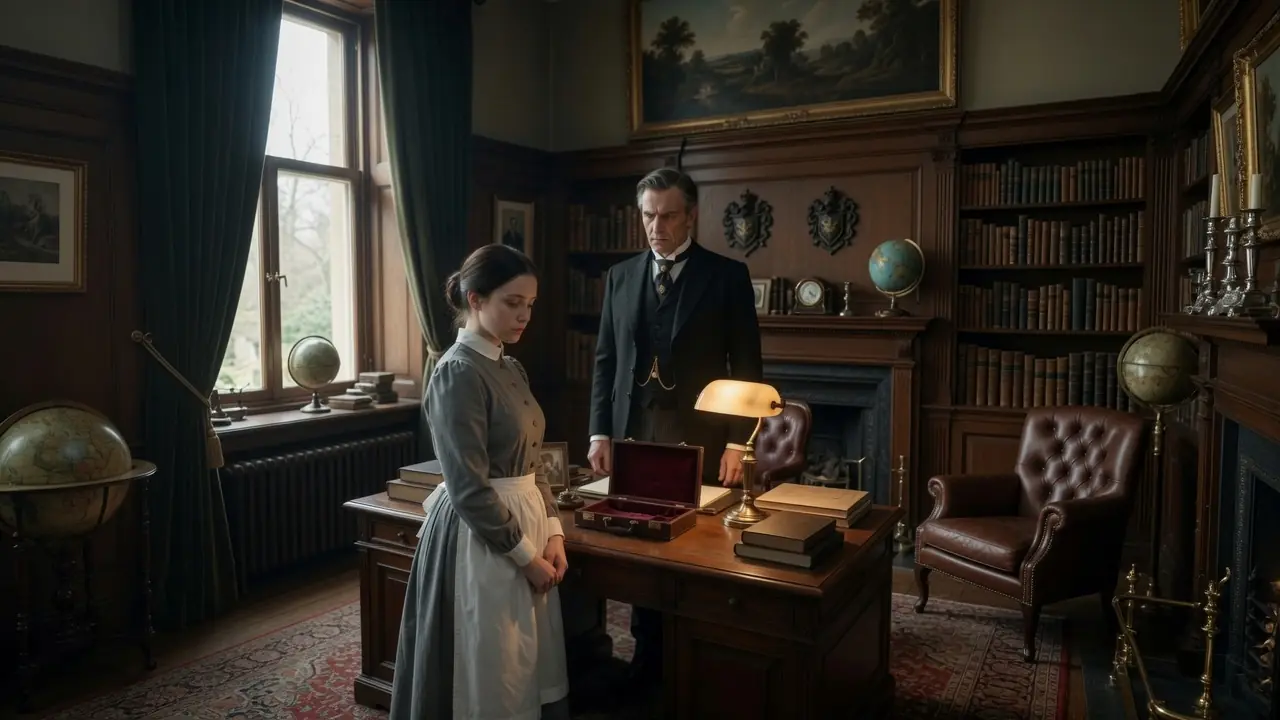
The silence in the Duke of Blackwood’s study was a specific architectural thing. It was built of old leather, the scent of beeswax, and the weight of books that had not been opened in a generation. Ara Vance stood before the great mahogany desk, her hands clasped loosely in front of her. She had been summoned from the library, where the dust motes danced in the afternoon light like tiny forgotten histories. Here in this room, the air did not move.
Alistair, the Duke, did not look at her. His gaze was fixed on a point somewhere beyond the mullioned window, where the autumn grounds of Blackwood Manor were surrendering to a bruised twilight. On the desk between them lay a small, exquisite thing: a velvet-lined case, now empty. “Lord Fitz William informs me the miniature of my mother was on the reading table this morning,” the Duke said. His voice was like the rest of him: controlled, precise, and devoid of warmth. It was a voice accustomed to giving orders that were not questioned.
“He says you were the only person in the library all day. The miniature is now gone.” It was not a question. It was a statement of fact from which an inescapable conclusion was to be drawn. Ara’s gaze flickered to the empty case. She had seen the portrait, of course: a woman with Alistair’s dark hair and a sad, knowing smile painted on a sliver of ivory. It was a beautiful, deeply personal object to leave lying about. She had considered moving it to a safer place but had decided against it. It was not her place.
Her place was to be invisible, to catalog the chaos of the Duke’s inherited library, a task for which she was paid a housemaid’s wages though it required a scholar’s care. “I did not take it, Your Grace,” she said. Her own voice was low and steady. It revealed nothing of the cold dread coiling in her stomach. She knew what this was. She had known from the moment the summons came. Lord Fitz William, the Duke’s visiting cousin, was a man of careless habits and easy blame.
The Duke’s jaw tightened almost imperceptibly. He finally turned his head, and his eyes, the color of a winter sky, met hers for what felt like the first time since she had arrived six months ago. He saw, she supposed, what everyone saw: a plain young woman in a drab gray dress, unremarkable in every way. A servant. “There is no one else. It could have been you,” he stated, his voice flat. He was not angry. Anger would have been easier to bear. This was worse. This was dismissal, a simple closing of a ledger, an administrative finality.
“I will not have a thief in my house. You will pack your things. You are to be gone from this estate by dawn.” He did not raise his voice. He did not need to. The words landed with the force of a physical blow. Yet Ara did not flinch. She held his gaze for a single measured beat. She saw no curiosity there, no flicker of doubt, only the cold certainty of a man who had made a decision and considered the matter closed.
She gave a small, correct curtsy. “Yes, Your Grace.” The quiet finality of her response seemed to catch him off guard. He had perhaps expected tears, denials, hysterics. He received only calm, dignified acceptance. For a moment his cold composure seemed to waver. A flicker of something—annoyance? confusion?—crossed his features before it was suppressed. He turned back to the window. The interview was over.
Ara walked from the room, her back straight. She did not look back. The great oak door closed behind her with a soft, definitive click, sealing her fate. She walked down the long, portrait-lined gallery, her footsteps echoing in the cavernous space. The painted eyes of Alistair’s ancestors watched her go, their faces impassive. They were accustomed to such small, silent tragedies. They were the fixtures of the house. She was transient, a ghost already departing. By dawn, it would be as if she had never been here at all.
Her room was in the attics, a small, clean space with a sloped ceiling and a single window that looked out over the stable yard. It was more than she had had before, and for that she had been grateful. She lit a single candle, its flame a small, brave thing against the encroaching darkness. The room held little of her: a change of dress, a worn copy of Seneca’s letters, and a small smooth stone she had carried with her from the coast where she grew up. These were the sum of her worldly possessions.
She began to pack, her movements unhurried and precise. She folded her spare dress and laid it in her small canvas bag. She wrapped the book in a piece of linen to protect its crumbling spine. Her hands did not tremble. The shock had settled into a kind of numb clarity. This was how it ended. Six months of careful, silent work, of bringing a small measure of order to a place long neglected, erased by a careless word from a careless man.
She had known the risks. A woman alone without family or fortune was a fragile vessel on a turbulent sea. Any accusation, no matter how baseless, could sink her. She had thought, foolishly, that her diligence would be its own shield. She had believed that her work would speak for her, but no one had been listening. The Duke had never once entered the library to see the progress she had made, to see the shelves she had organized, the leather-bound volumes she had cleaned and repaired with painstaking care. He saw only the surface of things. He had looked at her and seen a thief.
There was a soft knock on the door. Ara paused, her hand hovering over the little stone. “Come in.” The door opened to reveal Mrs. Gable, the housekeeper. She was a stern, wiry woman with eyes that missed nothing. She held a small cloth-wrapped parcel in her hands. She did not speak at first, simply stood in the doorway, her gaze taking in the neatly packed bag on the cot. Her expression was a mixture of pity and a hard, angry resignation.
“I heard,” Mrs. Gable said, her voice low. She stepped into the room and closed the door behind her. “Lord Fitz William, he’d lose his own head if it weren’t fastened to his shoulders. And the Duke, he listens to the wrong people.” Ara offered a small, sad smile. “It does not matter who he listens to. The word of a lord is worth more than the word of a maid.” “It shouldn’t be,” Mrs. Gable said fiercely. She set the parcel on the small bedside table. “There’s bread and cheese and a bit of coin. It’s not much, but it will see you to the next town.”
Tears pricked at the back of Ara’s eyes, the first she had felt all evening. It was not the Duke’s injustice that threatened to undo her, but this small, unexpected act of kindness. This was the wound: to be seen and valued by one person and so utterly dismissed by another. “Thank you, Mrs. Gable,” she whispered, her voice thick. “You have always been good to me.” “You’re a good girl, a clever one too. I’ve seen what you’ve done in that library. It’s a crime is what it is. A damned crime.” The housekeeper, a woman not given to profanity, seemed to spit the word out.
She looked at Ara, her gaze sharp. “You have somewhere to go?” Ara shook her head. “I will find somewhere.” It was a hollow promise, and they both knew it. Winter was closing in. A woman on the road with no references was in a perilous position. Mrs. Gable’s face hardened. “He is a fool. His father, the old duke, he saw people. This one, he only sees his own grief. He has walled himself up in it since his brother died.” She sighed, a weary, rattling sound. “Be careful on the road, child. There are worse men than fools in this world.” She patted Ara’s shoulder, a rough, brief gesture of comfort, and then she was gone, leaving the scent of lavender and righteous anger in her wake.
Ara sat on the edge of her cot, the warmth of the housekeeper’s touch still on her arm. She looked at the parcel: bread, cheese, and a few coins. An entire world of care contained in a simple bundle. She would not eat. Her throat was too tight. She would wait. The Duke had ordered her gone by dawn. She would obey him to the letter. She would wait for the first hint of gray light in the sky, and then she would walk away from Blackwood Manor and not look back.
The Duke dined alone that evening, as he often did. The cavernous dining hall, with its long polished table set for one, seemed to amplify his solitude. Lord Fitz William had been invited but had pleaded a headache, a convenient ailment that allowed him to avoid the quiet tension that had settled over the house since Ara’s dismissal. Alistair was glad of his absence. Fitz William’s chatter would have been unbearable tonight. He ate without tasting the food, his mind replaying the scene in his study.
The girl—he could not recall her name, only that she was one of the maids assigned to the upper floors—had been unnervingly calm. He had expected hysterics, pleas. He had braced himself for them. Her quiet acceptance was more unsettling than any outburst would have been. It was as if his judgment, the judgment of a duke, meant nothing to her. It was a dismissal she simply absorbed. He pushed his plate away, the food barely touched. A faint disquiet had taken root in him, a feeling he could not name. It was the same feeling he got when a column of figures in the estate ledgers refused to align, a sense of something being out of place.
The miniature was valuable, certainly, but its true worth was sentimental. It was one of the few likenesses he had of his mother. He had assumed a common servant would see only its monetary value, the gold of its casing. But her eyes, when she had looked at him, there had been no avarice, no fear, only a deep, still quietness, a dignity that did not belong to a thief. He retired to his study, intending to lose himself in the estate papers that always awaited his attention. But the silence of the room, usually a comfort, felt different tonight. It felt accusatory.
He found his gaze drawn to the empty velvet case on his desk. Fitz William had been so certain. “Found her in the library, dusting of all things,” his cousin had said with a dismissive laugh, “right next to the reading table where I left it. Clear as day, Alistair. Clear as day.” Alistair prided himself on logic, on evidence. The evidence here was circumstantial, resting entirely on the word of a man who was notoriously absent-minded. Fitz William had once misplaced a winning racehorse ticket for an entire fortnight, only to find it being used as a bookmark in a book of dreadful poetry.
The thought, unbidden, made Alistair stand. The library. He had not set foot in it for months, not since he had approved Mrs. Gable’s request to have one of the maids attempt to bring some order to the place. His father had been a bibliophile, but not a tidy one. The room was a testament to a lifetime of collecting without cataloging. He took a lamp and walked down the silent corridor. The library doors were immense, carved from dark oak. He pushed one open and stepped inside.
The air was different from how he remembered it. The usual scent of dust and decay was gone, replaced by the clean smell of lemon oil and old paper. The lamp cast a pool of golden light, pushing back the shadows. And in that light, he saw order. The chaotic piles of books were gone. The shelves were neat. The volumes arranged not alphabetically but by subject, and within each subject by date of publication. It was a system of astonishing clarity. He ran his fingers along a row of spines. They were clean, the leather treated and supple.
He pulled one out: a rare treatise on Roman architecture, a book he recalled having a broken spine. He opened it. The spine had been meticulously repaired, the torn pages mended with paper so fine the repair was almost invisible. He moved through the room as if in a trance. On a large central table, where there had once been a mountain of unsorted folios, there were now neat stacks, each tied with twine and labeled with a small, elegant tag: “Bot. 17th century uncataloged maps and atlases. French, circa 1810.”
His disquiet grew, twisting into something sharper. This was not the work of a common housemaid. This was the work of a librarian, a scholar. This was months of dedicated, intelligent labor performed in silence without instruction or praise. He walked toward the reading table where Fitz William claimed to have left the miniature. It was clear: a decanter and two glasses sitting on its polished surface. Nothing else. He frowned. Fitz William had been drinking brandy while he read that morning. Of course he had.
Alistair picked up the book his cousin had left open, a lurid novel of the sort Fitz William favored. He shook it gently. Nothing. Then his eyes fell on a tall leather-bound volume of Plutarch’s *Lives* standing on a nearby shelf. It was slightly askew. On impulse, he pulled it down, and there it was, slipped between the pages of the *Life of Cato the Younger*: the miniature of his mother. Fitz William, in a moment of brandy-fueled carelessness, had used it as a bookmark.
The discovery landed not with a sense of relief, but with the cold, heavy weight of shame. He had been wrong, utterly, demonstrably, and unforgivably wrong. He had not just made a mistake. He had committed a profound injustice. He had called an innocent woman a thief and thrown her out of his home, all on the flimsy word of his fool of a cousin. He stood there in the silent, orderly library, the miniature in his hand, the evidence of his error. But the true revelation was not the misplaced portrait. It was the room itself: the order, the care, the quiet intelligence it represented. This was the work of the woman he had just dismissed, and he did not even know her name.
He stared at the miniature in his palm. His mother’s sad, knowing smile seemed to mock him. She had been a woman of great perception and quiet kindness. She would have been appalled. She would have taken one look at that maid and seen the truth of her. He, her son, had looked and seen nothing at all. The shame was a physical thing, a cold fire in his chest. He had acted with the casual arrogance of his station, wielding his power without thought, without care. He had inflicted a wound on a person who had no means to defend herself, and she had met his cruelty not with outrage, but with a silence that was now deafening.
That silence, he realized, was not weakness. It was a judgment. He turned from the table and saw for the first time a small, neat ledger resting on a lectern in the corner. He walked over to it. The lamplight fell across the open page. In a hand of remarkable elegance and clarity, she had begun to catalog the entire collection. *Plutarch, Lives of the Noble Grecians and Romans. Dryden translation, London, 1683. Condition: good. Spine requires minor repair.* He slowly turned the pages. There were hundreds of entries, each one a model of precision, but it was the notes in the margins that stopped his breath.
Beside an entry for a collection of Virgil’s *Eclogues*, she had written: “Compare with the 1742 edition, page 88, for variance in translation of the fourth eclogue. This edition appears to soften the messianic tone.” He sank into the chair beside the lectern, the ledger open before him. This was not just cataloging. This was scholarship. This was a mind at work, a mind of quiet, formidable intelligence. And this was the woman he had called a thief and ordered to be gone by dawn.
A sudden, terrible urgency seized him. Dawn? What time was it? He pulled out his pocket watch. It was past midnight. Hours had passed. Dawn was no longer a distant abstraction. It was a rapidly approaching deadline. He had sentenced her to the road in the cold on the cusp of winter with nothing but a stain on her character for a reference. He remembered her name then. It came to him with a jolt. Ara Vance. Mrs. Gable had mentioned it. Miss Vance, a woman who knew the difference between two Latin translations, who could mend a broken book spine, who could bring order from chaos. A woman he had wronged so profoundly that the thought of it made him feel ill.
He closed the ledger. The house was still asleep, but he was more awake than he had been in years. The insulated, grief-haunted world he had built around himself had been breached, not by a thief, but by a quiet woman’s integrity. The question was no longer about his mistake. The question was whether it was too late to undo it. He strode from the library, his purpose clear. Apologies were meaningless without action. He had to find her. He had to find her before she walked out of the gates at first light and disappeared from his life forever, taking with her the quiet dignity he had so carelessly trampled. He had to make this right, not for his own conscience, but for her, because it was what justice demanded, and he, the Duke of Blackwood, had failed spectacularly in its administration. The weight of his title, of his duty, had never felt so heavy, nor his personal judgment so wanting.
Alistair went first to the housekeeper’s rooms. He knocked a sharp rap that echoed in the sleeping corridor. After a moment, the door opened a crack and Mrs. Gable peered out, her face etched with sleep and suspicion. Seeing the Duke, her expression hardened. “Your Grace,” she said, her tone clipped and cold. It was the most disrespectful he had ever heard her be. “Miss Vance,” he said, his voice tight with urgency. “Has she left?” Mrs. Gable’s eyes narrowed. “You commanded her to be gone by dawn. Ara is a woman who follows orders, even unjust ones.” The rebuke was plain and deserved.
“I was wrong, Mrs. Gable. I need to speak with her. Is she in her room?” The housekeeper hesitated, studying his face in the lamplight. She saw something there: the raw shame, the desperate urgency that seemed to soften her stance. “She was an hour ago in the attics, the last door on the left.” She did not wish him luck. She simply closed the door, leaving him alone in the hallway.
He took the narrow servant stairs two at a time, his boots loud on the bare wood. The air grew colder as he climbed. The attic corridor was dark and silent. He found the last door and knocked softly. “Miss Vance.” There was no answer. He knocked again, louder this time. “Miss Vance, it is the Duke. I must speak with you.” Only the silence of an empty room replied. A cold dread sharper than any he had felt before gripped him. He tried the handle. The door was unlocked. He pushed it open and held up his lamp. The room was bare, impossibly neat. The cot was made. The floor swept clean. There was no sign that anyone had ever lived there. She was gone. He had missed her.
The thought was a punch to the gut. He had sat in his library, absorbed in his discovery, while she had slipped away into the night. He had given the order, and she had obeyed, vanishing as completely as if she were a spirit. He turned and descended the stairs, his mind racing. Where would she go? She had no one. Mrs. Gable had implied as much. The nearest town was miles away, a long walk in the dark. A storm was brewing. He had felt the shift in the air, the wind rising with a mournful sound around the eaves of the manor.
He went directly to the stables. The stable master, a grizzled man named Peters, was asleep in his small room off the main bay. Alistair woke him without ceremony. “The maid, Ara Vance, did you see her leave?” Peters rubbed the sleep from his eyes, startled by the Duke’s presence at such an hour. “No, Your Grace. The gates are barred until first light. No one has gone out.” A small, desperate flicker of hope ignited in Alistair’s chest. “She is not in her room.” “Perhaps she’s waiting in the gatehouse lodge, Your Grace, to leave the moment the gates are open.” Of course. She would not defy his order by leaving early, but she would position herself to obey it at the first possible moment. She was waiting to be cast out. The image was unbearable.
“Saddle my horse, Alistair commanded. Apollo.” Peters blinked. “Apollo, Your Grace? It’s a rough night. The storm’s about to break. He’s a spirited mount.” “Now, Peters.” The stablemaster, seeing the grim set of the Duke’s jaw, asked no more questions. While Peters prepared the powerful black stallion, Alistair paced the cobbled yard. The wind was a physical force now, tearing at his coat, carrying the scent of rain and damp earth. He was acting on pure, desperate impulse. He, a man who planned everything to the smallest detail, was chasing a ghost in a rising storm.
When the horse was ready, Alistair swung himself into the saddle. “If Lord Fitz William asks for me,” he said to Peters, his voice hard as iron, “tell him I have gone to correct a mistake he created.” He spurred the horse into a canter, heading not for the main gate but for the east road, the most direct path away from the estate. The wind howled in his ears, and the first drops of cold rain began to fall, plastering his hair to his forehead. He rode with a reckless urgency, his mind fixed on a single image: a lone woman walking down a dark road with nothing but a small bag and the weight of a false accusation.
The ride was a battle against the elements and his own rising panic. The rain came down in earnest now, a driving, merciless torrent that turned the dirt road into a slick ribbon of mud. Apollo, true to his nature, fought the reins, his powerful body tense beneath Alistair. The darkness was absolute, broken only by the swinging circle of light from the lantern fixed to his saddle, which cast dancing, distorted shadows of the trees that lined the road. He was a fool, a blind, arrogant fool. He had inherited his father’s title, his lands, his wealth, but none of his insight into human character.
His father would have known. His father would have asked questions, would have looked the girl in the eye and seen the truth there. Alistair had inherited a world of duty and obligation, and in the process he had forgotten how to see the person standing right in front of him. His younger brother, Thomas, had once accused him of it. “You see the world as a series of accounts to be balanced, Alistair,” Thomas had said, not long before the riding accident that had taken his life. “You forget there are people behind the numbers.” Thomas had been the warm one, the one who knew the names of every tenant farmer’s child, who could charm a smile from the sternest scullery maid. Alistair had been the responsible one, the heir, the one who kept the estate solvent. After Thomas’s death, that sense of duty had calcified into a rigid, unyielding code. It had protected him from grief, but it had also blinded him.
He pushed the horse harder, leaning into the wind, the rain lashing his face. Every minute that passed felt like a failure. Every gust of wind seemed to whisper her name. Ara. He said it aloud, testing the shape of it on his tongue. It was a name that felt like it belonged to the woman in the library, the quiet scholar. It did not belong to a thief. He passed the old stone bridge that marked the halfway point to the village. The road ahead was empty. A cold knot of fear tightened in his stomach. Had he been wrong? Had she taken a different path through the woods, or had she left hours ago, finding some other way off the estate? His certainty began to fray, leaving only the raw edge of desperation. He was searching for one small figure in a vast, storm-tossed darkness. The odds were impossible. But he kept going. He had to. He owed her that much. He owed her the search, the effort. He owed her the witness of his own desperation to undo the damage he had done. The rain was relentless, soaking him to the skin. He was no longer a duke. He was just a man on a horse, chasing a memory in a storm, praying it was not too late. The light of his lantern cut a frantic path through the night, searching, always searching for a sign of her on the empty, unforgiving road.
Just as a sliver of hope began to die within him, his lantern light caught something. A flicker of movement ahead near the ancient oak that marked the final boundary of his lands. He strained his eyes, peering through the sheeting rain. It was a figure, small, solitary, walking with a steady, unhurried pace against the wind. It was her. Relief washed over him, so potent it almost buckled him. He urged Apollo forward, closing the distance. She did not seem to hear his approach over the roar of the storm until he was almost upon her. She stopped and turned, her face pale in the lantern light. She was holding a small shawl over her head, a futile gesture against the deluge. But her expression was not one of fear. It was the same look she had given him in the study: calm, contained, and unreadable.
He pulled his horse to a halt, the great animal stamping and snorting, its breath pluming in the cold air. The scene was a strange tableau: the powerful duke on his magnificent horse, drenched and disheveled, his face a mask of turmoil, and the dismissed maid standing on the muddy road, her small bag in her hand, looking up at him with a quiet, waiting stillness. All the power, all the privilege, all the authority of his position felt utterly meaningless in that moment. He was the one in need. She was the one who held all the cards.
He swung himself down from the saddle, landing with a splash in a puddle. The rain ran in rivulets down his face, dripping from his chin. He stood before her, the horse’s reins clutched in his hand. He was at a loss. The words he had rehearsed in his mind—the apologies, the explanations—all seemed inadequate now, flimsy against the reality of her quiet presence. “Miss Vance,” he said, his voice raw over the sound of the wind. She simply watched him, waiting. She did not speak. She did not prompt him. She gave him nothing. He had to find the words himself. He had to earn the right to speak them.
“I was wrong,” he began. The words were stark and unadorned. There was no other way to say it. “The miniature was not stolen. It was misplaced. My cousin used it as a bookmark. I found it.” He paused, letting the admission hang in the stormy air between them. Her expression did not change. It was as if she were merely receiving a piece of information she had known all along. “That is not all,” he continued, forcing himself to meet her steady gaze. “I went to the library. I saw your work, the repairs, the cataloging, the ledger.” He took a breath, the cold, wet air searing his lungs. “I have done you a grave injustice. I accused you of a crime you did not commit. I dismissed your work and I dismissed you. There is no excuse for it. My judgment was hasty and it was wrong.”
He had never apologized to anyone in his adult life. The words felt foreign in his mouth, but necessary. He felt the truth of them down to his bones. “I am asking you,” he said, his voice dropping lower, more earnest, “to return to Blackwood Manor.” He did not command her. He asked. It was a crucial distinction. He was not reinstating a servant. He was attempting to persuade a person of worth to overlook a profound insult. He was offering her a choice, something he had denied her in his study.
Ara looked at him for a long time. The rain dripped from the edge of her shawl, tracing a path down her cheek like a single silver tear, but her eyes were dry. They were assessing him, weighing his words, his posture, the raw sincerity etched on his face. He stood utterly still under her scrutiny, feeling as though his entire character was being judged in that silent, storm-lashed moment. He had held the power to ruin her, and now she held the power to refuse him. The reversal was absolute and just. He waited for her verdict, knowing he deserved whatever she chose.
The silence stretched, broken only by the wind and the rain. He could see the faint gray light of dawn beginning to bleed into the eastern sky behind her. The deadline he had set. He had found her at the very edge of it, at the boundary of his land and the end of his authority. Finally, she spoke. Her voice was quiet, but it carried clearly over the storm. “Why?” It was not the question he had expected. He had anticipated a refusal or perhaps a demand for higher wages or a different position. But this simple, direct question cut deeper. Why should she return to a place where she had been so wronged?
“Because my house is diminished without you in it,” he said, the words coming from a place of raw, unvarnished truth he hadn’t known existed within him. “Because the library needs you. Because I was wrong and I wish to make it right.” It was the closest he could come to explaining the profound shift within him, the sudden, jarring recognition of the value he had almost discarded. She continued to watch him, her gaze unwavering. He saw a flicker of something in her eyes. Not forgiveness, not yet. But something was being considered. She glanced down at her small, mud-spattered bag, then back at his face. He had the distinct feeling she was seeing him for the first time, just as he was truly seeing her. Not as a duke, not as a master, but as a man, flawed and humbled, standing in the rain.
After another long moment, she gave a single, almost imperceptible nod. It was not a promise of forgiveness. It was not an absolution. It was simply an assent, an agreement to return. It was more than he deserved. Relief, profound and bone-deep, washed through him. He did not smile. The moment was too solemn for that. He simply nodded in return, a silent acknowledgement of her grace. “The road is no place for you,” he said quietly. “Let me take you back.” He moved to help her onto the horse, but she took a small step back.
“I prefer to walk,” she said. It was not a challenge but a statement of preference. She would return, but on her own terms, on her own two feet. He understood. He would not force a proximity she was not ready to grant. He nodded again. “Then I will walk with you.” He turned, leading the great black stallion by the reins. Ara fell into step beside him, maintaining a careful, deliberate distance between them. And so they began the long walk back to Blackwood Manor.
The storm began to subside as they walked, the driving rain softening to a drizzle. The sky in the east brightened from gray to a pale, watery rose. Dawn was breaking. They walked in silence. It was not the hostile, empty silence of his study, but something new, a quiet space in which something might eventually grow. He did not know what the future held. He did not know if she would ever trust him, if he could ever earn her respect. But as the light of the new day illuminated the path before them, and he glanced at the composed, dignified woman walking beside him, he knew with absolute certainty that he was going to spend a very long time trying. The journey back to the house was the first step. Her presence beside him was a fragile, unearned gift, and he would not misjudge its value.